
How to Create a Press Kit That Actually Gets You Noticed
December 10, 2025
Building a press kit really comes down to a few key moves: pulling together your core brand assets, designing it so it's a breeze to use, and getting it into the hands of the right people. I like to think of it as your company's digital handshake. It's a single, convenient spot where a journalist can find everything they need—from your origin story and founder bios to crisp logos and your latest press release.
What Is a Press Kit and Why Your Brand Needs One Now
Before you start dragging files into a folder, let’s get clear on what a modern press kit (or media kit) actually is. It’s much more than a collection of logos. A press kit is a strategic PR tool designed with one person in mind: the busy journalist. Its job is to give reporters, bloggers, and influencers immediate, organized access to everything they need to tell your story accurately.
A great kit doesn't just answer questions—it frames your narrative. You control the assets, you provide the key messages, and you ensure your brand is represented consistently, no matter who is writing about you. This saves a journalist from having to hunt down your official bio or a high-quality headshot on a tight deadline.
The Strategic Advantage of a Professional Press Kit
In a crowded media space, a polished press kit sends a powerful signal. It says your brand is professional, organized, and ready for coverage. By removing all the friction, you become a far more appealing source for a reporter trying to hit a deadline. Instead of chasing you for basic details, they can get straight to writing a great story.
Here's why having one is a must for any brand serious about getting press:
- It Builds Credibility: It shows you understand how the media works and that you respect their time.
- It Ensures Brand Consistency: You can rest easy knowing only your approved logos, images, and messaging are out there.
- It Opens Up Media Opportunities: A complete, accessible kit makes you the go-to source for a last-minute expert quote or a feature story.
- It Simplifies Your Outreach: It becomes a central hub you can link to in every single pitch.
A press kit is your brand's silent ambassador. It works for you 24/7, providing clarity and consistency long after your initial pitch email has been read. It’s the difference between being a helpful source and being a difficult one.
The world of public relations is getting bigger and smarter. The global PR market is expected to hit $113 billion in 2025, and a huge part of that growth is driven by data. In fact, 96% of communication teams now lean on analytics to shape their strategies. This just reinforces the need for your press kit to be sharp, focused, and full of the right assets.
If you want to see what a truly effective kit looks like in the wild, checking out some top-tier influencer media kit examples is a great place to start. You'll get some fantastic ideas for visual storytelling and presenting your information.
Assembling Your Essential Press Kit Assets
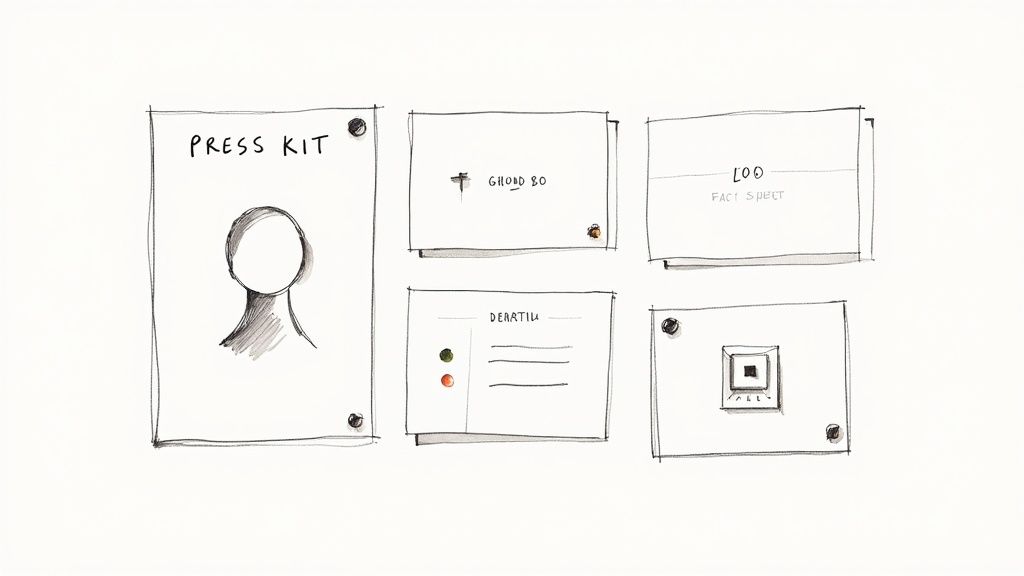
Alright, this is where you roll up your sleeves and start building the core of your press kit. You're gathering the actual materials a journalist will use to tell your story. I like to think of it less like filling out a form and more like stocking a pantry for a chef. Your goal is to give them high-quality, ready-to-use ingredients they can grab in a hurry.
Every single asset serves a purpose, whether it's establishing your company’s backstory or providing the exact visual a publication needs. A reporter on a tight deadline won't have time to reformat your logo or hunt down your founder's bio. When you make their job easier, you dramatically increase your chances of getting that feature.
The Company Story and Fact Sheet
First up, your company narrative. This isn't just a dry timeline; it's your origin story. In a concise, compelling summary, you need to explain what problem you solve, why your company even exists, and what makes you different from everyone else. Aim for under a page, and write it so that even someone completely outside your industry can get it instantly.
Paired with that story is a one-page fact sheet. This is the ultimate "at-a-glance" document. No fluff, just the key data points a journalist needs to ground their article in facts.
Make sure your fact sheet includes:
- Company Vitals: Your official name, founding date, where your headquarters are, and of course, your website URL.
- Key Milestones: Think launch dates, major product releases, or the day you hit your first 1,000 customers.
- Funding Information: Total funding raised and the names of your key investors or VC firms.
- User/Customer Data: Any impressive metrics you can share, like the number of active users or customer growth percentages.
- Leadership Team: A simple list of the founders and key executives with their titles.
Compelling Founder and Executive Bios
Let's be honest, people connect with other people, not faceless brands. That’s why founder and executive bios are so crucial—they bring a human element to the table. Every key team member should have a short biography (around 150-200 words) that hits on their expertise, their role, and what gets them out of bed in the morning.
And please, skip the corporate jargon. Instead of saying a founder "ideated and actualized synergistic solutions," tell a real story. For example, "Frustrated by the lack of affordable project management tools for freelancers, Jane Doe, a designer with over a decade of experience, built the platform she always wished she had." That's memorable. It's relatable. It's what a reporter can actually use.
Pro Tip: I always recommend keeping two versions of each bio. Have a standard third-person one ready to go, but also a slightly more casual, first-person version. This gives you flexibility for different kinds of media opportunities, from a formal feature to a casual Q&A.
Your Library of Brand Assets
Visuals are completely non-negotiable. A story with strong images is infinitely more likely to get published and shared. Your press kit absolutely must include a well-organized folder of high-resolution brand assets that a journalist can download in a click.
Here’s a quick checklist for your visual library:
- Logos: Give them options. You need your logo in PNG (with a transparent background), SVG (for scalability), and JPG. Make sure to include full-color and monochrome (black and white) versions.
- Founder Headshots: Professional, high-res headshots of all key executives are a must. I'd even suggest offering a couple of choices with different backgrounds or poses.
- Product Screenshots & Photos: If you sell a physical product, get professional photos from multiple angles. For software, provide clean, high-resolution screenshots showing your best features in action.
The Essential Press Release
Even in today's crazy-fast media world, the press release is still a cornerstone of PR. In fact, research shows that around 74% of journalists prefer getting news this way. The catch? Only a tiny 2-3% of releases actually lead to a story. So yours has to be great. One simple trick: including strong, well-written quotes can boost media pickup by up to 40%.
A press release is your official announcement for something newsworthy—a product launch, a funding round, a major partnership. It follows a specific format that journalists know and expect. The final paragraph, the boilerplate, is your official "about us" summary. If you're new to this, a great first step is learning what a boilerplate is in a press release. Getting these components right shows you're a professional and gives a journalist everything they need to do their job well.
Designing a Press Kit That Actually Gets Used
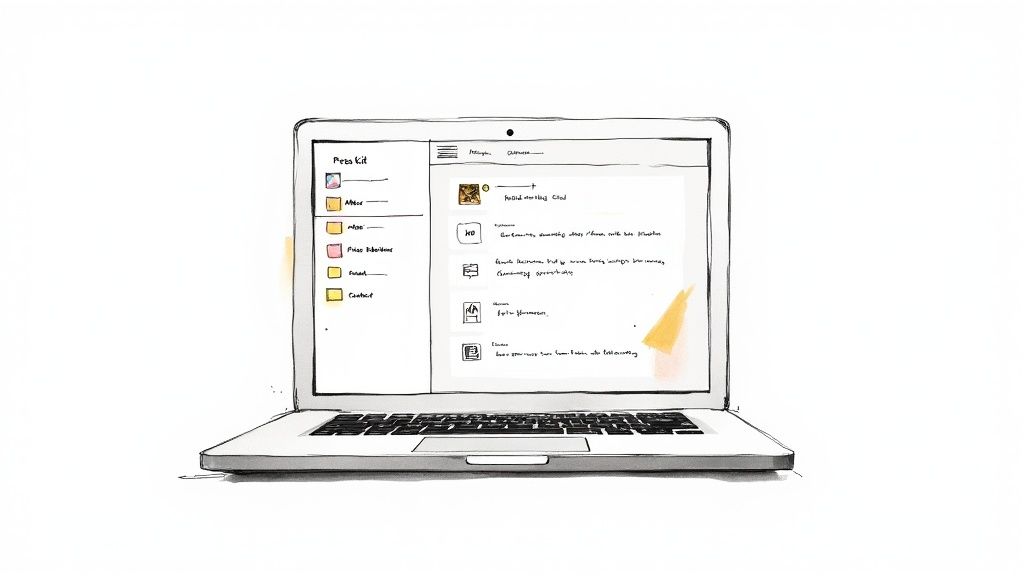
You’ve got all the pieces. Now, how do you put the puzzle together? This is where many startups stumble. You can have the most compelling story and the slickest product shots, but if a journalist has to fight to find them, you've already lost.
Think about it from their perspective. They're on a brutal deadline and need assets now. Your job is to make their job easier. A clean, intuitive press kit isn't just a "nice-to-have"—it's a sign of professionalism that directly impacts your odds of getting featured. Eliminate every ounce of friction.
Choosing the Right Home for Your Press Kit
Where your press kit "lives" is just as critical as its contents. You've got a few solid choices, and the right one often depends on your resources and how you plan on sharing it.
- A Dedicated Web Page: This is the gold standard, no question. A simple, easy-to-find page like
yourwebsite.com/pressoryourwebsite.com/mediais professional, always up-to-date, and lets you control the brand experience. Journalists can browse everything before deciding what to download. - A Shared Cloud Folder: Using Google Drive or Dropbox is a fantastic, low-cost alternative. It's incredibly easy to set up and share with a single link. The secret here is meticulous organization, which we'll dive into next.
- A Downloadable ZIP File: This should never be your only option. It’s useful as a "download all" button, but it forces a journalist to grab the whole package before they can even peek inside. Always give them the choice to browse first.
My advice? Go for a hybrid model. Build a dedicated press page on your website. Display key info and allow for individual file downloads. Then, add a big, obvious "Download Full Kit (.zip)" button that links to a neatly organized cloud folder. This gives every journalist, no matter their workflow, exactly what they need.
Organization and File Naming: The Details That Matter
Once a reporter lands in your press kit, the experience has to be effortless. A messy folder of cryptically named files is an instant turn-off.
Start by creating a simple, logical folder structure. Don't just throw everything in one big pile. A clean setup might look like this:
- 01_Logos
- 02_Founder_and_Team_Photos
- 03_Product_Screenshots
- 04_Documents (for your fact sheet, press releases, etc.)
See those numbers? That's a little trick I've learned to force the folders into a specific order, ensuring the most important stuff is always at the top.
Within those folders, your file names need to be crystal clear.
A filename like
IMG_8734.jpgis a journalist's nightmare. Instead, name itFounder_JaneDoe_Headshot_2024.jpg. This tiny change saves them from opening a dozen files to find the right one, instantly making you their favorite person.
Finally, offer the right file types. Don't make them ask. Provide logos in both PNG (for web, with a transparent background) and SVG or EPS (for high-res print). Photos should be high-quality JPGs, and all documents should be PDFs to lock in the formatting. By anticipating their technical needs, you're not just providing assets—you're building a reputation as a reliable source.
Writing a Press Release That Tells a Story
The press release is the heart of your press kit, but let's get real for a moment. Most of them are painfully dry, full of corporate jargon, and destined for the trash folder. A journalist’s inbox is a warzone for attention, and a bland announcement about your "exciting new feature" simply won't survive.
To actually get noticed, you need to shift your mindset from announcing to storytelling. Your press release can't just be about what you did; it has to scream about why it matters. A reporter is always thinking, "So what?" and "Why should I care now?" Your job is to answer those questions before they're even asked.
Finding an Angle That's Actually Newsworthy
Every bit of company news, no matter how small it seems, has a story buried inside. Your mission is to dig it out and find an angle that makes it compelling to someone outside your company Slack channels. A reporter doesn't care about your internal milestones—they want conflict, solutions, and human impact.
Let's break down how to reframe some common startup announcements into real stories:
The Product Launch: Don’t just list the specs. Tell the story of the headache it cures. Instead of "InnovateCo Launches New AI-Powered Analytics Dashboard," try this: "InnovateCo’s New AI Tool Aims to Save Small Businesses 10 Hours a Week on Data Analysis." See the difference? The second one is about the user's win.
The Funding Round: The money is boring. What you're going to build with it is the story. Instead of "StartupTech Secures $5M in Series A Funding," frame it like this: "StartupTech Raises $5M to Tackle Rising Cybersecurity Threats for Remote Workers." Now you've connected your funding to a problem everyone is talking about.
The New Executive Hire: It's not about the person; it's about the mission. Instead of "Global Corp Hires Jane Doe as New VP of Sustainability," go with: "Global Corp Taps Climate Expert Jane Doe to Lead Aggressive Push for Carbon-Neutral Operations by 2030." This paints the hire as a bold, strategic move.
Your Headline and Lede: The First Three Seconds
You have roughly three seconds to hook a journalist. It all hinges on your headline and your first sentence (the "lede"). Your headline has to be active, specific, and punchy. It should shout the most newsworthy part of your story from the rooftops.
The lede needs to immediately answer the classic questions: who, what, when, where, and why. Don't make them dig for the good stuff. Get right to the point in that first paragraph. Applying solid UX writing principles here is a game-changer; it forces you to be clear and user-focused from the jump.
Your press release headline isn't just a title; it's a pitch. A great one can be the difference between a reporter opening your email or hitting delete without a second thought. It needs to tell the whole story in under 15 words.
If you want to get into the nitty-gritty of formatting, we have a complete guide on how to write a press release that provides templates and examples for any situation.
The Art of a Quotable Quote
Executive quotes are often the most wasted real estate in a press release. They tend to be stuffed with jargon-filled platitudes that add absolutely nothing. A good quote, on the other hand, gives your story personality and a human perspective that a journalist can copy and paste directly into their article.
A powerful quote should do one of these three things:
- Explain the "Why": Share the passion or vision behind the news.
- Offer a Bold Prediction: Make a confident statement about where the industry is heading.
- Provide a Customer-Centric View: Focus entirely on how this news makes life better for the end user.
Ditch bland statements like, "We are thrilled to announce this new partnership." Instead, give them something with teeth: "This partnership is about fundamentally changing how creative teams collaborate. We saw a major gap in the market, and together, we're closing it." Now that's a quote a journalist can actually use.
Finally, make life easy for them. Don't just mention you have photos or videos—embed direct, clickable links right there in the release. Adding visuals dramatically increases the chances they’ll pick up your story, because you’ve just handed them everything they need on a silver platter.
Getting Your Press Kit Into the Right Hands
You've done the hard work. Your press kit is polished, the photos are sharp, and your story is ready to tell. But a brilliant press kit sitting unseen on a hard drive is like a silent billboard in the desert—it’s not doing its job. Now it’s time to shift from creation to connection.
The real art of PR isn't just about having great assets. It’s about getting those assets in front of the right people, at the right time, with the right message. The old "spray and pray" method of blasting out mass emails? That strategy is dead. Success today is all about surgical precision and building genuine relationships.
Finding the Right Journalists to Target
Your first move isn't writing an email; it's building a smart, highly targeted media list. Pitching your new fintech app to a food blogger is a complete waste of everyone's time and, frankly, can get you a bad reputation. You need to find the specific journalists, editors, and influencers who actually live and breathe in your world.
Start by thinking about your ideal customer. What publications are they reading? What podcasts do they never miss? These are the outlets you should be targeting. Once you have a list, it’s time to dig deeper.
- Pinpoint Specific Writers: Don't just aim for the publication itself. Find the individual writers who cover your specific niche. Scan their recent articles—are they writing about startups, AI, or direct-to-consumer brands?
- Get a Feel for Their Angle: Read their work. Seriously. Do they prefer founder interviews, data-heavy trend pieces, or straightforward product reviews? Your pitch needs to fit their established style, not the other way around.
- Check Their Social Feeds: A quick look at what they’re talking about on X (formerly Twitter) or LinkedIn can give you incredible insight into what they're genuinely interested in right now.
This isn't just about qualifying leads. It's about finding a real point of connection. You're searching for the reporters whose audience would truly get value from hearing your story.
Crafting a Pitch That Actually Gets Opened
Journalists are drowning in pitches, receiving hundreds every single day. Yours has just a few seconds to make an impression. The secret? Personalization and a deep respect for their time. A generic, copy-and-pasted email is an instant trip to the trash folder.
Your pitch needs to be concise, compelling, and clearly customized. It should immediately signal that you’ve done your homework and aren't just another name on a massive email list.
Pro Tip: Never, ever start an email with "Dear Sir/Madam" or "To the editor." Use the journalist's first name. It's the bare minimum, but it shows you've at least invested a moment of effort.
A great pitch email almost always follows this simple structure:
- A Killer Subject Line: Be specific and intriguing, not spammy. Instead of "Exciting News," try something like, "Story Idea: New Data Shows Remote Work Burnout is Costing SMBs Millions."
- The Personalized Opener: Briefly mention a recent article of theirs you genuinely liked. "I really enjoyed your piece on the future of AI in project management..." This proves you’re a reader, not just a pitcher.
- The Core Pitch: Get straight to it. In two or three sentences, explain what your news is and, more importantly, why their audience should care. Connect your story directly to their beat.
- The Easy "Ask": End with a clear, low-friction call to action. Don't say, "Let me know if you want to write about us." Instead, try, "Happy to share more details or connect you with our founder. Here's a link to our full press kit for your convenience."
For a deeper dive into the nuances of outreach, our guide on how to contact journalists is packed with specific templates and tactics that can make a huge difference.
Using Smart Tools for Outreach
Trying to manage all of this manually can get overwhelming fast, especially when you're wearing multiple hats at a startup. This is where smart tools can be a game-changer, helping you streamline the process without losing that all-important personal touch.
Platforms like PressBeat are built for exactly this. They use AI to help you find the most relevant journalists covering your industry, making sure your pitch lands in the right inbox from the start. This kind of tech handles the heavy lifting of research and targeting, which frees you up to focus on the human side of things.
The goal isn't to automate the relationship-building itself, but to automate the tedious parts of the process. This gives you more time to personalize your pitches, follow up thoughtfully, and have real conversations with the journalists who show interest. By combining smart research, a personalized pitch, and the right technology, you can turn cold outreach into warm connections and give your amazing press kit the audience it truly deserves.
A Few Lingering Press Kit Questions
You’ve gathered your assets and you’re almost ready to go. But a few practical questions always seem to pop up right at the end. Getting these details right is the final polish that turns a good press kit into a great one—the kind journalists actually appreciate using.
Think of it this way: a well-organized, up-to-date press kit shows you respect a journalist's time. It signals you’re a professional and reliable source, which can make all the difference.
How Often Should I Update My Press Kit?
Your press kit is a living, breathing part of your company's story, not a "set it and forget it" document. A good rule of thumb is to schedule a full review at least once a quarter. Block out some time to update your company stats, refresh founder bios, and double-check that all your contact info is still accurate.
Of course, some news can't wait for your quarterly check-in. You need to update your kit immediately after any major company milestone. This includes moments like:
- Closing a new round of funding.
- Launching a new flagship product or feature.
- Announcing a big partnership or acquisition.
- Winning a major industry award.
An outdated press kit sends a terrible message. It tells a journalist you're either not doing anything newsworthy or you simply don't care about making their job easier. Neither is a good look.
What's the Difference Between a Press Kit and an EPK?
This is mostly a matter of industry jargon. While they do the same job, the name changes depending on who you're talking to.
In the world of startups, tech, and general business, you'll almost always hear "Press Kit" or "Media Kit." It's the standard term for the folder of assets you give to journalists and reporters.
Switch over to the creative industries, and you’ll hear "Electronic Press Kit" or EPK. This is the go-to term for:
- Musicians and bands
- Authors and public speakers
- Actors and filmmakers
- Visual artists
The core ingredients are the same: bios, professional photos, past press mentions, and contact details. An EPK, however, will be tailored to its industry with things like music samples, tour dates, book excerpts, or an artist's portfolio. The goal is identical—it’s just the specific content that's a bit different.
Should My Press Kit Be a PDF, a Webpage, or a ZIP File?
This is a classic question, but the answer is surprisingly simple: don't make journalists choose. The best practice is to offer a mix of formats.
Your first move should be to create a dedicated "Press" or "Media" page on your website. This is non-negotiable. It acts as your central hub where a journalist can easily find everything, browse your story, and grab just the one or two assets they need—like a logo or a headshot.
But here’s the key: on that same webpage, include a clear, easy-to-find button that lets them download the entire kit as a single .ZIP file.
This hybrid approach covers all the bases. The reporter on a crushing deadline can snag a single image in seconds. The feature writer planning a deep dive can download the whole package for later. The only format to avoid is sending a large PDF as an unsolicited attachment—it's clunky, often gets flagged as spam, and makes it a pain for anyone to pull individual images or text from.
Ready to get your story in front of the right journalists? PressBeat uses AI to identify the perfect reporters for your brand and crafts personalized pitches to secure the media coverage you deserve. Stop guessing and start getting published. Learn how PressBeat can amplify your message today.