
How to Do a Press Release That Gets Media Attention
December 8, 2025
Doing a press release that actually gets results is all about telling a compelling, newsworthy story in a way that makes sense to journalists. It’s a shift from just shouting your company updates into the wind to crafting something that genuinely helps reporters do their jobs. In a media world that's more crowded than ever, this is how you earn real credibility and get your brand noticed.
The Modern Press Release: A Practical Overview
Forget what you think you know about press releases. They aren’t just dry, formal announcements you blast out into the ether. A modern press release is a direct pitch to a journalist, professionally packaged. Its number one job is to make a reporter's life easier by handing them a story that’s clear, credible, and genuinely interesting to their readers.
The old spray-and-pray approach of tossing your news onto a wire service and hoping for a bite is long gone. Success today is built on a targeted strategy, and that starts with finding an angle that matters to people outside your company walls.
Why Bother With Press Releases Anymore?
With social media and endless content marketing, it’s fair to ask if the press release is a relic. But the truth is, it’s a foundational PR tool that does a few critical things other channels just can’t touch.
A solid press release helps you:
- Control the Narrative: It’s your chance to frame the story in your own words right from the start, making sure your core message is crystal clear.
- Build Credibility: When a reputable media outlet covers your story, it’s a powerful third-party endorsement that builds trust with customers, partners, and investors.
- Boost Your SEO: Getting featured in the media almost always means getting high-authority backlinks. Those are pure gold for helping your website climb the search rankings.
The proof is in the numbers. The public relations industry—where press releases are a core currency—was valued at $112.98 billion in 2025 and is on track to hit over $133 billion by 2027. That growth tells you one thing: managing reputation professionally is more important than ever. You can dive deeper into these PR market trends to see how they impact your strategy.
Key Takeaway: The goal isn't just to announce something. It's to give a journalist a story so good they'd feel like they were missing out if they didn't cover it.
To help you get there, let's break down the essential building blocks.
Anatomy of a Press Release That Works
Think of your press release like a toolkit for a journalist. Each part has a specific job to do, and when they all work together, they make it incredibly easy for a reporter to say "yes" to your story. Here's a quick look at the core components and why each one matters.
| Component | Purpose and Best Practice |
|---|---|
| "For Immediate Release" | Tells journalists the news is ready to go live now. Placed at the very top. |
| Headline | Your first and only shot to grab attention. Make it compelling, clear, and under 100 characters. |
| Dateline | CITY, State – Month Day, Year – Establishes credibility and context by showing where and when the news originates. |
| Introduction | The first paragraph. It must summarize the entire story—the who, what, when, where, and why—in 25-40 words. |
| Body Paragraphs | Flesh out the story with details, quotes from key people, and supporting data. Keep paragraphs short (2-3 sentences) to make them scannable. |
| Boilerplate | The "About Us" section. A short, standard paragraph at the end that describes your company. |
| Media Contact | Name, email, and phone number for the person journalists can contact for more info. Make it easy for them to follow up. |
| ### | Three hash marks centered on a line by themselves. This is the traditional symbol that signifies the end of the press release. Don't forget it! |
This structure isn't just about tradition; it’s a universal format that every journalist understands instantly. Using it correctly shows you respect their time and know how the game is played.
Finding a Story Worth Telling
Before you even think about writing, your press release lives or dies by one simple question: Is this actually news? This is the first—and biggest—hurdle where most companies stumble. A press release isn't an ad, and it’s not just an update for your internal team. It's a pitch for a story that a real journalist can tell their audience.
You have to think like a reporter. They filter every pitch through one lens: "Why should anyone who isn't a customer, an investor, or an employee care about this?" Answering that honestly is what separates a story that gets picked up from one that gets deleted.
It's More Than Just an Announcement
Too many startups treat every company milestone like it's front-page news. Launching a minor feature or hiring a new junior developer is fantastic for morale, but it’s almost never a story for the media.
So, what actually makes the cut? Real news has impact. It has an element of surprise or connects to a much bigger conversation happening in your industry. To figure out if your announcement has a fighting chance, you need to understand what makes a story newsworthy from a journalist's point of view.
These are the kinds of angles that consistently get traction:
- A major product launch that solves a real, painful problem.
- A big funding round (think Series A or beyond) that proves your market is taking notice.
- A strategic partnership with a major player that expands your reach or creates something new.
- Original research or data that reveals a surprising industry insight nobody else has.
- A key executive hire of an industry veteran whose move signals a larger shift in the market.
How to Turn Your News Into a Compelling Story
The trick is to connect your announcement to the bigger picture. It’s not about what you did—it’s about why it matters to everyone else.
I saw a small fintech startup do this brilliantly when they hired a former lead regulator. Instead of a bland "New Hire" announcement, they framed it as a "watershed moment for DeFi compliance." Suddenly, the story wasn't just about a person; it was about the implication of their move for the entire industry.
Another great example: a tech company noticed its user data showed a 40% increase in people using its collaboration tools after 8 PM. They turned that one data point into a report on "The New 9-to-9 Workday." Business publications loved it because it told a fascinating story about a cultural shift, not just a product.
Pro Tip: Never lead with product features. Lead with the human problem your product solves or the trend it represents. Journalists are hunting for stories about people, conflict, and progress—not a list of specs. Your product is just the evidence that makes the story real.
Before you start drafting, gut-check your idea. Does it have conflict or progress? Does it affect a lot of people? Is it timely? If you can say "yes" to at least one of these, you've got something to work with.
Writing a Press Release Journalists Actually Read
Okay, you’ve got a story worth telling. Now it's time to build the actual press release. Think of it less like creative writing and more like assembling a high-performance engine. Every single component has a job, and it’s all designed to give a time-crunched journalist exactly what they need, instantly.
This is all about clarity and impact. Every sentence must earn its place. If it doesn’t add crucial information, provide context, or offer a compelling perspective, get rid of it. Let's walk through how to construct each piece so your release gets read, not deleted.
Nail the Headline and Subheadline
Your headline is your first—and often only—shot at grabbing a journalist's attention. It needs to be a powerhouse, conveying the core news and sparking just enough curiosity to earn a click.
A great headline is:
- Action-Oriented: Kick it off with a strong verb. "Tech Startup Launches AI..." grabs you much faster than "AI Product Launch by Tech Startup."
- Specific and Clear: Ditch the vague buzzwords. "AI Platform Secures $15M Series A to Automate Enterprise Compliance" tells a reporter the who, what, and why in a single breath.
- Concise: Aim for under 100 characters. This isn't just a guideline; it's a practical necessity to prevent your headline from being truncated in email subject lines or on the newswires.
Your subheadline, sometimes called the deck, is a single sentence that provides that next layer of critical context. It should expand on the headline with one more compelling detail.
Headline Example: InnovateHealth Launches Tele-Mental Health Platform to Serve Rural Communities
Subheadline Example: New service connects patients in underserved areas with licensed therapists via a secure, HIPAA-compliant app, addressing a critical care gap.
Craft a Powerful Opening Paragraph
Journalists are hardwired to hunt for the "who, what, when, where, and why" immediately. Your first paragraph, the lede, has to deliver all of it on a silver platter. Seriously, assume they will only read this single paragraph before making a judgment call.
Keep this paragraph tight—three sentences, max. Start with the dateline (CITY, State – Month Day, Year –) and then dive right in, summarizing the entire announcement.
Key Insight: Don’t try to build suspense. A press release is not a mystery novel. Give the reporter the conclusion first, then use the rest of the release to provide the supporting evidence.
Develop the Story in the Body
The body paragraphs are where you flesh out the story you introduced in the lede. This is your chance to explain the significance of the news, introduce key players with compelling quotes, and back it all up with data.
Keep your paragraphs short and scannable, just one to three sentences each. Use them to proactively answer the questions a journalist will inevitably have:
- What specific problem does this solve?
- Why is this announcement important right now?
- What is the real-world impact on the industry or for customers?
This is also the perfect spot for a powerful quote. Quotes are your secret weapon for adding a human voice and a distinct point of view. Please, avoid generic, jargon-filled statements like, "We are thrilled to leverage synergies..." Instead, have your CEO or a key executive offer genuine insight that a journalist can actually use.
Bad Quote: "We're excited to announce our new product which will provide value to our customers."
Good Quote: "For years, small businesses have been priced out of effective cybersecurity. Our new platform changes that by giving them enterprise-grade protection for the cost of a few cups of coffee a month."
To really get inside a journalist's head, I've found it helpful to borrow strategies from high-converting cold email templates, which are all about delivering immediate value to the recipient.
Conclude with the Boilerplate and Contact Info
Finally, every professional press release wraps up with two standard components. First up is the boilerplate, which is your company's "About Us" blurb. It’s a short, standardized paragraph that explains who you are, what you do, and what your mission is, giving essential background to any reporter unfamiliar with your brand. For a deeper dive, check out our guide on what a boilerplate is in a press release.
The average press release clocks in around 400 words, with the sweet spot being between 300 and 500 words to give enough detail without overwhelming the reader. And here's a fascinating trend: by 2025, an estimated 61% of press releases will be written or assisted by AI, a testament to how these tools are becoming standard in the PR toolkit.
Lastly, and most importantly, include clear Media Contact information. List the name, title, email, and phone number of the person a journalist can reach for more details or to schedule an interview. Make it frictionless for them to follow up. To signal the end of the document, place three centered hash marks (###) on the final line.
Press Release Formatting Checklist
Before you hit send, run through this quick checklist. It ensures your press release looks professional and gives journalists the information in the standard format they expect. A clean, predictable structure builds instant credibility.
| Element | Included? | Quick Tip |
|---|---|---|
| Headline | ☐ | Keep it under 100 characters and start with an action verb. |
| Subheadline | ☐ | A single sentence that adds one more crucial detail. |
| Dateline | ☐ | CITY, State – Month Day, Year – |
| Lede Paragraph | ☐ | Covers the who, what, when, where, and why in 2-3 sentences. |
| Body Paragraphs | ☐ | Short, scannable paragraphs (1-3 sentences) with supporting details. |
| Quote(s) | ☐ | Add a human voice; make sure it sounds authentic and insightful. |
| Boilerplate | ☐ | Your standard "About Us" paragraph. |
| Media Contact | ☐ | Name, title, email, and phone number are clearly listed. |
| ### End Mark | ☐ | Three centered hash marks to signify the end of the release. |
Following this structure isn't about being rigid; it's about speaking the language of the media. It shows you respect their time and understand what they need to do their job effectively.
Getting Your Story in the Right Hands
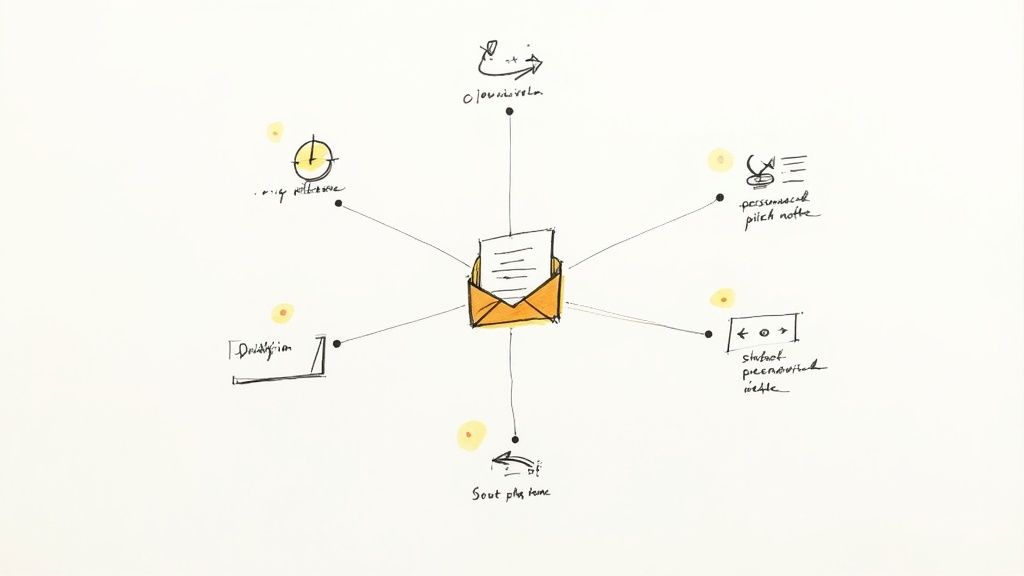
Let's be blunt: even the most perfectly crafted press release is just a document if it doesn't land in front of the right people. Distribution isn't the final step; it's the moment your story either takes flight or gets buried in the noise. This is where your hard work turns into actual media coverage.
The big question you need to answer is whether you should blast your news out using a newswire service or take a more surgical approach by building a targeted media list from scratch. Each path has its place, and the right choice depends entirely on your goals.
Newswires vs a Curated Media List
Newswire services, like PR Newswire or Business Wire, are the "shotgun" approach. They can push your release to thousands of newsrooms, websites, and databases all at once. For a publicly traded company with disclosure requirements or a major consumer brand launching a product, this wide reach and speed can be invaluable.
For most startups and tech companies, however, a curated media list is almost always the smarter play. This means you're hand-picking the specific journalists, bloggers, and influencers who live and breathe your industry. You’re trading sheer volume for precision, making sure your story lands in an inbox where it will actually be appreciated and understood.
To really get traction, your press release needs to be part of a larger content distribution strategy.
Building Your High-Impact Media List
Creating a custom media list is an investment of time, but the payoff is huge. You’re not just collecting email addresses; you’re identifying potential partners who can help tell your story.
Your aim should be a lean, powerful list of 20-30 highly relevant contacts, not a bloated list of hundreds of strangers. Here’s how you find them:
- Pinpoint Your Target Publications: First, figure out where your ideal customers get their news. Is it a niche industry blog, a major tech publication, or a trade journal? Make a list.
- Find the Right Journalists: At those publications, look for the reporters who have covered similar companies, technologies, or market trends. Dig through their article archives using keywords related to your announcement.
- Use Social Media and Modern Tools: Platforms like X (formerly Twitter) and LinkedIn are gold mines. Journalists are often active, sharing their work and discussing topics they're passionate about. You can also use tools like Hunter or RocketReach to help track down professional email addresses.
Once you have your list, the real work starts: crafting a pitch that feels personal and respects their time.
Crafting the Perfect Pitch Email
Think of your email pitch as the personal note wrapped around your press release. A generic, copy-pasted message is the fastest way to get your email deleted. Instead, you want a short, personalized note that instantly connects your news to their work.
Here’s what a winning pitch email looks like:
- A specific and compelling subject line (e.g., "Story Idea: [Your Press Release Headline]").
- A brief, personal opener that shows you've done your homework ("Loved your piece on AI in fintech...").
- A single sentence summarizing your news and explaining why it matters to their audience.
- The full press release pasted directly into the body of the email. Never send it as an attachment.
The competition for a journalist's attention is intense. Some estimates suggest they get around 100 press releases every single day. Yet despite the flood of information, 74% of journalists still say they prefer to receive news via press releases, which proves they're still incredibly valuable when done right.
Key Takeaway: The goal of your pitch isn't to tell the entire story. It's to convince the journalist that the story is worth their time to explore further.
Timing and Follow-Up Strategy
When you hit "send" matters. I've found that the best engagement comes mid-week. Aim for Tuesday, Wednesday, or Thursday between 9 AM and 11 AM in the journalist's local time. Mondays are a write-off as they dig out from their weekend inbox, and by Friday, everyone's focus is already on the weekend.
What if you send your pitch and hear nothing but crickets? It's okay to follow up. A single, polite nudge is perfectly acceptable. Wait about three or four business days, then reply to your original email with a simple, friendly message. Something like, "Just wanted to gently bump this up in your inbox in case it's a fit for your readers," works wonders. It’s professional, not pushy.
Effective distribution is a mix of smart targeting and genuine relationship-building. For a deeper dive into all your options, you might find our guide on https://www.pressbeat.io/blog/how-to-distribute-a-press-release helpful. By focusing on relevance and personalization, you dramatically improve your chances of turning that press release into a media win.
How to Measure Press Release Success
So, you’ve hit "send" and your press release is out in the wild. Great job, but the work isn't over yet—in fact, it's just getting started. Now it’s time to figure out if anyone actually cared.
Measuring success is more than just a vanity check; it's about understanding the real-world impact of your announcement. Did it build authority? Drive traffic? Get you in front of the right people? Let's break down how to track the metrics that actually matter.
Tracking Media Pickups and Placements
The first thing you’ll want to know is simple: who covered your story? This is the most immediate sign of success, but it's crucial to look at the quality of the coverage, not just the quantity. A feature in a top-tier industry publication is worth far more than a hundred mentions on automated news aggregators.
You can get started for free. Set up Google Alerts for your company name, the product you announced, and a few keywords from your headline. This is a simple, no-cost way to get notified whenever your story pops up online.
When you're ready to get serious, paid PR software like Muck Rack, Cision, or Meltwater will give you a much deeper view. These tools monitor everything—online, print, and even broadcast—and provide detailed analytics on reach and sentiment that you could never gather by hand.
Measuring SEO Impact and Backlinks
One of the most valuable, long-term benefits of a great press release is the boost it gives your website's SEO. When a respected publication links back to your site, it’s a massive signal to Google that you’re a credible source of information.
These high-authority backlinks are pure gold. A single link from a well-known tech blog can do more for your search rankings than dozens of links from unknown sites. Use tools like Ahrefs or Semrush to keep an eye on your backlink profile after your announcement goes live. Look for new "referring domains" and pay close attention to their Domain Rating (DR) or Authority Score (AS).
When a major publication with high domain authority links to your startup’s funding announcement, it’s not just sending you visitors. It's giving your website a vote of confidence that helps you rank higher for your target keywords for months, or even years, to come.
Analyzing Website Traffic and Conversions
Did all that media buzz actually send people to your website? It’s time to jump into your Google Analytics account and find out. The "Acquisition" report is your best friend here, as it will show you exactly which articles are sending you referral traffic.
This data is incredibly valuable because it tells you which audiences are most interested in what you have to say. But don't just stop at traffic numbers. Dig deeper.
- Referral Traffic: How many people clicked through from a specific article?
- Bounce Rate: Did they leave right away, or did they stick around to explore your site?
- Goal Completions: Most importantly, did they take an action you care about? Did they sign up for a demo, download a resource, or join your newsletter?
Connecting media pickups to these concrete user actions is how you prove that your PR is directly impacting the business. The average ROI for press releases can hover between 100% to 175% over 90 days, with top campaigns earning 5 to 20 high-quality backlinks.
This isn't just theory; it's a measurable return, which is why 68% of PR teams now use specialized software to track this impact. To see more data on this, check out these insights on how press release metrics translate to ROI. By focusing on these KPIs, you can build a rock-solid case for your PR efforts and make smarter, data-driven decisions for your next launch.
Watch Out for These Common Press Release Mistakes
Knowing how to write a great press release is one thing, but knowing what not to do is just as critical. I've seen countless promising announcements fall flat because of simple, avoidable errors that get them sent straight to a journalist’s trash folder.
Think of this as your final pre-flight check before you hit send. Getting these details right can be the difference between a story that gets picked up and one that gets ignored.
Burying the Lede
This is the cardinal sin of press releases. Journalists are swamped. They don't have time to wade through five paragraphs of your company's backstory to figure out the actual news. The most important, impactful piece of your announcement needs to be right there in the headline and the first sentence.
- Don't do this: Start with a long, meandering history of your company or a generic mission statement.
- Do this instead: Lead with the punchline. Something like, "InnovateHealth Launches AI Tool That Predicts Heart Disease Risk" gets straight to the point and screams newsworthy.
Respecting a reporter's time is the name of the game. Make their job easy, and they'll be more likely to cover you.
A journalist gives a press release less than a minute of their time. If you can't hook them in the first 10 seconds, you've lost them.
Using Incomprehensible Jargon
Your press release has to make sense to someone who doesn't live and breathe your industry. Cramming it full of corporate buzzwords, acronyms, and technical jargon is a guaranteed way to make a reporter's eyes glaze over. You're writing for a human being, not an algorithm or your C-suite.
Let's look at an example:
- Avoid this: "Our company is leveraging synergistic paradigms to streamline B2B workflows, unlocking unparalleled value creation."
- Try this: "Our new software helps businesses save time by automating their invoicing process and cutting down on manual data entry."
See the difference? Clarity always wins. If a journalist has to pull up Google to understand what you're talking about, they're probably just going to delete your email and move on.
Sending an Impersonal Blast
The "spray and pray" approach is dead. Blasting a generic email to a list of 500 reporters you scraped from the internet is the modern equivalent of junk mail. It immediately tells them you haven't bothered to learn what they cover.
Instead, put in the work. Build a small, focused list of journalists who have actually written about your industry or competitors. Then, write a short, personalized note to each one. Mention a recent article they wrote and explain why your news is a great fit for their specific audience. It takes more time, sure, but a targeted approach shows you're a professional and makes a response exponentially more likely.
Got Questions? We've Got Answers
Even with the best plan in hand, you're bound to have some questions pop up when you're deep in the press release trenches. Let's tackle a few of the most common ones I hear from founders.
What's the Best Day to Send My Press Release?
Think mid-week. My go-to window has always been Tuesday, Wednesday, or Thursday morning, usually between 9 AM and 11 AM in the journalist's local time zone.
Why? Mondays are a frantic catch-up day for most reporters, and by Friday afternoon, their minds are already on weekend deadlines or just switching off. Hitting that mid-week sweet spot gives your story the best chance of landing in front of a focused editor.
Should I Just Blast It Out on a Newswire?
For startups and tech companies, I almost always advise against it. A targeted, personal pitch to a hand-picked list of journalists is lightyears more effective than a generic newswire blast.
Newswires give you a firehose of distribution, but they're incredibly impersonal. They don't help you build the genuine relationships that lead to quality, long-term coverage from writers who actually understand your niche.
A newswire guarantees your release goes somewhere, but it doesn't guarantee a single person will read it, let alone care. A personalized pitch to the right journalist is always the smarter play for coverage that actually moves the needle.
How Long Should This Thing Be?
Keep it tight. The sweet spot is somewhere between 300 and 500 words.
That's just enough space to get all the critical information in—the who, what, where, when, and why—plus a great quote. More importantly, it's short enough for a busy journalist to scan in a minute and decide if it's for them. Don't bury your lead in fluff.
Honestly, Are Press Releases Still Worth the Effort?
Yes, one hundred percent. In a world of endless online noise, a well-crafted press release is a powerful way to build credibility and control your company's story.
Don't just take my word for it. The data shows that about 68% of businesses see a direct jump in brand visibility from their press releases. Plus, 25% of companies are pushing out over 10 releases a year, which tells you it’s a core part of their media strategy, not a one-off tactic. You can dig into more stats on press release effectiveness.
Ready to secure guaranteed media coverage without the guesswork? With PressBeat, our AI-powered platform identifies the perfect journalists, crafts personalized pitches, and manages the entire outreach process for you. Stop hoping for coverage and start getting it. Learn more at PressBeat.