
How to Send Out Press Releases That Get Noticed
November 27, 2025
Getting a press release out the door isn't a one-shot deal. It’s a carefully orchestrated process that starts long before you hit "send." You need a truly newsworthy story, a compelling narrative around it, a hand-picked list of the right journalists, and a personalized pitch to tie it all together. The old "spray and pray" tactic is dead; thoughtful, targeted outreach is the only way to earn media attention today.
The Modern Playbook for Press Release Success
If you think sending a press release is about blasting a generic message to a massive list, it's time for a rethink. Success in 2024 is all about precision, value, and strategy—not volume. Journalists are absolutely buried in pitches every single day, so your best bet is a focused, intentional plan. Think of it less as a task and more as a multi-stage project.
Everything boils down to one simple, unavoidable rule: you must have a genuinely newsworthy story. If you don't have that, nothing else matters. The best-written release and the most perfect media list won't save a non-story. The goal is to stop making announcements and start telling stories that will actually hook a reporter and resonate with their audience.
This simple workflow shows how the real effort is front-loaded.
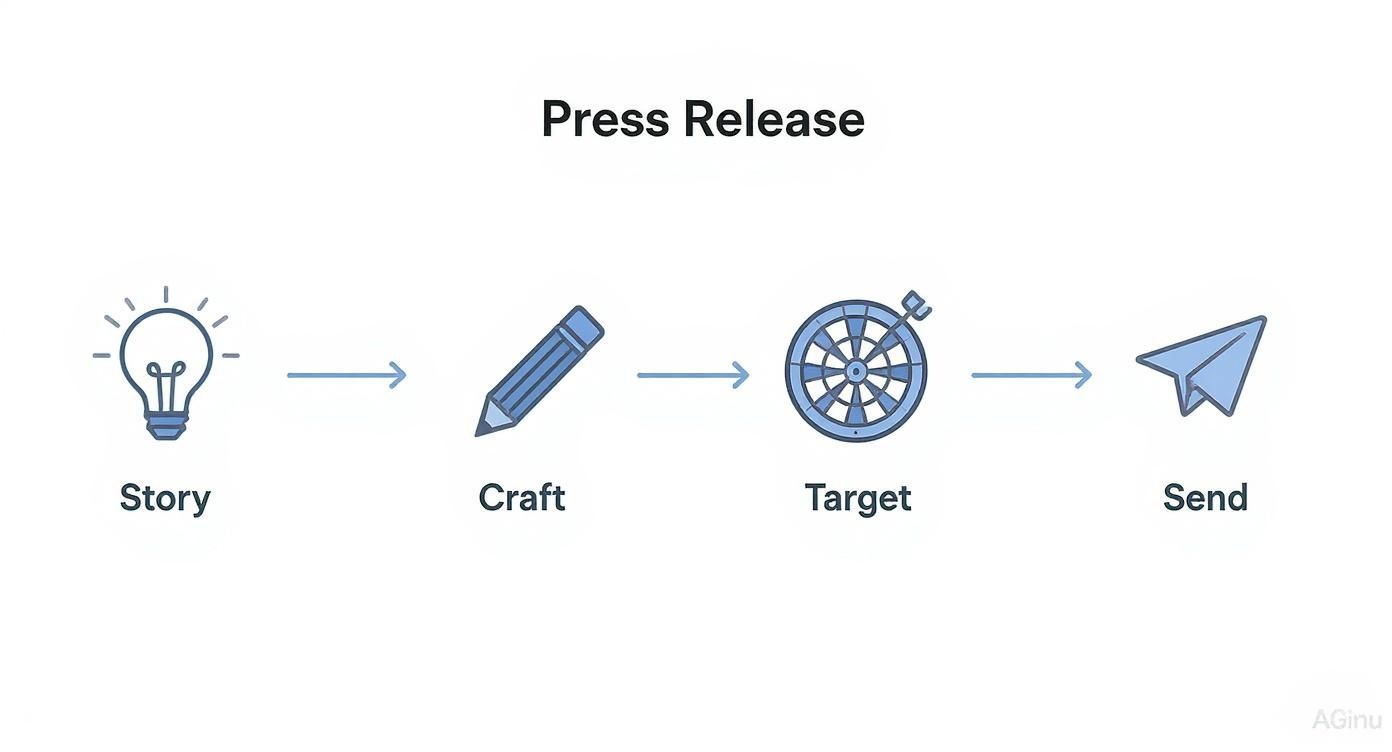
As you can see, "Send" is the very last thing you do. The heavy lifting happens when you're developing the story, crafting the release, and zeroing in on your targets.
To make this crystal clear, here’s a quick breakdown of the core pillars that support a successful campaign.
Press Release Success Pillars at a Glance
| Pillar | Objective | Key Action |
|---|---|---|
| Newsworthy Story | Create a genuine reason for media to care. | Identify an angle with real impact, novelty, or human interest. |
| Compelling Craft | Write a clear, concise, and engaging release. | Lead with a killer headline and hook; provide all essential info. |
| Targeted List | Find journalists who cover your specific niche. | Research reporters' beats, recent articles, and interests. |
| Personalized Outreach | Make your pitch stand out from the noise. | Tailor your email to each journalist, showing you've done your homework. |
These four elements work together. A weakness in one can undermine the entire effort, no matter how strong the others are.
Why a Strategic Approach Matters
The numbers don't lie. When you send out a generic press release, you're fighting an uphill battle. With tens of thousands of releases flooding inboxes daily, the average media pickup rate for these broad campaigns is a dismal 2–3%. It’s just noise.
But here’s the game-changer: targeted distribution to specific industry sectors can increase that pickup rate by as much as 67%. This statistic alone proves that a personalized strategy isn't just a nice-to-have; it's the only effective way to get results.
When done right, a press release is a fantastic tool in your arsenal for how to improve brand awareness, particularly in the B2B world. It builds instant credibility and can give your organic visibility a serious boost.
A great press release isn’t just about what you say; it's about who you say it to. The shift from mass communication to personalized connection is the single most important change in modern public relations.
Ultimately, thinking strategically means you stop wasting time and start focusing your energy where it counts—on the journalists who actually care about your corner of the world. That way, your news lands as a relevant opportunity, not just another unwelcome interruption in their day.
Crafting a Press Release That Journalists Actually Read
Before you even think about distribution, let's talk about what you're actually sending. A sloppy, poorly constructed press release is the fastest way to get your email deleted. The real goal is to create something that respects a journalist’s time and gives them a story, not just an announcement.
This isn't about just filling in a template. It's about understanding what makes a press release compelling and easy for a busy reporter to digest. Every single piece, from your headline down to the final "About Us" section, has a job to do.
The Anatomy of a Powerful Press Release
Think of your press release as a purpose-built vehicle for your story. It needs a logical structure so a journalist can glance at it and immediately grasp its newsworthiness and pull out the key facts. There's a standard format for a reason—it’s what the industry expects and knows how to work with.
Here’s a quick sketch of the essential layout that journalists are trained to look for.
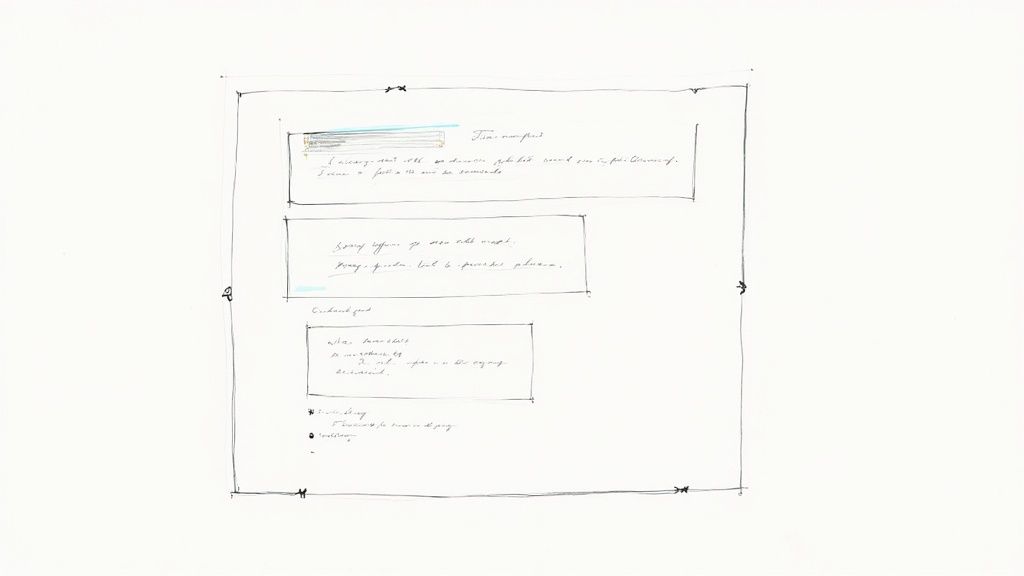
This structure isn't just for show; it creates clarity and makes it much easier for reporters to pick up your story and run with it.
Your headline is your one shot. Seriously. It has to be compelling enough to stop someone from scrolling, yet clear enough to convey the news. A great headline summarizes the entire story in about 10-15 words and often includes keywords that will help it show up in news searches.
Right after the headline comes your opening paragraph—arguably the most important part of the entire document. You have to nail the "who, what, when, where, and why" in the first few sentences. If a journalist can't figure out the core of your story in under 30 seconds, they're moving on.
Adding Depth and Credibility
Once you’ve hooked them with the essential facts, the body of your press release is where you build out the story with supporting details and context. This is your chance to add interesting statistics, background information, and, most importantly, quotes.
A huge mistake I see all the time is filling quotes with stale corporate jargon. A quote should add a human voice and a unique perspective. It needs to sound like something a real person would actually say, offering an insight that isn't just a rehash of the other paragraphs.
To make a journalist's job easier and build your own credibility, always include a link to a comprehensive media kit. This isn't optional anymore. A solid media kit should be a one-stop shop containing:
- High-Resolution Images: Product photos, professional headshots of key people, and company logos.
- Videos: Any B-roll footage, product demos, or short interviews that can be used for online or broadcast stories.
- Company Backgrounder: A short, digestible history and overview of your organization.
- Executive Bios: Professional biographies for anyone quoted or mentioned in the release.
Finally, every press release must end with a boilerplate. This is simply a short, standardized "about us" paragraph that gives journalists immediate context about your company. It grounds your announcement by telling them who you are and what you do. For a much deeper dive into each of these elements, check out our complete guide on how to write a press release.
Finding and Targeting the Right Media Contacts
You can write the most brilliant press release in the world, but if it lands in the wrong inbox, it’s just spam. Firing off your news to a generic newsroom address is the digital equivalent of tossing a message in a bottle into the ocean. You're just hoping it washes up on the right shore.
This is where the real work begins. Forget the mass blast. The key to sending out a press release that actually gets read is to think like a detective and build a hyper-targeted media list. Your mission is to find the specific journalists, editors, and bloggers who live and breathe your industry. They should have a genuine, professional reason to care about what you have to say. Sending a tech funding announcement to a food blogger? A complete waste of everyone's time.
Doing the Groundwork to Vet Your Contacts
Building your media list by hand takes some grit, but the payoff is huge. Remember, the goal isn't the biggest list; it's the right list.
Social and professional networks are your best friends here. Platforms like LinkedIn and X (formerly Twitter) are goldmines for this kind of research. You can search for journalists by the publications they write for or, even better, by their "beat"—the specific topic they're an expert in. Look at what they're talking about right now. Are they posting a call for sources on a story that fits your news? Bingo. That's an open door.
Once you’ve found someone promising, dig a little deeper:
- Read their recent work. Check out their last three to five articles. This tells you their style, tone, and what they’re currently focused on.
- Confirm their niche. Do they just cover "technology," or do they specialize in "SaaS for HR tech"? The more specific, the better.
- Know their audience. Who are they writing for? If their readers are your target customers, you've found a great match.
This homework is what allows you to personalize your pitch and stand out. It’s also smart to brush up on email prospecting best practices to make sure your outreach hits the mark.
Pro Tip: Never, ever start a pitch with "Dear Sir/Madam" or "To the Editor." Use their first name. Mention a specific, recent article they wrote. This simple act of showing you’ve done your homework and respect their work will immediately separate you from 90% of the noise in their inbox.
How to Organize Your Media List
As you find these high-value contacts, keep them organized. A simple spreadsheet is all you need to create your outreach command center.
| Column | Purpose | Example |
|---|---|---|
| First Name | For personalizing your email. | Sarah |
| Last Name | For a professional greeting. | Chen |
| Publication | To keep track of the outlets. | Tech Weekly |
| The most important piece of info. | sarah.chen@email.com | |
| Link to Article | To reference their work in your pitch. | [Link to their latest story] |
| Pitch Angle | Your custom hook for this person. | "Following your piece on AI..." |
This structured approach keeps you from sending duplicate emails and helps you track every conversation. For more in-depth strategies on finding direct emails and writing the perfect pitch, check out our guide on https://www.pressbeat.io/blog/how-to-contact-journalists. Building this quality list is the single most important step in turning a simple announcement into a genuine media opportunity.
Choosing Your Press Release Distribution Channels
You've got a polished press release and a list of journalists who need to see it. Now comes the moment of truth: how do you actually get it in front of them? This isn't just about hitting "send." The method you choose will make or break your campaign's reach, budget, and ultimate success.
Fundamentally, you have two paths you can take: rolling up your sleeves for manual outreach or leveraging a professional distribution service. There’s no single "right" answer here; the best choice is the one that aligns with your specific goals and what you can realistically manage.
The Power of Manual Outreach
I've seen this work wonders. Manual outreach is exactly what it sounds like: you personally email your press release and a customized pitch to every journalist on your list. This is the most hands-on, personal approach you can take, and it's fantastic for building real, lasting relationships.
This strategy shines when you have a smaller, laser-focused media list of maybe 10-50 people who are a perfect match for your story. Think quality over quantity. Your goal isn't to get a hundred syndicated mentions, but to land one or two high-quality, in-depth features.
- The upside? It's incredibly personal, costs nothing but your time, and helps you forge direct connections with the people who shape your industry's narrative.
- The downside? It takes a lot of time and simply doesn't scale. Your reach is capped by the number of thoughtful, personalized emails you can realistically send.
A well-crafted personal pitch cuts through the noise. It shows a reporter you’ve actually read their work and respect their time, which immediately sets you apart from the hundreds of generic blasts clogging their inbox.
Navigating Press Release Distribution Services
On the other end of the spectrum, you have press release distribution services, also known as newswires. These are platforms built for one thing: scale. They take your release and blast it out to massive networks of media outlets, newsrooms, and online portals.
This is the route to take when your primary goal is broad, immediate visibility. Think major company announcements—a big funding round, a merger, a game-changing product launch. In these cases, you need to blanket a region, or even the world, with your news as quickly as possible. For a deeper dive into the mechanics, our guide on how to distribute a press release breaks it all down.
Of course, that kind of reach isn't free. The cost of a distribution service can swing wildly depending on how wide you cast your net. A single-country distribution might run you anywhere from €400 to €1,500. If you need to cover a whole continent like Europe or the Americas, that price can jump to €3,500. And for a full-blown global campaign hitting over 300,000 journalists? You could be looking at costs as high as €9,500.
To help you weigh your options, here's a quick comparison of the different distribution methods you'll encounter.
Comparison of Press Release Distribution Methods
| Method | Typical Cost | Best For | Key Advantage |
|---|---|---|---|
| Manual Email Outreach | Free (time investment) | Niche stories, relationship building, small targeted lists (10-50 contacts) | High personalization and relationship-building potential. |
| Automated PR Tools | €50 - €300 / month | Startups & SMEs needing efficient, targeted outreach without newswire costs. | Combines the targeting of manual outreach with the efficiency of automation. |
| Newswire Service (National) | €400 - €1,500 | Major national news, product launches, financial announcements. | Guarantees broad reach and syndication across a specific country. |
| Newswire Service (Global) | €3,500 - €9,500+ | IPOs, mergers & acquisitions, major international company news. | Maximum possible reach, hitting hundreds of thousands of outlets worldwide. |
Each of these methods has its place. The key is to avoid defaulting to one without considering what you're trying to achieve.
Choosing a distribution channel isn't about picking the most expensive or widest option. It's about aligning your method with your message. A heartfelt local story gets lost on a global newswire, while a major tech IPO needs more than a handful of emails.
In many cases, the most effective strategy is actually a hybrid approach. Use a distribution service to create a baseline of broad awareness, then follow up with highly personalized pitches to your A-list media contacts. This gives you the best of both worlds: scale and substance.
Getting the Timing, Follow-Up, and Measurement Right
So you've hit "send" on your press release. Great. But if you think your job is done, you're missing the most critical part of the process. What happens after the send is where a simple announcement becomes a genuine PR win.
It really boils down to timing. Pitching a journalist at the wrong moment is like trying to get their attention in the middle of a breaking news storm—your story, no matter how good, is going to get lost. We’ve all been there. Mondays are a write-off; everyone's swamped with weekly planning meetings. And by Friday afternoon? Most people are already thinking about the weekend.
Finding the Sweet Spot for Sending
Years of data and experience point to a clear sweet spot: midweek. If you want to maximize your chances of getting picked up, Thursday is your best bet. Aim to land in their inbox somewhere between 10 a.m. and 2 p.m.
This window gives them just enough time to review your story, ask questions, and maybe even slot it into their editorial calendar before the week wraps up. Send it first thing in the morning, and you risk getting buried under a mountain of overnight emails. Send it too late in the afternoon, and it’s likely to be ignored until the next day… if you’re lucky. For a deeper dive into the numbers, check out these public relations statistics on prlab.co.
Once the release is out there, it's time to be patient. But not too patient. This is where a smart, professional follow-up strategy makes all the difference. It’s a delicate balance; you have to be persistent without becoming a nuisance.
The Art of the Follow-Up
The absolute golden rule here is to add value. A "just checking in" or "did you see my email?" message is just noise. It's annoying, and it shows you aren’t thinking about their needs.
Instead, give it at least 24-48 hours, then send a helpful nudge. A good follow-up should be:
- Short and sweet. Seriously, two or three sentences is all you need.
- In context. Always reply directly to your original pitch. Don't make them search for what you're talking about.
- Genuinely helpful. Offer something new. Maybe it’s exclusive access to your CEO for an interview, a high-resolution photo gallery, or a new data point that adds to the story.
If you send one polite, value-added follow-up and still hear crickets, it's time to let it go. Pushing any further is a surefire way to burn a bridge with that journalist and land your email address on their block list.
Measuring What Truly Matters
Finally, let's talk about what success actually looks like. The old-school approach was to just count up the number of articles, or "placements," your release got. That’s a start, but it barely scratches the surface. To show the real worth of your PR work, you need to track metrics that tie back to actual business goals.
Stop counting clips and start measuring impact. A single article in a high-authority publication that drives targeted traffic and sales is worth more than a hundred syndicated mentions on low-quality sites.
It’s time to move past vanity metrics and focus on what really moves the needle.
- Referral Traffic: Jump into your website analytics (like Google Analytics) and see how much traffic is coming directly from the articles that featured your news.
- Backlink Acquisition: Use a tool like Ahrefs or Moz to find out how many new, high-quality backlinks you earned from the coverage. This is a massive win for your SEO.
- Social Media Engagement: Look at the conversation. Track mentions, shares, and comments about your announcement on platforms like LinkedIn and X (formerly Twitter).
- Brand Search Volume: Check Google Trends. Did you see a spike in people searching for your brand name right after the announcement went live? That’s a great sign.
By focusing on these KPIs, you can paint a much clearer picture of your campaign’s true impact and make smarter decisions for the next one.
Your Press Release Questions, Answered
Let's face it, the little details of sending a press release can feel overwhelming. Get them wrong, and your big news might fall flat. Get them right, and you’ll make a journalist’s day—and drastically increase your chances of getting coverage.
Here are some of the most common questions I get asked, along with some straight-to-the-point answers based on years of being in the trenches.
How Long Should a Press Release Be?
Keep it tight. You're aiming for the sweet spot: between 400 and 500 words.
Think about it from the journalist's perspective. They're drowning in emails, and a massive wall of text is an instant "delete." They need to grasp the story in a few seconds, not spend ten minutes digging for the lede.
Get all the critical information—who, what, when, where, why—packed into that first paragraph. The rest of the release should offer supporting details, a quote with some personality, and your company boilerplate. Anything extra is just noise.
A press release isn't the story itself; it's the kit a journalist needs to build the story. Your job is to give them the essential tools, cleanly and quickly.
Can I Send Attachments in a Pitch Email?
Let me be blunt: never. This is one of the cardinal sins of media outreach.
Attaching a PDF or Word doc is the fastest way to trigger a spam filter or, just as bad, completely irritate the journalist you're trying to win over. They're often on the go, checking emails on their phone between assignments. Making them download a file is a huge friction point.
Here’s the right way to do it:
- Paste the full text of your press release directly into the body of the email, right after your personal pitch.
- Include a link to your online media kit where they can easily grab high-res images, logos, or other assets.
- Link to the release on your website’s newsroom, too.
This makes their job easier, and when you make a journalist's job easier, you immediately stand out.
When Should I Follow Up with a Journalist?
This is a delicate balance. You need to be persistent without being a pest. My rule of thumb is to wait at least 24 to 48 hours before following up. They need time to sort through their inbox, and a follow-up sent just a few hours later feels desperate.
When you do send that follow-up, make it count. Keep it short, reference the original email, and try to add new value. Maybe you can offer an exclusive interview or a new piece of data that's just come to light.
One polite, helpful follow-up is plenty. If you still hear crickets after that, it’s time to let it go. Bombarding them with messages will get you blacklisted, not published.
Ready to stop guessing and start getting guaranteed media coverage? PressBeat uses AI to identify the perfect journalists and craft personalized pitches, ensuring your story lands in front of the right audience. See how our automated platform can secure you press articles every month at https://pressbeat.io.