
how to write a media pitch that wins coverage
December 6, 2025

Crafting a media pitch that actually lands coverage is about more than just writing a good email. It's about researching the right journalist, finding a truly newsworthy angle, and presenting a story that offers genuine value. Your pitch has to be personal, concise, and immediately answer the unspoken question in every reporter's mind: why should I care?
The secret is to make their job easier, not harder.
Why Most Media Pitches Fail (And How Yours Can Succeed)
Before you write a single word, picture a journalist's inbox. It’s not just busy; it's a relentless, overwhelming flood of requests, press releases, and half-baked ideas from all over the world. Getting your head around this reality is the first, most crucial step to writing a pitch that gets noticed.

Most pitches fail because they’re just more noise. They’re impersonal, irrelevant, or blatantly self-serving, showing zero respect for the journalist's time, their beat, or what their audience actually wants to read.
The Harsh Reality of a Journalist's Inbox
The numbers don't lie, and they paint a pretty stark picture. A shocking 3.15% of all pitches ever get a response. Even worse, less than half are ever even opened. This isn't meant to discourage you; it's a reality check. Just hitting "send" is nowhere near enough.
This cutthroat competition forces journalists to develop lightning-fast filters. Your email has just a few seconds to prove it’s worth their time before it’s archived or, more likely, deleted forever.
"The fact that your company exists or your CEO will be in town does not make a story."
This blunt truth from entrepreneur Amber Mac perfectly sums up the gap between what companies think is news and what journalists actually need for a story.
Let's break down the essential components of a pitch that works.
Anatomy of a Winning Media Pitch
A quick look at the essential elements that make a media pitch stand out. This table gives a high-level overview before we dive into the details of each component.
| Component | Why It Matters | Quick Tip |
|---|---|---|
| Compelling Subject Line | It’s your first (and maybe only) impression. It determines if the email gets opened. | Be specific and intriguing, but avoid clickbait. Think "headline," not "email subject." |
| Personalized Greeting | Shows you've done your homework and aren't just spamming a list. | Use their first name and reference a recent article they wrote. Simple, but powerful. |
| The Hook (The Lede) | The first 1-2 sentences. It must grab their attention immediately. | State your most newsworthy point upfront. Don't make them hunt for the story. |
| The Core Pitch | The "what" and "why." This is where you explain the story and its relevance. | Keep it concise (3-4 sentences). Connect your news to a larger trend or their audience's interests. |
| The Value Proposition | Clearly state what you're offering (e.g., an interview, data, expert commentary). | Make it easy for them to say yes. Offer exclusive assets if you can. |
| Call to Action (CTA) | Tell them exactly what you want them to do next. | A simple, low-friction question like, "Are you the right person to cover this?" works wonders. |
| Professional Signature | Provides your contact info and credibility at a glance. | Include your name, title, company, and a link to your website or LinkedIn profile. |
Mastering these components is the difference between being ignored and getting a response.
Common Pitching Mistakes to Avoid
So, what are the tripwires that send a great idea straight to the digital trash can? Most failed pitches stumble over a few basic, avoidable mistakes.
- Irrelevant Targeting: This seems obvious, but pitching a tech story to a food critic happens constantly. Even subtle misses—like sending a B2B SaaS pitch to a writer who exclusively covers consumer gadgets—will get your email deleted on sight.
- Generic, Impersonal Blasts: Nothing screams "spam" like "Hi there" or, even worse, getting the journalist's name wrong. If your pitch looks like it was copied and pasted to a hundred other people, it will be treated like junk mail.
- Burying the Lede: Journalists are chronically short on time. If they can't figure out what your story is about in the first two sentences, they’re not going to read the rest. Put your most interesting fact or angle right at the top.
- Lack of a Newsworthy Angle: A pitch that just announces a new product feature or a website redesign isn't a story; it’s an ad. It’s on you to figure out why anyone outside your company should care. Before you do anything else, you absolutely must understand what makes a story newsworthy.
Laying the Groundwork for a Winning Pitch
A great pitch isn't about clever writing. It's built on a foundation of smart research long before you ever type a single word. In my experience, skipping this prep work is the number one reason pitches fail; it’s what separates a real opportunity from the generic spam that gets a journalist to hit "delete" in under a second.
The whole point is to turn a cold email into a warm, relevant conversation. You want to be the solution to a reporter's biggest problem—finding a great story—not just another piece of noise clogging their inbox. And that starts with genuinely understanding the person on the other side of the screen.
Do Your Homework on the Journalist
Before you even think about your subject line, you need to become a student of the journalist you want to pitch. I'm not just talking about knowing their official beat, like "consumer tech" or "venture capital." You need to get a feel for their specific voice, their recent obsessions, and the little nuances in how they cover their industry.
This is where you find the connection points that make your outreach feel personal and authentic.
- Read their last five articles. Seriously. Pay close attention to the angles they choose, the kinds of experts they quote, and the overall tone. Is their writing data-heavy and analytical, or do they focus more on the human side of the story?
- Check their social media. See what they're posting and talking about on platforms like X (formerly Twitter) or LinkedIn. What topics are they riffing on outside of their published work? You might find a pet project, a personal interest, or a strong opinion that you can connect with.
- Figure out who they write for. A pitch for a highly technical trade publication needs to be completely different from one for a mainstream lifestyle magazine. Know the audience.
A pitch that says, "I saw you cover the future of work..." is lazy and generic. But a pitch that says, "Your recent article on the four-day work week really nailed the challenges of asynchronous collaboration, which is exactly what our new data sheds light on..." proves you’ve actually done the reading.
This detailed understanding is your secret weapon. It lets you shape your story to fit perfectly into their ongoing narrative, making it an incredibly easy "yes" for them. Of course, all this research is useless if your email never lands in their inbox. Make sure you're up to speed on finding the right email address for journalists and editors to ensure your hard work pays off.
Find an Angle That's Actually Newsworthy
Let's be blunt: your new product feature isn't a story. It's an update. It’s your job to find the newsworthy angle within that update—the hook that makes it relevant to people who aren't on your payroll. A feature that solves a widespread, timely problem? Now that's a potential story.
To find your angle, grill yourself with these questions:
- Why now? Does your story connect to a current trend, a recent news event, or something seasonal? Timing is everything in the news world.
- Why should their audience care? How does your news impact their readers' lives, careers, or finances? You have to frame the benefit for the end user, not for your company.
- What makes this different? Are you offering up exclusive data, a contrarian opinion, or first-ever access to a key person? This is what makes your pitch stand out from the dozens of others they'll get today.
Imagine you're launching a new project management tool. A weak angle is "Announcing New PM Tool." A much, much stronger angle is "New Data Reveals 75% of Remote Teams Waste 10 Hours a Month on Redundant Tasks." Your tool is then positioned as the solution to that problem. The second option is a story a journalist can run with. For more ideas on framing your outreach, check out our guide on how to contact journalists.
When you put in this work upfront, you completely change the dynamic. You stop being someone asking for a favor and become a resource offering a well-researched, relevant, and timely story. This prep work is the most reliable way to write a pitch that doesn't just get opened, but actually gets a response.
From Subject Line to Signature: How to Write a Pitch That Lands
Alright, you've done the legwork. You've found the right journalists and you have a newsworthy angle you know they'll care about. Now comes the crucial part: actually writing the pitch. Every single element, from the subject line down to your signature, has a job to do in convincing a busy reporter that your email is the one worth opening.
Think of it as a three-stage process: you research, find your angle, and then you connect. It’s a simple flow, but one that’s easy to get wrong.
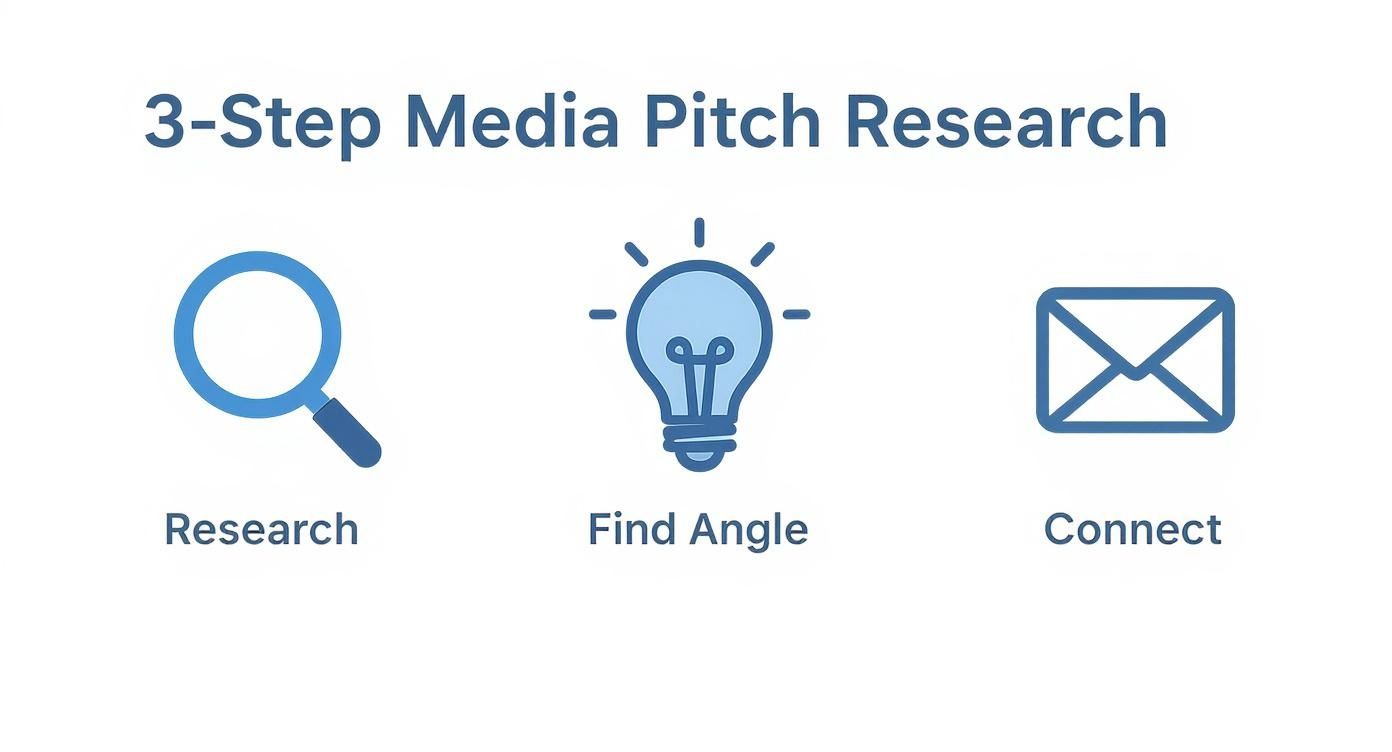
This framework is a good reminder that a successful pitch isn't just about the email you send; it's the result of all the thoughtful steps that come before it.
The Subject Line: Your First (and Only) Impression
Let's be blunt: your subject line is everything. It's the gatekeeper. It determines whether your carefully crafted pitch gets opened or sent straight to the trash folder. Stop thinking of it as an email subject and start treating it like a news headline. It needs to be punchy, compelling, and deliver immediate value.
Please, never use generic phrases like "Story Idea" or "Media Pitch." They scream "mass email." Instead, lead with your most interesting tidbit.
Here are a few formulas I’ve seen work time and time again:
- For Data-Driven Stories: "Pitch: New study finds [surprising statistic]"
- When Offering an Exclusive: "Exclusive: Interview with [Expert] on [trending topic]"
- To Tie Into the News Cycle: "For your [beat] coverage: A source on [current event]"
The goal is to spark curiosity without veering into clickbait. A great subject line makes a promise of relevance—and that’s exactly what a reporter is looking for in a sea of emails.
Perfecting the Body of Your Pitch
Once they've opened the email, the clock is ticking. You have seconds, not minutes, to make your case. Brevity isn't just a suggestion; it's a hard-and-fast rule. Consider this: 25% of journalists get more than 100 pitches a week, and a massive 67% prefer pitches under 200 words. You can see more data behind these trends in this report on PR statistics from marketersmedia.com.
Here’s how to structure the body of your pitch to respect their time and get your point across.
The Personalized Opener
Start by proving you're not a robot. A quick, genuine reference to a recent article or even a post they shared on social media will immediately set you apart.
- What not to do: "Hi [Journalist Name], I'm a big fan of your work." (So generic.)
- What to do instead: "Hi [Journalist Name], your recent piece on AI's impact on supply chains really captured the nuances of the issue."
That one sentence shows you see them as an individual, not just another contact on a list.
The Hook and Summary
Get straight to it. Your most newsworthy finding or the core idea of your story needs to be in the first one or two sentences. Don't bury the lede.
Your opening paragraph should immediately answer three questions: What is the story? Why should my readers care? And why is this important right now?
After that initial hook, give them a brief, scannable summary. A few bullet points work wonders here. Make it easy for them to grasp the key details in a glance.
The Clear Value Proposition
Tell them exactly what you're offering. Don't make the journalist dig around or guess what you want from them. Clearly spell out the assets you have ready for them.
- Exclusive access to new research data.
- An interview with the CEO who led the project.
- High-resolution images and a full media kit.
- Expert commentary on a developing news trend.
The easier you make their job, the more likely you are to get a positive response.
From a Clear Ask to a Professional Signature
How you end your pitch is just as critical as how you begin. You need to smoothly guide the journalist to the next step and give them everything they need to take action.
Your call to action (CTA) shouldn't be demanding. Instead of "When can we schedule an interview?", try a softer, low-friction question.
Examples of CTAs That Work
- "Does this sound like something you'd be interested in covering?"
- "Are you the right person to look at this, or should I reach out to a colleague?"
- "Happy to send over the full report if this is of interest."
These are easy to answer with a quick "yes" or "no" and feel much less pushy. Right after the CTA, add a clean, professional signature with your name, title, company, and a direct link to your website.
By structuring your pitch this way, you're delivering all the necessary information in a format that respects a journalist's time. To see how these principles come together, check out some real-world examples in our guide to crafting the perfect media pitch email example.
Adding Credibility with Data and Assets
An interesting idea might get a journalist's attention, but an idea backed by hard evidence is what actually lands you the story. Let's be honest, if your pitch is just an opinion, it’s easy for them to hit delete. But when you anchor that pitch with solid data, you elevate it from a simple suggestion to a genuinely newsworthy story.

This isn't just about sprinkling in a few numbers. It’s about giving a reporter the proof they need to build an article they can't find anywhere else. By bringing compelling stats or exclusive research to the table, you're not just pitching—you're basically co-creating the story. You’re handing them a piece with built-in authority, saving them hours of research and making your pitch incredibly appealing.
Make Your Pitch Irresistible with Data
Reporters are always on the hunt for evidence to strengthen their articles. When your email lands in their inbox with the data already baked in, it’s an immediate signal that you’ve got something real and well-researched. The proof is in the numbers: a staggering 68% of journalists say they prefer pitches that include data or original research.
This tells you everything you need to know. In modern PR, tangible, credible information is your golden ticket. It's also why you need to get your email pitch right, since 96% of journalists prefer to be contacted this way over any other channel.
To make sure your pitch really sings, you have to nail the opening. For some great inspiration, check out these examples of powerful hooks that grab attention.
Your goal should be to make your best data point the headline of their future article. Don't bury your most shocking statistic in the third paragraph. Put it right in the subject line and the very first sentence of your pitch.
How to Present Data Effectively
Simply dropping a number into your email isn’t going to cut it. How you frame and present your data makes all the difference. You have to make the information both easy to digest and impossible to ignore.
Here’s how to do it right:
- Highlight the "So What?": Never just state a number—explain why it matters. Instead of saying, "Our survey found 55% of workers are unhappy," try framing it with impact: "Our new data reveals a hidden productivity crisis, with a majority of the workforce (55%) now completely disengaged."
- Use Bold Text for Key Figures: Make your most important stats jump off the page. Drawing the eye to something specific like $2.4 billion in losses or a 73% increase ensures it doesn't get overlooked.
- Offer the Full Story: Tease the top-level finding in your pitch, but always offer to share the complete report or data set. This shows you’re transparent and gives the journalist more to dig into.
Prepare Your Media Kit in Advance
Beyond the data, having a full suite of assets ready to go shows you’re a pro and makes a journalist's job so much easier. A media kit (or press kit) is essentially a one-stop shop with everything a reporter could need. Getting this sorted out before you even think about sending a pitch is a must for any serious outreach.
Your media kit should always be a simple link to a folder—never, ever send attachments. Big files can get caught in spam filters and are a pain for busy reporters to download.
Your kit should include:
- High-Resolution Images: A mix of product shots, professional headshots of your key people, and clean company logos.
- Expert Bios: Short, punchy biographies for any executives or experts you're offering up for an interview.
- Company Fact Sheet: A simple one-pager with key details like your founding date, mission, core stats, and contact info.
Providing these resources upfront removes all the friction. It sends a clear message: you're organized, professional, and ready to help them create a fantastic story. That's a huge advantage right out of the gate.
The Art of the Follow-Up and Measuring Your Success
https://www.youtube.com/embed/YQXDBk5jKrk
Hitting "send" on your pitch is a huge milestone, but it's not the finish line. Not even close. The real magic in landing media coverage often happens in the follow-up—a delicate dance between persistence and professional courtesy.
Too many incredible stories get buried in a journalist's inbox simply because the sender gave up too soon. You have to remember, reporters are drowning in emails. A quick "no" isn't the default response; more often than not, a lack of a reply just means "I'm swamped right now."
Crafting a Follow-Up That Actually Adds Value
Here’s the golden rule of following up: never, ever just "bump" an email. A message that says "just checking in" or "following up on my last email" is a waste of everyone's time and instantly marks you as an amateur.
Instead, every single follow-up you send should offer something new. Your goal is to be a helpful resource, not another item on their to-do list. Each time you reach out, you have another chance to prove your value and the strength of your story.
A great follow-up can look like a few different things:
- A new hook: "Following up on my pitch about our productivity data, I saw the news about corporate return-to-office mandates. Our findings actually offer a pretty timely counterpoint to that whole trend."
- Fresh information: "Quick update on my previous email—we just landed an exclusive case study with a Fortune 500 company using this tech that I can share with you."
- A helpful asset: "Hi again, thought you might find this short video explaining the core concept from my pitch useful for your research."
This approach respects their time while gently reminding them of the great story you're offering.
The key is to shift your mindset from "Why haven't you replied?" to "Here's another reason why this story is perfect for your audience." That small change in perspective makes all the difference.
Timing Your Follow-Up Without Being Annoying
Timing is everything. Jump the gun, and you'll come off as aggressive. Wait too long, and your story might go stale. There's no one-size-fits-all formula, but you can build a smart strategy around how a journalist engages with your initial pitch.
Follow-Up Timing and Strategy
To take the guesswork out of it, here's a simple guide to help you decide when and how to follow up without becoming a pest.
| Scenario | Recommended Wait Time | Follow-Up Action |
|---|---|---|
| No Open, No Reply | 3-5 business days | Send a polite follow-up with a slightly different subject line and a new hook. Your goal is to re-engage and earn that first open. |
| Opened, No Reply | 2-3 business days | They saw it and might be interested but got pulled away. A concise follow-up with a new piece of information can be the perfect nudge. |
| Opened and Clicked, No Reply | 1-2 business days | This is a big buying signal. Send a direct but helpful note: "Happy to provide more details or set up a quick call if that's easier." |
This table provides a solid framework, but remember to use your judgment. Generally speaking, sending more than two follow-ups without any sign of life is pushing your luck. If you’ve heard nothing after the second try, it's probably time to move on. Persistently emailing a non-responsive journalist is the fastest way to get your address blocked for good.
Measuring What Matters for Long-Term Success
You can't improve what you don't measure. If your strategy is just "send and pray," you're missing a massive opportunity to get better. Tracking a few key metrics turns every pitch into a learning experience, helping you refine your approach for the next campaign.
You don't need a complicated dashboard, just focus on these three numbers:
- Open Rate: This tells you one thing: how good your subject lines are. If your open rate is consistently low, it's a flashing red light telling you to start experimenting with new headlines and hooks.
- Response Rate: This is the true test of your pitch's relevance. A high open rate but a low response rate means your subject line is doing its job, but the body of your pitch isn't sealing the deal.
- Placement Rate: This is the prize. It’s the metric that tracks how many of those positive responses actually become published articles or media mentions.
When you analyze these numbers over time, powerful patterns start to emerge. Maybe you’ll find that pitches with data in the subject line perform best, or that a certain editor always opens your emails but never replies. This is the insight that helps you stop guessing and start making strategic moves that get results.
Pitching FAQs: Your Top Questions, Answered
Even the most seasoned PR pros have questions that pop up. After years of sending pitches, you learn that the answers usually come down to common sense and, most importantly, respecting a journalist's time and workflow.
Let’s clear up a few of the most common sticking points I see. Getting these little things right is what separates the pros from the amateurs and helps you build relationships that last.
What's the Best Day and Time to Hit Send?
Everyone wants the "magic window" for sending a pitch. While there’s no secret formula that works 100% of the time, experience and data give us some pretty strong clues.
The sweet spot is generally mid-week. Think Tuesday, Wednesday, or Thursday, between 8 AM and 11 AM in the reporter's local time zone. This timing is strategic—it dodges the Monday morning email avalanche and the Friday afternoon scramble to meet deadlines.
But here's the crucial caveat: this is a guideline, not a hard-and-fast rule. If your story is tied to breaking news, send it immediately. A truly time-sensitive angle doesn't wait for Tuesday morning. In PR, relevance always beats a perfect schedule.
Should I Attach My Press Release?
Absolutely not. Attaching files to a cold pitch is one of the fastest ways to get your email deleted or, even worse, sent directly to spam.
Corporate email filters are notoriously aggressive, and many journalists have a strict policy against downloading attachments from unknown senders for security reasons. It’s just not worth the risk.
Instead, you have two much better options:
- Link to the press release. Host it on your company’s online newsroom and include a clear link in the body of your pitch. This is the cleanest and most professional approach.
- Paste the text. If you don't have a newsroom, you can paste the full text of the release below your email signature. It's not as slick, but it’s still better than an attachment.
Your pitch is the movie trailer; the press release is the full film. The goal of the trailer is to get them interested enough to watch the movie, not to show them the entire thing upfront.
How Can I Pitch Without "Big News"?
You don’t need a massive product launch or a groundbreaking study to land great coverage. In fact, some of the strongest media relationships are built between big announcements, when you can prove your value as a resource.
When you don't have hard news, you have to get creative. Shift your thinking from "What can I promote?" to "How can I help?"
Try one of these angles:
- Offer Expert Commentary: Is there a major trend happening in your industry? Pitch your founder or an executive as an expert source who can offer a unique take on it. This is a classic "newsjacking" play that works wonders.
- Pitch a Contributed Article: Propose a byline or guest post written by your executive. The piece should offer genuine, non-promotional advice for the publication's audience.
- Connect Your Expertise to Their Beat: Read the journalist's last five articles. Find a common thread or an ongoing conversation and pitch a story that adds a new, insightful layer to it from your company's perspective.
Is It Okay to Pitch Multiple Reporters at the Same Outlet?
This is a huge no-no, and a mistake I see rookies make all the time. Blasting the same pitch to multiple journalists at the same publication is a surefire way to get yourself blacklisted.
It creates chaos internally for their editorial team and makes you look like an amateur who hasn't done their homework.
The right way to do it is to research and identify the single best contact for your story. Pitch them, and only them. Give them a fair amount of time to respond—I usually wait about a week. If you get radio silence after one polite follow-up, then you can consider moving on to a different person at the publication. But never, ever pitch them at the same time.
Ready to stop guessing and start getting guaranteed media coverage? PressBeat uses AI to connect you with the right journalists and craft pitches that get noticed. See how our platform can land you up to three press articles a month at https://pressbeat.io.