
Choosing a PR Agency for Startups A Founder's Guide
December 24, 2025

A great PR agency for startups is far more than a press release factory. Think of them as a strategic partner, a co-founder for your company’s narrative, whose entire job is to shape your story to win over investors, top talent, and your first crucial customers. Their real purpose is to take your vision and turn it into a compelling story that builds credibility when you have none.
What a PR Agency Really Does for a Startup

For a startup, public relations isn't about managing a reputation that already exists—it's about building one from the ground up. Big companies use PR to stay relevant; startups use it to prove they even belong in the conversation. A specialized PR agency for startups essentially translates your raw product vision into a story that clicks with the people who are critical to your survival.
This goes way beyond just blasting out announcements. They are strategists, figuring out which angles and stories will actually grab the attention of journalists, potential investors, and those all-important early adopters. They act as the bridge between your internal wins and how the outside world sees your momentum.
An agency’s true superpower is generating third-party validation. A glowing review or a founder feature in a respected publication is infinitely more powerful than any ad because it comes with earned credibility.
That's the key difference. Marketing pushes your message through paid channels to drive sales. PR pulls people in by earning media coverage that builds foundational trust. This is especially vital for new ventures, and getting a handle on the basics of PR for small business is a fantastic starting point for any founder.
Core Functions and Their Business Impact
A good startup PR agency isn't just chasing headlines for the sake of it. They're focused on activities designed to fuel your growth. Every action is tied to a business goal, whether that’s closing a funding round, attracting a key engineer, or signing your first big customer.
Let's break down how their core services deliver real, tangible results.
How a Startup PR Agency Drives Growth
Here’s a quick look at the core functions a PR agency delivers for an early-stage company and the direct business outcomes each service supports.
| PR Service | What It Actually Means | The Business Impact |
|---|---|---|
| Strategic Media Relations | Building real relationships with journalists, not just spamming a media list. They craft personalized pitches that offer reporters genuine value. | Secures coverage in key publications, driving brand awareness, website traffic, and inbound leads. |
| Founder Profiling | Positioning the founder as an expert through guest articles, podcast interviews, and speaking gigs. | Builds personal and company authority, making you more attractive to investors and top-tier talent. |
| Narrative Development | Nailing down your core story: What problem do you solve? Why now? What makes you different? This creates a clear, consistent message. | Ensures your entire team is aligned and that your story resonates powerfully with every audience, from customers to VCs. |
The value of these services isn't a secret. The public relations market was valued at USD 39.74 billion and is projected to skyrocket to USD 88.78 billion by 2032, growing at a CAGR of 11.66%. A huge part of that growth comes from startups realizing that PR isn't a luxury—it's a critical engine for growth.
At the end of the day, a PR agency helps your startup punch far above its weight. It gives you a voice and a presence in the market that would otherwise take years to build on your own.
Knowing When to Hire Your First PR Agency
Timing is everything. Jump the gun on hiring a PR agency for startups, and you'll burn through your runway with nothing to show for it. Wait too long, and a competitor might swoop in and own the story in your market before you’ve even had a chance to tell it.
The secret is to invest when your startup is actually ready to handle the spotlight.
Think of PR as a powerful amplifier. If you don't have a solid product, a clear message, or real traction, you’re just amplifying silence. But on the flip side, having a game-changing product without that amplifier is like shouting into the wind. The sweet spot for hiring an agency is right when you have something meaningful to talk about and the internal capacity to manage the leads, sign-ups, and attention that will follow.
Let's be clear: A PR firm is not a magic fix for a startup that's still trying to find its way. It's rocket fuel for a company that has its engine built and is ready to launch into its next growth phase.
Key Milestones That Signal PR Readiness
So, how do you know you've hit that sweet spot? Certain milestones are practically flashing signs telling you it's time to bring in the pros. These aren't just boxes to check; they're genuine, newsworthy moments an agency can spin into media gold.
Here are the most common signals that you're ready to make the call:
- You've Closed a Funding Round: Nailing down a Seed or Series A round is a massive vote of confidence. A good agency can take that news and use it to build serious momentum, attracting top-tier talent and signaling your credibility to the entire market.
- A Major Product Launch is Imminent: Got a new product or a major update in the works? That's your moment. PR is critical for building buzz before you launch, ensuring you have an audience waiting on day one.
- You've Achieved Product-Market Fit: Once you have real, happy customers and the data to prove you're solving a painful problem, you have an incredible story. Customer testimonials and hard data are the kinds of proof points journalists love.
- Competitive Pressure is Mounting: Are your competitors all over the news? If they're constantly getting headlines and defining the conversation in your industry, you can't afford to stay silent. Hiring an agency becomes both a defensive and offensive move to claim your rightful share of the spotlight.
The Founder Profile Litmus Test
Beyond company metrics, there’s another crucial element: you. A massive part of early-stage PR is building the founder's brand as a go-to expert. This is non-negotiable, especially when you're gearing up for another fundraise—investors bet on people, not just ideas.
Before you even think about hiring an agency, have an honest conversation with yourself and your co-founders. Are you truly prepared to be the face of this company? Great PR means you need to be available for interviews, ready to write opinion pieces, and able to nail your company's vision every single time.
Ultimately, deciding to hire a PR agency for startups boils down to two things: having a story worth telling and being ready to handle the success that follows. When your milestones and your mission finally line up, that's your green light to invest in shaping how the world sees you.
Decoding PR Agency Costs and Retainers
For any startup, every dollar counts. So, when you start looking at PR agencies, their pricing can feel confusing, almost deliberately murky. Getting a handle on how they charge is the first step to making a smart investment in your company's story. This isn't just about finding the cheapest price tag; it's about matching the cost to the value you'll get at your specific stage of growth.
Think of hiring a PR agency for startups like picking a subscription plan for your company's reputation. Some plans are all-inclusive, giving you ongoing support, while others are more à la carte, letting you pay for specific campaigns as you go. The trick is to find the structure that fits what you need to accomplish right now, without breaking the bank.
Most agencies you'll talk to will work on one of three main models. Each has its own pros and cons, especially for a company just starting out.
The Monthly Retainer Model
The most common setup you’ll encounter is the monthly retainer. You pay a fixed fee every month for a set list of services. This model is a founder's best friend when it comes to budgeting because it's predictable. It also lets the agency really dig in and become a part of your team, allowing them to think long-term, build relationships with journalists on your behalf, and be ready to act when unexpected opportunities pop up.
- Best For: Startups with consistent PR needs. Think building your founder's profile as an expert, keeping the buzz going after a big launch, or laying the groundwork for your Series A announcement.
- Typical Cost: A good boutique agency that knows the startup world will typically charge a retainer between $5,000 and $15,000 per month. Of course, this can shift depending on where you are (San Francisco prices are different from Omaha's) and how complex your industry is.
The catch? It’s a commitment. Most retainers come with a minimum contract, usually six to twelve months, which can feel like a huge financial weight for a seed-stage startup.
The Project-Based Fee Model
If a year-long retainer sounds terrifying, a project-based fee might be exactly what you need. Here, you hire an agency for one specific task with a clear start and finish line. It's the perfect solution when you have a single, massive event on the calendar and need to make a splash.
A project-based approach lets you "test drive" an agency. You can see what they're capable of and get a direct return on a very focused investment—a much lower-risk way to work with top talent for a make-or-break moment.
So, what kind of work fits this model?
- Announcing that huge funding round you just closed.
- Rolling out a brand-new product.
- Handling all the communications for a big partnership.
- Getting you a speaking slot at that one industry conference everyone attends.
Costs for a single project, like a product launch campaign, often start around $10,000 and can climb from there based on how much work is involved and which media outlets you want to target. While this gives you amazing flexibility, you miss out on the long-term relationship-building that is often the secret to lasting PR success.
Hybrid and Performance-Based Models
There’s a third way: the hybrid model. This mixes a bit of both worlds. For example, a startup might pay a smaller monthly retainer for basic, ongoing support (like media monitoring and a little outreach) and then pay separate project fees for big announcements. It’s a nice balance between having consistent support and the flexibility to go big when you need to.
You might also hear about performance-based models, but they're less common. This could look like a lower base retainer plus a bonus for hitting a huge goal, like getting a feature story in TechCrunch. It sounds great, but you have to be incredibly specific about what "success" looks like in the contract to avoid any arguments later.
Whichever path you're considering, read the contract with a fine-tooth comb. Pay close attention to clauses about ending the contract, what happens if work goes beyond the original scope, and how often you'll get reports. A transparent pr agency for startups won't hide from these details; they'll work with you to find a financial structure that matches your budget to your ambition.
Finding the Right PR Partner for Your Vision
Picking a PR agency isn't just another vendor contract. Think of it more like finding a strategic co-founder for your company's story. Get it right, and they’ll translate your vision into a narrative that captivates the media, investors, and your first 1,000 customers. Get it wrong, and you’ll burn through precious runway with nothing to show for it but a hefty invoice and a few random press clippings.
This decision is far too important to leave to chance. You need to move past the slick sales pitches and find a team that truly gets your company's DNA. It's not about finding a firm with a good reputation; it’s about finding your firm—one that lives and breathes your industry.
The Power of Niche Specialization
Imagine trying to explain your breakthrough deep-tech AI model to someone whose last client sold artisanal soap. They might be a PR pro, but the learning curve is massive, and the critical details of your story will almost certainly get lost. This is exactly why niche specialization isn't a "nice-to-have"; it's a non-negotiable.
An agency that already operates in your world—be it B2B SaaS, fintech, or health tech—brings three game-changing advantages to the table from day one:
- Existing Media Relationships: They’re not starting from scratch. They already know the key journalists, editors, and influencers covering your space and can call them up on your behalf.
- Industry Fluency: You won't waste a single minute explaining basic market dynamics or who your competitors are. They speak your language and understand the landscape.
- A Proven Track Record: They can show you concrete examples of how they’ve helped startups just like yours hit their goals. This isn’t theory; it’s battle-tested experience.
Choosing a generalist agency is like hiring a family doctor to perform heart surgery. While they understand the basics of medicine, you need a specialist with deep, focused expertise to handle what’s most critical to your company's health.
Your Evaluation Checklist
As you start shortlisting potential agencies, don’t just go with your gut. Use a simple checklist to evaluate each one objectively. This framework helps you cut through the noise and focus on what really matters for a successful partnership.
- Relevant Case Studies: Can they show you clear success stories from startups at your stage and in your industry? Ask for examples that mirror your own goals, like nailing a Series A funding announcement or launching a new product.
- Team Experience: Find out who will actually be working on your account. It’s a classic move for senior partners to lead the pitch, then pass the real work to junior staff. Insist on meeting the day-to-day team.
- Media Relationships: Don't just take their word for it. Ask them to name specific journalists they know well in your niche. A great agency will be happy to talk about their connections.
- Strategic Thinking: Do they ask smart questions about your business, or do they jump straight to tactics like press releases? You're looking for a strategic partner, not an order-taker.
- Cultural Fit: This one is huge. Does their communication style click with yours? Do they feel like an extension of your team? A strong cultural fit is the glue that holds everything together.
Essential Questions to Ask Potential Agencies
Once you have your shortlist, it’s interview time. The goal is to ask questions that reveal how they think and operate. Generic questions get generic answers, so use these ten to dig deeper.
- Based on what you know about us, what would be your top three priorities in the first 90 days?
- Can you tell me about a campaign for a similar startup that didn't go as planned? What did you learn?
- Which journalists covering our space do you have the strongest relationships with?
- How do you measure success, and what specific KPIs will you report on?
- Who from your team will be our main point of contact, and what's their direct experience?
- How do you stay current with trends in our specific industry?
- What does your collaboration process with our internal team look like?
- Can you walk us through a recent media placement you're proud of and the strategy behind it?
- What do you need from us to make this partnership a success?
- What truly makes you different from other agencies that focus on our niche?
The answers will tell you everything you need to know about an agency’s skills, honesty, and whether they’re the right partner to help you grow. Any great agency will welcome this level of scrutiny—it proves you’re a serious, strategic founder.
Remember, solid media relations is the bedrock of PR. This single function accounts for 32% of the global public relations market revenue, and for startups, it's the fastest way to build credibility. Studies even show that startups with strong, consistent PR coverage raise 2.5 times more funding on average than those without it. Understanding how the right digital PR services work isn't just about getting press; it’s about fueling your growth engine.
Measuring PR Success Beyond the Headlines
Vanity metrics are a startup’s worst enemy. Sure, seeing your company’s name splashed across a major publication feels fantastic, but that feeling doesn’t pay the bills or convince an investor to write that check. For a lean, data-driven startup, success isn't about counting headlines; it’s about measuring tangible business outcomes. A modern pr agency for startups gets this—they know they have to prove their worth with numbers, not just clippings.
Let's start by throwing out an old, broken metric: Advertising Value Equivalency (AVE). This is an old-school attempt to slap a dollar value on media coverage by comparing it to the cost of advertising space. It's not just outdated; it's misleading. The real power of earned media isn't its size—it’s its credibility. A single, powerful quote in a niche trade journal read by every one of your ideal customers is worth far more than a passing mention in a national outlet with a scattered audience.
The right way to measure PR is to connect it directly to your most critical business goals. It's about asking the right questions. Did that article actually drive qualified traffic to our website? Did our founder’s podcast appearance lead to a bump in demo requests? Are we hearing from more investors?
Moving from Impressions to Impact
To really know if your PR is working, you have to track KPIs that show genuine business momentum. These are the metrics that paint a clear picture of how public relations is influencing what your audience does and where your company stands in the market.
Here are the modern KPIs that actually matter:
- Website Referral Traffic: This is the big one. Using a tool like Google Analytics, you can see exactly how many people an article sent to your site. It’s the cleanest line you can draw from a piece of press to real audience action.
- Message Pull-Through: Did the story get your key points across? A great placement isn’t just a name-drop; it’s an article that clearly communicates your unique value proposition to the reader.
- Share of Voice (SOV): How often are you mentioned compared to your key competitors? If you’re being quoted more frequently on industry trends, it’s a strong sign your brand is becoming a recognized authority.
- Backlink Quality: A mention that includes a link from a high-authority site (think a Domain Rating of 70+) is an SEO goldmine. This is a long-term asset that PR builds, making it easier for customers to find you through a simple Google search. For a deeper dive, our complete guide to the measurement of public relations breaks these metrics down even further.
Correlating PR with Revenue and Growth
Ultimately, the goal is to connect PR to the numbers your board and investors live and breathe: leads, sales, and funding. Direct attribution can be tough, but you can absolutely track correlation, and that’s a powerful story to tell.
For instance, did you see a spike in inbound demo requests the week your CEO was featured on that popular industry podcast? Did a VC mention they saw your funding announcement in a key publication before reaching out? These are the data points that matter.
The simplest, most effective way to track this? Add a "How did you hear about us?" field to your contact and demo forms. Over time, you’ll see clear patterns emerge that tie PR activities directly to high-quality leads.
This data-driven mindset is especially critical during high-stakes moments like a funding round. In major markets like North America and Europe, startups often lean on a pr agency for startups to handle investor relations, where a single, well-placed article can boost valuation by an estimated 20-30%. To get a sense of this trend globally, you can find more insights on the global public relations market at Mordor Intelligence.
At the end of the day, measuring PR success is about shifting your focus from "Did we get press?" to "What did that press do for us?" When you track the right KPIs, you build an accountable partnership with your agency and can prove, with data, that your investment in public relations is a direct driver of business growth.
Your Step-By-Step PR Agency Hiring Checklist
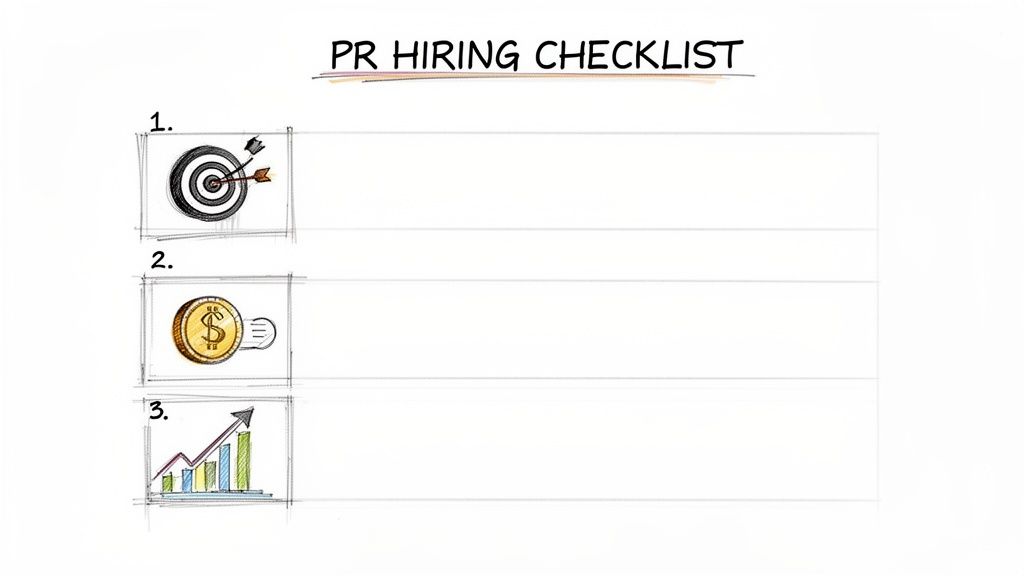
Finding the right PR agency for your startup can feel like searching for a needle in a haystack. I've been there. To cut through the noise, I've distilled everything we've talked about into a simple, step-by-step roadmap to guide your search.
Think of this process less like hiring a vendor and more like bringing on a key strategic partner. Every step is designed to make sure you're aligned on vision, budget, and what winning actually looks like for your startup.
Phase 1: Internal Strategy and Preparation
Before you even think about sending that first email, you need to get your own house in order. Jumping into conversations without clear goals and a solid budget is a recipe for wasted time and frustration. Doing this homework first means you’ll approach agencies with confidence and a clear purpose.
- Define Your Core PR Objectives: What are the top three things you need PR to accomplish in the next six months? Be specific. Are you trying to support a funding announcement, grow your share of voice by 20%, or drive sign-ups for a new product launch? Write them down.
- Set a Realistic Budget: Look at your runway and decide on a monthly retainer you can comfortably commit to for at least six months. This immediately filters out agencies that are way out of your league and keeps conversations productive.
Phase 2: Vetting and Selection
Okay, now that you know what you want and what you can spend, it’s time to find the right people. This stage is all about finding a team with the right experience, industry connections, and a culture that clicks with yours.
- Shortlist 3-5 Niche Agencies: Don't waste time with generalists. Zero in on firms that live and breathe your industry—be it SaaS, fintech, or health tech. Ask them for case studies from startups at a similar stage to yours.
- Conduct Structured Interviews: Prepare a consistent set of questions to ask every single agency. This is the only way to objectively compare their strategic thinking, the experience of the team you'll actually be working with, and the quality of their media relationships.
Final Checkpoint: Before you pop the champagne and sign the contract, do one last check. Make sure the agreement clearly spells out your KPIs, the reporting schedule (is it monthly?), and the names of the people assigned to your account. This simple step protects your investment and kicks off the partnership on the right foot—with total transparency.
Frequently Asked Questions
Jumping into the world of public relations can feel a little daunting for a founder. It’s a real investment of both money and time, so you want to be sure you know what you’re getting into. Let's tackle some of the most common questions we hear from startups thinking about hiring a PR agency.
How Much Does a Startup PR Agency Actually Cost?
For an early-stage startup, a solid boutique PR agency will typically run you a monthly retainer between $5,000 and $15,000. Where you fall in that range really depends on factors like the agency’s location, exactly what they'll be doing for you, and how niche your industry is.
If you’re not quite ready to commit to a monthly retainer, project-based work is another route. A one-off campaign for a big moment, like a product launch or a new funding announcement, usually starts around $10,000. Keep in mind, the larger, more established agencies that cater to well-funded, later-stage companies can easily command retainers of $20,000 and up.
What's the Real Difference Between PR and Marketing?
Here’s a simple way to think about it: marketing pays for attention, while PR earns it. They’re different tools for different jobs.
- Marketing is all about paid channels—think social media ads or Google search ads. The goal is direct and immediate: drive sales and capture leads. It's focused squarely on customer acquisition.
- PR, on the other hand, is about building your reputation through earned credibility. This means getting a journalist to write a story about you in a publication their readers trust. The goal here is to build authority with everyone who matters: investors, potential partners, top-tier talent, and customers.
They really are two sides of the same growth coin. Marketing creates the demand, and PR builds the trusted reputation that makes people want to be a part of what you’re building. The magic happens when they work together.
How Long Until I Start Seeing PR Results?
Patience is a virtue in PR. This is a marathon, not a sprint. While your agency gets to work on day one—crafting your story, building media lists, and starting outreach—it typically takes a good three to six months to see a significant, measurable impact.
Building real relationships with journalists isn't something you can rush. It's about positioning your startup as a go-to source in your field, and that takes time and consistent effort. A great agency will be upfront about this, managing your expectations while showing you the steady progress they're making from the very beginning.
Early victories might look like smaller mentions or connecting with key reporters. Over time, those initial wins build momentum, snowballing into bigger feature stories and a much stronger foothold in your market.
Ready to build your brand’s credibility without the hefty price tag and opaque process of a traditional agency? PressBeat uses AI to land you guaranteed media coverage in high-authority publications. We give you the transparency and results you need to grow. See exactly how it works at https://pressbeat.io.