
A Press Release Example Template That Gets Results
November 10, 2025
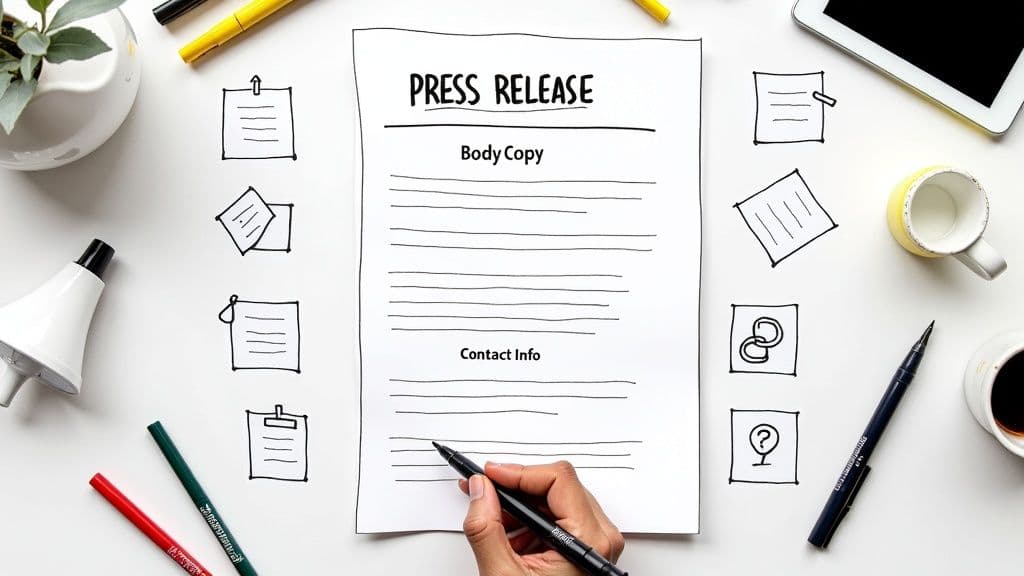
Still looking for a press release example template? You're in the right place. A great press release is so much more than just a news announcement. It's a powerhouse tool for boosting your SEO, building your brand, and making sure your story gets told your way.
Why Press Releases Still Pack a Punch in 2024
Let's get one thing straight: press releases are not dead. Not even close. But how we use them has completely changed. The old-school method of faxing a one-pager to a news desk and crossing your fingers is long gone.
Today, a well-written press release is a dynamic digital asset. It’s less of a one-off announcement and more like a permanent piece of content that works for you long after you hit "publish." When done right, a single release creates a digital footprint that journalists, customers, and Google can find for years.
It’s About More Than Just Media Mentions
The real magic of a modern press release is its versatility. It's not just about trying to land a story in a major publication. A single, well-crafted release can hit multiple marketing goals at once, making it one of the most efficient tools you have.
Here’s what a modern press release actually accomplishes:
- Boosts Your SEO: By weaving in relevant keywords and including valuable backlinks, a press release helps build your website's authority and can give your search rankings a nice lift.
- Engages Your Audience Directly: Once it's online, your release is a shareable piece of content. You can push it out on social media to pull interested readers directly to your site.
- Lets You Control the Narrative: This is your chance to frame the story. It ensures your key messages are clear, consistent, and accurate wherever they appear.
- Builds Instant Credibility: Seeing your company’s name on reputable news sites, even through a syndicated service, gives your brand an immediate stamp of authority and trustworthiness.
The Numbers Don't Lie
This isn't just theory—the data tells a clear story. A solid 68% of businesses see a direct increase in brand visibility from their press releases. This proves they're still a fantastic way to get your name out there.
On top of that, 74% of journalists still prefer getting company news this way, so it remains a critical tool for media relations. And when you optimize your release for search engines, you can increase its online visibility by around 52%, which means more traffic heading back to your website. If you're curious, you can dig deeper into these powerful press release statistics and see how they're shaping modern PR.
To help you get started, here's a quick breakdown of what goes into a press release that gets results.
Anatomy of a Modern Press Release
This table gives you a bird's-eye view of the key components, what they do, and a tip from my own experience for making each one count.
| Component | Core Purpose | Pro-Tip |
|---|---|---|
| Headline | Grab a journalist's attention and clearly state the news. | Be specific and use an active voice. Include a key number or impactful verb. |
| Dateline | Provide the city, state, and date of release. | This adds a layer of professionalism and tells readers where the news originates. |
| Introduction | Summarize the entire story (who, what, where, when, why) in the first paragraph. | Write it as if it’s the only thing someone will read. Get straight to the point. |
| Body Paragraphs | Elaborate on the news, add context, and provide supporting details. | Include quotes from key people to add a human element and credibility. |
| Boilerplate | A short "About Us" section at the end. | Keep it concise and always include a link to your company's homepage. |
| Media Contact | Provide the name, email, and phone number for follow-up questions. | Use a real person's contact info, not a generic "info@" address. |
Think of these as the building blocks. Get each one right, and you'll have a solid foundation for a successful release.
The goal is no longer just to get one big media hit. It’s about creating a discoverable, permanent asset that strengthens your brand's digital presence over time.
Ultimately, learning to write a great press release is a non-negotiable skill for anyone serious about building a strong brand in today's world.
Writing a Headline That Demands to Be Read
Your headline is the single most critical part of your press release. I can't stress this enough. Journalists wade through hundreds of pitches every day, and a bland headline is a one-way ticket to the trash folder. This isn't about clickbait; it's about summarizing your entire story's value in roughly 100 characters.
Think of your headline as the subject line for the most important email you'll send this quarter. It needs to be direct, factual, and interesting enough to make a reporter pause their endless scrolling. Generic announcements like "Company X Launches New Initiative" are dead on arrival. You have to focus on the impact.
Crafting a Magnetic Hook
The secret sauce of a great headline is the hook. What’s the one thing that makes your news genuinely interesting to someone outside your company? Is it a jaw-dropping statistic, a game-changing partnership, or a clever solution to a common problem? That’s your hook. Find it and lead with it.
Let's walk through a real-world example. A generic headline might be:
- TechSavvy Inc. Announces New Software Update
It’s factual, but it’s boring. It tells me nothing. Let's try again, this time with a proper hook:
- TechSavvy Inc. Launches AI Software That Cuts Small Business Accounting Time by 40%
See the difference? This version is specific, it dangles a quantifiable benefit (40%), and it uses an active verb ("Launches"). A reporter immediately understands why their audience of small business owners would care. Getting a feel for different press release headline examples is a great way to spark ideas for your own.
The Supporting Cast: The Sub-Headline and Dateline
Don't sleep on the sub-headline. This is your chance to add that extra bit of context that just wouldn't fit in the main headline. It’s a single sentence that builds on your hook and adds clarity.
A great sub-headline often explains the "how" or "why" of the main announcement. It gives journalists an extra nugget of information that makes the story feel more complete and easier for them to pitch to an editor.
Right after your headlines comes the dateline. This small detail grounds your story in a specific time and place, lending it credibility. It’s a standard, non-negotiable element of the press release format.
- Example: SAN FRANCISCO, CA – October 26, 2024 –
Including this shows journalists you know the rules of the game. It’s a simple signal that you’re a professional.
Remember, PR is all about what journalists want. Research shows that 67% of journalists prefer customized story angles that fit their beat, which all starts with a targeted headline. On top of that, pitches under 200 words get a much better response. This just proves that powerful, concise communication is everything.
Structuring a Clear and Compelling Body
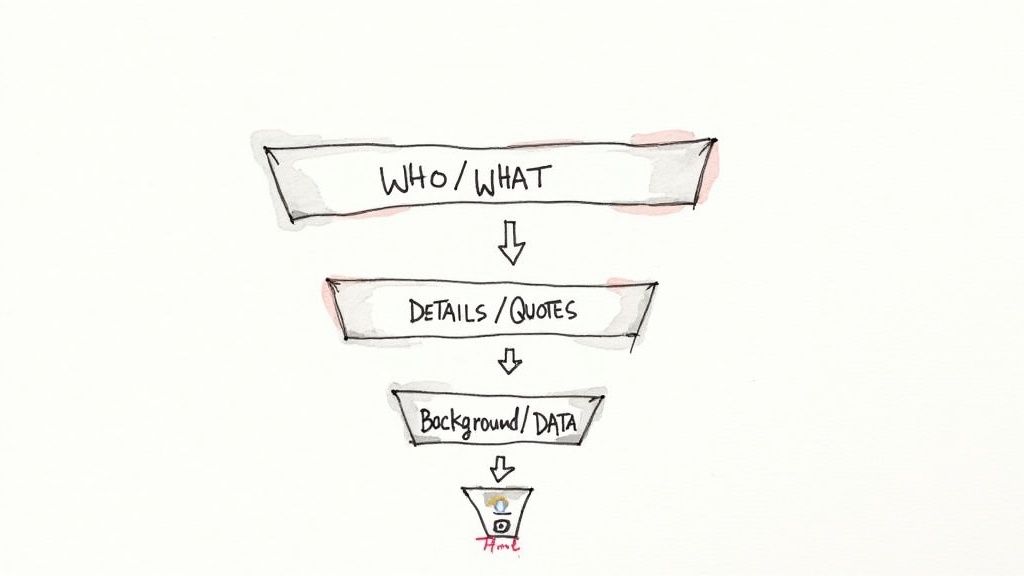
So, your headline did its job and hooked the journalist. Now what? The body of your press release needs to deliver on that promise, and fast. This isn't the time for a slow, meandering story. You have to get straight to the point. The gold standard for this is the inverted pyramid structure.
This classic journalistic model is simple: put the most important information right at the top. Your very first paragraph should be a tight, self-contained summary of the entire announcement. It needs to answer the essential "Five Ws" (and one H).
- Who is this about? (Your company)
- What is the news? (The launch, event, or milestone)
- When is it happening? (The date)
- Where is it taking place? (Location, if relevant)
- Why does it matter? (The impact or benefit)
- How is it happening? (The mechanism or key details)
Think of it this way: a busy journalist should be able to write a complete, albeit short, news brief using only your first paragraph. It’s the whole story in miniature, ensuring they get the main point even if they stop reading right there.
Building Out the Narrative
Once you’ve landed that powerful opening, the next few paragraphs are all about adding color and context. This is your chance to elaborate on the details you've already introduced. A great next step is to expand on the "why"—the real significance of your news.
For example, if your opening announced a new software launch, the second paragraph could dive into the specific problem it solves for customers or how it challenges the status quo in the market. Keep your paragraphs short and punchy, with each one building on the last.
Pro Tip: Your main goal is to make a journalist's job easier. Organize your information so they can quickly find the details they need, copy-paste quotes, and grasp the story's value without having to hunt for it.
A well-placed quote is a perfect way to break up the text and add a human touch. It gives your announcement a genuine voice and provides reporters with a ready-made soundbite.
Weaving in Credible Quotes
A quote from a key figure—your CEO, a project lead, or even a happy customer—adds instant personality and authority. The trick is to avoid bland, corporate-speak lines like, "We are thrilled to announce..." Those are filler. Instead, use the quote to offer a unique perspective that isn't stated elsewhere in the release.
Check out the difference.
Good Quote Example: "We saw that small businesses were spending over 10 hours a month on manual invoicing," said Jane Doe, CEO of FinTech Innovators. "Our new platform automates that entire process, giving founders back a full day of work each month to focus on growth."
See how that works? It provides a specific pain point and a measurable benefit, which is far more useful to a journalist than a generic statement of excitement. If you're looking for more guidance on how all the pieces fit together, our guide on what a press release looks like offers a great overview of the final format.
Finally, back up your claims with hard data whenever you can. Numbers scream credibility. Don't just say your new service is "popular"—state that it "acquired 10,000 new users in its first month." That simple change transforms a weak claim into a newsworthy fact.
Adding the Final Polish: Your Boilerplate and Contact Info
You've done the hard work: you’ve written a killer headline and a body that tells a compelling story. Now it's time to stick the landing. The last two pieces of the puzzle—your boilerplate and media contact info—are what separate a professional release from an amateur one.
Don't treat these final sections as an afterthought. They're your chance to give journalists the essential context they need and make it incredibly easy for them to get in touch. Mess this up, and all your previous effort could go to waste.
Nailing Your Boilerplate
Think of your boilerplate as your company's official elevator pitch, tucked neatly at the end of your press release. It’s a short, standardized "About Us" paragraph that instantly tells a busy journalist who you are, what you do, and why you’re relevant.
The key here is consistency and clarity. This isn't the spot for buzzwords or a long-winded origin story. Reporters just need a factual snapshot they can copy and paste for background. Keep it tight—three or four sentences is all you need.
Here’s a simple formula that works every time:
- Who you are: Start with your company name and core mission.
- Example: "InnovateTech is a SaaS company dedicated to helping small businesses streamline their operations."
- What you do: Mention your key product or unique value proposition.
- Example: "Its flagship platform, AutoTask, automates workflow management for over 10,000 users worldwide."
- Where to learn more: End with a call to action that directs them to your website.
- Example: "For more information, visit www.innovatetech.com."
Pro Tip: Your boilerplate should be the exact same on every single press release you send. This consistency builds brand recognition and ensures reporters always have the right information on file.
Getting this section just right can make a real difference. If you want to dive deeper, check out our guide on what a boilerplate is in a press release for more advanced tips.
Making it Painless for Journalists to Reach You
Right after the boilerplate, you need a Media Contact section. This part is purely functional. The goal is to give a reporter a direct line to a real, live human who can answer their questions on a tight deadline.
Nothing says "we don't care about the press" like a generic "info@" email address. It’s a massive red flag. Instead, provide everything they need to connect without any friction.
Make sure to include these key details:
- Name: The full name of your go-to media person.
- Title: Their role (e.g., PR Manager, Communications Director).
- Email: Their direct work email address.
- Phone Number: A direct line or cell number is always best.
- Website: A link to your press page or online media kit.
By providing clear, direct contact details, you show respect for a journalist's time and position your company as a credible, helpful source. It’s the final, crucial step in building a press release that gets results.
Getting Your Press Release Seen with Smart SEO
So you've crafted the perfect announcement. That's a huge step, but it's only half the battle. If your press release lands in an empty room, did it even make a sound?
The old "spray and pray" email blasts just don't cut it anymore. Today, getting noticed is all about smart targeting and search engine optimization.
Think of your press release as more than just a one-day media pitch. It's a permanent digital asset. A well-optimized release can keep attracting traffic and building your brand's authority for years, long after the initial buzz has faded.
This isn't just a small shift; it's a fundamental change in how we approach PR. Modern strategies are all about measurable results, moving away from mass distribution toward highly segmented campaigns. Thanks to search technology, your announcement can live online indefinitely, ready to be discovered. You can dig deeper into these future trends in press release distribution to get ahead of the game.
Optimizing Your Release For Search Engines
To get found, you have to think like a search engine. The first step is figuring out which keywords your target audience—and, just as importantly, journalists—are actually searching for.
Don't just cram them in randomly. Weave your most important keywords naturally into your headline, your sub-headline, and definitely within the first paragraph. That's where they'll have the biggest impact.
For instance, if you're launching a new tool, a specific keyword like "AI-powered scheduling app" is far more effective than something generic.
Beyond keywords, links are your secret weapon. Instead of using vague phrases, embed your links in descriptive anchor text that gives Google context about the destination page.
- Weak Link: Click here
- Strong Link: Learn more about our new AI-powered scheduling app
A well-placed backlink from a news site that picks up your story is SEO gold. It's a massive signal to search engines that your website is a credible authority, which can give your entire domain a serious boost.
Press Release SEO Before and After
Updating your press release for modern SEO doesn't have to be complicated. It's about shifting from old-school habits to smarter, search-friendly practices. Here’s a quick-glance table showing how to make those upgrades.
| Element | Traditional Approach | Modern SEO-Optimized Approach |
|---|---|---|
| Headline | Often creative but vague. | Includes a primary keyword naturally. |
| Keywords | An afterthought or "stuffed" in. | Researched and integrated strategically. |
| Links | "Click here" or naked URLs. | Descriptive, keyword-rich anchor text. |
| Content | Focused only on the announcement. | Includes quotes, data, and evergreen info. |
| Multimedia | Low-res images, if any. | High-quality, optimized images with alt text. |
| Distribution | Mass email blast to a large list. | Targeted outreach to relevant journalists. |
By making these small but crucial adjustments, you treat your press release not just as a news item, but as a valuable piece of content that can perform for you over the long term.
From Mass Blasting To Targeted Outreach
I’ll say it again: the days of blasting your release to a generic list of thousands of journalists are over. True success comes from personalization and relevance. The goal isn't to reach everyone; it's to reach the right people.
This means you have to do a little homework. Find the specific writers and publications that cover your industry. Read their recent work to understand their beat and what their audience cares about.
When you finally reach out, mention something specific you liked about their work. It shows you're not just another spammer. A personalized pitch is 10 times more likely to get a response than a generic one.
Before you hit send, this infographic covers the final checks every professional press release needs to pass.
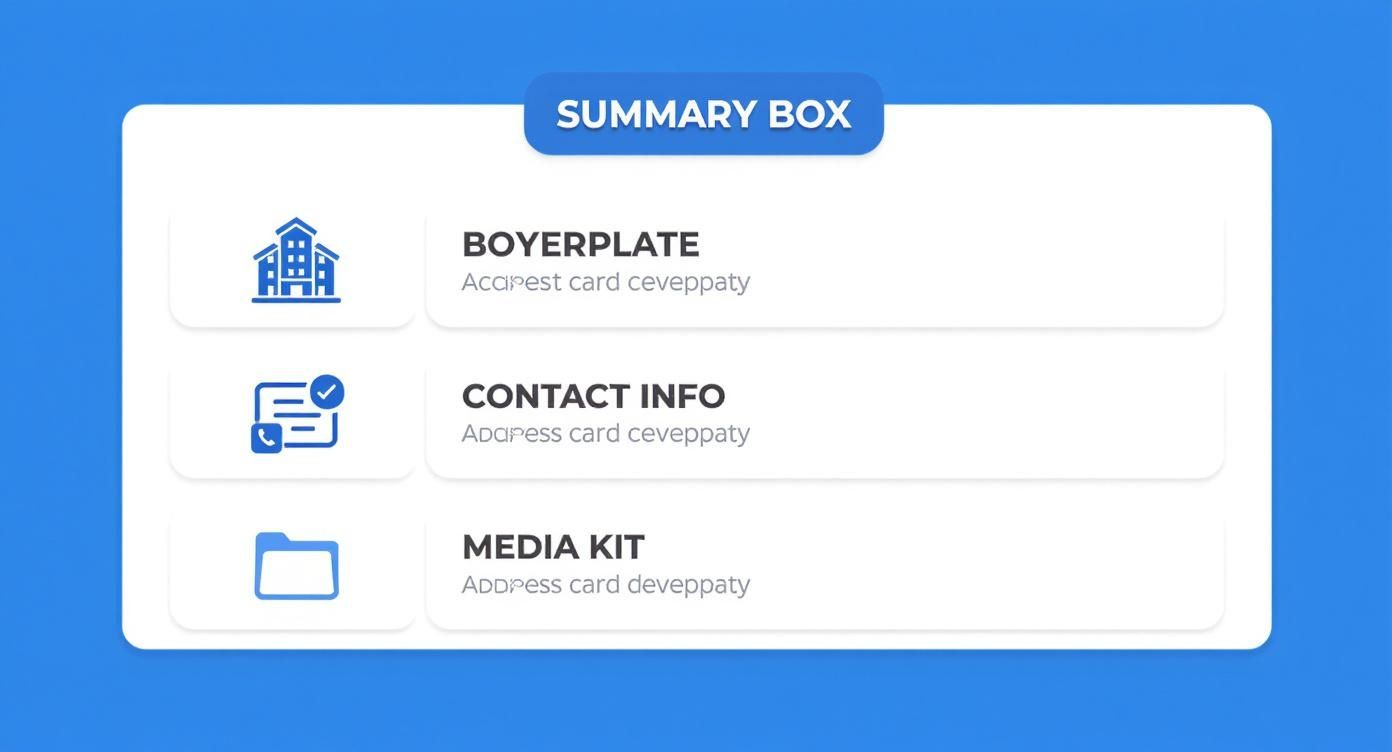
These final touches—a clear boilerplate, direct contact info, and an easy-to-find media kit—make a journalist's job so much easier. That alone can dramatically increase your chances of getting coverage.
Got Questions? Let's Talk Press Release Best Practices
Even with a great template in hand, you're bound to run into a few questions. That's totally normal. Getting an announcement perfect means sweating the details. Let's walk through some of the most common sticking points I see so you can get your release out the door with confidence.
How Long Should a Press Release Be?
Keep it tight. The sweet spot is almost always between 300 and 500 words.
That gives you just enough room to nail the essentials—the who, what, when, where, and why—without losing your reader's attention. You can fit in a great quote and your company boilerplate, too. If you’re pushing past 500 words, you’re probably including details that belong in your media kit. A journalist is just scanning for the hook, not reading a novel.
Think of your press release as the appetizer, not the main course. Its job is to make a reporter hungry for the full story, which they can get from you or your media kit.
How Many Links Are Too Many?
When it comes to links, less is definitely more. I stick to just two or three super-relevant links in the entire document.
If you cram in too many, it starts to look like spam, and you risk getting flagged by email filters or press release distribution services. It just looks unprofessional.
Here’s a simple strategy that works every time:
- One link in the body: Point this to the most important destination, like the new product page or an event registration form.
- One link in your boilerplate: This one should always go straight to your company’s homepage.
This gives reporters a clear path to more information without cluttering the page or looking desperate for clicks.
When Is the Best Time to Hit 'Send'?
Timing can make or break your outreach. Sending your release at the right moment dramatically improves your chances of getting noticed. The golden window, based on years of experience, is mid-week and mid-morning.
Tuesdays, Wednesdays, and Thursdays are your best bet. Mondays are a chaotic mess of catching up from the weekend, and by Friday, everyone’s already thinking about their weekend plans. Aim to send it between 9:00 AM and 11:00 AM in the journalist's local time zone. That’s when they’re actively looking for stories to cover that day.
Can I Send a Release for Something That Isn't a Huge Deal?
Absolutely. You just have to find the right story within your announcement. You don’t need to be launching the next iPhone to write a press release. The trick is to find an angle that offers real value to a reporter's audience.
Newsworthy stories are often more subtle than you think. Consider these angles:
- A new, strategic partnership with a well-known company.
- The release of an original, data-heavy report on your industry.
- Hiring a noteworthy executive who brings a lot of credibility.
- Launching a community initiative or social impact project.
It's all about how you frame it. It’s not, "We hired a new CMO." It’s, "Marketing Veteran Joins XYZ to Spearhead Global Expansion." Before you write a single word, ask yourself: "Why would anyone outside of my company actually care about this?"
Ready to stop guessing and start getting noticed? PressBeat uses AI to connect your story with the right journalists, automating your outreach and securing the high-impact coverage your business deserves. Build your press release and launch your campaign today at https://pressbeat.io.