
A Modern Guide to Public Relation Campaigns
December 1, 2025

A public relations campaign is much more than just firing off a press release and hoping for the best. It's a calculated, strategic effort to shape how the public sees your brand and to earn positive media coverage. Think of it as telling your story, but in a way that gets the right people to listen and care, whether you're launching a new product or cementing your brand's credibility.
Building Your PR Campaign Foundation
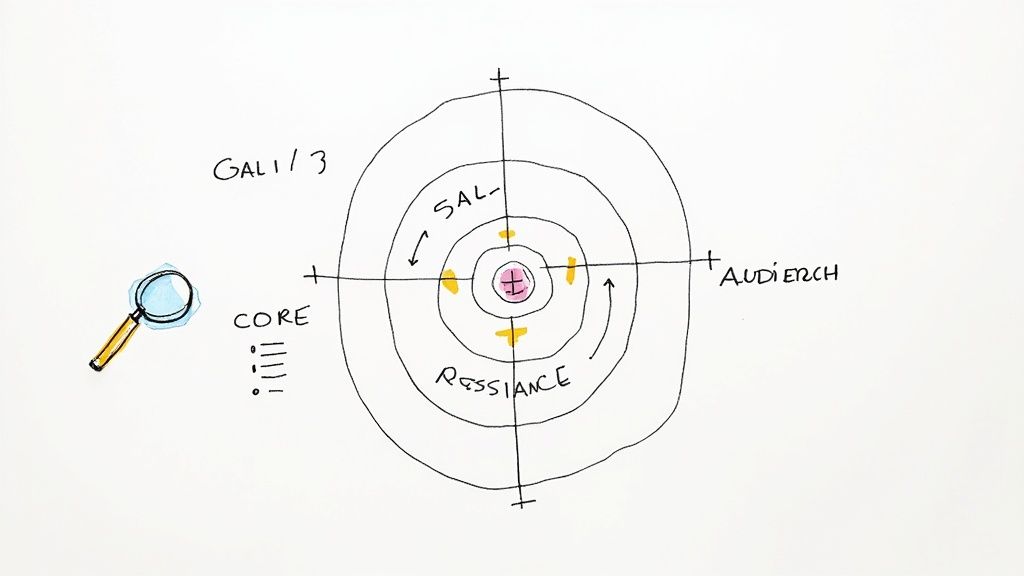
Before you even think about writing a pitch, you need to lay the groundwork. This is the crucial, often-overlooked phase where you build the strategic foundation for your entire campaign. Getting this right is what separates a PR push that drives real business results from one that just adds to the noise.
The stakes are high. The global public relations market is on track to hit $132.52 billion by 2029, a number that proves just how vital strategic communication has become. A deep dive into this trend can be found in the full PR market analysis on Research and Markets.
Without a clear plan, your efforts will be scattered and nearly impossible to measure. This foundational work ensures every email, every piece of content, and every media interaction has a purpose. It's how you turn PR from a reactive chore into a proactive driver of growth.
Define Your Campaign Objectives
Let's be blunt: "get more press" is not a real goal. It's a wish. Your objectives need to be specific, measurable, and tied directly to what the business is trying to achieve. Are you aiming to drive sign-ups for your new SaaS platform? Do you need to get on investors' radar for your next funding round? Or is the goal to establish your CEO as the undeniable expert in your niche?
Each of these objectives demands a completely different playbook. An investor-focused campaign will have you targeting financial journalists at places like TechCrunch and Bloomberg. A user acquisition campaign, on the other hand, means you’ll be chasing tech blogs and niche industry publications your potential customers read every day. If you want to see how this looks in practice, check out this sample PR strategy that breaks down the process.
To help translate your goals into something tangible, it's useful to connect them directly to business metrics.
Connecting PR Goals to Business Metrics
This table shows how typical PR goals for tech startups can be measured with specific KPIs.
| Campaign Goal | Primary KPIs | Example for a Tech Startup |
|---|---|---|
| Increase Brand Awareness | Share of Voice (SOV), Media Mentions, Website Traffic | Tracking how often your AI-powered analytics tool is mentioned compared to competitors in top-tier tech publications. |
| Generate Sales Leads | Referral Traffic, Demo Requests, Conversion Rates from Media Placements | A feature in a popular marketing blog drives 500 new visitors, resulting in 30 demo requests for your martech platform. |
| Establish Thought Leadership | Speaking Engagements, Quoted Mentions, High-Authority Backlinks | Your CTO is quoted as an expert in a WIRED article on quantum computing, leading to two keynote invitations. |
| Support Fundraising Efforts | Investor Meetings from Media, Coverage in Financial Press | An article in Forbes about your pre-seed round leads to inbound interest from three venture capital firms. |
Ultimately, tying your PR activities to concrete business outcomes is what proves its value to the rest of the company.
Pinpoint Your Target Audience
You can't tell a compelling story if you don't know who you're talking to. Go deeper than basic demographics and build out a detailed persona of your ideal customer or user. The key is to understand their world—what they read, what they listen to, and what keeps them up at night.
Ask yourself these questions to get a clearer picture:
- What publications do they actually read? Be specific. Is it HackerNoon, a niche Substack, or a trade journal?
- Which podcasts are on their commute playlist? Knowing the key voices in their industry can unlock powerful new channels.
- Who are the influential figures they follow on social media? This helps you map out the key opinion leaders in your space.
- What problems are they desperately trying to solve? Your story needs to connect with a challenge they're facing right now.
A deep understanding of your audience allows you to tailor your story in a way that feels authentic and relevant, dramatically increasing the chances of it being picked up by journalists and shared by your target community.
Craft Your Core Message
Once you know your goals and your audience, it's time to craft your core message. This is the heart of your campaign—the single, powerful idea you want to communicate. It's the "why anyone should care" behind your news. A great message is concise, compelling, and consistent across every channel.
It’s not a list of features. It’s the emotional and logical hook that grabs people.
For a tech startup, a strong core message might focus on how your technology solves a frustrating, industry-wide problem in a completely new way. It should be simple enough to remember and repeat, becoming the narrative backbone for every press release, pitch, and interview you do. When people talk about your company, this message is the story you want them to tell.
Developing Your Story and Media Assets
Alright, you've got your strategy locked in. Now comes the fun part: turning that strategy into the actual stuff you'll send to journalists. This is where your campaign's story stops being an internal concept and becomes a tangible package a reporter can sink their teeth into.
Let's be real—a great idea isn't enough. You have to present it in a way that makes a reporter's job easier, not harder. Effective public relation campaigns are built on a foundation of high-quality, professional assets. These materials do the talking for you, establishing credibility and giving context long before you ever land an interview. Think of them as your digital handshake.
Your mission here is to anticipate a journalist’s every need and have the answer ready before they even ask. A well-organized media kit is your secret weapon, serving as a one-stop shop for information and visuals. Get this right, and you’ll remove friction and seriously boost your chances of getting noticed.
Assembling Your Essential Media Kit
A media kit is the home base for your campaign. It needs to be dead simple to access, whether that’s a clean page on your website or a neatly organized cloud folder (think Google Drive or Dropbox). Journalists are busy people; they value clarity and convenience over everything else. No one wants to download a massive, clunky zip file.
To be truly effective, your kit should include a few non-negotiable items:
- Company Backgrounder: A punchy, one-page document that tells your company's story. What’s your mission? What problem do you solve? Cut the jargon and focus on the human narrative.
- Executive Bios and Headshots: You’ll need professional bios and high-resolution headshots for your key founders or executives. These should highlight their expertise and why they're the right people to be talking about this topic.
- High-Resolution Visuals: This is crucial. Include your company logo in multiple formats (PNG, SVG), product screenshots, and maybe even a few professional photos of your team or office. Make sure everything is print-quality and easy to download.
- Customer Testimonials or Case Studies: Nothing beats third-party validation. Including a few powerful quotes or a short case study shows a journalist that your product makes a real-world impact.
A polished and well-organized media kit signals that you're a pro. It tells journalists you respect their time and know what they need to build a story, which makes them far more likely to work with you.
This collection of assets isn't just busywork; it's the backbone of your outreach. It ensures your message is consistent and gives journalists everything they need to tell your story accurately.
Crafting a Press Release That Gets Read
The press release is a classic PR tool, but let's face it: most of them are ignored. Thousands are blasted out every single day, and the delete key gets a real workout. To make yours stand out, it needs a genuinely newsworthy angle.
A simple product update or a new hire? That’s rarely news on its own. The trick is to connect your announcement to something bigger—a surprising industry trend, a compelling piece of data you've uncovered, or a significant impact on your customers. Before you write a single word, ask yourself: Why would a total stranger care about this? If the answer isn't immediately obvious, you don't have a story yet. For a deeper look at this, our guide on what makes a story newsworthy is a great resource.
Your headline is everything. It's the first—and maybe only—thing a journalist will read. It has to be compelling, clear, and summarize the entire story in under 15 words. A reporter skims hundreds of headlines a day; you have about three seconds to grab their attention.
A solid press release generally follows this flow:
- Compelling Headline: An active, intriguing summary of what’s new.
- Dateline and Intro: Get right to the point. The first paragraph must cover the who, what, where, when, and why.
- Body Paragraphs: This is where you add color with supporting details, context, and a strong quote from a founder or key executive. Use data to back up your claims.
- Boilerplate: Your standard "About Us" paragraph. Keep it short and to the point.
- Media Contact: Make it incredibly easy for them to get in touch. Include a name, email, and phone number.
When you package your story and assets this thoughtfully, you're no longer just shouting an announcement into the void. You're providing a valuable resource for the media, and that preparation is what separates successful public relation campaigns from the ones that get ignored.
Executing a Smarter Media Outreach Plan
Alright, this is where all that careful planning gets put into action. A successful media outreach campaign isn't about blasting a generic email to hundreds of journalists and just hoping something sticks. It’s a targeted, almost surgical process that values quality over sheer quantity. The real wins in public relations campaigns come from connecting with the right people, with the right message, at exactly the right time.
And make no mistake, the competition is fierce. As of 2025, the U.S. has about five PR professionals for every one journalist. That statistic alone shows you just how hard it is to cut through the noise. It’s why a smart, personalized approach isn’t just nice to have—it’s essential. You can dive deeper into the numbers and get a sense of the current state of PR on PR Lab.
So, let's officially ditch the old "spray-and-pray" method. The goal here is to build genuine connections that can help your brand long after this one campaign is over.
Building Your Targeted Media List
Your media list is the absolute foundation of your outreach. A well-curated list is your most valuable asset, making sure your story lands in front of the reporters, bloggers, and influencers who actually cover your world and speak to your audience.
Start by figuring out which publications your ideal customers are actually reading. Use tools like Google News, dig through social media searches, and even run a competitor backlink analysis to see who’s writing about similar topics or companies. You're looking for reporters whose beat aligns perfectly with your story.
Here’s a practical way to structure your media list so it actually works for you:
- Journalist’s Full Name: This is non-negotiable for personalization.
- Publication: The media outlet they write for.
- Specific Beat/Area of Focus: Get specific, like "AI in healthcare," "B2B SaaS," or "consumer fintech."
- Recent Relevant Article: Grab a link to a recent story they wrote. This is pure gold for personalizing your pitch.
- Contact Information: Email is king, but a social media handle (like X/Twitter) can be a great secondary touchpoint.
The point of this exercise is to build a highly focused list of 20-30 key contacts, not a generic database with hundreds of names. Every single person on that list should represent a real, tangible opportunity.
Crafting a Pitch That Earns a Reply
Journalists are drowning in pitches—they get dozens, if not hundreds, every single day. Yours has just a few seconds to make an impression. The secret is to be concise, relevant, and genuinely helpful. A great pitch isn't really about you; it's about giving them a valuable story idea they can run with.
Keep your email incredibly short. Aim for under 150 words as a solid rule of thumb. Structure it so it’s easy to scan and digest. Remember, you're not just sending an email; you're trying to start a conversation.
Your pitch has to immediately answer one question: Why should this specific journalist care about this story right now? If the answer isn't screamingly obvious in the first two sentences, your email is probably already in the trash.
Anatomy of a Successful Pitch
Let’s break down what a pitch that actually gets read looks like.
| Pitch Component | Purpose | Best Practice Example |
|---|---|---|
| Subject Line | Grab their attention and signal relevance instantly. | "Story Idea: New Data Shows Remote Work Burnout is Spiking" |
| Personalized Opener | Show you’ve actually done your homework. | "Hi Jane, I really enjoyed your recent article in Tech Today on the future of work." |
| The Hook | Get straight to the point. What's the story? | "My company just released a study of 5,000 tech workers that found a 40% increase in reported burnout." |
| The Offer | State clearly what you can give them. | "I can share the full data report and connect you with our CEO, an expert on workplace psychology, for a comment." |
| Call to Action | Make it ridiculously easy for them to say yes. | "Would you be interested in seeing the exclusive data?" |
This structure shows you respect the journalist's time and positions you as a helpful resource, not just another person with their hand out.
The Art of the Follow-Up
So you sent your pitch and... crickets. Don't panic. Silence doesn't always mean "no." More often than not, it just means the journalist is swamped. A polite, well-timed follow-up can make all the difference.
Wait at least 3-5 business days before you even think about following up. When you do, keep it even shorter than your first email. Just reply to your original message and add a quick, one-sentence nudge.
Something like, "Just wanted to gently bump this in your inbox in case it’s of interest," works perfectly.
Whatever you do, never follow up more than twice. If you still don't get a response, it’s time to let it go and move on. Pestering a journalist is the fastest way to burn a bridge and get your email address blacklisted. A respectful approach will be remembered, even if they pass on this story, and it sets you up for a better relationship down the road.
Using Modern Tools and AI for PR
The days of drowning in spreadsheets to build media lists and cold-calling newsrooms are, thankfully, behind us. Modern public relation campaigns run on smart technology that handles the grunt work, delivers sharp insights, and gets your story heard in ways we could only dream of a decade ago.
Think of these tools not as a replacement for the human touch in PR, but as a way to free yourself up for what really moves the needle: crafting a killer strategy, telling a compelling story, and building real relationships with the media. From AI platforms to slick analytics, this tech is no longer a nice-to-have; it's essential for running an efficient and impactful campaign.
The Rise of AI in Public Relations
Artificial intelligence has officially moved from a buzzword to a core part of the PR pro's toolkit. It’s brilliant at chewing through the data-heavy tasks that used to eat up our days, letting teams work faster and with more precision than ever before.
This isn't some far-off future, either. The shift is happening now. A huge trend is the integration of generative AI into PR workflows. In fact, about 37% of communications professionals are already using AI to help write or fine-tune their content—that’s a 9 percentage point jump from just last year. If you want to dive deeper, Cision's comprehensive report has some fantastic insights on AI's growing role in PR.
So, how does this actually help? Here are a few real-world examples:
- Smarter Media List Building: Forget manually digging for journalists. AI platforms can scan millions of articles and social profiles to pinpoint the perfect contacts for your story based on what they actually write about.
- Personalized Pitching at Scale: AI can help you draft highly personalized emails without spending hours on research. It can pull a journalist's recent articles or tweets to create an opening that shows you've done your homework.
- Content Creation and Polish: Need a starting point for a press release or some punchy headline ideas? AI is a fantastic creative partner. We actually walk through how to do this in our guide on using an AI press release generator.
Smarter Media Monitoring and Analytics
You can’t improve what you don’t measure. Gone are the days of setting up a thousand Google Alerts. Modern media monitoring tools give you real-time notifications whenever your brand, competitors, or key industry topics pop up online.
But it’s more than just a simple ping. These platforms offer sophisticated sentiment analysis, so you know not just that people are talking about you, but how they feel. This data is gold for understanding public perception and getting ahead of any negative stories before they gain traction.
By tracking mentions and sentiment as they happen, you get a clear, data-backed picture of how your campaign is landing. It allows you to make smart, quick adjustments based on what the market is telling you, right now.
This dashboard in PressBeat is a perfect example of how you can monitor campaign progress in real time.
It pulls all your key metrics into one place, giving you a transparent look at your outreach and results.
Choosing Your PR Tech Stack
Building a solid PR tech stack doesn't need to be overwhelming. The idea is to pick a few core tools that work well together and simplify your entire workflow.
For most tech companies, a great starting point includes:
- A Media Database and Outreach Platform: This is your mission control for finding reporters, organizing lists, and sending out pitches. Platforms like PressBeat wrap all of this into one system, using AI to automate the most time-consuming parts.
- A Media Monitoring Tool: You’ll need this to keep an eye on brand mentions, see what competitors are up to, and stay on top of industry trends across news, blogs, and social media.
- An Analytics Dashboard: This brings all your KPIs together—website traffic from media hits, backlink quality, share of voice—so you can create reports that clearly show the ROI of your public relation campaigns.
As you look at different ways to bring AI into your PR work, you might find some good ideas in this list of the Top 10 AI Brand Visibility Tools.
Ultimately, the best tools come down to your specific goals and budget. The main thing is to embrace technology as a powerful partner—one that helps you work smarter, faster, and with way more impact.
Measuring Real Campaign Impact and ROI
So, your pitches landed, and the articles are live. Now for the million-dollar question: did it actually work? Measuring the success of your public relation campaigns isn't about collecting a folder of links. It’s about proving that all that effort actually moved the needle on your business goals.
This is where you tie everything back to the objectives you set from day one. Your job is to demonstrate real value, not just report on activity. Forget the simple list of media mentions; you need to craft a story that shows how your press coverage led to tangible outcomes.
Moving Beyond Vanity Metrics
Impressions—the massive, ego-boosting number of potential eyeballs on your story—are the ultimate vanity metric. It’s a nice figure for a slide, but it tells you nothing about whether the right people saw your message or if they did anything about it. To get to the heart of ROI, you have to dig deeper.
Here’s a breakdown of the KPIs that actually matter in modern PR.
Essential PR Campaign Metrics
To truly gauge the effectiveness of your efforts, focus on metrics that connect directly to business outcomes. This table outlines the most critical KPIs to track.
| Metric | What It Measures | Why It Matters |
|---|---|---|
| Share of Voice (SOV) | Your brand's presence in the industry conversation compared to competitors. | Shows if you're becoming a recognized authority and gaining ground on the competition. |
| Referral Traffic | The number of website visitors who came directly from a media placement. | A direct, measurable link between a specific article and potential customer interest. |
| Backlink Quality | The authority (e.g., Domain Rating) of publications linking back to your site. | High-quality backlinks (think DR 70+) are SEO gold, boosting your organic search rankings. |
| Sentiment Analysis | The overall tone (positive, neutral, negative) of your media coverage. | A clear indicator of brand reputation and public perception. Positive sentiment builds trust. |
These metrics shift the conversation from "how much noise did we make?" to "what impact did we create?"
The most powerful PR reports don't just showcase wins; they tell a story backed by data. They prove that your campaign didn't just generate noise—it created momentum, built authority, and drove qualified traffic.
Building a Comprehensive PR Report
Your campaign report is the final chapter, the deliverable that communicates your success to leadership and stakeholders. Make it clear, concise, and visually engaging. The goal is to walk them through your initial objectives, what you did, and most importantly, what it all meant. If you're new to this, it's worth learning how to calculate marketing ROI that proves value using proven frameworks.
The right tools are essential for gathering this data. Modern PR tech stacks are built on three pillars: content automation, media monitoring, and deep analytics.

These functions work together to help you not only execute a campaign but also pull the numbers you need to prove its worth.
Structuring Your Success Story
A great report isn't a data dump. It’s a compelling narrative that connects your PR activities to real business impact.
Here’s a simple structure I’ve found works every time:
- The Executive Summary: Lead with the good stuff. What were the top three wins? Give a snapshot of the results right up front so busy execs get the point immediately.
- A Quick Goal Recap: Remind everyone what you set out to do. This reframes the results around strategy, not luck.
- The Coverage Hall of Fame: This is where you show off your best placements. Don't just list them—include screenshots, pull quotes, and explain why each one was a big deal. Was it a top-tier outlet? Did it include a quote from your CEO?
- Performance Metrics Dashboard: Present your data visually. Use charts and graphs to illustrate referral traffic, backlink growth, and Share of Voice. Make the data easy to understand at a glance.
- Lessons Learned & What's Next: What worked, and what could be better? Pull insights from the data to inform your next campaign. This demonstrates strategic thinking and a drive for constant improvement.
By focusing on these deeper metrics and telling a clear, data-driven story, you’ll do more than just report on your work—you'll prove the undeniable business value of your public relations efforts.
Answering Your Biggest PR Campaign Questions
Even with a solid plan, your first few PR campaigns can feel like a shot in the dark. It's totally normal to have questions. Getting clear answers upfront can be the difference between moving forward with confidence and making a costly mistake. Let’s clear up a few of the most common things that trip up startups and tech founders.
Think of this as a reality check. From understanding how long things actually take to figuring out what journalists even consider "news," these insights will help you sidestep the usual traps and give your campaign a real fighting chance.
How Long Until We See Results?
This is the question on everyone's mind. While a huge announcement might get you a hit within 24 to 48 hours, that's the exception, not the rule. Building real, lasting media presence is a marathon, not a sprint. The truth is, PR success is measured over months, not days.
For a consistent campaign designed to build your brand and keep you in the conversation, you should really start looking for meaningful results in about three to six months.
Early on, you have to look for the leading indicators—the small signs that things are working. Positive replies from journalists, a mention in a niche blog, or a jump in social media shares are all proof you're on the right path, long before a big feature story comes out.
These little wins tell you that your message is hitting home and you're talking to the right people. They're the foundation for the bigger coverage you're aiming for.
What Is the Biggest Startup PR Mistake?
By far, the most common (and damaging) mistake is treating your product launch like it’s front-page news. Journalists get dozens of "we launched a new product" emails every single day. Unless it solves a massive problem in a completely new way, is backed by a huge funding round, or has a major name brand attached as a partner, it’s just not a story on its own.
A great pitch needs a real hook that goes beyond your features list. You have to think bigger.
- Got compelling data? If you've surveyed your users and uncovered a surprising trend, that’s a story.
- Have a big-name customer? Showcasing how a well-known client got incredible results with your product is a story.
- Hold a contrarian view? If your founder has a bold, counterintuitive take on a hot-button issue in your industry, that’s a story.
Without a genuine narrative, your email is just another piece of noise in an already overflowing inbox. Your product is the context for the story, not the headline.
How Can We Run a Campaign on a Tight Budget?
Good PR doesn't have to cost a fortune. If you're working with a lean budget, you just have to trade money for smart, focused effort. Your time and the relationships you build are your most valuable assets here.
Start small. Focus all your energy on building real connections with a handful of the most important journalists in your niche. Get to know their work and engage with them thoughtfully on social media long before you even think about sending a pitch.
Here are a few powerful, low-cost tactics that actually work:
- Use Free Tools: Services like HARO (Help a Reporter Out) are fantastic for providing expert quotes and snagging easy media mentions.
- Create One Amazing Asset: Instead of trying to do everything, build a single, data-packed report or a super-comprehensive guide and then promote the heck out of it. Make it the centerpiece of your campaign.
- Offer Expert Commentary: Position your founder as the go-to expert for insights. You can also offer to write bylined articles (guest posts) for relevant publications.
These strategies build credibility and get you coverage without the massive price tag of a big agency campaign. It’s proof that being smart can easily beat having a big budget.
Ready to get your story in front of the right audience without the guesswork? PressBeat uses AI to connect you with top-tier journalists and guarantees media coverage. See how PressBeat can automate your PR success.