
Thought Leadership Content Strategy: Elevate Your Tech Startup
December 27, 2025

Let's be honest—simply having a great product isn't enough anymore. A solid thought leadership content strategy is what separates your startup from the noise, establishing you as the go-to authority in your space.
It's not about churning out more content. It’s about sharing sharp, forward-thinking ideas that tackle the questions your audience hasn't even thought to ask yet. Get this right, and you'll build deep trust, close deals faster, and even catch the eye of the media.
Why Thought Leadership Is Your Startup's Ultimate Growth Lever

In a tech landscape saturated with options, buyers are tired of the same old marketing song and dance. They're looking for genuine experts who not only understand their problems but can also paint a clear picture of what's next. This is where a focused thought leadership content strategy becomes your secret weapon.
Think of it as owning a specific conversation in your industry. It’s a calculated move that lets you connect with smart buyers way before they're even considering a purchase.
Moving Beyond Buzzwords to Drive Real Growth
A well-executed plan does more than just boost your blog traffic; it turns your brand into an essential resource. This pivot from "vendor" to "advisor" delivers real, tangible results that hit the bottom line.
A modern thought leadership strategy delivers a few key advantages that directly address the challenges startups face.
Key Benefits of a Modern Thought Leadership Strategy
| Benefit | Impact on Your Startup |
|---|---|
| Build Unshakeable Trust | Consistently sharing original data and unique insights proves you know your stuff. This builds the kind of credibility that paid ads can't touch. |
| Accelerate the Sales Cycle | Leads who've read your content come to the table already educated and aligned with your perspective. Sales calls become strategic, not introductory. |
| Attract Earned Media | Journalists need credible sources. Your unique point of view makes you an easy choice for quotes and features, generating valuable organic press. |
| Command Premium Pricing | When you're seen as the leading expert, you're no longer competing on price. Your value is tied to your expertise, not just your features. |
Ultimately, these benefits work together to create a powerful, self-sustaining growth engine for your startup.
"True thought leadership isn't about having all the answers; it's about asking the right questions and shaping the future of the conversation. It's the ultimate long-term investment in your brand's authority."
We built this guide for startup founders and tech marketers who need a practical playbook, not just theory. We’ll walk through everything from pinpointing your unique angle and creating compelling content to getting it in front of the right people—and measuring what truly matters. It’s time to turn your expertise into your most powerful growth engine.
Finding Your Niche and Defining Your Audience

The biggest mistake I see startups make with thought leadership is trying to be the loudest voice in the room. Real success isn't about shouting; it's about owning a specific, high-value conversation. If you try to be an expert on everything, you end up being an authority on nothing.
The trick is to narrow your focus dramatically. Find that sweet spot where your team’s unique expertise, your product’s reason for being, and a real, nagging problem for your ideal customer all overlap. That’s where genuine thought leadership is born.
Pinpoint Your Unique Area of Authority
Start by figuring out what your company knows that no one else does. This goes way beyond product features. Think about the insights you've picked up from building your solution and, more importantly, from talking to your early users. Your unique angle might be a contrarian take on a common industry practice or some firsthand data that flat-out contradicts a popular assumption.
Let's say you're a B2B SaaS startup in supply chain analytics. Don't just create content about "logistics." That's a black hole. Instead, you could own a niche like "predictive analytics for last-mile delivery disruptions." That kind of specificity lets you build deep authority, fast.
To nail down your niche, get your team in a room and hash out these questions:
- What’s the single biggest headache our product solves for our best customers?
- What industry trend do we have a strong, data-backed opinion on?
- What common advice in our field do we think is just plain wrong?
Answering these will help you move from generic topics to a focused area where your voice becomes essential.
A powerful niche isn't just a topic; it's a point of view. It's the unique lens through which your brand interprets the industry, providing clarity and direction where others see only complexity.
Go Beyond Demographics to Understand Your Audience
Once you’ve staked your claim on a niche, you need to define your audience with surgical precision. A vague description like "marketing managers at tech companies" just won't cut it. You have to get inside their heads. What keeps them up at night? Where do they actually go for advice?
This is where building out detailed audience personas becomes non-negotiable. Go past job titles and company sizes to uncover their core motivations and professional fears. What podcasts are they listening to on their commute? Which industry newsletters do they actually open? Who do they already trust? To really get this right, learning How to Create Buyer Personas is a critical step that pays off big time.
Mapping Expertise to Audience Pain Points
With a sharp niche and a detailed persona in hand, the final piece is connecting the dots. You need to map your unique expertise directly to their most pressing problems. This is how you make sure every single piece of content isn't just insightful, but genuinely useful. It's this alignment that builds the kind of trust that turns casual readers into loyal fans—and eventually, customers.
This isn’t just marketing fluff; it’s a proven way to build influence. Trust in thought leadership content has skyrocketed, jumping from 59% in 2019 to 73% in 2024 among decision-makers. Why? Because over 70% of these leaders are actively using it to spot trends and spark new ideas. For a startup trying to make its mark, that's a massive opportunity.
Let’s go back to our supply chain SaaS example.
Audience Persona: "Sarah," a Logistics Director
- Pain Point: She’s constantly putting out fires from unexpected delivery delays, which kills customer satisfaction and racks up costs.
- Question: "How can I see potential disruptions in my last-mile network before they blow up?"
- Mapped Content Idea: A data-driven report called "The Top 5 Leading Indicators of Last-Mile Failure and How to Model Them," using anonymized, aggregated data from your platform.
See how that works? You've just turned your abstract expertise into a concrete solution for a real-world problem. That’s how you become an essential resource in your niche.
Creating Content That Establishes Your Authority
Alright, you’ve picked your niche. Now for the hard part—and the fun part. It’s time to stop strategizing and start creating content that doesn’t just answer questions but actually shapes the conversation in your industry.
This isn’t about churning out blog posts to fill a calendar. We're talking about crafting assets so genuinely insightful that your audience feels like they’ve found a secret weapon. You're aiming to move beyond the obvious and tap into the deep, unique knowledge your company already has. Every single piece should be a calculated move to build your reputation as the go-to authority.
Developing a Strong and Consistent Voice
Your voice is what separates you from the noise. It’s your brand’s personality, written down. It’s the difference between a dry, corporate report and an article that feels like it came from a sharp, opinionated expert you’d want to grab coffee with. A great voice is consistent, instantly recognizable, and feels true to who you are as a company.
Think about the experts you follow. They don't just list facts; they have a take. Are you the analytical one who brings all the data? The provocative one who challenges old assumptions? Or the pragmatic guide who offers clear, actionable advice? Pick a lane and stay in it. That consistency is what builds trust over the long haul.
True authority isn't just about what you say, but how you say it. A powerful voice turns unique data into a compelling narrative, making your insights not just informative, but memorable.
Moving Beyond the Standard Blog Post
Look, blog posts are the bread and butter of any thought leadership content strategy. But if that’s all you’re doing, you’re leaving a ton of impact on the table. To really cement your authority, you have to swing for the fences with bigger, more substantial formats that prove you’ve done the work.
Try mixing in some of these heavy hitters:
- Original Research Reports: Survey your industry, dig into your own platform data, and publish what you find. This creates a proprietary asset that people have to cite, driving high-quality backlinks and getting you on the media's radar.
- Data-Rich Whitepapers: Go incredibly deep on one specific, painful problem your audience has. Combine your own data with outside research to offer a definitive, step-by-step solution.
- Opinionated Articles: Take a stand. Wade into a controversial topic or make a bold prediction about an emerging trend. A well-argued, provocative piece can ignite conversations across your entire industry and position you as a true forward-thinker.
Yes, these formats are a bigger investment. But the payoff is huge. They create a "center of gravity" for your brand, becoming cornerstone assets you can slice and dice for months.
Weaving Narratives from Your Company Data
Your company is sitting on a goldmine of unique insights—you just have to know where to look. Product usage data, customer support tickets, and sales call transcripts are packed with real-world proof of your audience's biggest challenges and behaviors. This first-party data is your secret weapon.
For example, a project management SaaS could analyze anonymized data to find the most common bottleneck in team workflows. Imagine publishing a report titled, "We Analyzed 10,000 Projects and Found the #1 Productivity Killer." That’s content no competitor can touch because the data is yours alone.
This is especially critical in B2B, where 55% of buyers say thought leadership significantly influenced a purchase. The catch? 85% of decision-makers feel that most content out there is fluff with no original ideas. Tapping into your own data is the single best way to deliver the unique value buyers are desperate for. You can find more on these trends and how authentic stories build trust in this full analysis of SaaS content marketing statistics.
Balancing AI Ideation with Human Expertise
Let’s be real: AI is an amazing tool for getting started. It’s perfect for brainstorming topics, outlining articles, and getting you past that dreaded blank page. It can summarize research and structure information in a flash.
But here’s the thing: AI can’t fake expertise. It has no personal anecdotes, no contrarian opinions, and no bold predictions based on years of experience. That irreplaceable final layer—the human insight—has to come from your actual experts.
Here's a workflow that actually works:
- Use AI for Ideation: Ask a tool like ChatGPT to brainstorm 10 article ideas on a theme like "the future of remote collaboration."
- Interview Your Expert: Grab 30 minutes with your Head of Product. Show them the ideas and ask for their raw, unfiltered takes, war stories, and predictions. Record it.
- Draft with AI Assistance: Use the interview transcript to create a detailed outline. Then, let AI help you flesh out the basic sections.
- Inject Human Insight: This is the most important step. A skilled writer must go back through and weave in your expert's unique voice, stories, and opinions, transforming a generic draft into something with a real pulse.
This hybrid approach lets you produce more content without sacrificing the authenticity that makes it worth reading in the first place.
Choosing the Right Content Format
Not all content formats are created equal. The best choice depends on your goals, your audience, and frankly, the resources you have. A quick-turnaround opinion piece is great for jumping on a trend, while a deep research report is a long-term play for building foundational authority.
The table below breaks down some of the most common formats to help you decide where to invest your time and energy.
Thought Leadership Content Format Comparison
| Format | Best For | Resource Investment | Potential Impact |
|---|---|---|---|
| Original Research Report | Generating press, creating a cornerstone asset, driving backlinks | High (data analysis, design, promotion) | Very High |
| Data-Driven Whitepaper | Lead generation, educating late-stage prospects, deep dives | Medium-High (research, writing, design) | High |
| Opinionated Article/Essay | Building a personal brand, sparking conversation, quick wins | Low-Medium (writing, expert time) | Medium-High |
| Webinar/Live Event | Engaging an audience directly, lead generation, community building | Medium (prep, platform, promotion) | High |
| Podcast Interview | Reaching a new audience, building relationships, humanizing experts | Low (expert time) | Medium |
| Case Study | Providing social proof, supporting sales, demonstrating ROI | Low-Medium (customer interviews, writing) | Medium |
Ultimately, a strong strategy uses a mix of these formats. Use the high-impact, high-effort pieces as your "tentpoles" for the quarter and fill in the gaps with lower-lift formats like opinion pieces and podcast appearances to keep the momentum going.
Amplifying Your Voice with Strategic Distribution
You’ve just put the finishing touches on a brilliant, data-driven whitepaper. The insights are sharp, the arguments are compelling… and it’s sitting on your blog. Unread.
This is where so many thought leadership strategies fall flat. Creating incredible content is only half the job. If no one sees it, it might as well not exist. Success hinges entirely on a deliberate, multi-channel distribution plan that gets your ideas in front of the right people.
Without a smart distribution strategy, you're essentially just talking to yourself. The goal is to shift your mindset from being a publisher to being a promoter, actively pushing your content into the channels where your audience already lives and breathes.
The Owned, Shared, and Earned Media Mix
A bulletproof distribution plan never puts all its eggs in one basket. It’s about creating a balanced portfolio across three distinct media channels, each playing a unique role in building your authority.
Owned Channels: This is your home turf—your blog, website, and email list. You have 100% control here. It's the perfect place to host your big, foundational content and build a direct line of communication with your audience.
Shared Channels: Think social media platforms like LinkedIn and X, plus niche online communities (like specific Slack groups or subreddits). This is borrowed ground where you can join conversations, share snippets of your content, and pull people back to your owned properties.
Earned Channels: This is the holy grail. Earned media is any coverage you haven't paid for—press mentions, guest articles in respected industry publications, or interviews on popular podcasts. These placements are powerful, third-party endorsements that scream "expert."
The real magic happens when these channels work in concert. A new research report on your blog (owned) gets teased with a LinkedIn carousel (shared), which then catches the eye of a journalist who features your findings in a major publication (earned). That’s the flywheel in action.
The Art of the Pitch: Landing Earned Media
Securing earned media can change the game for a startup. It’s an instant credibility booster that puts your brand in front of a massive, pre-built audience. But you can't just spam reporters and hope for the best. Getting a journalist’s attention demands a thoughtful, targeted approach that respects their time and offers real value.
This whole process is often part of a broader digital PR strategy. It’s about building relationships, not just sending pitches. Start by identifying a handful of reporters who live and breathe your niche. Follow their work. Engage with their posts. Understand what stories get them excited.
When you finally reach out, make sure your pitch is concise, hyper-relevant, and offers a unique angle or a piece of exclusive data they can’t find anywhere else.
A great pitch never asks, "Can you cover my company?" It answers, "Here’s a compelling story for your audience, and I have the unique data to back it up." You have to shift the focus from your needs to theirs.
Repurpose Ruthlessly to Squeeze Every Drop of ROI
One of the most efficient ways to dominate your niche is to stop thinking in terms of one-off content pieces. Start thinking in campaigns. A single, high-effort "pillar" asset—like an original research report—is the gift that keeps on giving, but only if you repurpose it strategically.
This is a simplified look at the process for creating that kind of core authority content.
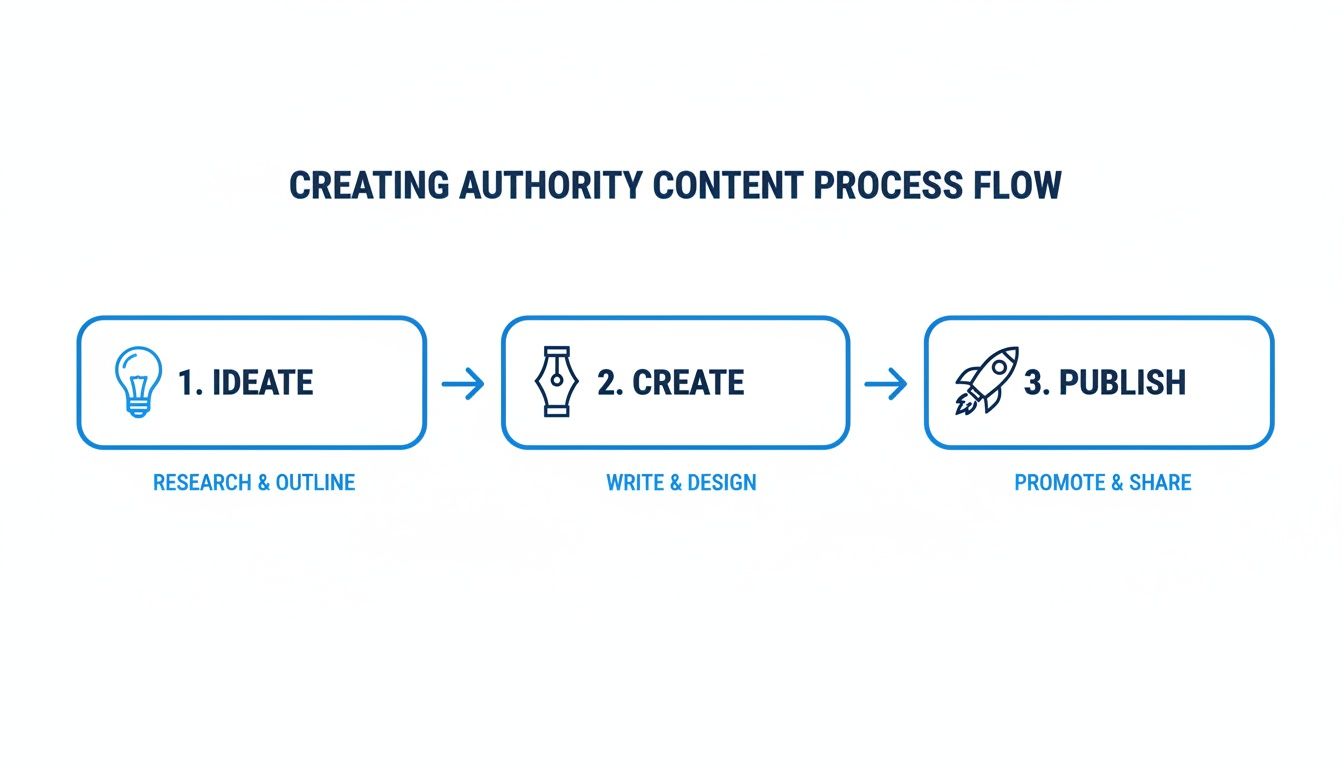
That final "publish" stage is where the real work of repurposing begins, turning one big effort into dozens of smaller touchpoints.
Let's say you just launched that big research report. Here’s how you can atomize it for maximum impact:
- Blog Posts: Break out each key finding or chapter into its own deep-dive blog post.
- LinkedIn Articles: Get your founder to write an opinionated take on the single most surprising statistic from the report.
- Social Media Graphics: Design shareable infographics, quote cards, and data charts for all your social channels.
- Webinar: Host a live event where your subject matter expert breaks down the findings and takes questions from the audience.
- Sales Enablement: Distill the most potent data points into a one-page summary for your sales team to use in prospect conversations.
This approach isn't about creating more work; it’s about making your initial investment work harder for you. It ensures your core message hits every segment of your audience in the formats they actually prefer.
Measuring the Real-World Impact of Your Content
Putting out a fantastic piece of thought leadership feels good. You're sparking conversations, seeing your name pop up, and generally feeling like you're making a dent. But let's be honest, feelings don't impress your CEO or board.
To prove your strategy is more than just a vanity project, you have to connect your content to real business goals. This isn't just about justifying your budget; it’s about knowing what's actually working so you can double down on it and ditch what isn't.
We can break this down into three key areas that, together, tell the full story of your content's value.
Gauging Your Brand Impact
This is all about the top of the funnel—tracking your growing influence and authority in the market. While these metrics can feel a little fuzzy, they are crucial leading indicators of long-term success. They show your voice is cutting through the noise.
Here’s what to keep an eye on:
- Share of Voice (SoV): How much of the conversation in your space do you own versus your competitors? Tools like Brandwatch or Mention are great for this, giving you a clear benchmark of your visibility.
- Inbound Media Requests: This is a big one. Are journalists, podcasters, or event organizers starting to come to you for quotes and interviews? That’s a powerful signal that your expertise is being recognized by the people who matter.
- Branded Search Volume: Are more people typing your company's name directly into Google? This is a fantastic indicator that your thought leadership is building genuine brand awareness.
These metrics prove you're not just shouting into the void; you're actively shaping your industry's conversation. If you want to dig deeper into the relationship between visibility and authority, it helps to understand the fundamentals of measuring public relations effectiveness.
Tracking Demand Generation
Okay, now we're talking pipeline. This is where you connect your brilliant content directly to attracting and nurturing potential customers. It’s all about drawing a straight line from a blog post to a new lead in your CRM.
To pull this off, you need a solid link between your website analytics and your CRM. This is what lets you trace someone's journey from their very first click on an article all the way to becoming a qualified lead for your sales team.
"Vanity metrics make you feel good, but pipeline metrics get you budget. The goal is to draw a clear line from a blog post or a whitepaper to a new sales opportunity in your CRM."
Focus on these critical demand-gen KPIs:
- Content-Attributed Leads: How many new contacts first found you through a piece of your content? Using attribution models in tools like Google Analytics or HubSpot will help you track both first-touch and multi-touch conversions.
- Conversion Rates on Gated Content: If you’re putting your best stuff—like original research or in-depth whitepapers—behind a form, what percentage of people actually fill it out? This tells you just how compelling your premium content really is.
- Newsletter Subscribers from Content: Is your blog so good that it convinces people to hand over their email for more? This is a great sign that you're building an audience that wants an ongoing relationship with your brand.
Monitoring Sales Enablement
Finally, how is your content helping your sales team actually close deals? Your best thought leadership shouldn't just live and die on your blog; it needs to be an active weapon in your sales playbook.
This is probably the most overlooked part of content measurement, but it can show the clearest ROI. The key is to work closely with your sales team and find out which articles and reports they’re actually using in their conversations.
A few smart ways to measure this:
- Content Usage by Sales: Are reps actively sharing specific articles or reports with prospects? Many sales enablement platforms can track this automatically, giving you direct insight into what’s resonating.
- Deal Velocity: Dig into the data. Do deals close faster when a prospect has engaged with one of your key thought leadership pieces? This can be a powerful metric to track over time.
- Influence on Closed-Won Deals: Sometimes the best data is qualitative. Just ask your sales team to tag deals in your CRM that were heavily influenced by a piece of content. Hearing a salesperson say, "That report on X was the reason they signed," is pure gold.
Common Questions About Thought Leadership Strategy
Diving into a thought leadership strategy for the first time always kicks up a few questions. Let's walk through some of the most common ones we hear from startups and tech marketing teams who are ready to build authority but want to get it right from the start.
How Long Until We See Real Results?
This is always the first question, and the honest answer is: it takes time. You’re not just flipping a switch here.
While you might see some encouraging signs early on—a little bump in social media engagement, maybe a few more clicks to your site—the results that really move the needle take patience. Genuine authority isn't built in a quarter.
Plan on committing to at least 6 to 12 months of consistent, high-quality work before you can realistically expect to see major wins. We're talking about better organic rankings, a steady flow of inbound media requests, or leads in your pipeline that came directly from your content. Think of it as a long-term investment in your brand's reputation. The effects are cumulative; each great piece you publish builds on the last.
Can a Small Team Actually Pull This Off?
Absolutely, but you have to be smart and strategic. A small startup team can't win by creating more content than a huge competitor. You have to win by being more focused and delivering higher quality. The key is to go deep, not wide.
- Own a Micro-Niche: Don't try to be an expert on "B2B marketing." That's a losing battle. Instead, become the go-to authority on something specific, like "AI-driven personalization for e-commerce checkout flows." Specificity is your secret weapon.
- Focus on High-Impact Formats: You can't do it all, so don't even try. Master one or two content types that work for you. For example, a single, data-packed blog post each month—repurposed into social snippets, a newsletter, and a presentation—can have way more impact than a dozen generic articles.
- Tap Into Your Experts Efficiently: Your founder, engineers, and product managers are sitting on a goldmine of unique insights. But don't ask them to write. That’s a huge ask. Instead, interview them. A 30-minute recorded chat can give a content creator enough raw material for multiple articles, posts, and quotes.
Your goal isn't to out-produce everyone. It's to create better, sharper content that a very specific audience can't ignore.
What's the Difference Between This and Content Marketing?
This is a great question because it gets to the heart of the strategy. While they're related and often overlap, their core purpose is different.
Content marketing is generally focused on answering the questions your audience is already asking. It’s about capturing existing demand, usually through SEO, by creating helpful "how-to" guides, tutorials, and straightforward explainers. Think of it as fulfilling a known need.
Thought leadership, on the other hand, is about answering the questions your audience should be asking but aren't yet. It’s about introducing new ideas, challenging old assumptions, and sharing a unique point of view on where the industry is going. You're trying to shape the conversation and create future demand by showing people the way forward.
A simple way to put it: Content marketing helps your audience solve today's problems. Thought leadership helps them get ready for tomorrow's opportunities.
How Do I Turn Our Team's Expertise into Actual Content?
Most of your company's best ideas are probably locked away in the heads of your subject matter experts (SMEs). The trick is building a simple system to get those ideas out, polish them up, and package them for your audience.
Start by scheduling regular, short interviews with your internal experts—your Head of Product, a senior engineer, or even your top sales rep. Don't just ask them what they want to write about. Instead, dig for their unique perspective.
Try asking questions like these:
- "What's the biggest misconception our customers have about this space?"
- "What's a piece of data you've seen lately that really surprised you?"
- "If you had a crystal ball, what’s one bold prediction you'd make about our industry in the next five years?"
These conversations are your raw material. Record and transcribe them, then pull out the golden nuggets: the strong opinions, the surprising stats, and the contrarian takes. A skilled writer can then take those insights and weave them into a compelling story, backed by data and real-world examples, that establishes your company as an authority.
Ready to get your startup's voice heard by the journalists who matter? PressBeat is your AI-powered partner for securing predictable media coverage. We help you land features in high-authority publications, turning your expertise into earned press. See how we can amplify your thought leadership at https://pressbeat.io.