
What is a boilerplate in press release? Quick guide
November 29, 2025

A press release boilerplate is your company’s official signature. It’s that compact “About Us” section you find at the very end of a news announcement, and it’s designed specifically for busy journalists.
Think of it as the business card you hand over right after sharing your big news. It gives a reporter the essential context they need in seconds, making sure they understand who you are, what you do, and why you matter.
What Exactly Is a Press Release Boilerplate?
While the main body of your press release is all about the news, the boilerplate answers a much more fundamental question: "Who is this company?"
It’s a short, standardized paragraph that always lives at the very end of the release, just before the media contact details. Its job is simple: to provide a concise, consistent summary of your organization. This small block of text carries a surprising amount of weight. For a journalist, it's often the first place they look to get a feel for your company's credibility and understand your position in the market.
A well-crafted boilerplate can be the deciding factor between a reporter feeling confident enough to cover your story and them moving on to the next email in their crowded inbox.
Purpose and Placement: Why It Matters
Imagine a journalist on a tight deadline. They’ve opened your press release, and the headline grabbed their attention. But they've never heard of your company. Instead of forcing them to open a new tab and start digging through your website for basic info, the boilerplate delivers it instantly.
Its primary job is to provide context, build credibility, and maintain brand consistency across all communications. By standardizing this information, you control the narrative and ensure every reporter gets the same core message.
A missing boilerplate is a red flag for media professionals. When a press release lands without one, it creates extra work for the journalist and can make a company seem amateurish. More often than not, they’ll just pass on the story.
Anatomy of an Effective Boilerplate
Mastering the boilerplate comes down to the art of effective information summarization. You have to distill your company's entire identity into just a few powerful sentences.
Every solid boilerplate contains a few core components that work together to paint a complete picture for the media. To see where this section fits into the bigger picture, check out our guide on what a press release looks like.
Here's a quick breakdown of what goes into a great boilerplate.
Anatomy of a Press Release Boilerplate
| Component | Purpose | Example Snippet |
|---|---|---|
| Company Identity | Clearly states what your company does and who it serves. | "InnovateTech is a B2B SaaS platform that helps..." |
| Mission or Value Prop | Explains your core purpose or unique selling point. | "...by automating complex logistical challenges." |
| Key Differentiators | Highlights what makes you stand out (technology, market position). | "Our proprietary AI engine delivers 99.8% accuracy..." |
| Credibility Markers | Includes achievements, funding, or notable clients. | "...trusted by industry leaders like Acme Corp and Globex." |
| Call to Action | Provides a link for more information. | "Learn more at www.innovatetech.com." |
Think of these components as the building blocks. You don't need to use them in this exact order, but a strong boilerplate will almost always touch on each of these points to give a journalist everything they need.
Why Your Boilerplate Is a Powerful PR Tool
So, why all the fuss over a single paragraph? It’s easy to dismiss the boilerplate as just a formality tacked on to the end of a press release. But that’s a rookie mistake. In reality, it’s one of the hardest-working tools in your entire PR arsenal.
Think of it as your company's official elevator pitch, frozen in time for any journalist, investor, or potential customer who stumbles across your news. Its job is to deliver the most important information with the least amount of effort for the reader.
This little block of text is quietly building trust and cementing your brand identity in the background. A reporter scrambling to meet a deadline doesn't have time to go digging for information on every company they write about. Your boilerplate hands them an instant, reliable snapshot, saving precious minutes and making it far more likely they’ll actually cover your story.
It Provides Instant Context and Credibility
A great boilerplate is a masterclass in efficiency. It answers the two most critical questions—"Who are you?" and "Why should I care?"—before the journalist even thinks to ask them. It immediately frames your announcement by establishing your place in the market, what makes you different, and how big of a deal you are.
For a busy reporter, that context is pure gold. It helps them decide in seconds whether your news is a good fit for their audience. A well-written boilerplate pulls this off by:
- Establishing Authority: Are you "trusted by over 50,000 businesses worldwide"? Did you just raise a significant funding round? Mentioning key clients or impressive user numbers provides instant social proof.
- Clarifying Your Niche: It tells journalists exactly where you fit into the competitive landscape, preventing them from misinterpreting what your company actually does.
- Saving Time: It stops a reporter from having to click away from your press release just to find basic company info. You’re removing friction and making their job easier.
A powerful boilerplate transforms your company from an unknown name into a clearly defined, credible organization in just a few sentences. This shift is crucial for turning a press release into a published story.
It Reinforces Consistent Brand Messaging
Your boilerplate is the anchor of your brand's story in the media. Every single press release you send out is another chance to reinforce who you are and what you stand for. Consistency is everything when you're trying to build a strong brand.
This isn't just about press releases, either. A solid boilerplate becomes the foundation for all your communications, tying into broader strategies to increase brand awareness. It ensures that whether a journalist is covering your very first launch or your tenth major milestone, they’re working from the same core message, solidifying your company’s identity in the public eye.
Crafting a Boilerplate That Gets Noticed
A great boilerplate is way more than just a company summary tacked onto the end of a press release. Think of it as your company's elevator pitch, distilled into its most potent form. It’s a strategic piece of communication, and the best ones share some common traits.
The real goal here is to build instant credibility. You're not just telling a journalist what you do; you're showing them why you matter in your industry. It's a careful dance between explaining your mission, defining your market position, and offering up some hard proof.
The Core Ingredients of a Winning Boilerplate
Imagine you're making a signature dish. Each ingredient is crucial, and leaving one out can throw off the entire flavor. A powerful boilerplate is no different and needs to blend a few key elements.
- Your Mission and Value Proposition: Start with a crystal-clear, no-fluff sentence about what your company does and who it helps. Ditch the vague marketing speak. What specific problem are you solving?
- Market Positioning: Quickly explain where you stand. Are you the scrappy disruptor, the established market leader, or a niche specialist? This gives journalists immediate context.
- Key Products or Services: Name your flagship offerings. This gives reporters a tangible idea of what your company actually brings to the table.
These elements lay the foundation, but what truly makes a boilerplate sing is adding layers of proof. Our guide on essential press release writing tips gets into the weeds on how to frame these points for the biggest media impact.
Using Data to Build Unshakable Credibility
This is the secret sauce that separates a forgettable boilerplate from one that reporters actually remember. Vague claims like "we are a leading provider" are white noise. Numbers, on the other hand, grab attention and build trust.
Your boilerplate should be the ultimate proof point. It’s where you concisely back up your claims with hard evidence, transforming a simple description into a powerful statement of authority.
Boilerplates that drop impressive, concrete numbers—like revenue figures, customer counts, or user stats—simply perform better. Saying you serve "over 2 million active users" or are "trusted by 45% of Fortune 500 companies" speaks volumes more than any empty adjective ever could. It’s about showing, not just telling. You can find more insights on using data this way in this detailed analysis on DesignRush.
Finishing Strong with Awards and a Clear CTA
You’ve set the scene with your mission and backed it with data. Now it's time to add the finishing touches that cement your authority and guide the reader.
If you’ve won any significant awards or earned industry recognition, mention them. Being named to a big-name list or winning a well-known award is a powerful form of social proof. It's an external stamp of approval that tells a journalist you're the real deal.
Finally, always wrap it up with a clear call-to-action (CTA). This is almost always a simple, direct link to your company’s website. It gives an interested reporter an immediate next step to learn more, find your press kit, or check your facts.
Learning from Good and Bad Boilerplate Examples
Theory is one thing, but seeing a boilerplate in the wild is where the real lightbulb moments happen. To truly get a feel for what separates an effective boilerplate from a forgettable one, let’s put a few examples under the microscope, side-by-side. This direct comparison will make the abstract principles feel much more concrete.
So many weak boilerplates fall into the same traps. They’re often stuffed with confusing jargon, make huge, sweeping claims without a shred of proof, ramble on for way too long, or somehow manage to leave out the most important details. By picking apart a poorly written example, we can see exactly what not to do and understand why it just doesn’t land with a journalist.
A Common (But Ineffective) Boilerplate Example
Let’s invent a tech startup, "Innovate Solutions Inc.," and draft a boilerplate that, unfortunately, looks a lot like what we see every day.
(BAD EXAMPLE)
About Innovate Solutions Inc.
Innovate Solutions Inc. is a leading provider of groundbreaking, synergistic business solutions designed to optimize and revolutionize the enterprise landscape. We leverage our proprietary, next-generation platform to empower businesses to achieve unparalleled success. Our mission is to be the global leader in our space, offering transformative results for our valued clients.
This is a classic case of saying a lot without actually saying anything. It’s a word salad of empty buzzwords—"groundbreaking," "synergistic," "revolutionize"—that have been so overused they’ve lost all impact. A journalist reading this has no clue what the company actually does, who it helps, or why they should give it a second thought. It’s an instant trip to the trash folder.
Rewriting for Clarity and Impact
Now, let's give that same fictional company a do-over. We’ll rewrite their boilerplate, but this time, we’ll focus on clarity, hard numbers, and a clear purpose. This new version fixes the flaws by swapping vague fluff for tangible facts.
(GOOD EXAMPLE)
About Innovate Solutions Inc.
Innovate Solutions Inc. is an AI-powered logistics platform that helps retail businesses reduce shipping costs by up to 30%. Our software automates route planning and carrier selection for a network of over 2,500 shipping partners, ensuring efficiency for our 200+ clients, including major brands like StyleForward and The Gadget Hub. Founded in 2022, Innovate Solutions was recently named "Top Logistics Startup of the Year" by Tech Disruptors Magazine. Learn more at www.innovatesolutions.com.
The difference is night and day, right? This version is so much stronger for a few specific reasons. It immediately tells you what the company does ("AI-powered logistics platform") and for whom ("retail businesses").
Even better, it backs up its claims with hard data—"reduce costs by up to 30%," "2,500 shipping partners"—which builds instant credibility. Tossing in a recent award serves as a powerful third-party endorsement, proving that someone else thinks they're a big deal.

This simple breakdown shows the three pillars of a strong boilerplate: a clear purpose, compelling proof points, and a straightforward call to action that tells the reader what to do next.
The good example is tight, packed with proof, and gives a journalist everything they need to know in seconds. By ditching the jargon and focusing on specifics, it turns a generic corporate paragraph into a compelling mini-pitch that reinforces the company's value and authority.
Boilerplate Do's and Don'ts
To make things even clearer, here’s a quick cheat sheet summarizing the key takeaways from our examples. Think of this as your go-to guide for writing (or rewriting) your own boilerplate.
| Do | Don't |
|---|---|
| State what you do clearly in the first sentence. | Use vague, industry jargon like "synergistic" or "paradigm-shifting." |
| Include hard numbers (customers, funding, growth) to build credibility. | Make grand claims without any data or proof to back them up. |
| Mention notable customers or prestigious awards. | Exceed the recommended 100-word limit. Brevity is key. |
| Write in the third person ("The company is...") | Forget to include a link to your company’s website. |
| Keep it concise and focused on the most essential information. | Try to cram in every single feature or product detail. |
Following these simple rules will help you stay on the right track and avoid the common pitfalls that render so many boilerplates ineffective. It’s all about providing clear, verifiable information that makes a journalist’s job easier.
Boilerplate Templates for Startups and Tech Firms
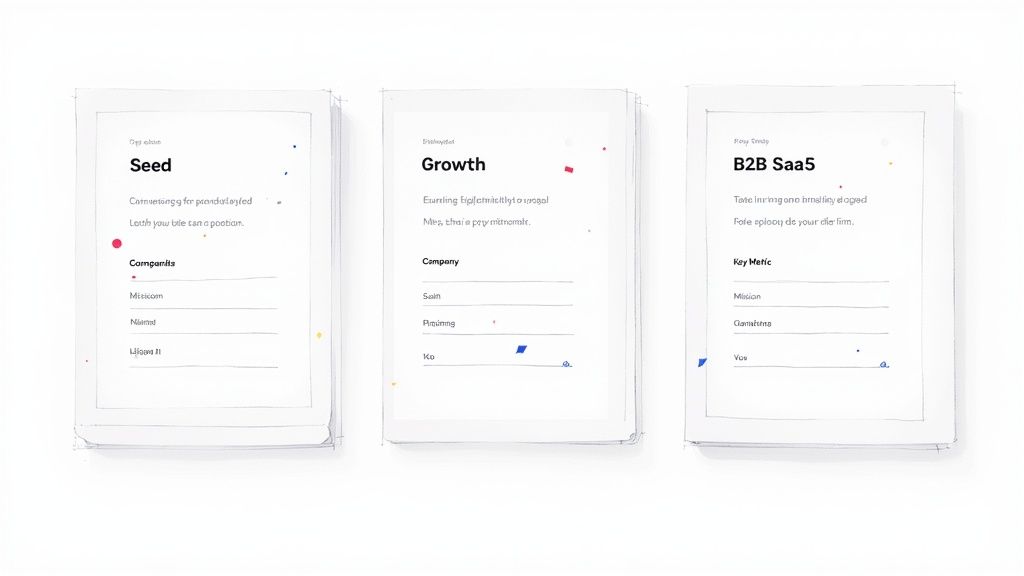
For a startup or tech company, the boilerplate is much more than a simple "About Us" section. It’s your elevator pitch, your credibility statement, and your vision all rolled into one powerful paragraph. Journalists, especially in tech, are hunting for data and a compelling narrative, so a generic summary will get you nowhere.
The trick is to match your boilerplate to the story you're telling. Announcing a funding round? Your boilerplate should scream potential. Launching a new product? It needs to be packed with proof of traction. Your company's story evolves, and your boilerplate has to evolve right along with it.
Template for Seed-Stage Startups (Announcing Funding)
Early on, you're selling the dream. Your story is about the future, the problem you're obsessed with solving, and the brilliant team you've assembled to do it. This boilerplate focuses on that vision.
About [Company Name]
[Company Name] is a [category] startup on a mission to solve [specific problem] for [target audience]. Founded in [Year] by [Founder Names]—a team with deep roots in [industry/field]—the company is building [product/platform description]. With a fresh $[Amount] seed round led by [Lead Investor], [Company Name] is now positioned to [key objective, e.g., ‘aggressively scale its go-to-market strategy’]. Find our story at [www.yourwebsite.com].
This gives a journalist everything they need: who you are, what you're building, and how this new funding is the fuel for your fire.
Template for Growth-Stage Companies (Product Launch)
Once you're in the growth stage, the narrative shifts from potential to proof. You have users, data, and market validation. Your boilerplate needs to reflect that confidence by leading with hard numbers.
About [Company Name]
[Company Name] is the engine behind [Product Name], the [product category] platform now used by over [Number] people to [solve a key problem]. Our technology empowers [target audience] to achieve outcomes like [specific outcome, e.g., ‘cutting project delivery times in half’]. Backed by [mention notable investors], [Company Name] has already processed [data milestone, e.g., ‘10 million API calls’] and works seamlessly with tools like [Integration Partner 1] and [Integration Partner 2]. See how it works at [www.yourwebsite.com].
Template for B2B SaaS Platforms (Highlighting Clients)
In the B2B world, your reputation is built on the company you keep. The fastest way to build credibility is to name the big players who trust you. This template puts your client logos front and center.
About [Company Name]
[Company Name] delivers a [platform description, e.g., ‘next-generation AI-driven logistics platform’] for the [industry] sector. We help market leaders like [Client Name 1], [Client Name 2], and [Client Name 3] to [achieve a specific result, e.g., ‘optimize their supply chains and reduce operational costs’]. Our platform was recently recognized with the [Award Name] for its industry impact. Learn more at [www.yourwebsite.com].
Of course, these are just starting points. The best boilerplates are living documents, updated with fresh, compelling data that directly supports the news you’re announcing. For a wider range of options, check out our complete collection of press release templates in Word to find one that’s a perfect match for your next big story.
How to Maintain and Update Your Boilerplate
Your press release boilerplate isn't a "set it and forget it" kind of thing. It's easy to fall into the trap of writing it once and just pasting it at the end of every release, but that’s a mistake. The best way to think of your boilerplate is as a living document that needs to evolve right alongside your business.
Its main job is to provide consistency, but that consistency is useless if the information is stale. The real challenge is finding the sweet spot between a stable brand identity and an accurate reflection of where your company is today. Getting this right means your boilerplate is always the most powerful, compelling, and honest snapshot of your organization.
Establishing a Cadence for Review
Even when things feel quiet, it’s a good habit to schedule a regular check-up for your boilerplate. Putting a quarterly or semi-annual review on the calendar prevents outdated details from slipping through the cracks and ensures your core message stays sharp.
During these quick reviews, just run through a simple checklist:
- Does this still nail our mission and what we offer our customers?
- Are these metrics and data points still our most impressive stats?
- Did we win any new awards or hit any major certifications that should be in here?
This simple routine stops your boilerplate from becoming an afterthought. It makes sure it's always polished and ready to go when you have big news to announce.
Key Triggers for an Immediate Update
Beyond those scheduled reviews, certain business events should be an immediate red flag that it’s time for an update. These are the big moments that change your company’s story, and your boilerplate needs to catch up—fast. Not updating it after a major milestone just looks sloppy.
Be on the lookout for these common triggers:
- Securing a new funding round: Your boilerplate shouldn't still be talking about your seed round from two years ago when you just closed a Series B. That sends a very confusing signal.
- Hitting a major user or customer milestone: Passing 1 million users or signing your 500th enterprise client are huge credibility boosters. Get them in there!
- Launching a flagship product: If a new product fundamentally changes your company's direction, the boilerplate has to reflect that new reality.
- A strategic pivot or rebranding: This one’s a no-brainer. When your entire identity or business model shifts, your boilerplate has to lead the charge.
Once a company develops an effective boilerplate, it functions as a reusable template that appears in every subsequent press release, creating a recognizable watermark of organizational identity. This is why balancing consistency with currency is so crucial; you want journalists to recognize you, but also see your most current achievements. You can discover more insights about boilerplate standards on Indeed.com.
Ultimately, your boilerplate is the final, authoritative word on who you are. By keeping it fresh and packed with your biggest wins, you guarantee every single press release is anchored by the strongest and most accurate version of your brand.
Ready to get your story in front of the right journalists without the guesswork? PressBeat uses AI to identify the perfect reporters for your news and crafts personalized pitches that get noticed. Secure guaranteed media coverage and see your results in real-time. Start your campaign today at https://pressbeat.io.