
What is a media pitch? Learn to craft pitches journalists actually read
December 11, 2025

Think of a media pitch as your direct line to a journalist. It's not a formal announcement blasted out to the world; it’s a short, personal invitation for a specific reporter to cover your story.
Forget the dry, corporate-speak. A great pitch is more like a movie trailer for your news—it gives just enough information to hook them and make them eager to see the full picture.
So, What Exactly Is a Media Pitch?
At its core, a media pitch is your best tool for earning media coverage. It’s a targeted message, usually an email, crafted for a single journalist or a specific publication. You're not just sending information; you're proposing a story idea that you believe is a perfect fit for their audience.

The whole point is to cut through the noise. Journalists are buried in emails every single day, so your pitch needs to be concise and immediately relevant. This isn't just a hunch; the numbers back it up. Pitches under 150 words see a 5.89% response rate, which plummets to just 1.46% for those over 500 words. Brevity and relevance aren't just nice-to-haves—they're essential. You can find more helpful media pitching strategies and statistics over at Influize.com.
Pitch vs. Press Release: What's the Difference?
It’s a common point of confusion, but the distinction is simple and crucial. A press release is a formal, factual document announcing something newsworthy from your company. It's written in a standard format and often sent out widely.
A media pitch, on the other hand, is the personal, persuasive email that introduces the story behind that press release. It connects the dots for the journalist, explaining why their readers would care about your news.
Think of it this way: the press release is the official record (the what), while the pitch is the compelling conversation starter (the why you should care). Getting this right is fundamental to building real relationships with the media instead of just adding to their inbox clutter.
Here's a quick breakdown to make the differences crystal clear.
Media Pitch vs Press Release at a Glance
This table helps you quickly see how these two essential PR tools differ in their purpose, audience, and overall feel.
| Characteristic | Media Pitch | Press Release |
|---|---|---|
| Purpose | To propose a unique story idea and generate interest. | To officially announce company news or events. |
| Audience | A specific, individual journalist or editor. | A broad audience, including multiple media outlets. |
| Format | Informal, conversational email or message. | Formal document with a standardized structure. |
| Tone | Personal, persuasive, and tailored. | Objective, factual, and official. |
In short, one is a personalized conversation, and the other is a public statement. A smart PR strategy knows when and how to use both effectively.
Why a Great Pitch Is Your Startup's Secret Weapon
For any growing startup, a fantastic media pitch is so much more than just another PR task—it's a serious engine for growth. While you can always buy an ad to rent someone's attention for a day, a single piece of earned media coverage builds something far more valuable and lasting.
Think of it as the difference between a flashy billboard on the highway and a recommendation from a friend you trust. When a respected journalist or publication decides your story is worth telling, it comes with their stamp of approval. That third-party endorsement signals to everyone—customers, investors, potential partners—that you're a company worth watching.
Driving Real Business Growth
This kind of credibility isn't just a nice-to-have; it leads to real, measurable results. A well-placed article can send a wave of new, highly relevant visitors to your website. And because they're coming from a trusted source, they arrive with a level of confidence that makes them much more likely to convert.
On top of that, these articles almost always include backlinks to your site. To search engines like Google, those links are a huge vote of confidence, boosting your authority and helping you rank higher in search results. One great pitch can truly be the gift that keeps on giving, driving organic traffic long after the initial excitement dies down.
For a lean startup, media pitching offers an incredible return on investment. It's a strategic move that punches way above its weight, turning a good story into brand equity, market authority, and bottom-line revenue.
From Coverage to Industry Authority
Getting your name in the news is one thing, but a truly great pitch can do more. It can position you and your company as a genuine leader in your field, supporting bigger goals like thought leadership marketing. This is your chance to steer the conversation and become the go-to source for insights in your niche.
Ultimately, getting your pitching game right gives you several key advantages that are critical for any startup looking to scale quickly:
- Builds Instant Credibility: Earned media is social proof you simply can't buy.
- Attracts Investor Attention: VCs and angel investors are always scanning the news for the next big thing.
- Generates High-Quality Leads: Your story gets in front of a targeted audience that's already interested in what you do.
- Provides a Competitive Edge: When you're the one being quoted in major outlets, you immediately stand out from the crowd.
Mastering what is a media pitch isn't just a PR skill—it's about turning your startup's story into its most powerful secret weapon.
The Anatomy of a Pitch Journalists Actually Read
So, what actually goes into a pitch that a journalist will open, read, and—most importantly—act on? It's not about one single brilliant idea. A great pitch is a carefully constructed message where every single component works together to grab a journalist's attention and convince them your story is worth their incredibly limited time.
Get these elements right, and you're no longer just another email cluttering their inbox. You're offering a genuine, valuable story.
This isn't just about getting your name out there, either. A successful pitch is a direct line to serious startup growth, helping you build credibility, drive traffic, and even give your SEO a nice boost.
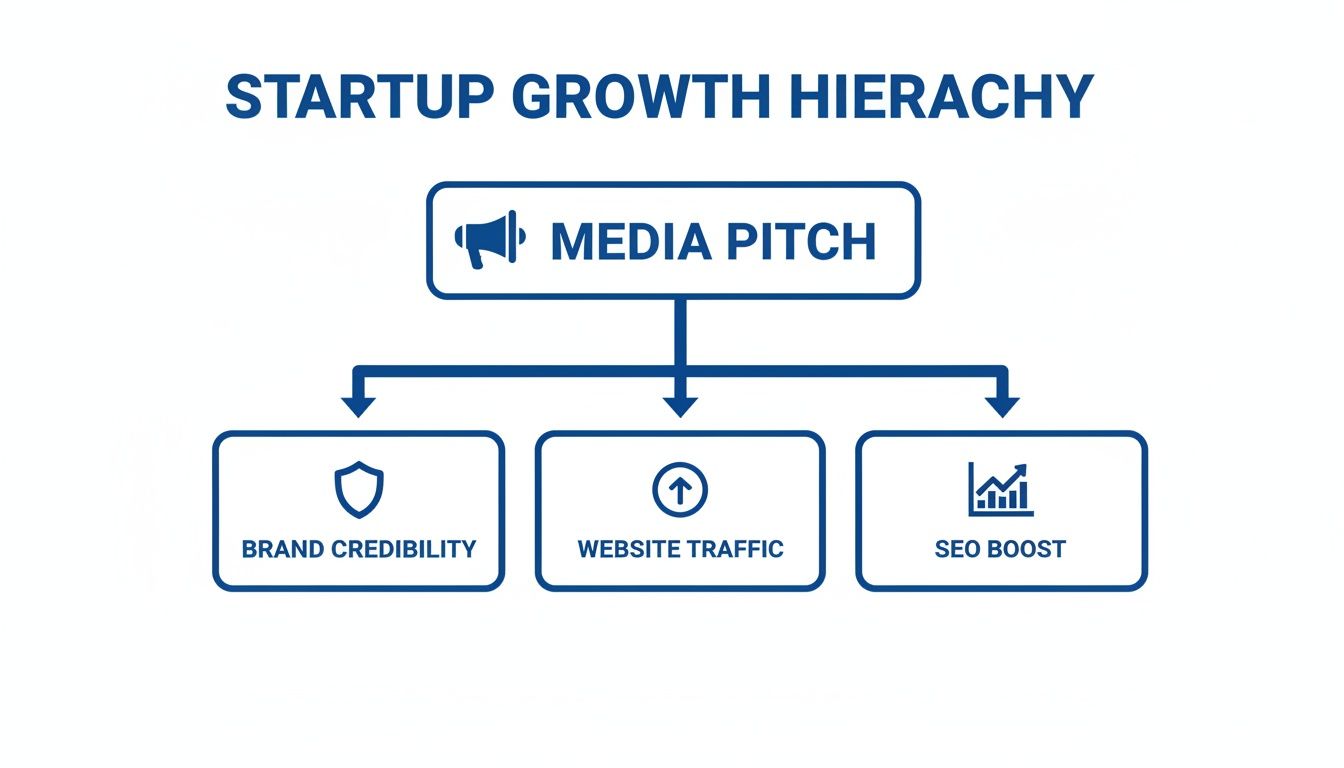
As you can see, pitching is far more than a simple PR task. It's a fundamental growth engine that delivers real, tangible results for your business.
The Make-or-Break Subject Line
Let’s be honest: your subject line is the gatekeeper. Journalists get flooded with dozens, sometimes hundreds, of pitches every single day. A bland or generic subject line is a one-way ticket to the trash folder. It has to be short, sharp, and compelling, ideally under 49 characters.
For any media pitch, crafting high-converting email subject lines is where you win or lose the game. The best ones hint at the story's value without ever feeling like clickbait. Think of it as an exclusive headline you wrote just for them.
- Bad: Press Release: New Product Launch
- Good: Pitch: New data shows [surprising trend] in [industry]
The Personalized Opening Hook
Starting your email with "Dear [Journalist Name]" is table stakes. It’s the bare minimum. A truly powerful opening immediately proves you’ve done your homework. Mention a recent article they wrote, a specific topic they cover, or even a comment they made on Twitter.
This simple act of personalization does more than just show respect; it instantly signals that your pitch isn't part of a massive, generic email blast. It’s your chance to build a real human connection and turn a cold outreach into a warm, relevant conversation.
Your Compelling Value Proposition
This is the heart of your pitch. In just one or two punchy paragraphs, you have to answer the journalist's unspoken question: "Why should my readers care about this, and why right now?" Your value proposition needs to be newsworthy, fresh, and directly relevant to their audience.
The strongest pitches don't just state what the news is; they explain why the news matters. Frame your story around a larger trend, a surprising statistic, or a solution to a common problem.
For example, don’t just announce a new app feature. Explain how that feature solves a huge pain point for a specific group of people. To see this in action, check out these powerful media pitch email examples.
The Clear and Simple Call to Action
Finally, every great pitch wraps up with a clear, low-friction call to action (CTA). Don't make the journalist guess what you want from them. Your job is to make their next step as easy as possible.
Instead of a vague "Let me know what you think," be direct and helpful.
- "Are you available for a quick 15-minute chat next week to walk through the data?"
- "I have the full report and high-res images ready to go. Can I send them over?"
This kind of clarity removes all the guesswork and makes it incredibly easy for them to say yes, turning your pitch from a hopeful email into a published story.
Adapting Your Pitch for the Modern Journalist
The days of sending a wall of text and hoping for the best are long gone. Newsrooms today are fast-paced, digital-first operations. Stories aren't just told with words; they're shown with images, videos, and compelling data. If you want to understand what a media pitch really is in this era, you have to think beyond the email itself and consider the entire package you're sending.
A journalist's job is to create content that grabs an audience and doesn't let go. Your job is to make that as easy for them as possible. When you include ready-to-use multimedia assets, your pitch transforms from a simple idea into a nearly finished story kit. That simple shift can be the difference between getting ignored and getting published.
Go Beyond the Written Word
Telling a journalist your story is one thing. Showing them is a game-changer. They are under incredible pressure to produce content quickly, and handing them high-quality assets on a silver platter saves them a ton of time.
The data backs this up. Recent research shows that 22% of journalists are now specifically asking for multimedia elements in pitches. What's more, a massive 81% have used images in their articles in just the last six months, which tells you everything you need to know about the demand for visual content. You can dig deeper into these trends and what they mean for your PR strategy in this 2025 media report.
Your pitch needs to be more than just an email—it should be a doorway to a richer story.
- High-Resolution Images: Think professional photos of your product, your team, or your founder in action.
- Data Visualizations: Got interesting stats? Turn them into a clean, shareable infographic.
- Short B-Roll Video: Provide quick video clips that a news editor can easily slice into a segment.
- Expert Headshots: Don't make them hunt for a decent photo. Have professional headshots of your key people ready to go.
Pitching New Formats and Platforms
A media pitch isn't just for traditional articles anymore. The sharpest PR pros are looking beyond print and online articles to the platforms where people are actually spending their time. This means learning to adapt your story to fit different formats.
A data-heavy announcement might be perfect for a detailed blog post, for instance. But if you're pitching a podcast, you'll want to focus on the charismatic founder who can bring the human side of that data to life. This is just one of many proven tactics in modern PR that can seriously expand your reach.
Think of your core story as a block of clay. For a journalist, you might shape it into a vase. For a podcaster, a sculpture. For a YouTuber, a series of mugs. The substance is the same, but the form changes to fit the medium.
Next time you're planning a campaign, think about these other outlets:
- Podcasts: Can you pitch your founder or an in-house expert as a guest to talk about industry trends?
- YouTube Channels: Could you offer a popular creator in your niche an exclusive look or a product demo?
- Influential Newsletters: How about providing a unique insight or a special deal crafted just for that newsletter's audience?
Common Pitching Mistakes That Guarantee Deletion
Even the most brilliant story can fall flat if the pitch is flawed. Let’s be real: journalists are drowning in emails. They get dozens, sometimes hundreds, of pitches every single day and have developed a sixth sense for what's worth reading and what’s destined for the trash folder.
Knowing what not to do is just as important as knowing what to do. A single typo, a generic greeting—that’s often all it takes to kill your chances. Avoiding these common blunders is your first step toward actually getting a response.
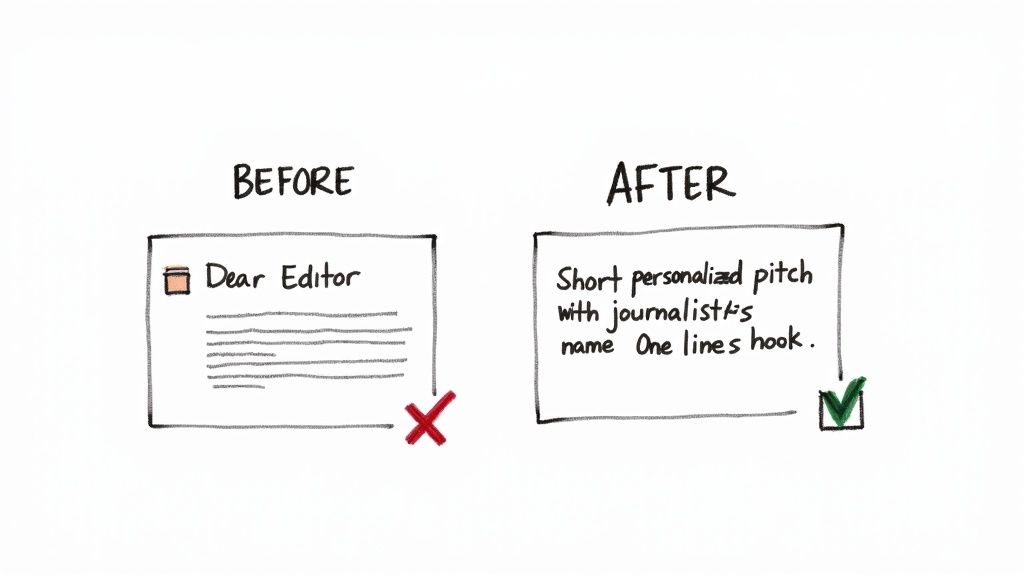
Most of these mistakes boil down to two things: a lack of research and a failure to respect the journalist's time. Get these right, and you're already ahead of the game.
Sending Impersonal Email Blasts
There's no faster way to get your email deleted than making it painfully obvious you've sent the same thing to fifty other people. Starting your email with "Dear Editor" or "To Whom It May Concern" is an immediate red flag. It screams that you couldn't be bothered to find out who you're even talking to.
Personalization isn't just a nice-to-have; it's everything. A quick mention of a recent article they wrote or a topic they cover shows you've done your homework.
- Before: "Hi, I have a story that would be great for your publication."
- After: "Hi [Journalist's Name], I really enjoyed your recent piece on [Specific Topic]. It made me think a related story about [Your Angle] could be a great fit for your readers."
See the difference? One feels like spam, the other feels like a thoughtful suggestion from someone who pays attention.
Focusing on Promotion Instead of Story
Here's a hard truth: journalists aren't here to give you free advertising. Their job is to tell compelling stories that their audience will find interesting, valuable, or entertaining. A pitch that just drones on about product features is a sales brochure, not a story.
You have to find the angle. Instead of just listing what your product does, frame it as a narrative with a hook that will grab their attention.
Your pitch has to answer the journalist's unspoken question: "Why should my audience care?" If your email only talks about how great your company is, it fails the test. Find the human element, the surprising data, or the problem you're solving.
Ignoring the Journalist's Beat
Pitching a B2B SaaS story to a food blogger is a complete waste of everyone's time. A journalist’s beat is their specific area of focus—the topic they live and breathe every day. Sending them something totally unrelated is the clearest sign that you have no idea who they are or what they do.
Not only will your pitch get ignored, but you might also burn that bridge for good. Why would they ever open an email from you again, even if you eventually have a relevant story? Always double-check their beat and recent articles before you even think about hitting "send."
How to Measure the Real Impact of Your Pitching
Getting a journalist to say “yes” feels great, but it’s the starting line, not the finish. The real value of a media pitch isn't just getting the story placed; it’s about what that story does for your business. Simply looking at email open rates just doesn't cut it.
The data tells a clear story. The average open rate for a pitch email hovers around 44%, but the actual success rate—the number of pitches that turn into published stories—is under 5%. This gap shows exactly why focusing on opens is misleading. You need to track what truly moves the needle. You can learn more about key PR industry statistics on rankomedia.com.
Key Performance Indicators for PR
Instead of just celebrating every open or reply, a smarter, data-driven approach ties your pitching efforts to tangible business results. These are the metrics that prove your value and help you sharpen your strategy for the next campaign.
Media Placements and Reach: This is the most basic, yet crucial, metric. Keep a running list of every article, interview, or mention you secure. More importantly, note the publication's domain authority and its estimated monthly traffic. This gives you a clear picture of the potential audience your story reached.
Referral Traffic: Jump into your analytics. How many people clicked through to your website from that article? This is a direct line connecting the story to customer action, showing that the piece didn't just get read—it got people interested enough to learn more.
SEO Impact: A single placement in a high-authority publication can deliver a powerful backlink. This is huge. That link acts as a vote of confidence for your website, signaling to search engines that you're a credible source and boosting your organic search rankings over time.
The ultimate goal is to connect your pitching efforts to business objectives. An article that drives 50 new sign-ups is infinitely more valuable than 10 articles that generate zero traffic.
From Mentions to Momentum
Finally, step back and look at the bigger picture. Are more people talking about your brand on social media after a story goes live? Are you seeing a spike in people searching for your company's name on Google? These qualitative shifts are just as important for understanding the full impact of your work.
By focusing on these results, you stop treating pitching as just an outreach task and start seeing it for what it is: a strategic driver of growth. For a deeper dive, check out our guide on the most effective methods for the measurement of public relations.
A Few Common Questions About Media Pitching
Even with the best game plan, you're bound to have questions when you're in the trenches of media outreach. Let's tackle a few of the most common hurdles you'll face so you can navigate them with confidence.
How Long Should I Wait Before Sending a Follow-Up?
Patience is key, but you also have to be persistent. The sweet spot for a follow-up is generally 3-5 business days. This gives a busy journalist enough breathing room to see your first email without letting it sink to the bottom of their inbox forever.
When you do follow up, keep it polite and brief. Just a gentle nudge to bump your original message. If you still don't hear back after that one attempt, it's probably time to move on. Bombarding a reporter with emails is a surefire way to burn that bridge for good.
Should I Pitch a General Inbox or a Specific Journalist?
Always, always aim for a specific person. Sending your pitch to a generic inbox like "editor@publication.com" is the media relations equivalent of a message in a bottle—it’s unlikely to find the right shore.
Take a few extra minutes to find the specific reporter who covers your industry or beat. A personalized pitch sent to the right person shows you've done your homework and respect their work. It's a simple step that instantly sets you apart and dramatically improves your odds of getting a reply.
What’s the Best Day and Time to Send a Pitch?
There's no single magic formula, but some times are definitely better than others. Data and experience point to mid-week as your best bet. Try sending your email on a Tuesday, Wednesday, or Thursday morning, usually between 8 AM and 10 AM in the journalist's local time zone.
Mondays are often a whirlwind of catching up and planning meetings. By Friday, people are mentally checking out for the weekend. Sending your pitch during that mid-week morning window ensures it lands when they're most likely to be actively looking for new stories.
Can I Pitch the Same Story to Multiple Journalists?
Yes, you can pitch the same story idea to different journalists at different publications. What you absolutely should not do is send the same pitch to multiple reporters at the same outlet simultaneously. That’s a quick way to look unprofessional.
If you have a really big story and want to make it extra appealing, you can offer it as an "exclusive." Clearly state this in your subject line or the first sentence. Giving one publication the first crack at your news can be a powerful motivator for them to act fast.
Ready to stop guessing and start getting published? PressBeat uses AI to find the perfect journalists, crafts personalized pitches, and guarantees you get the media coverage your startup deserves. See how it works at https://pressbeat.io.