
What Is Earned Media A Startup’s Guide To Free Publicity
December 26, 2025

At its core, earned media is any mention, share, or review of your brand that you didn't pay for or create yourself. It's the digital equivalent of word-of-mouth, happening organically when journalists, influencers, or customers decide your story is worth telling.
Because it comes from an impartial third party, this type of coverage is often the most trusted and impactful form of marketing you can get.
Earned, Paid, and Owned Media: What's The Difference?
To really get a handle on earned media, it’s helpful to understand its relationship with its two siblings: paid and owned media. Every solid marketing strategy uses a mix of all three, but they each serve a very different purpose.
Let's use a simple analogy: You've just opened a new restaurant.
- Paid Media: This is the billboard you rent on the highway or the sponsored ad you run on Facebook to promote your grand opening. You pay for the exposure, and you get complete say over the message and visuals.
- Owned Media: This is your restaurant's website, its Instagram profile, and the beautifully designed menu on each table. You own these platforms, giving you total control to post what you want, when you want.
Earned Media is what happens next. A local food critic dines at your restaurant unannounced, loves the experience, and writes a rave review in the Sunday paper. You didn't pay for that placement or control what they wrote. You earned it with a great product.
This visual helps clarify how the three work together.
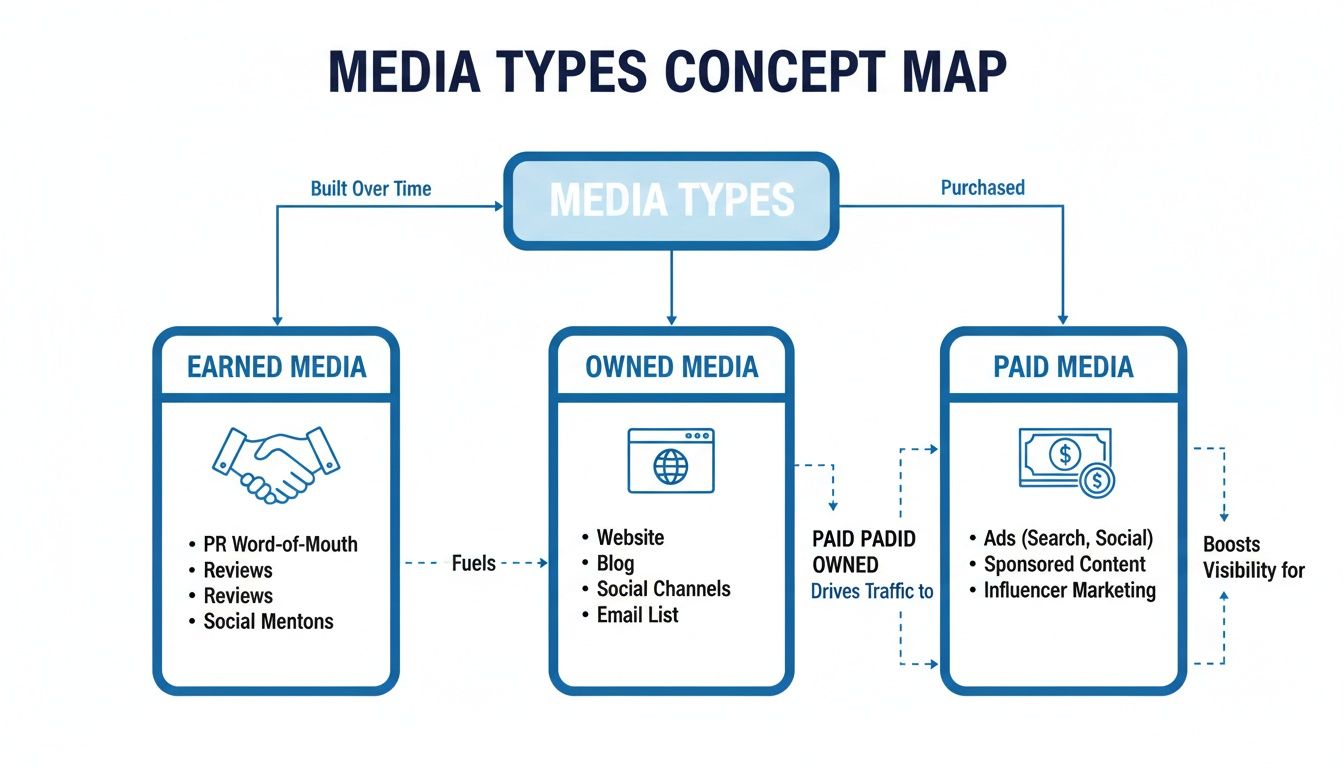
As you can see, each media type offers a trade-off between control and trust. Earned media sits at the top when it comes to credibility.
The Unmatched Power of a Third-Party Endorsement
The real value of earned media comes down to one thing: authenticity. When a respected journalist, a trusted industry voice, or even an everyday customer shares a positive opinion about your brand, it carries far more weight than any ad ever could.
Study after study confirms that consumers trust recommendations from peers and experts over brand-created content. That trust is gold—it builds your brand's authority, boosts consumer confidence, and drives real business results. We explore this in much more detail when we break down the true value of earned media.
This kind of powerful social proof can pop up in all sorts of places:
- A feature story in a top-tier publication like Forbes or TechCrunch.
- A positive mention during a popular industry podcast.
- An unprompted, glowing review from a well-known influencer on TikTok.
- Viral social media posts from happy customers sharing their experiences.
At the end of the day, earned media is the most powerful marketing asset a business can have. It creates a foundation of trust that you simply can't buy.
Earned Vs Paid Vs Owned Media At A Glance
To make it even clearer, here's a quick side-by-side comparison of the three media types. This table breaks down the core differences in how they're defined, what they look like in practice, and the primary benefit each one offers.
| Media Type | Definition | Key Examples | Primary Benefit |
|---|---|---|---|
| Earned Media | Publicity generated by third parties without payment. | Press coverage, customer reviews, social media mentions | High Credibility & Trust |
| Owned Media | Content and channels controlled by your brand. | Company blog, website, social media profiles | Full Control & Brand Voice |
| Paid Media | Exposure you pay for on external channels. | Google Ads, social media ads, sponsored content | Guaranteed Reach & Targeting |
Understanding these distinctions is the first step in building a balanced strategy that uses the control of owned media and the reach of paid media to generate the high-impact credibility of earned media.
Why Earned Media Is Your Startup’s Secret Weapon
Let's face it: we live in a world drowning in ads. Your customers have developed a finely tuned radar for sponsored content and sales pitches, and they've gotten very good at tuning them out. This is where earned media comes in—it’s the one advantage you can’t buy, but it’s the most powerful one you can have: genuine trust.
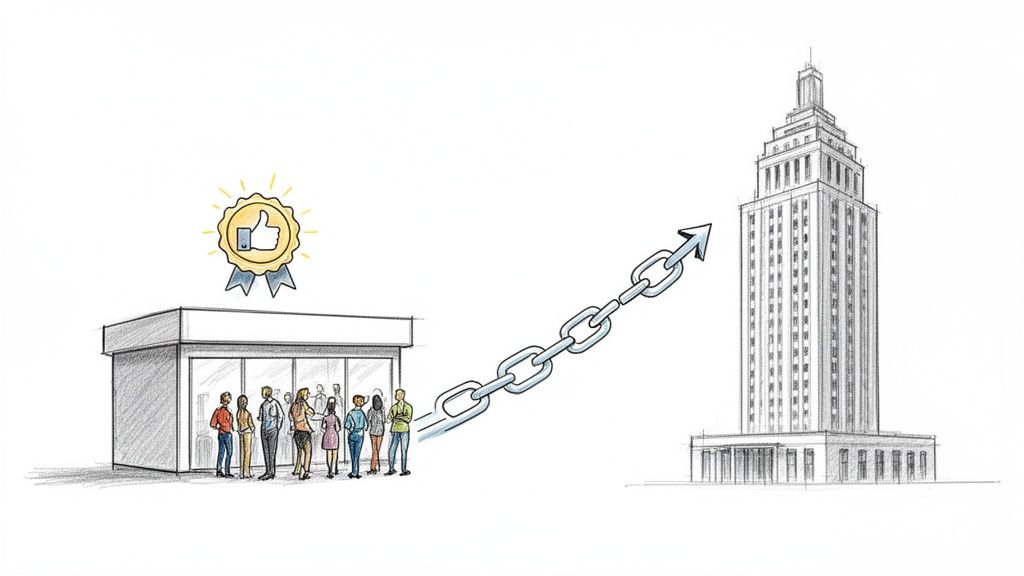
Think about it. When an independent journalist, a respected trade publication, or even just a happy customer decides to talk about your brand, it's a powerful signal. It’s an authentic, third-party endorsement that tells the world your startup isn’t just another ad—it’s a solution actually worth talking about.
This isn’t just a hunch; the data backs it up. As trust in advertising keeps dropping, a recent analysis found that 30% of PR professionals are doubling down on earned media. Why? Because earned coverage can have 4-5 times more impact on how people see your brand compared to a paid ad. In fact, customers are 3.5 times more likely to buy something after seeing it mentioned by a trusted source. You can discover more insights into the growing importance of earned media strategy and its ROI.
Supercharge Your SEO with High-Authority Backlinks
Beyond building trust, one of the biggest wins from earned media is the direct boost it gives your Search Engine Optimization (SEO). When a top-tier publication—we’re talking outlets with a Domain Rating (DR) of 70 or higher—writes about you and links to your website, it's like a massive vote of confidence in the eyes of Google.
That single, high-quality backlink tells search algorithms that your site is credible and worth showing to more people. The results are pretty straightforward:
- Improved Search Rankings: You start climbing the ladder for the keywords that matter, making it easier for customers to find you when they’re actively searching.
- Increased Domain Authority: Every quality backlink strengthens your website's overall authority, creating a lasting SEO asset that keeps paying dividends.
- Boosted Organic Traffic: Higher rankings mean more clicks, which translates to a steady stream of qualified visitors—all without spending a dime on ads.
Honestly, a single feature in a major outlet can deliver more SEO power than months of tedious, conventional link-building. It sets a powerful foundation for long-term, sustainable growth.
A Cost-Effective Engine for Growth
For any startup watching its budget, the economics of earned media are hard to beat. Paid ads demand a constant cash injection to stay visible; the moment you stop paying, you disappear. But a well-placed earned media story? That article, podcast mention, or review keeps working for you long after it goes live. It stays online, driving traffic and building your reputation for months—sometimes years.
Earned media isn't just a marketing tactic; it's a business validation tool. A positive feature in a respected publication can attract investor attention, validate your product-market fit, and significantly shorten the sales cycle by building credibility before a prospect even speaks to your team.
Think about the ripple effect. You can share that one positive story on your own blog and social channels (that’s your owned media). Your sales team can use it to build trust with new leads. This ability to amplify a single piece of coverage across multiple channels means the return on investment (ROI) often blows comparable paid campaigns out of the water. For startups needing to make every dollar count, this kind of efficiency is priceless.
Proven Tactics To Generate Earned Media Coverage
Knowing what earned media is and actually getting it are two different things. Securing that coveted feature requires a smart, proactive game plan. While there’s no magic button, there are absolutely proven tactics that will get you noticed. It all boils down to preparation and learning to think like a journalist.
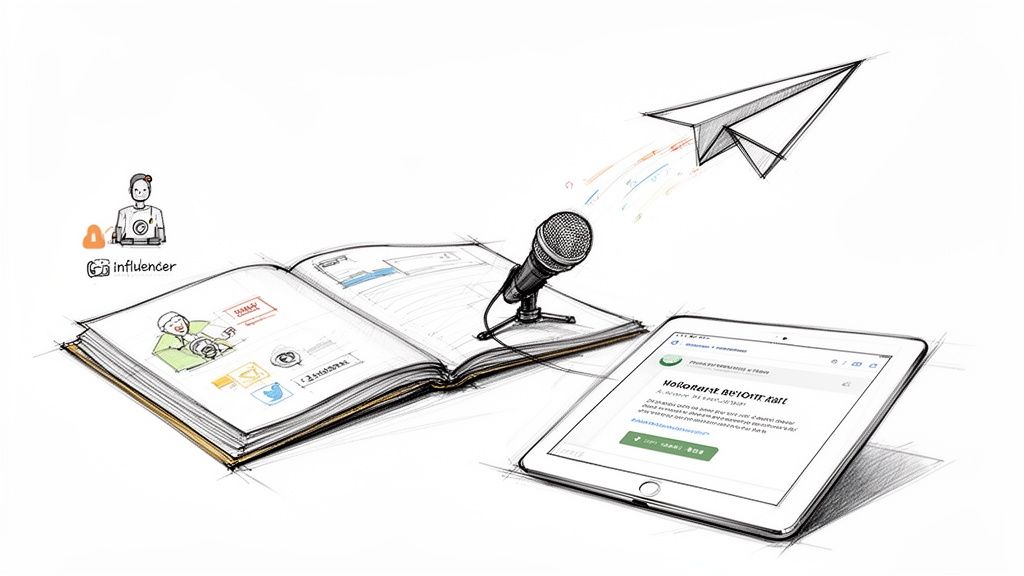
The bedrock of any solid outreach is a comprehensive and ready-to-go media kit. This isn't just a folder with your logo. Think of it as a tool designed to make a reporter's life infinitely easier. When they're scrambling to meet a deadline, having everything they need in one spot can be the deciding factor that gets your story picked up.
Your media kit should be the ultimate resource for anyone covering your company. Make sure it includes:
- Company Overview: A quick, punchy summary of who you are, what you do, and why it matters.
- Founder Bios & Headshots: Professional photos and compelling backstories for your key people.
- High-Resolution Logos & Product Images: Give them options in various formats so they don't have to ask.
- Recent Press Releases: An organized archive of your latest announcements.
Putting this together signals that you're professional and you respect their time—a huge plus in their book.
Find Your Newsworthy Angle
Let’s be clear: journalists don’t want to run ads for you. They're on the hunt for compelling stories that will hook their readers. To land earned media, you have to frame your company news as something genuinely interesting to people who don't work there.
Not every company update is headline news, but you can find a newsworthy angle in many milestones. Look for powerful narratives like these:
- Innovative Product Launches: Did you just release a first-of-its-kind feature? Does it solve a massive headache for people in a totally new way?
- Insightful Data Reports: Have you gathered original data that uncovers a surprising trend? Reporters love exclusive data they can build a story around.
- Strategic Partnerships: Teaming up with a big name in your industry can create a compelling story about growth and market impact.
- Major Funding Rounds: Securing a significant investment is a huge vote of confidence in your vision, and that's always a story worth telling.
The trick is to tie your news to a bigger conversation. How does your announcement ripple out to affect the industry, the economy, or the daily lives of consumers?
Master The Art Of The Personalized Pitch
Once you’ve got your story, you need to get it to the right people. Blasting a generic email to a list of a hundred journalists is the fastest way to get your emails sent to spam. Success comes from personalization.
Your pitch needs to be a short, sharp email that gets right to the point. It has to immediately answer three critical questions for the journalist:
- Why me? Prove you've done your homework. Mention their beat or a recent article they wrote and explain why your story is a perfect fit.
- Why now? Give them a reason to cover this today. Is your news tied to a current event, an industry shift, or a seasonal trend?
- Why should my audience care? Spell out the value for their readers. What's the takeaway?
A great pitch feels less like a request and more like a valuable tip from a trusted source. It’s a targeted, respectful communication that offers a compelling story idea, not a demand for coverage.
Following up is key, but don't overdo it. A single, polite follow-up a few days after your initial email is standard. Any more than that, and you risk annoying them and burning a bridge. For a deeper dive into effective outreach, check out these essential public relation tactics.
Broaden Your Horizons Beyond Traditional Media
Getting a feature in a major publication is a huge win, but the modern media world is so much bigger than that. Smart startups are also tapping into other powerful channels to build momentum and connect with niche audiences.
One of the most powerful long-term plays is investing in a solid thought leadership content marketing strategy. When you position your founders as go-to experts, reporters will start coming to you for quotes and insights.
Don't forget these other high-impact tactics:
- Collaborating with Niche Influencers: Find creators with dedicated followers in your space. Their endorsement can feel more authentic and trusted than traditional media.
- Leveraging User-Generated Content (UGC): Encourage your customers to share their experiences. Showcasing real reviews and social posts is incredibly powerful social proof.
- Guest Appearances on Podcasts: Pitch your founder as a guest on relevant podcasts. It’s a fantastic way to share your story and expertise with a built-in, engaged audience.
By mixing these strategies, you create a web of opportunities for your story to be told, building a rich and diverse portfolio of earned media.
Navigating The Modern Earned Media Landscape
The idea of "media" has completely changed. It’s no longer just the morning paper or the six o'clock news. For startups to make a real impact today, they have to grasp that earned media has exploded into a massive, fragmented ecosystem. Getting a single feature article is nice, but it's just one piece of a much larger puzzle.
This new landscape is a vibrant mix of everything from niche industry blogs and influential Substack newsletters to podcast interviews and quick shout-outs from creators on TikTok or YouTube. Each channel is a direct line to a specific, engaged audience that genuinely trusts the voices they follow. Getting your head around this shift is the first real step to building a PR strategy that actually works.
To keep a pulse on this wide-ranging conversation, you need to get good at mention social listening. It's the only way to know what people are saying about you, where they're saying it, and when.
The Rise Of Authority And Recency
In this sprawling new world, two things matter more than anything else: authority and recency.
When you land coverage in a high-authority publication—think outlets with a Domain Rating (DR) of 70 or higher—it's like getting a stamp of approval that everyone recognizes. It tells potential customers, investors, and even search engine algorithms that your brand is credible and worth paying attention to.
But authority isn't enough on its own. A story from yesterday has infinitely more impact than one from last year. Fresh, recent coverage keeps your brand top-of-mind and signals to Google that you’re relevant right now, which can give you a serious visibility boost. The real goal for any startup is to create a steady drumbeat of recent, authoritative mentions.
The modern earned media game isn't just about getting one big hit. It's about consistently earning mentions in the right places, at the right time, to build a cumulative effect of trust and authority over time.
The news cycle moves at lightning speed, which can feel daunting. But it also means there are more opportunities than ever for sharp, agile startups to jump into the conversation and make their mark.
Winning In The Age Of AI
Just when we thought things couldn't change any faster, along came AI chatbots. Tools like ChatGPT are rapidly becoming the new search engines, pulling their answers directly from the vast library of content on the internet. This is where earned media has become absolutely non-negotiable.
News consumption is splintering into what some call 'media bubbles,' and traditional press is now just one part of a complex "earned media mosaic" that includes everything from influencer nods to AI-optimized articles. It's a staggering thought, but up to 90% of the citations that feed these AI models and build brand visibility come from earned media. For startups aiming to lead their category, this is a critical battleground.
Getting that high-authority coverage is no longer just about brand awareness or SEO. It's about cementing your startup into the foundational knowledge of the internet. When a respected journal covers your launch or an industry expert quotes your founder, that data gets absorbed by these large language models (LLMs).
The result? When someone asks a question about your industry, the AI is far more likely to mention your company as a key player. This is the new frontier of brand discovery, and it’s happening right now.
Overcoming Modern Challenges
While the opportunity is massive, the path isn't easy. Newsrooms are shrinking, and journalists are buried under an avalanche of pitches—often hundreds a day. Trying to break through that clutter with a generic, one-size-fits-all email is a recipe for failure.
To win, your approach has to be strategic and deeply personal. Your story must be genuinely newsworthy, and your pitch has to show you've done your homework on the journalist and their publication. This is where a smart process, backed by the right technology, can turn the tables in your favor, helping you find the perfect opportunities and craft messages that get opened, read, and acted upon.
How to Measure the Real ROI of Your Earned Media
Let’s be honest: the old ways of measuring PR are broken. Metrics like impressions or Advertising Value Equivalency (AVE) are dinosaurs. They might look impressive on a slide, but they don't tell you what your CEO and investors really care about: business results.
To prove that your earned media is more than just a nice-to-have, you have to connect it directly to the bottom line. The conversation needs to shift from "How many eyeballs saw our name?" to "What did those eyeballs do next?" This is how you transform your reporting from a simple list of media placements into a compelling story of business growth.
Moving Beyond Vanity Metrics
The first step is ditching the metrics that feel good but mean nothing. A massive impression number is pure vanity if it didn't reach the right people or inspire a single action. Modern PR measurement tracks the entire journey, from a reader finishing an article to them landing on your website and becoming a customer.
It's all about knowing what to track and what to ignore. Here’s a quick guide to help you focus on what truly matters.
Modern Vs Outdated Earned Media Metrics
Too many startups get stuck reporting on metrics that don't prove business impact. This table shows you exactly where to shift your focus to demonstrate real, tangible value from your earned media efforts.
| Metric Category | Modern Metric (Focus on This) | Outdated Metric (Avoid This) |
|---|---|---|
| Website Impact | Referral Traffic & Conversions | Impressions |
| SEO Value | Domain Authority & Keyword Ranking Lifts | Advertising Value Equivalency (AVE) |
| Brand Health | Branded Search Volume & Direct Traffic | Number of Placements |
| Lead Generation | Attributed & Assisted Conversions | Social Media Mentions (volume only) |
By concentrating on the "Modern Metric" column, you can build a rock-solid business case for PR that resonates with your entire leadership team, not just the marketing department.
Tracking Website Traffic and Conversions
One of the most powerful ways to show ROI is to follow the digital breadcrumbs from a press mention straight to your website. This isn’t complicated; tools like Google Analytics make it incredibly straightforward.
Simply set up your analytics to watch for referral traffic from the websites publishing your story. This data lets you answer the most important questions:
- How many new visitors did that one article send our way?
- Did they stick around? What was their engagement like on our site?
- Most importantly, how many of them signed up for a demo, downloaded our whitepaper, or actually bought something?
By tracking these direct and assisted conversions, you can draw a straight line from a specific PR campaign to new leads and revenue. It’s clear, quantifiable proof of financial impact.
Measuring the SEO and Brand Halo Effect
The magic of earned media doesn't stop with direct clicks. A great feature in a respected publication creates a "brand halo effect," boosting your credibility and visibility everywhere.
See a sudden spike in direct traffic (people typing your URL into their browser) or a jump in branded search volume (people Googling your company name)? That’s a tell-tale sign your PR is building real brand awareness and recall.
And let's not forget the SEO juice. High-quality backlinks from reputable news sites are gold for search rankings. Keep an eye on your Domain Authority (DA) score and watch your position for key search terms. When these metrics climb after a PR win, you're demonstrating long-term value that keeps paying off long after the initial buzz fades.
When you bring all these measurement tactics together, you can finally paint a complete picture of your success. If you want to dive deeper into this, you can learn more by calculating earned media value using these modern KPIs. This approach proves that earned media isn't just a cost—it's a powerful engine for real, sustainable growth.
How to Automate Your Earned Media Strategy
If you're running a startup, your two most precious resources are time and focus. Securing great press is a massive win, but let's be honest—the traditional process is a grind. Researching reporters, writing custom pitches, and managing follow-ups is a full-time job that most lean teams just can't spare.
This is where a smarter, more automated approach comes in. It’s not about cutting corners; it’s about working more intelligently.
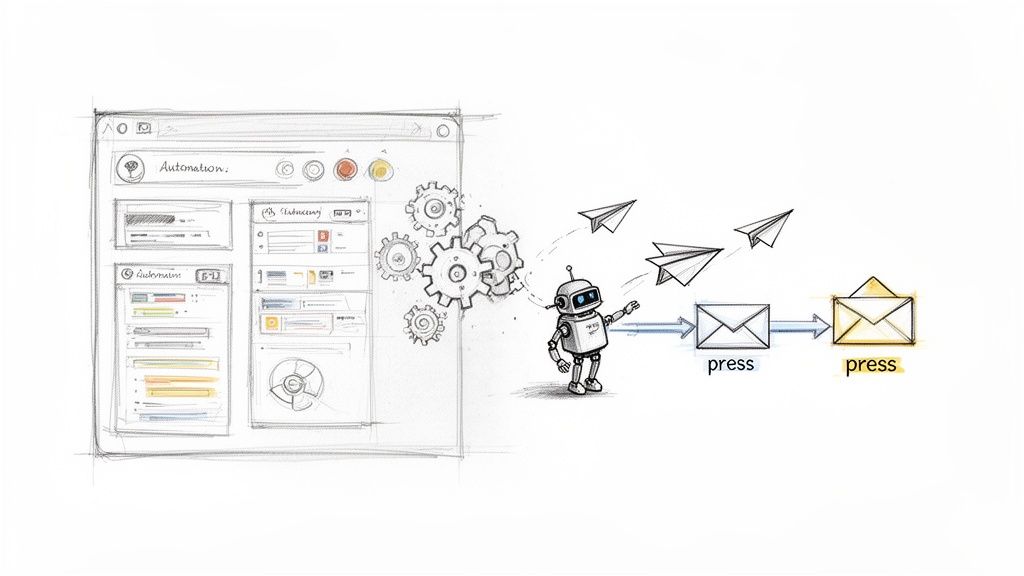
Think of it like having a "PR agency in a box"—a system that does the heavy lifting while you stay focused on building your company. Modern PR platforms make top-tier results accessible, turning a once-overwhelming process into a predictable workflow.
The Power of an AI-Driven Pitching Engine
At the heart of any successful media outreach is getting the right story to the right journalist at the right moment. AI-powered platforms like PressBeat turn this from a guessing game into a science. The system can instantly scan a massive database of journalists to find the exact people who cover your industry and have a history of writing about topics just like yours.
This kind of technology takes the most time-sucking tasks off your plate:
- Finding the Right Journalists: Instantly pinpoint reporters in over 160 countries who are a perfect match for your announcement. No more endless searching.
- Crafting Personalized Pitches: AI can help you draft pitches that feel personal, often by referencing a journalist’s recent articles. This small touch dramatically increases your reply rate.
- Automating Follow-ups: The system manages smart, polite follow-ups for you, keeping your story top-of-mind without being a nuisance.
By automating the outreach, startups can finally achieve the scale and precision that used to be reserved for big agencies with big budgets.
From Murky Retainers to Clear Results
One of the biggest knocks on traditional PR has always been the lack of transparency. You write a big check, cross your fingers, and hope for the best. Modern platforms completely upend that old model by giving you total visibility into your campaigns.
With a platform like PressBeat, you get a real-time dashboard showing every key metric—from how many journalists opened your pitch to who actually replied. This insight is gold. You can see exactly what's working and what isn't, making your entire PR effort more accountable.
The real goal here is to move from random, one-off press hits to a reliable engine for growth. By focusing on high-authority publications (think DR 70+) and even offering a performance guarantee, platforms like PressBeat are turning high-impact media coverage into a dependable part of a startup’s marketing toolkit.
This data-driven, automated approach finally gives startups a way to earn powerful, authentic media validation that is efficient, transparent, and built to scale right alongside them.
Got Questions About Earned Media? We've Got Answers.
Jumping into earned media can feel a bit like learning a new language. You know it's valuable, but there are a lot of nuances. Let's clear up a few of the most common questions we hear from founders.
How Long Does It Really Take to Get Press Coverage?
This is the classic "it depends" question, but I can give you a more concrete answer than that. If you're going the traditional route—manually building media lists, researching every reporter, and sending one-off emails—you're looking at months of work before you see your first piece of coverage. It's a slow, relationship-driven grind.
But you can speed things up dramatically. Using a more modern, efficient system to get a truly newsworthy story in front of the right people can land you your first publication in under a month. With a platform like PressBeat, we've seen clients get published within weeks of their first campaign.
Is Earned Media Actually Better Than Just Running Ads?
They're different tools for different jobs, but they're most powerful when used together. Paid advertising gives you immediate, controllable traffic. You pick your audience, you pay the price, and the visitors start rolling in. The catch? The second you turn off the spend, the traffic disappears.
Earned media, on the other hand, is an asset you build. It delivers something paid ads never can: genuine trust. That third-party validation from a respected publication makes every other part of your marketing—including your ads—work better. It's the credibility that keeps paying dividends long after the article is published.
For a startup, earned media is the long game. Paid ads rent you an audience for a day, but earned coverage builds a reputation that attracts customers, top talent, and even investors for years to come.
Can We Just Handle PR Ourselves, or Do We Need to Hire a Pricey Agency?
You can absolutely do your own PR, and many founders start out that way. The reality, though, is that it's a massive time sink that can easily pull you away from what you should be doing: building your product and talking to customers.
On the flip side, a traditional PR agency can deliver great results, but their retainers often start at a price point that makes most early-stage startups wince. It's a tough spot to be in.
This is exactly why hybrid solutions are becoming so popular. Platforms built for startups give you the strategic power and reach of an agency, but through smart, affordable software. You get the best of both worlds—real results without the eye-watering cost.
Ready to stop hoping for press and start making it happen? PressBeat's AI-powered platform turns earned media into a predictable engine for growth, helping you land coverage in high-authority publications without the agency price tag. Get your story heard today.