
What is Generative Engine Optimization? A Quick AI-Driven Overview
December 25, 2025

Imagine your brand's expertise showing up as a direct answer in ChatGPT or Google's AI Overviews, not just another blue link on a results page. That's the core idea behind Generative Engine Optimization (GEO).
Simply put, GEO is the strategy of making your content the go-to source for AI-powered answer engines.
Welcome to the New Era of Search with GEO

The internet is changing right under our feet. For two decades, the game was straightforward: climb to the top of Google's search results. Traditional Search Engine Optimization (SEO) was all about that climb, a mix of keywords, backlinks, and technical tweaks to land a spot on page one. It was a fight for clicks, and ranking was king.
But now, a new player is rewriting the rules. Generative AI tools are becoming the world's favorite research assistants. They don't just serve up links; they synthesize information and give you the answer directly. This is precisely why Generative Engine Optimization has become so important. The goal isn't just to rank your website anymore—it's to make your content so authoritative that AI engines choose to quote you.
From Clicks to Citations
Think of it this way: traditional SEO is like getting your book on the most visible shelf in a library. The higher it's placed, the more people see it.
GEO, on the other hand, is about becoming the expert that all the other books on the shelf are citing.
Your goal is no longer just visibility. It's to become the canonical source of truth that AI relies on to build its answers. This shift turns your content from a simple destination into a foundational part of the web's knowledge.
This means the old playbook needs an update. While SEO focuses on convincing search crawlers that you're relevant, GEO is about proving your undeniable authority to Large Language Models (LLMs). This requires a different approach, one that blends the best of SEO with the credibility-building principles of earned media and PR. You can see how this connects to brand building in our guide on what is digital PR.
GEO vs Traditional SEO At a Glance
To make the distinction crystal clear, here’s a quick comparison of where the old and new strategies focus their energy.
| Focus Area | Traditional SEO | Generative Engine Optimization (GEO) |
|---|---|---|
| Primary Goal | Rank high in search results for clicks | Get cited as a source in AI-generated answers |
| Target Audience | Search engine crawlers and human users | Large Language Models (LLMs) and human users |
| Key Metric | Keyword rankings, organic traffic, CTR | Direct citations, brand mentions, attributed answers |
| Content Focus | Keyword optimization, on-page relevance | Factual accuracy, expertise, clear data points |
| Authority Signal | Backlinks, domain authority | Media mentions, expert quotes, verifiable facts |
As you can see, while SEO aims for visibility, GEO targets validation. It's a subtle but powerful shift in thinking.
Why This Matters for Founders and Marketers
For anyone trying to build a brand today—founders, marketers, PR pros—understanding Generative Engine Optimization isn't just a good idea; it's essential. This is how you future-proof your brand's voice online.
As more people turn to AI for instant answers, being the source of those answers gives you a level of authority that a simple link could never match. This guide will show you exactly how to make that shift, moving from chasing clicks to building the kind of influence that makes you an indispensable resource in the age of AI.
Why GEO Is Your New Competitive Advantage
We're in the middle of the biggest change to how people find information since the first search engines came online. For decades, the path was simple: someone typed a query, clicked a blue link, and landed on your website. That entire journey is being short-circuited.
AI-generated answers are quickly becoming the new front page of the internet, and this is completely rewiring user behavior. This isn't some far-off prediction; it's happening right now. Features like Google’s AI Overviews and conversational tools like Perplexity serve up direct answers, summarizing information before a person even has a chance to click. Your brand's content, once just a click away, is now being filtered through an AI.
The Shrinking Click-Through Rate
The impact on website traffic is immediate and easy to see. When an AI summary answers a question directly, there’s often no reason for the user to click through to the source articles. The result? A steep drop in organic traffic, even for content that ranks at the very top. We're facing a new reality where being #1 in the search results no longer guarantees a visit.
The data tells a stark story. By early 2025, AI answer boxes were already showing up for 10–15% of monitored search queries. When they do, clicks plummet. Some industry trackers have seen zero-click rates jump as high as 58–60% in major markets. On average, pages featured in an AI summary see their click-through rate (CTR) fall by 30–54%.
For informational searches, the drop is even more dramatic. One analysis found AI Overviews slashed CTRs by about 50–55%, taking them from a 1.4% benchmark down to less than 0.7%. You can dig into more generative engine optimization statistics to see the full picture.
This forces a major shift in strategy. We have to stop optimizing just for clicks and start optimizing for citations inside the AI answers. The new goal is to be the trusted source the AI quotes.
This is exactly why Generative Engine Optimization gives you a powerful edge. If you ignore this change, you risk becoming invisible as AI becomes the main way people get their information.
From Traffic Driver to AI Influencer
In this new world, earned media plays a completely different—and more powerful—role. It's not just about getting referral traffic or a backlink for SEO anymore. High-quality coverage in authoritative publications is now one of the best ways to influence the AI models that are shaping what people see and believe.
When a respected news outlet writes about your brand, it sends a strong, trustworthy signal that AI engines are built to notice. That's the core of what Generative Engine Optimization is: building a library of credible, third-party proof that an AI can use to form its answers.
Here’s why this is so critical:
- Trust and Authority: AI models are trained to favor information from established, authoritative sources. A feature in a DR 70+ publication sends a much stronger signal than a blog post you publish yourself.
- Narrative Control: When you secure positive and accurate media coverage, you get to actively shape how AI summarizes your company, your products, and your expertise.
- Future-Proofing Your Visibility: As more and more people lean on AI for answers, getting cited directly in those answers is the new form of top-ranking visibility.
Thinking with a GEO mindset isn't just about keeping up with a trend. It's about claiming your brand's spot in the future of how people discover things online. It’s how you make sure your voice is heard when an AI is doing the talking.
Understanding the Core Pillars of GEO
To get your arms around Generative Engine Optimization, you have to shift your thinking. Forget about old-school SEO tactics for a minute and think more like a librarian who's building a collection of trusted knowledge. Why? Because that’s exactly what AI models are doing—scouring the web to find and synthesize the most reliable information they can.
GEO is simply the practice of making sure your brand's expertise is the credible, go-to source they find. It all comes down to three core pillars: authority, recency, and clarity.
Getting these right is how you put GEO into action. It's a straightforward framework for focusing your PR and content efforts where they'll make the biggest difference in this new era of AI-driven search.
This concept map shows how GEO fundamentally changes the game. It positions your brand right inside the AI's answer, which might mean fewer direct clicks but builds massive authoritative influence.
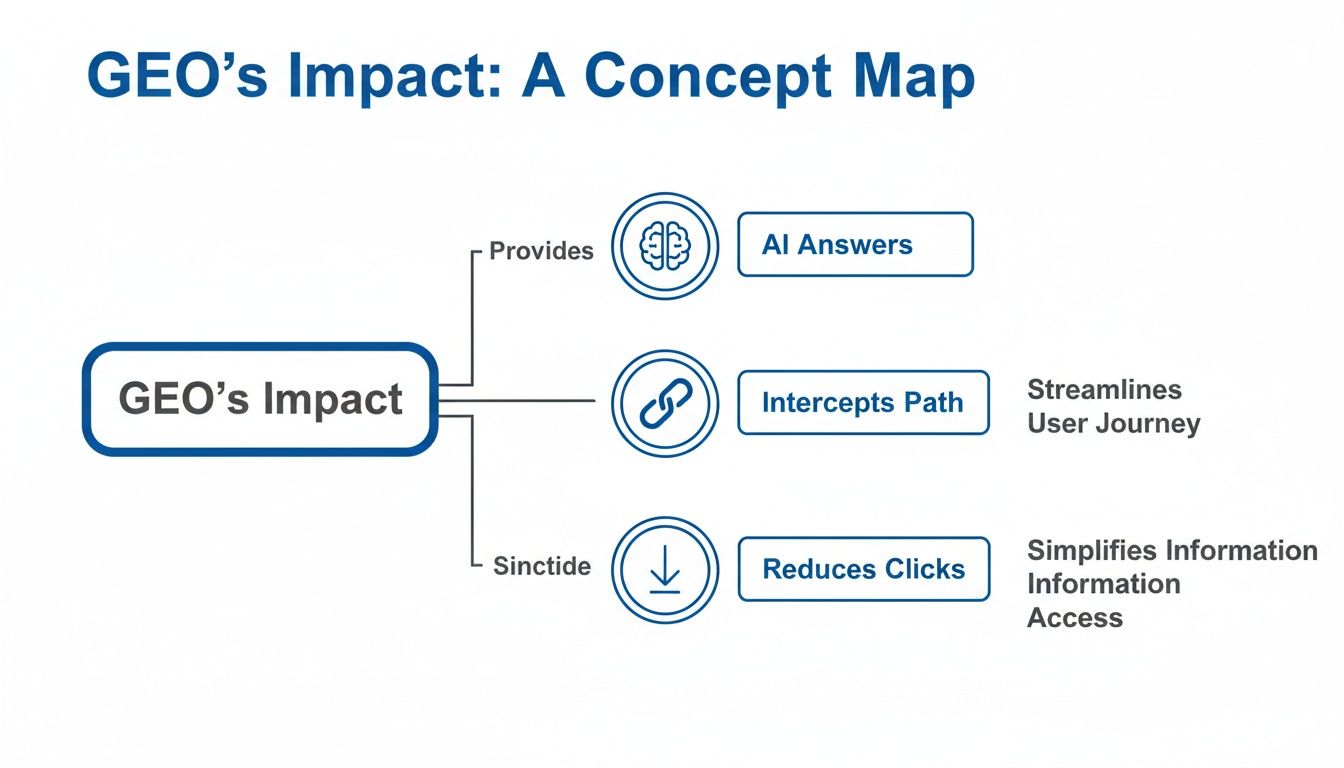
The takeaway here is huge: success isn't just about driving traffic anymore. It's about becoming a cited source within the AI engine itself.
The Pillar of Authority
Authority is the absolute foundation of GEO. AI models are trained to sniff out and prioritize information from sources that ooze credibility and trustworthiness. They're constantly asking, "Who is the real expert here?"
Your job is to make sure the answer is you.
But how do these AI engines actually gauge authority? It’s not just about what you say on your own website. They are looking for validation from other high-quality, independent sources. This is where earned media becomes your most powerful tool.
- High-Domain Rating (DR) Placements: Getting your brand featured in publications with a DR of 70+ sends a massive trust signal. These are established, respected outlets that AI models already trust.
- Third-Party Endorsements: When a reputable journalist or industry publication mentions your company, it's like a public vote of confidence that AI can easily understand and weigh.
- Expert Citations: Quoting recognized experts in your field or, even better, publishing original research adds a thick layer of credibility that algorithms are specifically designed to find and value.
Think of every high-authority media placement as another brick in your brand's digital reputation. The more you stack, the stronger your authority becomes in the eyes of an AI.
The Pillar of Recency
In a world that moves at the speed of a tweet, information gets stale fast. AI models know this. They are hardwired to favor sources that provide the most current, up-to-date information, while dusty, outdated content gets pushed to the back of the line.
Recency isn’t just about hitting "publish" on a new blog post. It’s about maintaining a fresh, relevant narrative around your brand. It tells the AI that your expertise is current and matters right now.
This pillar is all about momentum. If your last significant media mention was over a year ago, an AI might just conclude you’re no longer a major player in the conversation. Consistent, fresh coverage is what keeps your brand top-of-mind for these models.
To nail recency, you need to focus on:
- Consistent News Flow: Keep a steady drumbeat of updates, whether it's a new product, a key partnership, or a funding announcement.
- Joining Timely Conversations: Connect your brand’s expertise to current events or trending topics in your industry. Be part of the conversation.
- Regular Content Updates: Don't let your own website get stale. Keep your content fresh by updating statistics, adding new insights, and refreshing older articles.
This continuous activity ensures that whenever an AI scans the web, it finds a trail of recent, relevant signals that all point back to your brand.
The Pillar of Clarity
The final piece of the puzzle is clarity. You can have the most authoritative, up-to-the-minute content on the planet, but if an AI can't understand it, it's useless. Large Language Models (LLMs) need information structured in a way that’s dead simple to parse, digest, and synthesize.
Clarity is all about making your key messages incredibly easy to grab. This touches on both how you write and how you format your content. The easier you make it for an AI to pull out a key fact, quote, or data point, the higher the chance you'll be cited.
Here are some practical ways to boost clarity:
- Simple Language: Ditch the corporate jargon. Write in a clear, direct style that a human can easily understand.
- Structured Formatting: Use headings, subheadings, bullet points, and numbered lists. These break up the text and create a logical road map for the AI.
- Factual Statements: Present key information as clear, verifiable facts. This makes your content "quotable" for an AI.
- Structured Data: Implement schema markup on your website. This is like giving AI models a cheat sheet that explicitly tells them what your content is about.
By focusing on these three pillars—building undeniable authority, maintaining a constant drumbeat of recency, and presenting your expertise with crystal clarity—you create a powerful GEO strategy. It’s how you position your brand to be the source of truth for the next generation of search.
Putting Generative Engine Optimization Into Action
Theory is great, but seeing how Generative Engine Optimization actually works in the real world is where it all clicks. This is the point where a smart framework becomes a repeatable, predictable system for building the kind of authority that gets you noticed.
Platforms like PressBeat are built specifically to put GEO into practice. They turn abstract ideas like authority, recency, and clarity into a clear, actionable workflow. It’s the perfect example of how a modern brand can engineer the exact media coverage that AI engines are designed to find and cite. We're moving away from just hoping for press and toward building it strategically.
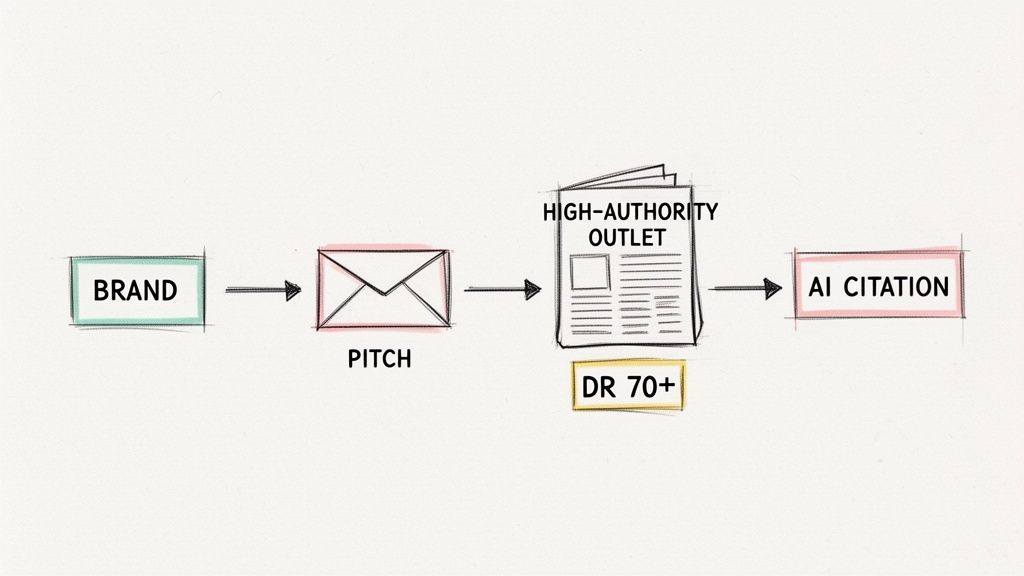
The whole process is designed to do more than just get your name in an article. It’s about getting your name into the right articles—the ones that AI models already see as foundational sources of truth.
Step 1: Target High-Authority Outlets
The first move in any solid GEO strategy is picking the right targets. AI models don’t view all sources as equal; they give enormous weight to established, high-authority publications. This is why a core part of a system like PressBeat is cutting through the noise to focus only on outlets meeting a strict authority benchmark, usually DR 70+.
This isn't your old-school "spray and pray" pitching. Instead, the system intelligently pinpoints the specific journalists and editors who are already covering your industry. That precision makes sure your story lands in front of someone who not only works for a credible publication but actually has an editorial reason to care about your expertise.
By zeroing in on these high-DR outlets, you're directly feeding AI engines the signals they crave when deciding who to trust. Every single placement acts as a powerful vote of confidence, bolstering your brand's digital authority.
Step 2: Craft a GEO-Friendly Narrative
Once you’ve found the right journalists, you have to craft a pitch they can't possibly ignore. Here again, a GEO-focused approach breaks from traditional PR. The goal is to develop a story angle that is timely, genuinely newsworthy, and incredibly easy for a busy journalist to run with.
A platform like PressBeat helps you sharpen your narrative by first validating your media kit and campaign angles. This step ensures your core messages are clear, concise, and backed by facts—making them easy for both a human editor and an AI model to understand.
The system then builds personalized pitches that tie your brand’s news to current trends or ongoing industry conversations. This intense focus on recency is vital for GEO, as it tells AI engines that your brand is a relevant, active player in its field right now.
For example, a pitch might connect your company’s latest data report to a recent industry breakthrough, making your story immediately valuable. This turns what used to be a tedious, manual chore into a streamlined process, allowing brands to keep up a steady drumbeat of fresh coverage. To dig deeper, our guide on the modern AI press release generator explores how technology is changing the game.
Step 3: Deliver Predictable Results
The final piece of the puzzle is turning this entire workflow into a predictable engine for media coverage. The old agency model often feels like a black box—you pay a big retainer and cross your fingers. A GEO-driven platform flips that on its head by emphasizing transparency and guaranteed outcomes.
Here’s how the workflow delivers that predictability:
- Automated Outreach: The system does the heavy lifting, sending personalized pitches and managing follow-ups so you get consistent outreach without the manual grind.
- Real-Time Monitoring: You can track everything on a live dashboard. See which journalists opened your pitch, who replied, and the moment an article goes live. This transparency takes all the guesswork out of the equation.
- Guaranteed Placements: Because the entire process is fine-tuned for success, platforms like PressBeat can offer guaranteed publications, often with a money-back promise. This aligns everyone's interests and ensures you only pay for real results.
By combining smart targeting, newsworthy stories, and transparent tracking, this approach makes high-authority media coverage an achievable, repeatable goal. It’s a system designed from the ground up to build the exact digital footprint that Generative Engine Optimization rewards, helping you get featured in AI answers without the high costs and slow pace of traditional PR.
How to Measure Success in the Age of AI
As AI answer engines start to feel like the new front page of the internet, our old yardsticks for success are quickly gathering dust. If clicks and referral traffic are no longer the name of the game, how do you actually prove your Generative Engine Optimization efforts are paying off? The secret is to shift your focus from vanity metrics to the real signals of influence and authority.
This means we have to look past a simple traffic report. A modern measurement plan for GEO stops counting clicks and starts tracking how AI is shaping and amplifying your brand’s story. It's a blend of qualitative and quantitative insights that shows the genuine, lasting impact of your work.
Moving Beyond Clicks and Traffic
First things first: you have to accept that success in GEO just looks different. A single, authoritative mention in an AI-generated answer can be worth more than hundreds of website clicks. Why? Because it cements your brand as a trusted expert at the very moment a user is looking for a clear, final solution.
Instead of getting bogged down in referral traffic, start watching these key performance indicators (KPIs) that actually reflect GEO goals:
- Brand Mentions in AI Answers: This is your most direct feedback loop. Keep a close eye on how often your brand, products, or key people are cited by engines like ChatGPT, Perplexity, and Google's AI Overviews.
- Sentiment of Citations: It’s not just about getting mentioned; it’s about how you’re mentioned. You need to analyze the context and tone of each citation to make sure the AI is painting your brand in an accurate and positive light.
- Share of Voice: How often does your brand pop up in AI answers for your core topics versus your competitors? A bigger share of voice is a clear sign you’re becoming the go-to authority in your space.
Connecting GEO to Business Outcomes
While direct citations are a crucial metric, you still have to tie your GEO work back to real business results. This is how you prove ROI to stakeholders who are used to seeing traditional analytics. The trick is to find the links between your earned media wins and the metrics that drive the business forward.
Generative Engine Optimization isn’t about abandoning measurement; it’s about measuring what truly matters. We're shifting from tracking immediate actions (clicks) to monitoring long-term influence (authority).
For instance, after you land a piece of coverage in a high-authority publication (think DR 70+), start looking for a lift in corresponding metrics like these:
- Branded Search Volume: When more people start searching directly for your brand name, it’s a powerful indicator that your visibility and authority are on the rise.
- Direct Traffic: An uptick in users typing your URL straight into their browser often points to growing brand awareness, a classic benefit of great media coverage.
- Conversion Quality: The traffic you get from AI referrals might be lower in volume, but the quality is often way higher. These users have essentially been pre-qualified by the AI, which can lead to much better conversion rates.
Ultimately, showing the value of GEO requires a new way of thinking. For a much deeper look, our guide on the measurement of public relations lays out additional frameworks that fit perfectly with this new reality. It’s all about building a solid case that connects high-quality earned media not just to brand mentions, but to the growth of your brand's overall authority and leadership in the market.
Common GEO Mistakes and How to Avoid Them
Shifting to Generative Engine Optimization requires a different way of thinking, and it’s all too easy to slip into old SEO or PR habits. A few common missteps can quietly sabotage your efforts, making your brand invisible when AI assistants formulate their answers. Spotting these pitfalls is the first step to getting it right.
The most frequent mistake is treating GEO like a numbers game—a throwback to old-school link-building. Brands chase a high volume of media placements, assuming that more is always better. This strategy backfires because AI models are incredibly picky about their sources. They'll flat-out ignore mentions from low-authority blogs and content farms.
Another classic error is creating content that sounds like a sales pitch. AI engines are designed to hunt for objective, factual information, not promotional fluff. Overly branded press releases or articles that lack any real insight are immediately disqualified as a trustworthy source.
Chasing Quantity Over Quality
The single most damaging mistake is focusing on getting as many placements as you can, no matter where they come from. Generative engines place enormous weight on publications with high domain ratings (DR)—think DR 70+—because these are proven signals of trust and authority. A single mention in a top-tier outlet is worth more to an AI than dozens of links from obscure sites.
How to fix it: Shift your entire focus from volume to value.
- Target High-DR Outlets: Make it your mission to secure coverage in respected, authoritative publications that AI models already trust.
- Build Real Relationships: Instead of a "spray and pray" email blast, invest your time in connecting with key journalists at the outlets that matter in your industry.
The goal of Generative Engine Optimization isn't just to be mentioned; it's to be mentioned in places that matter. Think of it as earning a reference from a respected expert versus a random stranger.
Creating Promotional Content
It's a tough habit to break, but brands often can't resist talking about themselves. They'll push out press releases for minor company updates or write articles that are just thinly veiled ads. This kind of content completely lacks the objective, factual foundation AI models need to synthesize an answer. It’s seen as biased, and as a result, it gets ignored.
How to fix it: Become a source of genuine insight.
- Invest in Thought Leadership: Create content that’s actually useful, built on original data, expert analysis, or a unique perspective on your industry.
- Answer Real Questions: Develop resources that provide clear, unbiased answers to the questions your audience is asking. This makes your content inherently more valuable and "quotable" for an AI.
Adopting a One-and-Done Approach
The final trap is treating media outreach like a single campaign—something you do for a product launch or a funding announcement and then forget about. This kind of sporadic activity doesn't build the consistent, ongoing narrative that AI engines look for. Without a steady drumbeat of fresh information, your brand’s authority can seem outdated almost overnight.
How to fix it: Maintain consistent momentum. A regular cadence of new, relevant coverage is crucial for signaling recency. This ongoing activity ensures that whenever an AI scans the web for information, it finds a consistent trail of signals that establish your brand as a current and active authority in your field.
Frequently Asked Questions About GEO
As Generative Engine Optimization moves from a buzzword to a must-have, plenty of good questions are popping up. We hear them all the time from founders, marketers, and PR pros who are trying to figure out how to adapt to this AI-first world. Here are the answers to the most common ones.
Is GEO Replacing SEO?
Nope. GEO isn’t here to kill SEO; it’s the next logical step. Think of it as a powerful new layer you add on top of your existing digital strategy, not a replacement for it.
SEO is all about getting your web pages to rank high in the list of blue links, and that's still incredibly important. GEO, on the other hand, is about making your content so clear, authoritative, and citable that AI engines will feature it directly in their generated answers. They share the same foundation—great, trustworthy content—but the end game is a little different. A smart strategy needs both.
Generative Engine Optimization doesn’t replace SEO; it complements it. One gets you on the list of results, the other gets your brand quoted in the answer itself.
How Is GEO Different from SGE?
It's easy to mix these up, but they refer to two different sides of the same coin. SGE, or Search Generative Experience, is the actual feature you see in Google Search—the AI-generated summary that appears at the very top.
GEO is the work you do behind the scenes. It's the whole strategy you use to get your brand, your data, and your insights featured within SGE and other answer engines like Perplexity or ChatGPT.
To put it simply:
- SGE is the product (Google’s AI-powered search feature).
- GEO is the process (all the optimization you do to show up there).
Your GEO efforts are what convince Google's SGE that your brand is the right source to cite.
Can I Optimize for All AI Engines at Once?
For the most part, yes. The fundamental principles of GEO—building authority, staying current, and writing with absolute clarity—will serve you well across every AI platform out there.
That said, different engines do have their own little quirks. Perplexity, for instance, really leans into recent sources and clear citations, which makes your earned media strategy absolutely critical. ChatGPT seems to have a soft spot for deep, comprehensive content that proves you’re an expert.
The best approach? Build a rock-solid foundation that works everywhere. Focus on getting media placements in high-authority outlets (DR 70+) and make sure your content is cleanly structured. Once you have that down, you can start tweaking things if you see one specific AI engine sending a lot of attention your way.
How Do I Start with Generative Engine Optimization?
Getting started with GEO is less complicated than it sounds. The first step is to simply audit your brand's current online narrative. What do AI engines already think about you?
From there, aim your PR and content cannons at high-authority publications that AI models already trust. This is your foundation.
Make sure every single article, press release, or blog post you create is structured for pure clarity. Use sharp headings, bullet points, and facts that are easy to pull out. Shifting your focus from just "keyword density" to creating "quotable clarity" is the single most important step you can take.
Ready to make your brand the authority AI engines trust? PressBeat helps you secure predictable media coverage in the high-authority publications that matter for Generative Engine Optimization. See how it works at https://pressbeat.io.