
Affordable Press Release Distribution: How to Gain Startup Coverage on a Budget
January 2, 2026

Getting your press release out there without breaking the bank is more achievable than you might think. In fact, many solid distribution services now offer plans for under $100 per release. The secret isn't a bigger budget; it's about shifting your mindset from expensive, wide-net campaigns to a smarter, more targeted approach that gets you more bang for your buck.
Why Smart PR Does Not Mean Expensive PR

Let's get one thing straight: you don't need a five-figure agency retainer to get meaningful media coverage for your business. That's an old myth. The game has changed, and today’s tools give small businesses and founders the kind of visibility that was once reserved for the big players. With the right strategy, affordable press release distribution can truly level the playing field.
This isn't a new trend, either. The shift started back in the early 2010s with the rise of services designed to make media outreach accessible to everyone. I remember when platforms like EIN Presswire hit the scene around 2013 with plans for $99.95—a breath of fresh air compared to traditional agency costs.
Fast forward to today, and the market is packed with even more budget-friendly options. You’ve got services like 24-7 Press Release with $29 plans or IssueWire offering free tiers and paid options starting at just $21. When a basic agency campaign can easily run you $5,000, these services can slash your costs by 95% or more. If you're looking for what fits best, you can find great rundowns of the best press release distributors online.
The core idea is simple: a targeted approach often outperforms a massive, expensive blast. Reaching ten highly relevant journalists who actually cover your niche is far more valuable than spraying your news across a thousand generic outlets.
The Modern PR Advantage
Effective PR today isn’t about how much you spend—it’s about how smart you spend it. The availability of powerful, low-cost tools gives startups and small businesses a massive leg up.
So, why can a smaller budget still land you big wins?
- Precision Targeting: Affordable tools let you zero in on the exact journalists, bloggers, and publications that are a perfect fit for your industry. No more guessing.
- Direct Communication: You get to build real relationships with the media yourself. This bypasses the expensive middleman and helps create more authentic, lasting connections.
- Measurable ROI: Modern platforms give you the data. You can see exactly what your investment is getting you in terms of website traffic, valuable backlinks, and brand mentions.
Ultimately, this guide is all about showing you tactics that work without draining your bank account. It’s proof that smart PR has nothing to do with the size of your wallet.
Alright, you've got a polished press release ready to go. Now comes the critical part: how do you actually get it into the right hands? The path you choose here will make or break your entire campaign.
You've essentially got three main routes to consider: the old-school newswire blast, a roll-up-your-sleeves DIY approach, or using modern PR software. Each one has its place, and the best fit really depends on your budget, your goals, and how much time you can spare.
It’s not just about picking the cheapest option; it’s about being strategic. Let's dig into what each path looks like in the real world.
The Traditional Newswire Route
Think of newswires as the classic, wide-net approach. Services like PRWeb or EIN Presswire are designed for mass syndication. You give them your release, and they push it out to a massive network of news sites, media outlets, and online portals.
This is your go-to when you need broad, fast visibility. It works well for things like official financial reports, legally required announcements, or big company news that needs to blanket the internet for SEO purposes. You'll get a ton of online placements and backlinks, which is great for digital presence.
The trade-off? It’s impersonal. Top-tier journalists rarely pick up stories straight from the wire; they’re looking for a personal connection and a unique angle.
The DIY Manual Outreach Method
The DIY approach is the polar opposite of a newswire blast. This is all about precision and personal touch. You become the publicist, painstakingly researching and building a hyper-targeted list of journalists who genuinely cover your industry.
Instead of a generic blast, you'll send a handful of carefully crafted emails, referencing a reporter's recent articles and explaining exactly why your news is a perfect fit for their audience. It's slow, detailed work, no doubt about it.
But the payoff can be huge. This is how you land meaningful feature stories. If you have a compelling, human-interest angle and your goal is to get coverage in 5 key publications rather than 500 random websites, this is the way to go. The only real cost is your time.
Key Takeaway: Your choice depends on your goal. Are you aiming for widespread online visibility for SEO and brand awareness (newswire), or are you trying to land a feature story in a top industry publication (DIY)?
The Modern PR Platform Solution
What if you want the best of both worlds? That’s where modern PR platforms come in. They offer a powerful middle ground, blending the scale of a newswire with the targeting of DIY outreach.
These software tools give you access to vast media databases, help you pinpoint the right journalists, and streamline your outreach efforts. It's a way to personalize your pitching without spending hundreds of hours on manual research.
This is a fantastic option for small teams and startups that need an efficient, repeatable, and data-driven process. You get the tools to scale your outreach intelligently. For a deeper look at the players in this space, our guide on the best press release distribution services breaks down the specific features and costs.
Comparing PR Distribution Methods
To make the decision a little easier, here's a side-by-side look at how these three methods stack up against each other.
| Method | Best For | Typical Cost | Key Advantage | Main Drawback |
|---|---|---|---|---|
| Newswire Service | Broad online visibility, SEO backlinks, official announcements | $100 - $1,000+ per release | Speed and massive syndication | Low chance of media pickups |
| DIY Manual Outreach | Building media relationships, landing feature stories, niche news | Your time | High-impact, personalized coverage | Extremely time-consuming |
| PR Platform | Scalable, targeted outreach with data-driven insights | $50 - $500+ per month | Blends automation with personalization | Can have a learning curve |
Ultimately, the right choice is the one that aligns with your specific goals. A newswire can give you a quick SEO boost, but nothing beats a personalized pitch for landing a story that truly moves the needle.
Craft a Media Kit That Actually Gets Used
Your press release is the hook, but a solid media kit is what reels the journalist in and helps them build the story. Think of it as your company's ultimate cheat sheet. When you hand a reporter everything they need in one tidy package, you save them a ton of time and instantly look like a pro who has their act together.
Don't make the mistake of dumping every single company document into a massive, bloated folder. The name of the game is lean and effective. A reporter chasing a deadline doesn't have time to dig for your logo or a decent headshot; they need the key assets, and they need them now. Nailing this is a cornerstone of any affordable press release distribution plan because it makes a reporter's "yes" that much easier, and it doesn't cost you a dime.
The Essentials for Your Lean Media Kit
Your kit needs to be the go-to resource that answers all the basic questions and provides ready-to-use assets in a flash. Focus on making it dead simple to navigate. Every single item in there should have a clear purpose and remove a potential headache for the journalist.
Here’s what you absolutely have to include:
- Company One-Pager: A clean, one-page PDF that sums up who you are, what you do, your mission, and the key facts—think founding date and a list of your executive team.
- High-Resolution Logos: Don't make them hunt. Provide your logo in different formats (a .PNG with a transparent background is a must-have) and color variations, like full-color, black, and white.
- Professional Headshots: Include crisp, high-quality photos of the key people, like your CEO or founder. Make sure they’re well-lit and have a consistent style.
- Product or Service Imagery: Give them a gallery of high-resolution screenshots, product photos, or even lifestyle shots showing your offering in the real world.
If you want a deeper dive, our complete guide on how to create a press kit breaks down every element and shows you exactly how to put one together.
Thinking about how this all fits into your broader strategy? This chart helps map your PR goals to the right distribution approach.
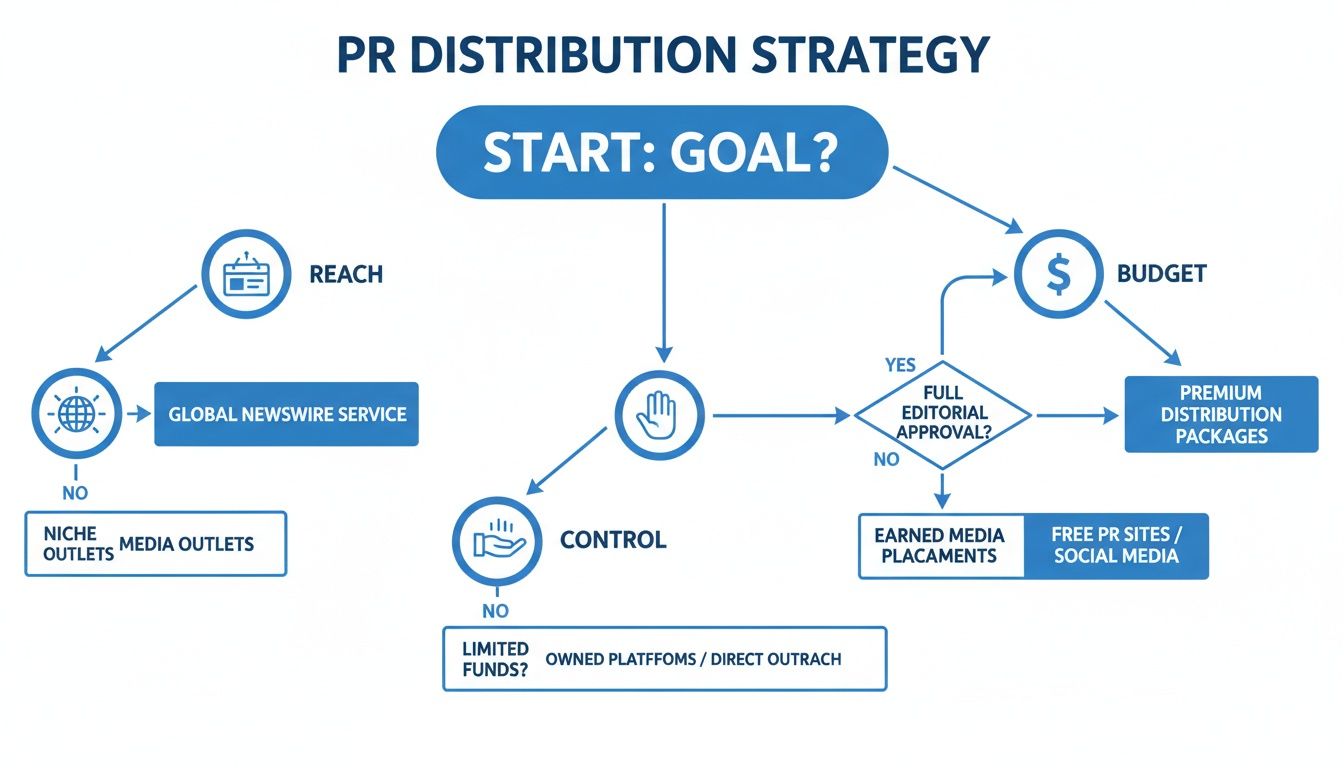
As you can see, the path you choose—whether you're aiming for massive reach, total control over your message, or just trying to be smart with your budget—will define what success looks like.
Putting It All Together (Without a Designer)
Good news: you don't need to hire a designer to build a professional media kit. The real keys are keeping it clean, organized, and incredibly easy to access.
My favorite pro tip: Host your media kit on a simple, easy-to-find page on your website, something like
yourcompany.com/media. From there, all you have to do is drop that one link into your pitch. No more clogging up inboxes with a bunch of heavy attachments.
It's as simple as creating a main folder in Google Drive or Dropbox. Inside, create subfolders for "Logos," "Headshots," and so on. Then, just grab a shareable link—making sure it’s set to "public" or "anyone with the link can view." This tiny bit of prep work shows you're ready for business and makes a journalist's job so much easier, which can be the difference-maker in getting that story published.
Writing a Press Release That Stands Out
You don't need to shell out for an expensive copywriter to get media attention. The real secret to a press release that actually gets read isn't a massive budget—it's mastering the art of storytelling. Journalists are swamped with hundreds of pitches every single day. Yours has to cut through that noise immediately.
The most important shift you can make is to frame your announcement as a story. Don't just list facts. Connect your news to a bigger industry trend, a problem you're solving for real people, or a milestone that matters. That’s how a dry update becomes a narrative a reporter can actually run with.
Crafting a Killer Headline and Lead
Your headline is everything. It's often your only shot to make a journalist pause and click instead of hitting delete. It needs to be specific, punchy, and deliver the core news in under 100 characters. Ditch the vague, clickbait-style fluff and go for pure clarity. Put yourself in their shoes: what’s the single most important piece of information here?
For instance, "Startup X Launches Innovative New Platform" is a guaranteed path to the trash folder. Something like "Fintech Startup ‘LaunchPad’ Secures $5 Million to Automate Small Business Invoicing" is worlds better. It instantly tells the reporter who’s involved, what the news is (funding), and why it matters. If you’re stuck, browsing a few press release headline examples is a great way to get the creative gears turning.
Next, your lead paragraph has to deliver on the headline's promise within the first 25-40 words. It must quickly answer the classic questions:
- Who is this about?
- What is the actual news?
- When is this happening?
- Where is the company or event located?
- Why should anyone care?
This is the "inverted pyramid" in action. It’s designed so a time-crunched journalist can grasp the entire story in 30 seconds. Even if they only read that first paragraph, they should have everything they need to know.
Your goal is to make the journalist's job ridiculously easy. A clean, well-structured story with a clear angle isn't just a press release—it's the blueprint for their next article.
Building Out the Body and Adding Credibility
Once you've hooked them, the body of the release is where you add the supporting details and color. This is your chance to weave in more context, but stay laser-focused. This is a news document, not a sales page, so kill the jargon and marketing fluff.
To really add some weight, drop in a powerful quote. A direct quote from a founder, CEO, or even a happy customer adds a much-needed human element. It gives journalists a unique perspective they can lift directly into their story. Just make sure it sounds like a real person talking and adds genuine value, rather than just repeating facts you've already stated.
Finally, every professional press release needs to be wrapped up with these three components:
- Boilerplate: A short, standard paragraph at the very end describing your company. Think of it as your "About Us" for the media.
- Media Contact: The name, email, and phone number for the person reporters can reach out to. Make sure they're prepared to answer questions!
- ### (End Mark): A simple
###centered on its own line signals the end of the document.
Following this structure shows you respect a journalist's time and know what you're doing. A well-written release is the foundation of any affordable press release distribution plan because it will perform better no matter which channel you end up choosing.
Finding the Right Journalists Without Wasting Hours
You can write the most compelling press release in the world, but if you send it to the wrong people, it’s like shouting into the wind. It just won't matter. The secret to effective, budget-friendly PR isn't a massive, expensive blast—it's precision targeting.
Forget building a huge list of a thousand generic contacts. Your real goal is to curate a small, powerful list of journalists, bloggers, and influencers who actually cover your world. This focused approach is what gets your news into an inbox where it’s not just another email, but a genuinely relevant story. That’s how you get noticed.
Scrappy Tactics for Building Your Media List
Here’s the good news: you don't need to shell out for expensive database software. A little digital detective work using tools you already have is often all it takes to build a killer list. You just need to think like a reporter and look for bylines.
Start with a few smart Google searches. Instead of just searching your keywords, get specific. Try queries like:
"SaaS funding news" writer"fintech product launch" author"sustainability startup" journalist
This simple trick will pull up articles written by the exact people who cover your beat. Jot down their names and the publications they write for. That's the bedrock of your media list right there.
LinkedIn is another goldmine. Use its search bar to find people with titles like "tech reporter," "business journalist," or "editor" at the outlets you’ve already flagged. You can often see their recent articles and posts, which gives you priceless intel on their specific interests.
A well-researched list of 20 highly relevant journalists is infinitely more valuable than a generic list of 2,000 random media contacts. A bit of personalization will always outperform a generic mass email blast.
Leveraging Social Media for Direct Connections
Don't overlook Twitter (now X). It’s probably the most powerful free tool you have for connecting with journalists. So many reporters are active on the platform, sharing their work and talking about the topics they're genuinely passionate about.
Use the search function to find conversations happening around your industry's keywords and see which journalists are chiming in. Follow them. Engage with their content (genuinely, please!). This isn't just about finding an email address; it’s about getting a feel for their beat and what they care about long before you ever send a pitch.
Once you’ve found your key targets, you have to get in touch. To really make an impact, you'll need to know how to find anyone's email address and connect with them directly.
This hands-on method is a world away from just throwing your news on a broad newswire service. That said, the rise of budget-friendly distributors has completely changed the game. There are now over 20 major distributors with plans under $100. In fact, data shows 70% of small businesses are now choosing these affordable wires over traditional PR agencies, saving a massive 80-90% compared to high-end services.
Think about it: companies like News Power have plans starting at just $59, while NewswireJet offers targeted analytics for $129. This shift in evolving PR pricing models means you can blend a targeted DIY list with an affordable wire for a seriously powerful, modern strategy.
Tracking PR Wins That Actually Matter
So, you've sent your press release out into the world. Now what? The big question is whether your budget-friendly distribution strategy is actually paying off. It's incredibly easy to get dazzled by vanity metrics like "potential reach," which is often just a hugely inflated, theoretical audience number.
The real measure of success isn't about how many eyeballs could have seen your news. It’s about the tangible impact it had on your business. To prove the value of your work, you have to connect the dots between your PR activity and results that actually move the needle. Let's shift the conversation from "how many people saw it?" to "what business did it bring in?"
Key Metrics to Monitor
Instead of drowning in abstract figures, you’ll want to track a few concrete outcomes. The good news is you can do most of this with free tools like Google Analytics. After each campaign, make these metrics your first stop.
Referral Traffic: Dive into the Acquisition report in Google Analytics. Can you see traffic coming from the specific media outlets that picked up your story? This is your direct link between a press mention and a new website visitor.
New Backlinks: Use a free tool like Google Search Console to see who’s linking to your website. Every time a high-authority domain links back to you, it's a huge win for your SEO and overall credibility.
Branded Search Volume: Take a look at your search data. Did more people search for your company's name right after the release was published? A sudden spike is a clear signal that you’ve sparked real interest and boosted brand awareness.
Direct Leads and Conversions: This is where the rubber meets the road. If you haven't already, set up goal tracking in Google Analytics. Now you can directly attribute new sign-ups, demo requests, or sales to the traffic generated from your media placements.
A single media placement that drives 10 qualified leads is infinitely more valuable than a hundred placements that generate zero traffic. Focus on the outcomes, not just the output.
Beyond the metrics from traditional media, don't forget about your wider online reputation. A big part of managing public perception involves cultivating positive online reviews on platforms like Google. This kind of organic feedback is powerful social proof that reinforces the credibility you build through press coverage.
Ultimately, tracking these real-world numbers is how you prove the ROI of your PR strategy. It gives you the hard data you need to fine-tune your approach and get even better results next time.
Got Questions? We've Got Answers
When you're trying to get your news out there without breaking the bank, a few questions always seem to pop up. Let's tackle some of the most common ones I hear from folks just starting out.
What's the Best Day to Send Out a Press Release?
You want to hit that sweet spot in a journalist's week. I've always had the best luck sending releases out mid-week—think Tuesday, Wednesday, or Thursday mornings.
Try to land in their inbox between 9 AM and 11 AM local time. Mondays are usually a blur of catching up and planning, and by Friday afternoon, most editors are already thinking about the weekend. Your big news can easily get lost in the shuffle.
How Much Should I Realistically Budget for a Campaign?
You don't need a massive budget to make a real impact. For a solid, single press release campaign, a budget somewhere in the $75 to $200 range is a fantastic place to start.
This amount is enough to get you on reputable distribution services that guarantee placement on hundreds of legitimate news sites. You get a great mix of online visibility and genuine value, without shelling out for the big-name newswires.
The real win with a budget-friendly press release isn't just about getting published. It's about getting published on sites that actually build your credibility and get your story in front of the right people.
How Many Sites Will My Release Actually Appear On?
With most affordable distribution services, you can expect guaranteed placement on anywhere from 100 to over 300 websites. This is huge for your online footprint and gives your SEO a nice little boost.
Just keep in mind, getting a feature story in a place like Forbes or TechCrunch is a different game. That almost always comes from building relationships and sending personalized pitches directly to the journalists who cover your beat.
Ready to stop guessing and start getting guaranteed media coverage? PressBeat uses AI to find the perfect journalists and craft pitches that get noticed, ensuring your startup's news lands in top publications. See how PressBeat can secure your next feature.