
A Modern Guide to Crisis Public Relations Management
December 14, 2025

Crisis public relations is all about managing the conversation between your company and the public when things go wrong. The goal? To protect your reputation from taking a serious hit. It's about a fast, controlled response to minimize the damage and, hopefully, rebuild trust with your customers and stakeholders.
Understanding Your Public Relations Playbook
For any startup or fast-paced marketing team, a PR crisis isn't a matter of if, but when. It could be anything—a product recall, an executive's poorly-worded tweet, or a single negative review that catches fire online. These things can spiral into a full-blown reputational nightmare in a matter of minutes.
Without a plan, most teams panic. The result is often chaotic, mixed messaging that only pours fuel on the fire. This is exactly why a crisis public relations playbook is one of the most critical documents your company can have.
A solid playbook turns that reactive panic into a structured, strategic response. It's not some dusty document you write once and forget about. Think of it as a living guide that clearly defines roles, responsibilities, and pre-approved actions before you're in the hot seat. For a solid example of how to structure those immediate steps, this crisis management playbook for law firms is a great reference. The industry is different, but the core principles of having a clear, actionable plan are universal.
The Core Pillars of Crisis Readiness
You can't possibly plan for every single thing that could go wrong. Instead, effective crisis management is about building a flexible framework that can adapt to whatever comes your way. Your entire readiness strategy really boils down to a few key pillars:
- Proactive Monitoring: You can't get ahead of a crisis you don't even know is brewing. This means setting up social listening tools and alerts to catch negative chatter before it explodes.
- A Designated Response Team: When a crisis hits, there should be zero confusion about who's in charge. This team needs to include key people from your comms, legal, and leadership teams.
- Clear Escalation Protocols: Not every negative comment is a five-alarm fire. Your playbook needs to spell out what turns a minor issue into a major event that requires everyone's immediate attention.
A 2021 PwC survey really put this into perspective, finding that a staggering 95% of business leaders felt their crisis management capabilities needed to be better. That's a huge gap between knowing a crisis can happen and actually being ready for it.
From Theory to Action
At the end of the day, a crisis PR strategy is about taking back control—control of the narrative, your message, and your internal response.
Think of it as building organizational muscle memory. By running drills and making sure everyone knows the playbook, their actions become second nature when the pressure is on. This preparation is what ensures your first public statement comes across as confident and empathetic, not defensive and jumbled. It also gets all your internal teams on the same page, stopping conflicting messages from leaking out and doing even more damage. This guide will walk you through the practical steps and templates you need to build that muscle.
Building Your Crisis Detection and Escalation Framework
Great crisis PR isn't really about having the perfect response ready to go; it's about having a system that catches the smoke before it turns into a wildfire. You simply can't respond to a crisis you don't see coming. This means you need to stop reacting and start proactively listening for trouble—and know exactly what to do when you find it.
The whole system is built on a foundation of constant, intelligent monitoring. You have to set up real-time media monitoring and social listening alerts, but don't just stop at your brand name. Cast a wider net to track:
- Your brand and products: Obviously, you need to catch direct mentions, reviews, and any discussions popping up.
- Key executives: Keep an eye on the public profiles and mentions of your C-suite and other public-facing leaders.
- Industry keywords and competitors: This helps you understand the broader conversation and spot issues that could splash onto you.
Using Technology to Separate Noise from Threats
Let's be real—the sheer volume of online chatter makes manual tracking a fool's errand. This is where AI-powered tools become your best friend. Modern PR software can analyze sentiment at scale, figuring out the difference between a single grumpy customer and a coordinated negative campaign that's gaining steam. These tools cut through the noise so your team can focus on what actually matters.
In today's world, preparedness and speed are everything. Most communications pros know that a crisis is most likely to ignite or spread online. Yet, recent data shows a lot of companies still have big gaps in their readiness. The 2025 Cision and PRWeek Comms Report, which surveyed over 300 senior PR leaders, found that crisis comms, AI, and data are top priorities. The consensus? Rapid detection and response are no longer optional—they're fundamental to protecting your reputation.
This process generally breaks down into three core phases: Prepare, Respond, and Recover.
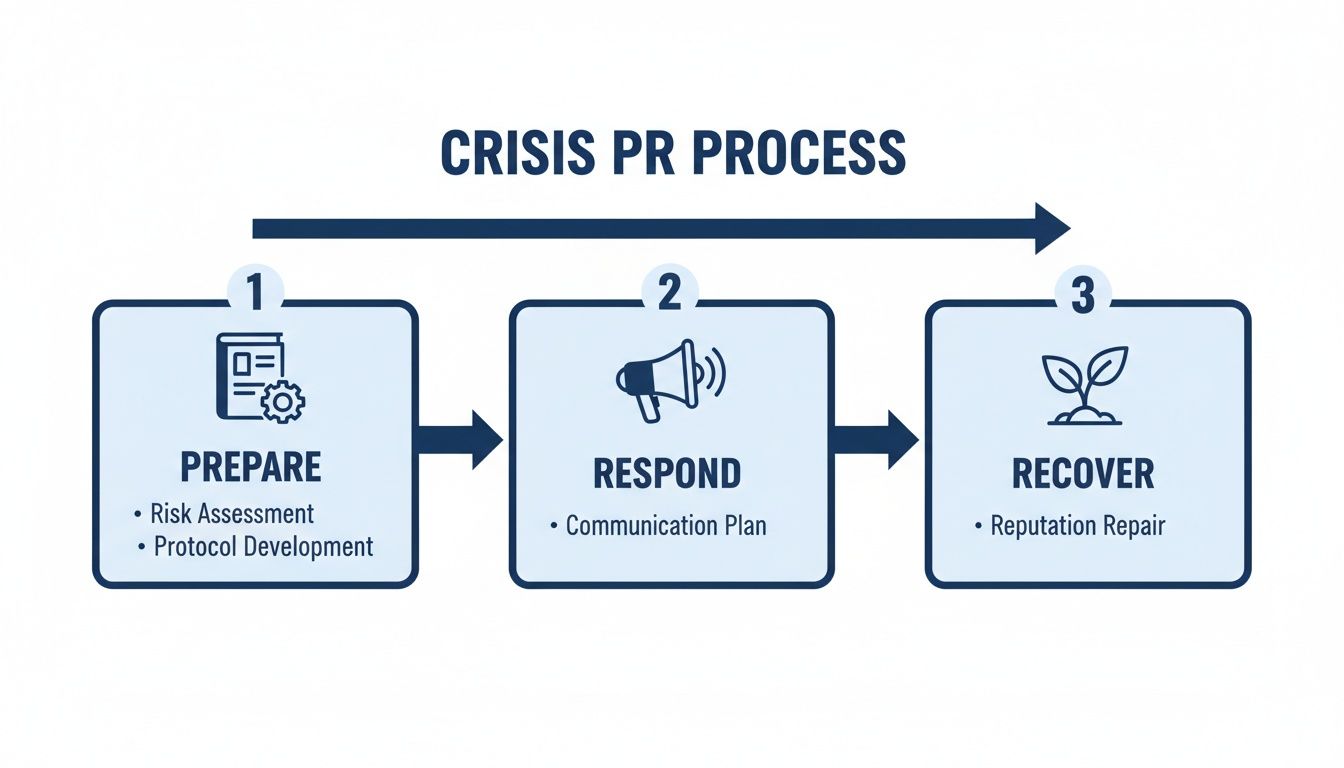
As you can see, a successful outcome depends on a continuous loop of solid preparation, decisive action, and thoughtful recovery.
Defining Your Escalation Protocol
Okay, so your monitoring tool flags a potential issue. Now what? A clear escalation protocol is what saves you from guesswork and panicked decisions. This is your roadmap—a simple but powerful guide that defines what separates a minor customer service ticket from a full-blown crisis needing executive attention.
It needs to clearly map out who gets notified, when they get notified, and how. A crucial part of this is having a modern data breach response plan ready, as data breaches are one of the most common and damaging crises a startup can face.
Key Takeaway: Your escalation path should be so clear that even a brand-new team member can look at it and know the immediate next step. The goal is to move from detection to informed action in minutes, not hours.
To make this practical, you need to assemble and train your Crisis Response Team (CRT) long before you ever need them. This isn't just a theoretical exercise; it's about assigning specific, actionable roles.
- Team Lead/Coordinator: The quarterback of the crisis, making sure all the moving parts are in sync.
- Primary Spokesperson: The single, trained voice who will talk to the media and the public.
- Internal Comms Lead: Responsible for keeping employees and internal stakeholders in the loop and on-message.
- Legal Counsel: Reviews every external message to make sure you're not creating unnecessary legal risk.
- Social Media Manager: Manages the real-time conversation and monitoring on all your social channels.
By defining these roles and setting up your protocols now, you build a system that's ready to activate at a moment's notice. We get into the nitty-gritty of what to include in our detailed guide on building a complete crisis management plan. This prep work is what ensures your response is swift, coordinated, and professional when it counts.
Crafting Your Rapid Response Crisis Messaging

When a crisis hits, the clock is your enemy. In the world of crisis PR, we live and die by the "Golden Hour"—that critical first 60 minutes where you have the best chance to shape the narrative. If you don't, you can be sure someone else will.
Silence is a vacuum, and speculation and misinformation will rush in to fill it. In those early moments, staying quiet looks like guilt, incompetence, or worse, indifference. Your first move isn't to have all the answers, but to show you're on it. A swift, carefully worded holding statement is your best friend here.
It’s a simple move, but it’s powerful. It buys you precious time to get your facts straight while showing everyone—your customers, your team, the media—that you're aware of the situation and taking it seriously. It acknowledges the problem, expresses concern, and promises that more information is coming. This single act can stop a bad situation from becoming a full-blown catastrophe.
The Anatomy of a Powerful Crisis Message
Once you’re past that initial holding statement, your messaging needs to be built on a rock-solid foundation. There are three things you absolutely have to get right to protect your reputation and start rebuilding trust.
- Acknowledge and Show Empathy: Before anything else, people need to see that you get it. They need to hear that you understand how serious this is and that you genuinely care about those who are affected. Drop the corporate-speak and use real, human language.
- Take Appropriate Accountability: This one is a tightrope walk. You have to own your part in the problem without opening yourself up to unnecessary legal risk. A good starting point is something like, "We are taking this matter very seriously and are conducting a full investigation into what happened."
- Outline Immediate Actions: Don’t just say you’re sorry—show it. Be crystal clear about the concrete steps you are taking right now to fix the problem, help anyone impacted, and make sure it never happens again.
A crisis message has to be delivered with both confidence and compassion. The tone you strike in those first few hours will dictate how you're perceived for the entire life of the crisis. People are looking for leadership, not a defense attorney.
Just look at the Deepwater Horizon oil spill. The initial response came across as defensive and completely tone-deaf, which crippled the company's reputation for years. That event was a wake-up call for the entire industry. Now, we know to prioritize immediate, transparent communication with verified facts and a heavy dose of empathy. Diving into some of these historical PR failures is a great way to see what not to do.
Developing Your Messaging Framework
In the middle of chaos, consistency is your shield. This is where a messaging framework, or a message map, becomes invaluable. It ensures everyone on your team—from the CEO talking to reporters to the social media manager handling angry comments—is telling the same story.
This isn't just a single press release. Think of it as a central playbook for all your crisis communications. It should include:
- Core Message: A quick, 2-3 sentence statement that nails down your position.
- Key Talking Points: Between 3-5 bullet points that back up your core message with the facts you've confirmed.
- Q&A Document: Get ahead of the game by anticipating the hardest questions you’ll face and drafting clear, concise answers.
- Audience-Specific Messages: Tweak the core message for different groups. Your employees need to hear something different than your investors or your customers.
To keep your communication sharp and effective, a simple do's and don'ts framework is incredibly helpful.
Crisis Messaging Framework Do's and Don'ts
Here's a quick-reference guide to make sure your crisis communication hits the right notes and avoids common pitfalls.
| Principle | Do (Effective Approach) | Don't (Ineffective Approach) |
|---|---|---|
| Accountability | State that you are investigating and taking the issue seriously. | Blame others, make excuses, or issue a flat "no comment." |
| Empathy | Acknowledge the impact on those affected and use human language. | Use cold, corporate jargon or minimize people's concerns. |
| Action | Clearly state the immediate, concrete steps you are taking. | Make vague promises or say you'll "look into it" without specifics. |
| Transparency | Commit to providing regular updates as more facts become available. | Go silent for long periods or release conflicting information. |
Remember, your first message sets the tone for everything that comes after. By moving quickly, communicating with empathy, and showing decisive action, you can successfully steer through the storm and start the process of rebuilding trust. That’s the core of effective crisis public relations.
Getting the Word Out: Media and Stakeholder Comms
Once you've locked down your core crisis message, the real work begins: getting it to the right people. It’s one thing to have a great statement; it's another thing entirely to ensure journalists, employees, investors, and partners actually see it. This is where your tactical crisis public relations plan shifts into high gear, focusing on targeted, consistent, and effective distribution.
When a crisis hits, you don't have time to be digging through spreadsheets or manually searching for journalist emails. That’s a recipe for disaster. Modern PR tools are your best friend here, letting you build hyper-targeted media lists in minutes. Forget the old "spray and pray" method. You can instantly filter for reporters who cover your specific industry, your city, and even similar incidents. This precision is everything—it means your pitch actually lands in a relevant inbox.
With your list ready, the pitch itself has to be incredibly concise. Journalists are drowning in noise during a breaking story, and a long-winded email will get deleted before they finish the first sentence. Your mission is to give them the essential, verified facts they need to report the story accurately.
Crafting a Pitch That Cuts Through the Noise
Think of your media pitch as the bridge between your official statement and the news story that ultimately gets published. It needs to be direct, factual, and genuinely helpful.
- Make your subject line clear and factual. This is not the time for clickbait. Something straightforward like "Statement from [Your Company] Regarding [The Incident]" is perfect.
- Lead with the most important info. Put your official statement or its key takeaways right in the first paragraph. Don't bury the lede.
- Link, don't attach. Always include links to your full press release, a dedicated crisis page on your website, or any other official resources. Attachments are a one-way ticket to the spam folder.
This first wave of outreach is your best chance to shape the narrative. If you want to dig deeper into the art of writing a pitch that reporters will actually open, our guide on what is a media pitch is packed with practical examples. The golden rule is to make their job easier, not harder.
Key Insight: In a crisis, journalists are not your enemy. They are a critical audience. If you provide them with fast, accurate, and easy-to-digest information, you foster fair reporting and prevent the rumor mill from taking over.
Don't Forget Your Insiders: Internal and Stakeholder Comms
While the media is your most public audience, your internal team and key stakeholders are arguably the most important. Nothing spreads faster than internal rumors, and a confused or frightened team can easily lead to leaks and conflicting public messages. In fact, a PRWeek study found that the CEO was directly involved in communications in 82% of successful crisis recoveries, which just shows how vital top-down clarity is.
Your internal communications plan has to be just as thoughtful as your external one. The primary goal is to establish a single, reliable source of truth for everyone connected to the company.
This means picking the right channel for the right group. While everyone should hear the same core message of accountability and action, the level of detail will vary.
- Employees: Start with an all-hands meeting (virtual is fine) led by the leadership team. Keep the conversation going with regular updates in a dedicated Slack channel or via a company-wide email.
- Investors & Board Members: These folks warrant a direct email or a private conference call from the CEO. They need to understand the potential business impact and the exact steps you're taking to manage it.
- Key Partners & Customers: For high-value relationships, a personal email from their main point of contact goes a long way. For your wider customer base, a dedicated landing page with a clear FAQ is an excellent, scalable solution.
By running these communication streams in parallel, you present a united front. You squash rumors before they start, make your team feel valued and informed, and reassure your partners that you've got the situation under control. This kind of coordinated response is what separates the pros from the amateurs.
Repairing Your Reputation After the Storm

You managed to navigate the initial chaos of a PR crisis. That's a huge win, but don't mistake it for the finish line. Putting out the fire is just the first, most frantic part of the job.
The real, lasting work in crisis public relations starts once the smoke clears. It's the slow, deliberate process of repairing your reputation and, more importantly, rebuilding the trust you’ve lost. This is where you prove that your apology and promises of action were more than just damage control.
Conducting a No-Holds-Barred Post-Mortem
Before you can truly move forward, you have to look back with brutal honesty. The first step in any genuine recovery is a thorough post-crisis analysis—a "post-mortem." This isn't about pointing fingers. It's about finding the root cause of the failure so you can make damn sure it never happens again.
Your analysis needs to dissect two key areas: the operational failure that caused the crisis and the communications failure that might have worsened it. Get your crisis team, key stakeholders, and even a few objective outsiders in a room to ask the hard questions.
- Operational Breakdown: What process, policy, or technical glitch actually led to the incident? Was it a known risk we ignored, or something completely out of left field?
- Communication Gaps: Where did our messaging fall short? Were we too slow? Was our tone deaf? Did different teams have conflicting information?
The goal here is a clear, factual account of what went wrong and why. This internal audit is the bedrock of your entire reputation repair strategy.
From Analysis to Actionable Change
Insights are useless if they just sit in a report. The findings from your post-mortem have to translate directly into a plan that highlights concrete actions. You don't rebuild trust with promises; you rebuild it with proof. People need to see you fixing the problem.
Rebuilding trust requires more than just words; businesses must take tangible actions to demonstrate their commitment to customers and stakeholders. A public commitment to change creates accountability and shows you've learned from the experience.
This plan should be made public, at least to a degree that makes sense for your business. Transparency is your greatest ally right now. Consider taking these steps:
- Publish a Post-Mortem Report: A transparent, public-facing report detailing your findings and the steps you're taking can be incredibly powerful. It shows you have nothing to hide.
- Launch New Initiatives: If the crisis exposed a weakness in your company culture, launch a new corporate social responsibility (CSR) or ethics program to address it head-on.
- Visible Leadership: Get your CEO to publicly discuss the lessons learned and the path forward. This could be a blog post, a video, or a handful of candid interviews.
Reshaping Your Digital Footprint
In this day and age, a crisis lives forever in Google search results. A critical part of long-term reputation repair is actively working to reshape your brand’s digital footprint, pushing positive, accurate stories to the top. This is where SEO and content marketing become your best friends.
The strategy is to create a steady stream of high-quality, positive content about your brand. This can highlight the changes you've made, showcase glowing customer success stories, or position your leaders as industry experts. For those looking to get this right, it’s worth exploring some foundational reputation management best practices to accelerate your recovery.
Over time, this good stuff will start to outrank the negative articles tied to the crisis, pushing them down where fewer people will see them. It's a long game, but it's essential for ensuring a single bad chapter doesn't define your brand's entire story. This is your chance to turn a moment of failure into a story of accountability, resilience, and transformation.
Your Crisis PR Questions, Answered
When you're in the middle of a crisis, questions fly thick and fast. Let's cut through the noise. Here are straightforward answers to the questions I hear most often from teams navigating the choppy waters of a public relations emergency.
What's the Real Difference Between an Internal and External Crisis?
It all comes down to the source of the problem—and how much control you have over fixing it.
- Internal crises are self-inflicted wounds. They start inside your company. Think employee misconduct, a major product flaw, or a data breach stemming from your own security gaps. A 2022 Deloitte study revealed that a staggering 57% of companies dealt with an internal crisis in the last two years, so this is a threat you have to be ready for.
- External crises are the things that happen to you. These are outside forces like a natural disaster that shutters your operations, a massive supply chain collapse, or a sudden change in government regulations. You didn't cause them, but you absolutely have to respond to them.
For your PR strategy, the distinction is crucial. With an internal issue, your job is to fix the root cause and communicate how you're doing it. With an external event, your focus is on adaptation and showing stakeholders you have a solid plan to weather the storm.
How Fast Do We Really Need to Respond?
Yesterday. The "Golden Hour" isn't just a catchy phrase; it's the most critical window in crisis management. This is the first 60 minutes after the story breaks.
Your objective isn't to solve the entire problem in an hour. It's to acknowledge it. Getting a quick holding statement out there shows everyone—the media, your customers, your own team—that you're aware of the problem and you're on it. If you wait, you create a vacuum, and that space will be filled with speculation, anger, and misinformation. Your job gets ten times harder when you’re fighting rumors instead of just managing facts.
Expert Tip: A quick, calm acknowledgment buys you time and shows leadership. Silence is almost always read as guilt or incompetence, and it can cripple your reputation before you even get a chance to speak.
What Goes Into That First Public Statement?
That first message you send out sets the tone for everything that follows. Keep it simple, human, and focused on three things:
- Acknowledge and Empathize: Confirm you know what’s happening. More importantly, show you care about those who are affected. "We are aware of the situation and deeply concerned..." goes a long way.
- Own the Response (Without Admitting Legal Fault): You need to show you're taking this seriously. Say you've launched an investigation. You're not admitting legal liability, but you are taking responsibility for finding a solution.
- Explain What You're Doing Right Now: What immediate steps are you taking? Are you shutting down a system? Reaching out to affected customers? Tell people. And promise to share more information as soon as you have it.
This isn't about having all the answers. It's about building a small bridge of trust when your audience feels most uncertain.
Should We Really Pause All Our Marketing?
Yes. Absolutely. Stop everything.
Imagine a serious data breach has just been announced, and then your cheerful, scheduled Instagram post about your company's summer picnic goes live. It’s jarring, tone-deaf, and makes the company look completely out of touch.
Hit the brakes on all scheduled social media, ads, and email campaigns. Right now, your only job is crisis communication. All your channels should be dedicated to providing clear, consistent updates. You can slowly reintroduce your normal marketing once the storm has passed, but if you jump the gun, you risk a fresh wave of public backlash for being insensitive. It's just not worth it.
Ready to take control of your narrative and secure the media coverage your startup deserves? PressBeat is the AI-powered PR platform that helps you get your story in front of the right journalists. Stop guessing and start getting published.