
7 Essential Format for Press Release Samples to Use in 2026
January 10, 2026
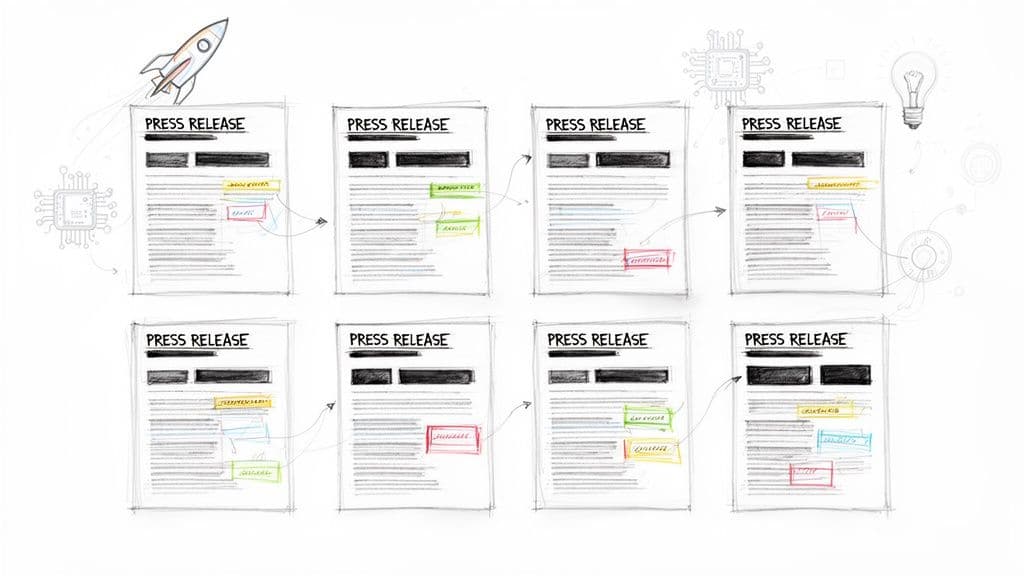
In the competitive world of tech and startups, getting noticed by journalists is harder than ever. A well-crafted press release isn't just about the news itself; it's about the delivery. The right format for press release samples can mean the difference between landing a feature in a top-tier publication and being instantly archived by a busy editor. Traditional PR outreach is often slow and unpredictable, but a perfectly structured announcement, especially when amplified by modern distribution tools, can cut through the noise.
This guide moves beyond basic templates to provide a strategic blueprint for startups and tech companies. We will break down the seven essential formats that resonate most with media contacts today. Each section offers a detailed analysis of a specific format, complete with a full press release sample, actionable do's and don'ts, and replicable strategies. Our goal is to equip you with the tactical knowledge needed to craft announcements that journalists find compelling and easy to use.
You will learn how to structure your news for maximum impact, whether you're announcing a product launch, a new funding round, or a strategic partnership. By mastering these formats, you can transform your company's milestones into a powerful engine for predictable, high-impact media coverage. Forget generic advice; this is a practical playbook designed to help you secure the visibility that drives growth. Let's dive into the formats that get results.
1. The Classic Inverted Pyramid Press Release
The Classic Inverted Pyramid is the undisputed gold standard for press release formats, and for a good reason: it’s designed for efficiency. This structure leads with the most critical, newsworthy information first, allowing a time-crunched journalist or editor to grasp the entire story's core message within the first few sentences. The format then cascades down to supporting details, quotes, and background information in descending order of importance.
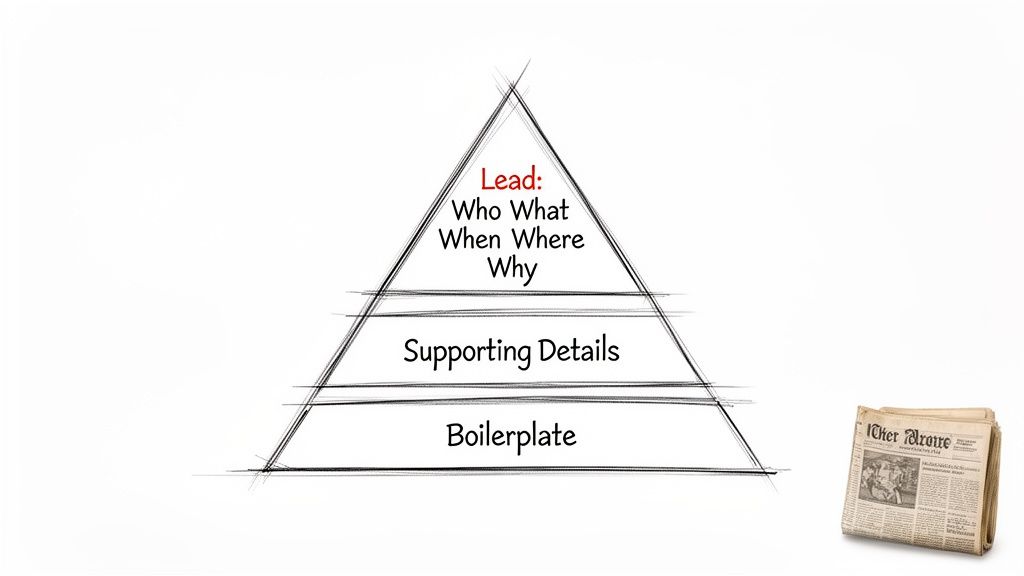
Popularized by wire services like the Associated Press (AP) and Reuters, this approach ensures that if an editor needs to cut the story for space, they can trim from the bottom up without losing the essential news. For startups, this means your key message, like a funding amount or product launch, is guaranteed to be seen.
Why This Format Excels
This format is particularly effective for any announcement with clear, hard news. Think of product launches from Apple or feature rollouts from Amazon AWS; the core news is always stated immediately. Similarly, when a startup announces its Series A funding on a major outlet like TechCrunch, the headline and first paragraph contain the "who, what, when, where, and why" without any fluff. This directness respects the journalist's time and aligns with how news is processed.
Modern AI-powered distribution tools and search engines also heavily favor this structure. Algorithms are programmed to weigh the opening sentences and paragraphs most heavily when determining relevance and newsworthiness, making the inverted pyramid a powerful tool for digital discoverability. For an in-depth guide on applying this method, you can learn more about the fundamentals of news release structure on PressBeat's blog.
Actionable Takeaways for Your Next Release
To make the most of this classic format for press release samples, follow these specific tactics:
- Front-Load the Metrics: Your first sentence should immediately state the most impactful number. For example, "InnovateAI today announced it has closed a $15 million Series A funding round..."
- Optimize the Headline: Write your headline as a complete, factual statement, not a creative teaser. This improves how AI tools and search engines categorize and display your news.
- Answer the 5 Ws Upfront: Ensure your opening paragraph (the "lede") answers Who, What, When, Where, and Why. This is the non-negotiable core of the inverted pyramid.
- Use Specifics: Include exact dates, locations (City, State), and the names of key partners or investors in the lede to add credibility and news value.
- Keep Paragraphs Short: Limit each paragraph to 2-3 sentences to maintain readability and make key points scannable.
2. The Narrative/Storytelling Press Release
While the Inverted Pyramid prioritizes facts, the Narrative/Storytelling format for press release samples prioritizes feeling and connection. This modern approach weaves your announcement into a compelling story arc, focusing on human interest to create an emotional hook. Instead of leading with raw data, it establishes context, introduces a relatable problem or character, and presents your news as the resolution.
This format is designed to cut through the noise of crowded inboxes by offering journalists a unique, engaging angle. By framing your news within a narrative, you provide a ready-made story that is far more memorable and shareable than a simple list of facts. It transforms a standard announcement into a pitch that feels exclusive and deeply human.
Why This Format Excels
The Narrative format is exceptionally powerful for startups and direct-to-consumer (DTC) brands that want to build a strong brand identity and community. Think of Warby Parker's social mission releases or Patagonia's environmental initiatives; the news is amplified by the story of impact. This approach allows a company to showcase its "why" just as much as its "what," making it ideal for announcements about company culture, social impact, or a product that solves a deeply personal problem.
This storytelling method aligns perfectly with the content-driven nature of modern media. Outlets are constantly looking for compelling human stories, not just corporate updates. Brands like Airbnb often use this format to highlight community impact, turning data points into narratives about how their platform changes lives. This makes the announcement feel less like a promotion and more like an authentic, newsworthy story.
Actionable Takeaways for Your Next Release
To effectively use the narrative format for press release samples, implement these specific strategies:
- Lead with a Protagonist: Start your story from a customer or user's perspective. For example, "For three years, freelance designer Maria Garcia struggled to manage invoices across multiple platforms..."
- Build the World: Use specific, vivid details to paint a picture and make the story feel real. Instead of saying your product helps, show how it helps a specific person in a specific scenario.
- Place the News Strategically: Don't reveal the core announcement in the first sentence. Build suspense and introduce your news about one-third of the way through the release as the solution to the problem you've established.
- Craft Conversational Quotes: Include quotes from founders or employees that sound authentic and passionate, not like scripted corporate jargon. These quotes should advance the narrative and add emotional weight.
- Focus on the "Why": Ensure your story clearly communicates the mission or problem that drives your company. The announcement itself should serve as a key plot point in this larger brand narrative.
3. The Data-Driven/Statistics Press Release
The Data-Driven Press Release is a powerful format that transforms proprietary research, survey findings, or market analysis into a compelling news story. Instead of announcing a product or company milestone, the core "news" is a surprising statistic or an insightful trend unearthed from data. This approach positions your company as a thought leader and an authority in your industry, earning media coverage by providing journalists with valuable, quantifiable content their audience craves.
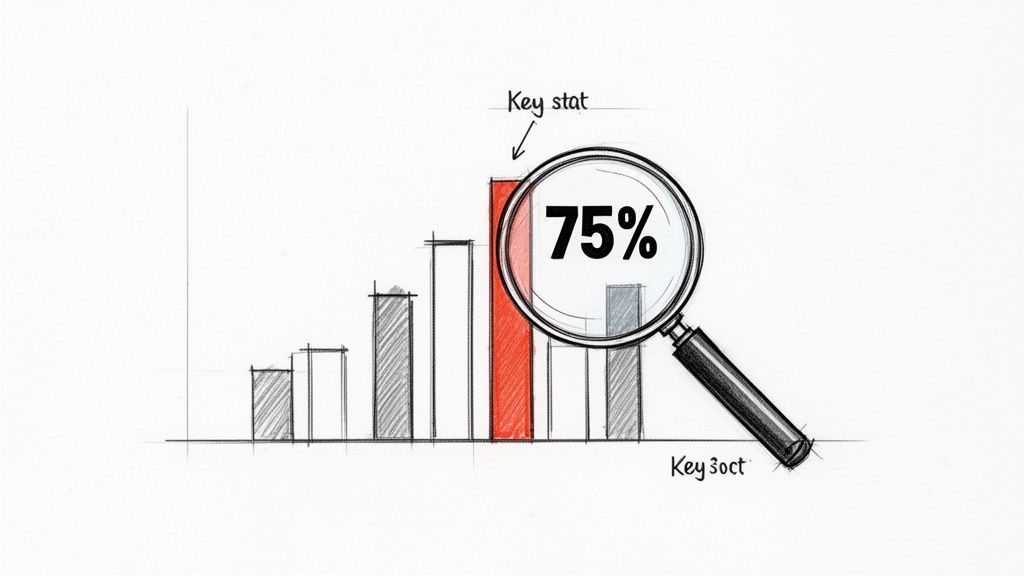
Pioneered by research institutions like Gartner and Pew Research Center, this format is now a staple for tech companies like HubSpot and Slack, which use annual reports to define industry conversations. By leading with a newsworthy data point, you offer journalists a ready-made headline and story angle, significantly increasing your chances of getting published in high-authority outlets.
Why This Format Excels
This format is exceptionally effective for establishing credibility and generating high-quality backlinks. When a startup like Buffer releases its "State of Social Media" report, the unique data becomes a primary source for countless articles, presentations, and reports, all of which link back to the original research. This creates a long-tail SEO benefit that a standard announcement rarely achieves. It shifts the narrative from "we launched a thing" to "we discovered a trend that impacts everyone."
This method is also highly favored by AI-driven news aggregators and discovery tools, which are programmed to identify and prioritize quantifiable, verifiable information. A headline containing a specific, impactful statistic is more likely to be flagged as newsworthy than a more generic announcement. To make your data truly resonate in a statistics-focused press release, it's crucial to consider not just the numbers, but how they are presented visually. Explore proven data-driven design strategies to create compelling charts and infographics that journalists can easily embed in their stories.
Actionable Takeaways for Your Next Release
To craft an effective data-driven format for press release samples, implement these tactics:
- Lead with the 'Wow' Statistic: Your headline and opening sentence must feature the single most surprising, counter-intuitive, or impactful data point from your research. For example, "New Study Reveals 78% of Gen Z Workers Would Quit a Job Due to Outdated Office Technology."
- Provide Context for Numbers: Don't just state a number; explain what it means. Use comparisons to add weight, such as "a 45% increase compared to last year" or "twice the rate of the industry average."
- Build a Narrative with Data: Use 3-5 additional key statistics in the body of the release to support your main finding and build a cohesive story around a central theme.
- Cite Your Methodology: Briefly explain how the data was collected (e.g., "a survey of 1,500 U.S. tech workers conducted in Q3 2023") to build trust and credibility with journalists.
- Offer the Full Report: Include a clear call-to-action with a link for journalists to download the full report or access a media kit with raw data and charts.
4. The Q&A/Expert Interview Press Release
The Q&A/Expert Interview format breaks from traditional press release structures by presenting information as a conversational dialogue. This format frames the content as an interview between a company executive, founder, or subject matter expert and a notional journalist or moderator. It’s designed to humanize a brand, showcase deep thought leadership, and provide journalists with ready-to-use quotes and unique story angles.
This approach transforms a standard announcement into a compelling narrative, making complex topics more accessible and engaging. Instead of just stating facts, it provides context, expert opinion, and personality. For startups, this format is an excellent tool for establishing founders as authoritative voices in their niche, even without a major product launch or funding news.
Why This Format Excels
This format is particularly effective for positioning a company or individual as a thought leader and for adding depth to a complex topic. Think of OpenAI's expert insights on AI policy or Shopify's CEO commentary on e-commerce trends; these releases provide journalists with direct, citable quotes that explain the "why" behind the news. It allows a company to control the narrative by proactively answering the questions they know journalists will ask.
This format for press release samples is also highly effective for personalized pitching. You can send the full Q&A to a journalist, or you can pull a single, powerful question-and-answer pair to use as a targeted pitch. This gives reporters a pre-packaged, expert-driven story angle that requires minimal effort on their part to incorporate into an article, making their job easier and increasing your chances of getting coverage.
Actionable Takeaways for Your Next Release
To leverage the Q&A format effectively for your next announcement, follow these specific tactics:
- Anticipate Real Questions: Brainstorm and script 5-7 questions that a journalist from your target publication would genuinely ask. Think critically about what their audience wants to know.
- Write Conversationally: Draft the answers as if your expert is speaking, not writing a formal document. Use contractions and a natural, accessible tone to make the content feel authentic.
- Include a Bold Prediction: Dedicate one question to a contrarian viewpoint or a bold prediction about your industry. This creates a hook that is highly likely to spark discussion and media interest.
- Keep Answers Concise: Limit each answer to 2-3 sentences. This ensures the content is scannable and that individual quotes are easy for journalists to lift and use.
- Embed Data and Anecdotes: Weave specific statistics, data points, or brief, relevant anecdotes into the answers. This adds credibility and gives reporters concrete facts to cite.
5. The Multi-Format/Multimedia Press Release
The Multi-Format Press Release is a modern, integrated approach designed for the digital media landscape. It moves beyond a text-only document by embedding a rich variety of multimedia elements directly into the release, such as videos, infographics, high-resolution photos, interactive charts, and downloadable social media graphics. This format acknowledges that journalists today are multi-channel content creators who need ready-to-use assets for their articles, social posts, and videos.
This strategy transforms a static announcement into a dynamic media kit. By providing pre-produced, high-quality content, you significantly lower the barrier for journalists to cover your story, increasing the likelihood of publication and shareability. For tech and startup announcements, this format for press release samples is exceptionally powerful, as it allows you to visually demonstrate a new product feature or convey complex data in an easily digestible way.
Why This Format Excels
This format is essential for any story that benefits from visual storytelling. Consider Netflix's press releases, which include preview clips and poster images, or Airbnb's announcements that are packed with stunning destination photography. These companies understand that providing compelling assets makes their story more engaging and easier for a journalist to build a comprehensive article around. Likewise, a fintech startup can use an interactive chart to illustrate market growth, making its data-heavy announcement more accessible.
Digital-first companies and platforms like PRWeb have popularized this approach because it directly aligns with how content is consumed online. A short, impactful video can summarize the news for social media, while a detailed infographic can be embedded in an online article, providing multiple angles for coverage from a single release. This multiplies your message's reach and impact across different platforms.
Actionable Takeaways for Your Next Release
To effectively build a multi-format press release, integrate these specific tactics:
- Lead with a Video Hook: Embed a short (15-30 second) video at the top of your release that summarizes the announcement. To enhance your multi-format press releases, explore modern resources such as AI video generator tools for creating dynamic video content.
- Create Self-Explanatory Visuals: Design infographics and charts that tell the core story on their own, even without the accompanying text. This makes them highly shareable.
- Provide a Downloadable Asset Pack: Include a link to a folder containing high-resolution versions of all multimedia, including founder headshots, product photos, and graphics sized for different social platforms (e.g., 1:1 squares, 16:9 landscape).
- Optimize All Assets: Ensure videos are optimized for mobile and desktop viewing, images are compressed for the web, and all files are clearly labeled for easy use.
- Include a Polished Boilerplate: Even with rich media, your boilerplate remains critical for context. To refine this essential component, review these expert tips on what a press release boilerplate is.
6. The Announcement/Event Press Release
The Announcement/Event Press Release is a specialized format engineered for time-sensitive news like event launches, conference keynotes, or major milestone celebrations. Unlike other formats that focus solely on a company's news, this one is built around the urgency of a specific date and time, emphasizing the "when, where, and how to participate" to drive both media attendance and public interest.
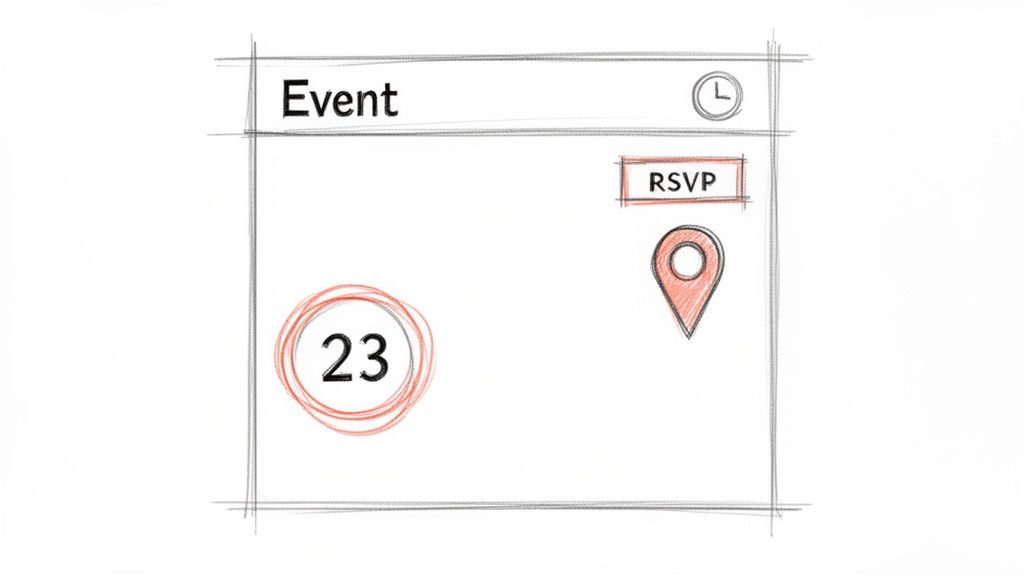
This structure’s main goal is to generate buzz and secure coverage before, during, and after an event. It treats the event itself as the central news item, providing journalists with a clear, compelling reason to cover it. The inherent deadline creates a natural sense of urgency, often boosting journalist response rates and encouraging faster publication to align with the event's timeline.
Why This Format Excels
This format is the go-to for major industry events like TechCrunch Disrupt or SXSW when they reveal keynote speakers or open registration. It works because it gives journalists more than just a story; it gives them an experience to cover. By highlighting exclusive content, high-profile speakers, and unique networking opportunities, the release transforms a simple announcement into a must-attend industry happening.
For startups, this is a powerful tool for punching above their weight. Sponsoring a community event or hosting a product launch party becomes a legitimate news story when framed correctly. The format is designed to provide all logistical details upfront, making it easy for a reporter to justify attending and covering the event. A well-crafted event release can secure calendar listings, pre-event features, and live coverage. For a deeper dive into this strategy, you can find more on crafting press releases for events on PressBeat's blog.
Actionable Takeaways for Your Next Release
To maximize the impact of your event press release, integrate these specific tactics:
- Lead with Logistics: Place the full event date, time (with timezone), and venue address or virtual link in the dateline or the very first sentence.
- Provide a Clear Call-to-Action: Include a prominent, easily clickable registration link within the first two paragraphs. Don’t make journalists search for it.
- Emphasize Newsworthiness: Answer the question: "Why is this event news?" Highlight a keynote speaker's first-ever announcement, the release of exclusive industry data, or a groundbreaking product reveal.
- Build Credibility with Bios: Include brief, impactful bios for key speakers or organizers to showcase their expertise and add prestige to the event.
- Leverage Visuals: Attach high-quality assets like speaker headshots, event branding, or photos of the venue to make your release more compelling and easier for journalists to use.
7. The Newsjacking/Trend-Responsive Press Release
The Newsjacking press release is a highly tactical format that capitalizes on a breaking news story or a trending cultural moment. Instead of creating news from scratch, this approach injects your company's unique perspective, data, or solution into a conversation that is already captivating journalists and the public. This format for press release samples is all about speed, relevance, and adding genuine value to an ongoing narrative.
This strategy requires agility, as the window of opportunity is often just a few hours. When a major data breach hits the news, a cybersecurity firm can issue a release with expert analysis. Similarly, when a new workplace trend goes viral, an HR tech company can release data on its real-world impact. The goal is to become a go-to source for commentary on topics already at the top of the news cycle.
Why This Format Excels
This format is exceptionally effective because it piggybacks on existing media momentum. Journalists are already assigned to cover the trending topic and are actively seeking fresh angles, expert quotes, and new data to advance their stories. A well-timed, insightful press release positions your company as a helpful expert, not just another brand seeking a headline.
For example, when remote work became a global mandate in 2020, companies like Zoom didn't just announce new features; they released data and commentary on the future of work, directly responding to the urgent questions on everyone's minds. Likewise, cryptocurrency platforms often issue rapid-response analyses during periods of market volatility, offering clarity and positioning themselves as thought leaders. This method allows startups to punch above their weight, gaining visibility in top-tier publications by being timely and helpful.
Actionable Takeaways for Your Next Release
To successfully execute a newsjacking press release, speed and relevance are paramount. Follow these specific tactics:
- Act Immediately: Identify a relevant trending story and aim to draft and distribute your release within 2-4 hours. The news cycle moves fast, and your commentary is only valuable while the story is hot.
- Add Real Value: Your release must offer a unique perspective, proprietary data, or an expert quote that moves the story forward. Don't just repeat what's already being reported.
- Target Active Journalists: Pitch your release directly to the reporters who have already written about the trending topic. They are the most likely to be looking for follow-up angles.
- Prep Your Experts: Have pre-approved quotes and talking points from your executives on key industry topics. This allows for rapid deployment without internal delays.
- Be Authentic and Sensitive: Only newsjack stories that genuinely align with your brand's expertise. Avoid capitalizing on tragedies, disasters, or highly sensitive social issues, as this can severely backfire.
7 Press Release Formats Compared
| Format | Implementation Complexity 🔄 | Resource Requirements ⚡ | Expected Outcomes 📊 | Ideal Use Cases 💡 | Key Advantages ⭐ |
|---|---|---|---|---|---|
| The Classic Inverted Pyramid Press Release | 🔄 Low — formulaic structure; easy to template | ⚡ Low–Medium — writer + quotes, basic vetting | 📊 Wide distribution; high AI/search discoverability | 💡 Product launches, funding, partnerships, broad news | ⭐ Maximizes publication chances; journalist-friendly; SEO/AI optimized |
| Narrative / Storytelling Press Release | 🔄 Medium–High — needs craft and pacing | ⚡ Medium — creative writing, interviews, editing | 📊 Higher engagement & shareability; stronger recall | 💡 Thought leadership, culture, founder narratives, DTC brands | ⭐ Memorable storytelling; humanizes brand; stands out in inboxes |
| Data-Driven / Statistics Press Release | 🔄 Medium — requires methodology clarity and validation | ⚡ High — research, data visuals, verification | 📊 High-authority coverage, frequent citations, backlinks | 💡 Market reports, industry trends, research launches, growth metrics | ⭐ Credibility and authority; AI and journalists favor quantifiable evidence |
| Q&A / Expert Interview Press Release | 🔄 Medium — needs natural flow and expert prep | ⚡ Medium — expert time, editing, transcript formatting | 📊 Very scannable; multiple angles for repurposing | 💡 Thought leadership, product explanations, expert commentary | ⭐ Ready-made quotes; builds thought leadership; journalist-friendly format |
| Multi-Format / Multimedia Press Release | 🔄 High — coordinates text + multiple media types | ⚡ High — video, infographics, production, hosting | 📊 Strong engagement, higher open/publish rates; SEO lift | 💡 Visual product launches, digital-first audiences, multimedia campaigns | ⭐ Provides publish-ready assets; cross-channel repurposing; higher visibility |
| Announcement / Event Press Release | 🔄 Low–Medium — logistics and timing sensitive | ⚡ Medium — coordination, registration links, assets | 📊 Immediate coverage potential; drives attendance and RSVPs | 💡 Events, webinars, product launch events, conference announcements | ⭐ Creates urgency; easy for journalists to schedule coverage |
| Newsjacking / Trend-Responsive Press Release | 🔄 High — rapid editorial judgment; ethical sensitivity | ⚡ Very High (speed) — on-call team; fast approvals and pitching | 📊 Potential for amplified, timely pickups and backlink velocity; high risk | 💡 Rapid-response commentary, trend-aligned announcements, real-time PR | ⭐ Leverages existing attention; can dramatically boost relevance if done well |
From Format to Feature: Putting Your Press Release to Work
Throughout this guide, we have journeyed beyond the basic template, exploring a diverse arsenal of seven distinct format for press release samples. We’ve seen how the classic inverted pyramid delivers hard news with efficiency, while the narrative format captivates with a compelling story. We analyzed how data-driven releases build authority, Q&A formats provide direct expert insights, and multimedia releases engage audiences on multiple sensory levels.
The core lesson is this: a press release is not a one-size-fits-all document. It is a strategic tool. The format you choose is a deliberate decision that should be dictated by your specific news, your target audience (the journalist), and your ultimate goal, whether that’s securing a feature story, building credibility with hard data, or humanizing your brand through a personal story.
Synthesizing Your Strategy: Key Takeaways
Mastering the format for press release samples dissected in this article moves you from simply announcing news to actively shaping its reception. Let’s distill the most critical, actionable insights that will elevate your next campaign:
Match the Medium to the Message: Before writing a single word, ask: "What is the most effective way to tell this specific story?" A funding announcement's impact is maximized by the credibility of a data-driven format, while a founder’s unique journey is best told through a narrative structure. Choosing the wrong format is like trying to fit a square peg in a round hole; it obscures the value of your news.
Structure for the Skim-Reader: Journalists are inundated with information. Every format we covered, from the Q&A to the inverted pyramid, prioritizes scannability. Use bolded text for key figures, blockquotes for powerful statements, and bullet points for digestible takeaways. Make it effortless for a journalist to grasp your story's essence in under 30 seconds.
Go Beyond the "What" to the "Why": A press release that only states facts is forgettable. The most powerful releases connect the news to a larger context. The "why" is what transforms a simple product launch into a story about solving a critical industry problem, or a partnership announcement into a narrative about market transformation. This is the element that hooks a reporter.
Assets are Non-Negotiable: In today's media landscape, a text-only press release feels incomplete. High-resolution images, embeddable videos, founder headshots, and data visualizations are not just accessories; they are essential components that make a story easier for a journalist to adopt and publish. The multimedia format is a baseline expectation, not a novelty.
Your Next Steps: From Template to Traction
Armed with this knowledge, your path forward is clear. You are no longer just filling in a template; you are architecting a compelling pitch. The next time you have news to share, resist the urge to default to a standard format. Instead, review the seven distinct format for press release samples we’ve explored and make a conscious, strategic choice.
Think like a journalist. Which format will make their job easiest? Which structure will resonate most with their audience? By building your announcement on this strategic foundation, you exponentially increase the likelihood that your news won’t just be seen; it will be featured. This methodical approach is what separates startups that get sporadic mentions from those that achieve consistent, predictable, and high-authority media coverage, turning press releases into powerful engines for growth.
Ready to move from a perfectly formatted press release to a published story? PressBeat uses AI to match your announcement with the most relevant journalists and automates personalized outreach, ensuring your news lands in the right inbox. Stop guessing and start getting featured by visiting PressBeat to see how intelligent distribution can amplify your message.