
What Is a Press Release Boilerplate A Guide with Examples
December 20, 2025

At the very end of a press release, you'll find a short, standardized paragraph. This is the press release boilerplate, and it's essentially your company's official "About Us" section, designed specifically for the media. Think of it as your company’s signature—it gives journalists and readers a quick, consistent snapshot of who you are, what you do, and why it's important.
Your Company Handshake Explained
Imagine your boilerplate as your company's digital handshake. It’s the final, firm impression you leave after sharing your big news. While the main body of the press release is always new and exciting, the boilerplate is that constant, reliable block of text that anchors your announcement and builds instant credibility.
Its main job is to provide essential context at a glance. In the fast-paced world of news, a journalist doesn't have time to go digging for basic information about your company. A well-crafted boilerplate serves it up on a silver platter, right there in the document they're already reading.
Where Did the Name Come From?
The name itself gives a big clue about its purpose. The term "boilerplate" dates back to the late 1800s and refers to the tough, rolled steel plates used for making steam boilers. These same plates were also used by newspaper syndicates to stamp identical columns and ads for widespread distribution.
Just like those durable, reusable steel plates, a PR boilerplate is a reliable, authoritative snippet of text that gets stamped onto every press release, time and time again.
Why It's a Must-Have, Not a Maybe
Simply put, the boilerplate is a non-negotiable part of your brand’s public identity. It grounds your announcement with the background information needed to make sense of the news, ensuring that every story you share reinforces a consistent and professional image. Leaving it out is like telling a great story but forgetting to introduce the main character.
A strong boilerplate is more than just an "About Us" section; it's a strategic tool for brand consistency. It ensures that every journalist, from a local blogger to a national reporter, receives the exact same core message about your company with every interaction.
This consistency is crucial for building brand recognition and trust over the long haul. As you look at the different parts of a press release, you'll notice how each section builds on the last, with the boilerplate acting as the final, definitive statement.
Here’s a quick breakdown of what makes a boilerplate tick.
Boilerplate Components at a Glance
| Component | Purpose | Why It Matters |
|---|---|---|
| Company Name & Identity | States who you are and what industry you're in. | Immediately orients the reader and sets the context for your news. |
| Core Mission/Vision | Explains your company's "why" in a compelling way. | Connects your brand to a larger purpose, making it more memorable. |
| Key Offerings | Highlights your main products, services, or solutions. | Gives a concrete understanding of what your business actually does. |
| Unique Value Proposition | Describes what makes you different from competitors. | Helps journalists understand your unique angle and news hook. |
| Credibility Markers | Mentions key stats, awards, or major milestones. | Builds trust and authority by providing tangible proof of success. |
| Call to Action/Website | Directs readers to a central hub for more information. | Encourages further engagement and makes it easy for media to follow up. |
Ultimately, a boilerplate is a small paragraph that does a tremendous amount of heavy lifting. It solidifies your company's identity and is a foundational element in the overall news release structure.
The Anatomy of a Powerful Boilerplate
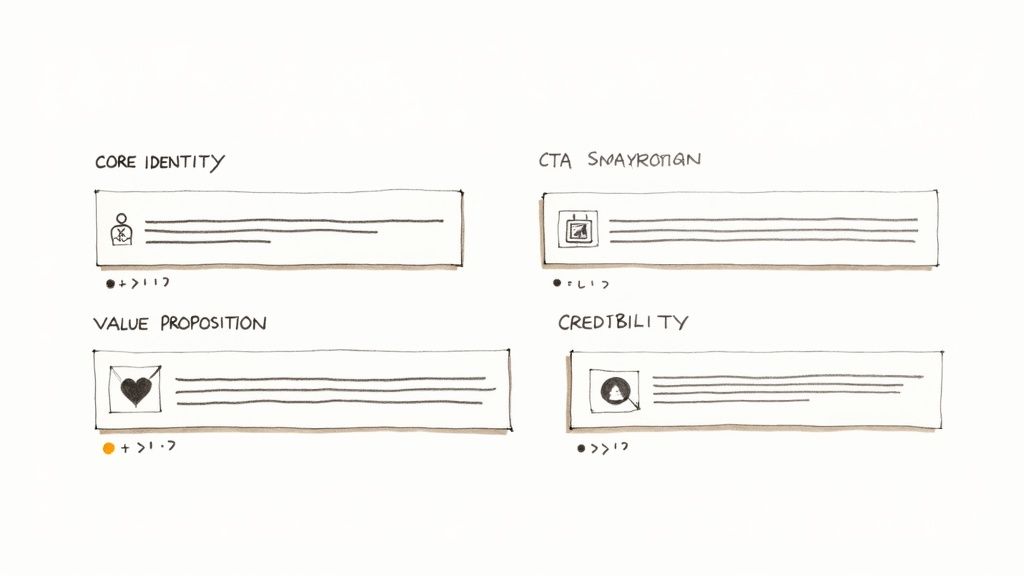
A great boilerplate doesn't just happen by accident. It's carefully engineered. Think of it like a recipe where every ingredient has a purpose. Miss one, and the whole thing falls flat. A truly effective boilerplate has four key elements that work in harmony to tell a journalist everything they need to know in a few short sentences.
These components give a quick, compelling snapshot of your business. Let's break down each one and see how they fit together.
The Core Identity Statement
First things first, you have to answer the most fundamental question: Who are you? This is your opening line, a single sentence that clearly states your company’s name and what you do. No fluff, no jargon—just a straight-up introduction.
For example, a tech company might start with: "InnovateTech is a leading provider of cloud-based project management solutions for small businesses." Right away, the reader knows the company's name, its specialty, and its target audience.
This statement is the anchor. It gives journalists the immediate context they need to understand where you fit in the market.
Your Value Proposition
Okay, so they know who you are. Now, you need to tell them why anyone should care. Your value proposition explains the problem you solve and for whom you solve it. This is where you connect your business to a real-world need. What makes you different or better?
A solid value proposition might sound something like this: "InnovateTech helps small businesses streamline workflows, improve team collaboration, and deliver projects on time and under budget."
This is the part that transforms your boilerplate from a dry description into a meaningful story. It shows a journalist not just what you do, but why it matters.
Credibility Boosters and Proof Points
Saying you’re great is one thing; proving it is another. This is where you back up your claims with hard facts and cold numbers. Credibility boosters are the verifiable details that build instant trust and show you’re a legitimate player.
These proof points are your chance to shine. Think about including things like:
- Founding Year: "Founded in 2015..."
- Customer Count: "...trusted by over 50,000 small businesses worldwide."
- Market Reach: "...with users in 90 countries."
- Major Milestones: "...a proud recipient of the 'Innovator of the Year' award."
The best boilerplates are concise and data-driven. Most public relations guides advise keeping them between 50–100 words, following a formula that combines who you are, what you do, and tangible proof points to back it up. Discover more boilerplate writing tips to craft a compelling summary.
These data points ground your claims in reality, making your company look more established, reliable, and ultimately, more newsworthy.
A Clear Call to Action
Finally, don't leave them hanging. Every boilerplate needs to point people in the right direction. The call to action (CTA) is usually just your company’s website, which acts as the front door for anyone wanting to learn more. It’s the simplest part, but it's absolutely essential.
A direct CTA like, "For more information, visit www.innovatetech.com," does the job perfectly. It ensures that any journalist, potential customer, or investor who's intrigued knows exactly where to find you next.
Why Numbers Build More Trust Than Words
Let's be honest: in public relations, fluffy, vague claims get you nowhere. A seasoned journalist has seen "industry-leading" and "innovative solutions" a thousand times before, and their eyes glaze over. They're trained to hunt for facts, not marketing jargon. This is where you can give your press release boilerplate a serious competitive edge by swapping empty adjectives for cold, hard data.
Numbers simply cut through the noise. They represent proof. While any company can claim to be a market leader, not every company can state that it serves 100,000 customers across 75 countries. Making that simple switch—from subjective claims to objective facts—is the fastest route to building credibility.
Remember, reporters are always on a deadline. They're looking for evidence, for something concrete they can use. A boilerplate loaded with specific metrics gives them exactly what they need to justify a story, making your company look established, trustworthy, and genuinely newsworthy.
Turning Vague Statements into Verifiable Facts
Let’s look at how this plays out in the real world. A lot of companies start with a boilerplate that sounds impressive but says absolutely nothing of substance. By injecting a few key data points, you can transform a weak, forgettable statement into one that grabs a journalist's attention.
Here’s a classic "before" example we see all the time:
Vague Version: "InnovateCo is a fast-growing software company that provides cutting-edge solutions to businesses worldwide."
Now, let's power it up with some real numbers:
Data-Driven Version: "Founded in 2018, InnovateCo is a software company serving over 25,000 businesses in 50+ countries. The company achieved 150% year-over-year revenue growth in 2023."
See the difference? The second version is instantly more believable. The founding year adds a sense of history, the customer count proves market validation, the global reach shows scale, and that growth metric signals serious momentum. Each number tells its own little story of success.
Which Metrics Matter Most to Journalists
Of course, not all numbers are created equal. To make the biggest splash, you want to focus on data that speaks to stability, growth, and market influence. Adding these kinds of quantitative proof points is a surefire way to elevate your boilerplate from marketing fluff to measurable fact. You can see more great examples of this in action by building a compelling boilerplate with these examples.
So, what are the go-to metrics you should include?
- Founding Year: This shows you’ve been around the block and have experience.
- Customer or User Count: Nothing says "people want this" like a large, growing user base.
- Revenue Milestones: This highlights financial stability and success (e.g., "$10M in ARR").
- Employee Headcount: A simple number that indicates the scale of your operation.
- Geographic Footprint: Show your reach, whether it's "offices in 5 cities" or "users on 3 continents."
When you hand-pick your most impressive figures, you’re not just giving journalists information—you’re arming them with the ammo they need to pitch your story to their editors. This data also plays a huge role in your company's perceived authority, a key factor when you're calculating your earned media value. In the end, numbers don't just support your story; they often become the story.
Nailing the Boilerplate: Best Practices and Mistakes to Avoid
A great boilerplate is part art, part science. You need precision, a consistent voice, and a little bit of strategic thinking. Once you have the basic building blocks in place, following a few simple rules will make sure it does its job effectively. Just as important, though, is knowing what not to do—because a few common mistakes can completely undermine your credibility with the press.
Think of your boilerplate as the foundation of your company's story in every press release. If it’s solid, the whole structure is stronger. If it’s weak or cracked, it makes everything else you’ve built on top feel a bit shaky.
Simple Rules for a World-Class Boilerplate
To really make an impact, your boilerplate needs to be a beacon of clarity and consistency. The entire point is to give a journalist a reliable, fact-based snapshot of your company they can trust and use without a second thought. Getting this right comes down to a few core principles.
These aren't just casual suggestions; they're the ground rules for crafting a professional and effective boilerplate that journalists will actually appreciate.
- Be Consistent with Your Brand Voice: Your boilerplate has to sound like you. If your brand is buttoned-up and corporate, write it that way. If you’re known for being quirky and energetic, let that personality shine through here, too.
- Keep It Under 100 Words: Journalists are busy. They don’t have time for a novel at the end of a press release. A tight, concise boilerplate respects their time and is far more likely to be read and used. Aim for a sweet spot between 50 and 100 words.
- Weave in Keywords Naturally: It’s smart to include a relevant keyword or two that describes what you do. This helps connect your press release to your broader SEO efforts, but don't force it. It should read smoothly, not like you're stuffing it for search engines.
- Update It Regularly: Your company isn't static, and your boilerplate shouldn't be either. Give it a check-up at least once a year, or after any major company event—like a new funding round, an acquisition, or a game-changing product launch. An outdated boilerplate just looks sloppy.
Common Mistakes That Weaken Your Message
Knowing what to do is only half the battle. Plenty of companies shoot themselves in the foot by falling into common traps that make their boilerplate feel generic, unbelievable, or just plain unprofessional. Sidestepping these blunders is key to leaving a strong, positive final impression.
The single biggest mistake is treating the boilerplate as an afterthought. It’s the last thing a journalist reads, which means it’s your final chance to communicate authority and make your brand identity stick.
Here are the most common errors you need to dodge:
- Overloading on Jargon: Filling your boilerplate with industry acronyms and buzzwords is a great way to confuse and alienate anyone who isn't already an expert in your niche. Stick to clear, plain English that anyone can understand.
- Making Empty, Hyped-Up Claims: Steer clear of vague, unprovable fluff like "we are the leading provider" or "we offer best-in-class solutions." If you can't back up a claim with a hard number or a specific fact, leave it out.
- Letting Your Facts Get Stale: Using old data, like your customer count from three years ago or an award you won back in 2018, makes it look like you're not paying attention to your own business. Keep it fresh.
- Forgetting to Link to Your Website: It sounds basic, but you'd be surprised how often this happens. Always, always include a clean, direct link to your homepage. It’s the final call to action.
Real-World Boilerplate Examples From Top Brands
Theory is great, but let's get down to brass tacks. Seeing how the big players craft their boilerplates is where you can really see these concepts click into place. We’ll break down a few examples from household names to see what makes their "About Us" section so effective.
You’ll start to notice how they blend their core identity, hard data, and strategic messaging into one tight, powerful package.
Tech Sector Example: Apple Inc.
Apple’s boilerplate is a masterclass in brevity and brand reinforcement. They don't just rattle off a product list; they remind you of their entire mission in a few short sentences.
"Apple revolutionized personal technology with the introduction of the Macintosh in 1984. Today, Apple leads the world in innovation with iPhone, iPad, Mac, Apple Watch and Apple TV. Apple’s four software platforms — iOS, macOS, watchOS and tvOS — provide seamless experiences across all Apple devices and empower people with breakthrough services including the App Store, Apple Music, Apple Pay and iCloud. Apple’s more than 100,000 employees are dedicated to making the best products on earth, and to leaving the world better than we found it."
Notice the perfect balance here. They open with their innovative legacy ("revolutionized personal technology") and immediately pivot to their current market dominance by listing their flagship products. That final sentence about their employees and mission adds a human element, turning a standard bio into a statement of purpose. It’s confident, concise, and just screams Apple.
E-commerce Example: Amazon
Amazon takes a different, but equally powerful, approach. Their boilerplate is all about their customer-centric philosophy and the sheer scale of their operation.
"Amazon is guided by four principles: customer obsession rather than competitor focus, passion for invention, commitment to operational excellence, and long-term thinking. Amazon strives to be Earth’s Most Customer-Centric Company, Earth’s Best Employer, and Earth’s Safest Place to Work. Customer reviews, 1-Click shopping, personalized recommendations, Prime, Fulfillment by Amazon, AWS, Kindle Direct Publishing, Kindle, Career Choice, Fire tablets, Fire TV, Amazon Echo, Alexa, Just Walk Out technology, Amazon Studios, and The Climate Pledge are some of the things pioneered by Amazon."
Instead of starting with sales figures, they lead with their guiding principles—a smart branding move. Then, they back it up with a laundry list of recognizable innovations, from AWS to Alexa. This gives tangible proof of their "passion for invention" and shows how a company can communicate its core values and its biggest wins at the same time.
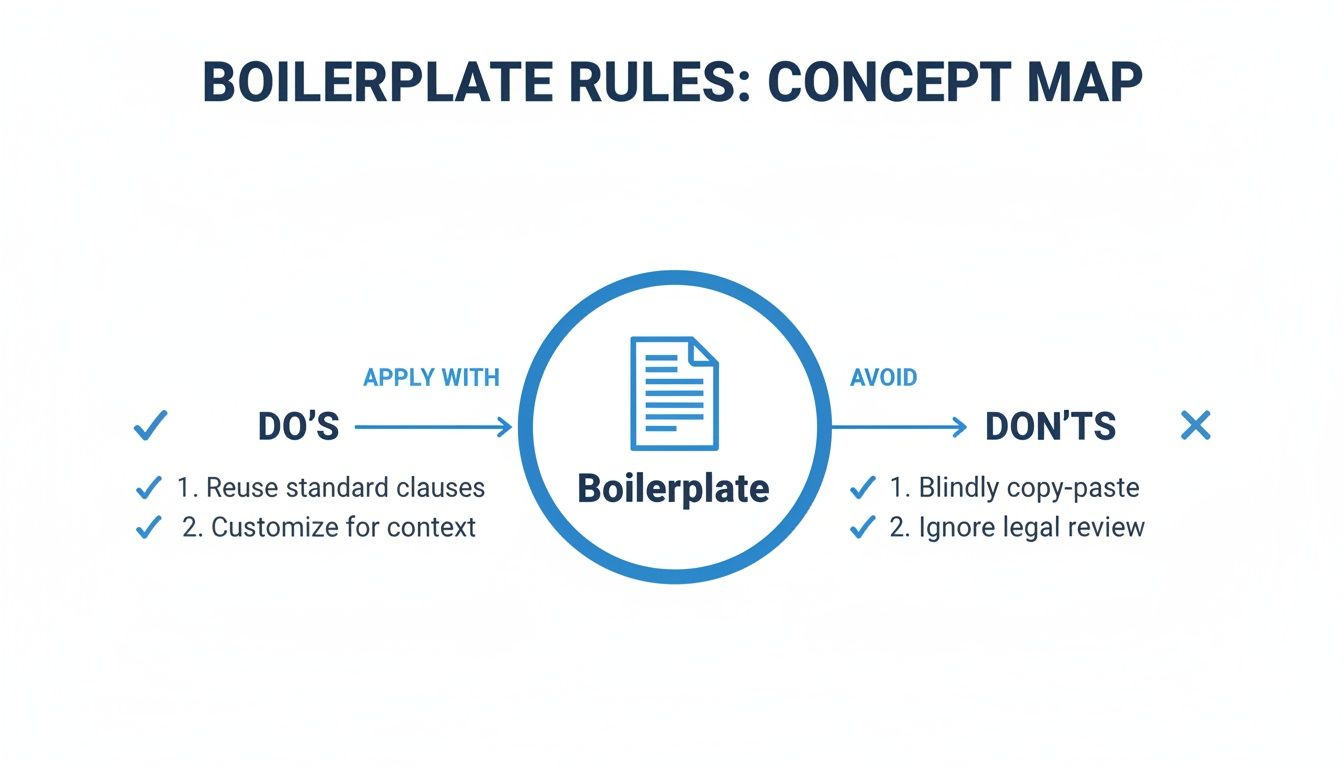
The takeaway here is that there's no single "right" way to write a boilerplate. While the basic structure is consistent, the tone and content should be a genuine reflection of your brand—whether you're mission-driven like Apple, customer-obsessed like Amazon, or something else entirely.
A Simple Template for Crafting Your Boilerplate
Alright, we've covered the theory. Now it’s time to get your hands dirty and actually build this thing.
Don't overthink it. Creating a solid boilerplate is surprisingly straightforward once you have a clear process. The whole point is to fuse your company's core purpose with its most compelling accomplishments into one tight, credible paragraph.
Let’s strip away the guesswork and get it done.
Your Four-Step Boilerplate Formula
Ready to write? The entire process can be broken down into just four simple steps. Follow them in order, and you'll have a polished, journalist-friendly summary ready to go in minutes.
Define Your Mission: First, answer this question in a single sentence: "What does our company do, and who do we do it for?" Keep it simple and direct.
List Your Achievements: Now, brainstorm your biggest wins. Jot down anything quantifiable—your founding year, number of customers, major industry awards, or key milestones you've hit.
Select Your Best Stats: Look at that list and circle the two most impressive and verifiable numbers. You're looking for stats that scream stability, growth, and credibility.
Combine and Polish: Finally, weave your mission sentence and your chosen stats together. Read it aloud to check the flow, trim any unnecessary words, and make sure you end with a link to your website.
Boilerplate Template
About [Company Name]
Founded in [Year], [Company Name] is a [description of your company] that [describe what you do for your target audience]. Trusted by over [Number] customers in [Number] countries, the company [mention a key differentiator or achievement]. For more information, visit [www.yourwebsite.com].
This fill-in-the-blanks approach is a fantastic starting point. It gives you a solid foundation to build from.
Of course, it's also helpful to see how the boilerplate fits into the bigger picture. You can check out a complete press release example template to understand how all the different pieces of an announcement come together.
Frequently Asked Questions
Even after you've nailed down the basics, you'll probably still have a few lingering questions about getting your boilerplate just right. Let's tackle some of the most common ones that come up.
Getting these final details sorted out is what separates a good boilerplate from a great one.
How Often Should I Update My Boilerplate?
Think of your boilerplate like a profile picture—it needs to reflect who you are now. A good practice is to give it a thorough review at least once per year.
But don't wait for the annual check-in if something big happens. You'll want to update it immediately after major company milestones, such as:
- Closing a new round of funding.
- Finalizing a merger or acquisition.
- Hitting a major growth landmark (like signing your 100,000th customer).
- Launching a new flagship product that changes the game for your company.
Nothing undermines your credibility faster than an outdated boilerplate. Keeping it fresh is non-negotiable.
Can I Include Awards in My Boilerplate?
Absolutely! Awards and recent funding are fantastic social proof. Think of them as a stamp of approval from the outside world, telling journalists and readers that you’re a serious player in your field.
The key is to be selective. Don't list every single award you've ever won. A prestigious industry award from last month carries a lot more weight than a local chamber of commerce prize from five years ago.
Your boilerplate is a highlight reel, not a full-length documentary. Its job is to showcase your most impressive, relevant, and recent accomplishments to quickly build trust.
Should My Boilerplate Change for Different Releases?
For the most part, no. Your core boilerplate should stay 95% consistent across every press release you send. This consistency is crucial for building a strong, recognizable brand identity. The fundamental story of who you are and what you do shouldn't be changing from one announcement to the next.
However, a little customization can be smart. You can make subtle tweaks to resonate with a specific audience. For a release going to a tech blog, you might slightly play up your technology stack. For a business publication, you might put a little more emphasis on your market share or growth trajectory. The trick is to keep the core message the same while fine-tuning the angle for maximum relevance.
Ready to get your story in front of the right journalists without all the guesswork? PressBeat uses AI to connect you with reporters who are actively looking for news just like yours. See how PressBeat can secure you guaranteed media coverage.