
A Modern Guide to News Release Structure That Gets Noticed
December 15, 2025
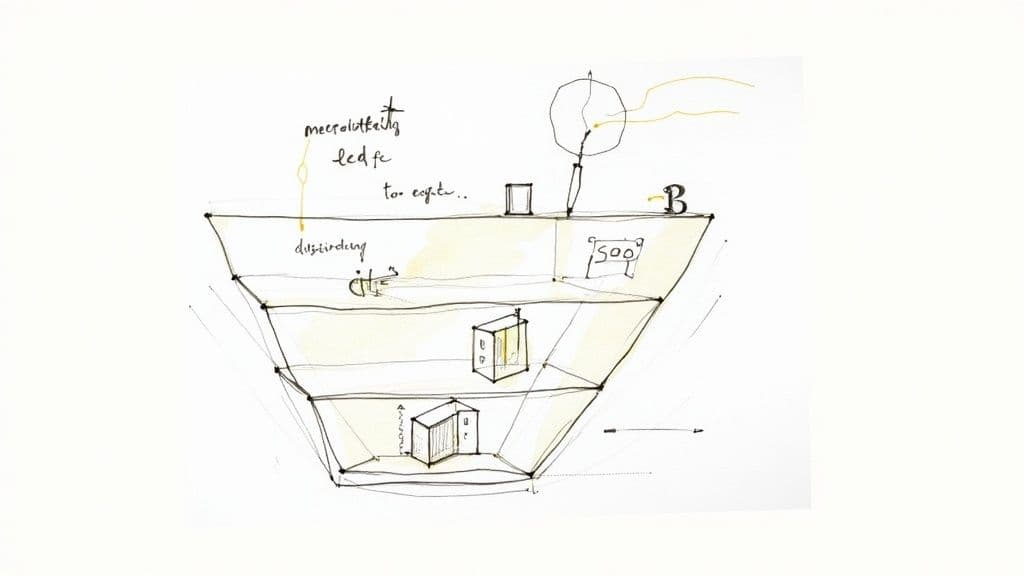
A solid news release structure is, without a doubt, the most critical factor in getting a journalist to actually read your announcement. Think of it as a universal language. It lets reporters instantly size up your story's value and pull out the facts they need. If you ignore this format, your news is just going to get buried.
Why a Disciplined News Release Structure Still Matters
In a world drowning in content, a predictable format isn't a limitation—it's your secret weapon. Journalists are always on a deadline. A well-structured release is a sign of respect for their time and an understanding of how they work. It immediately signals that you're a professional, which can make all the difference.
You're competing for a sliver of attention. The average reporter gets hit with around 100 press releases in their email every single day, and they have to sift through that noise to find what their readers care about. If you want to dig deeper into their world, check out some recent press release statistics. With that kind of volume, a clear, logical structure is non-negotiable.
The Inverted Pyramid Model
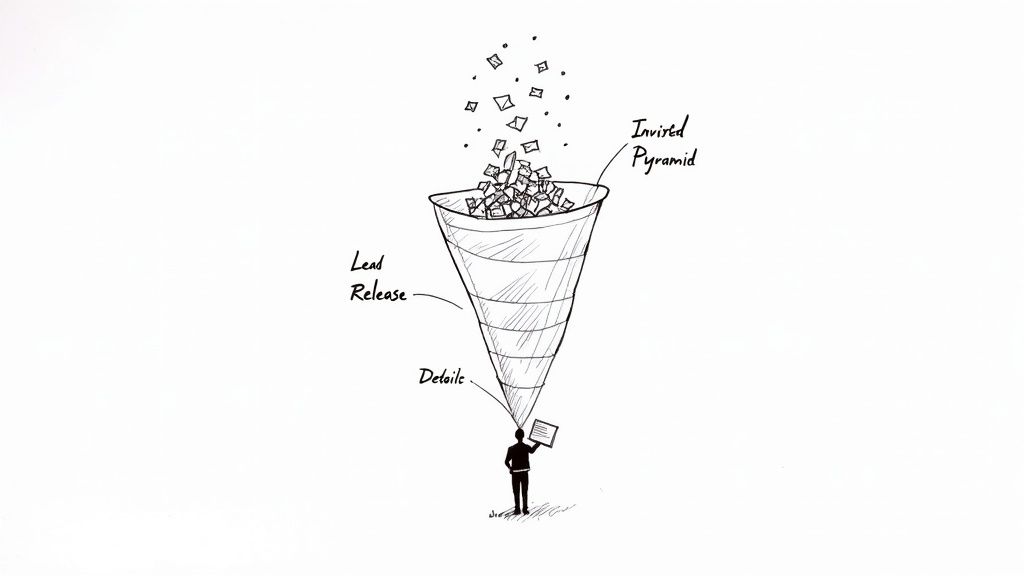
The gold standard for structuring any news release is the inverted pyramid. It’s simple: put the most important, must-know information right at the top. The supporting details come next, and the general background stuff goes at the very end.
Pretend a journalist only has 30 seconds to glance at your email. The inverted pyramid guarantees they get the main point of your story in the first few seconds.
A journalist’s goal is to figure out, “Is this newsworthy?” as fast as possible. The inverted pyramid is built for that. It gives them the conclusion first and the evidence second, acting as a filter in a very noisy world.
This model dictates the entire flow of your release. You start with a punchy headline and a tight lede, then flesh things out in the body with quotes and data, and wrap it all up with your company boilerplate and contact info.
Core Components of the Structure
Every piece of a news release has a job to do. When they all work together, they create a story that’s both compelling and incredibly easy for a busy journalist to digest. Here's a quick look at the core components that build an effective news release.
| Component | Purpose |
|---|---|
| Headline & Sub-headline | The initial hook. It grabs attention and summarizes the news in a single line. |
| Dateline & Lede | Sets the when and where, then delivers the most vital info (the 5 Ws) immediately. |
| Body Paragraphs | Expands on the lede with more context, supporting facts, data, and details. |
| Quotes | Adds a human voice, expert opinion, or authoritative perspective to the story. |
| Boilerplate | A standard, concise “About Us” paragraph that describes your company. |
| Media Contact | Crucial info (name, email, phone) so journalists can easily follow up for more. |
Nailing these elements is the foundation of getting your story told. Each part builds on the last, guiding the reporter from a high-level summary to the finer details they might need for their article.
Crafting Headlines and Ledes That Command Attention
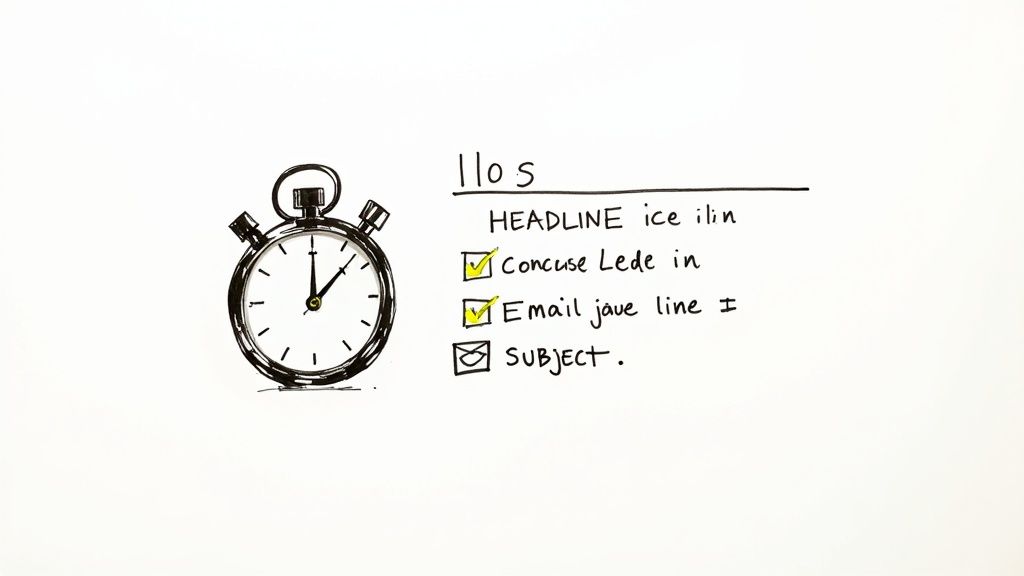
Let’s be honest: you have about three seconds to get a journalist to care. Their inbox is a battlefield, and your headline is your only weapon. If it doesn't land a punch, the rest of your announcement might as well not exist. It's not just a title; it’s your entire pitch, distilled.
Think of your email subject line as the movie trailer and the release headline as the opening scene. They have to work together to create an immediate sense of "I need to read this." Anything generic, like "Company X Launches New Product," is an instant trip to the trash folder. You have to lead with the impact, not just the action.
Writing Headlines That Cut Through the Noise
A great headline is active, specific, and packs the most important news into a single, tight line. It’s got a strong verb, maybe some compelling data, and zero fluff. For a startup, this is your chance to ditch the internal jargon and focus on the real-world problem you just solved or the massive milestone you just hit.
Here are a few angles that consistently work:
- Lead with the Impact: "InnovateHealth's AI Platform Slashes Patient No-Show Rates by 40% for U.S. Hospitals"
- Announce a Big Milestone: "FinTech Startup SecurePay Hits $50M in Processed Transactions, Launches Small Business Lending"
- Highlight a Strategic Partnership: "LogiTech and DriveAI Partner to Bring Autonomous Delivery to the Last Mile in Chicago"
Learning how to frame your news is a skill, and many of the same rules for writing great blog post titles apply here. The advice on how to write perfect headlines for your blog posts is directly relevant to making your release irresistible to a busy reporter.
A journalist reads your headline with one question in mind: "Why should my audience care?" If your headline doesn't answer that in under 10 words, you've already lost the battle for their attention.
If you're looking for more real-world examples, checking out a few powerful press release headline examples can spark some great ideas. Seeing what works for others is one of the best ways to get your own headline right.
Mastering the Lede Paragraph
Okay, so your killer headline worked—they clicked. Now, the lede has to deliver on that promise instantly. The lede is simply the first paragraph of your release, and its only job is to summarize the entire story by answering the classic "5 Ws": Who, What, When, Where, and Why.
This needs to be one single, punchy sentence. Seriously. Keep it under 25-30 words. You're giving the reporter everything they need to know in one breath. This isn't the time for background or flowery adjectives; it’s for cold, hard facts.
A weak lede sounds like this: "Our company, which has been working hard on new solutions, is excited to announce the release of a new software."
A strong lede gets straight to the point: "SAN FRANCISCO – (Date) – SaaS firm CloudSphere today launched its new cybersecurity platform, 'Guardian,' which uses machine learning to protect small businesses from ransomware attacks, a threat that grew 150% last year."
See what that did? In one sentence, we established:
- Who: SaaS firm CloudSphere
- What: Launched a cybersecurity platform, 'Guardian'
- When: Today
- Where: San Francisco (the dateline)
- Why: To protect small businesses from a rapidly growing threat
Nailing the headline and the lede is more than half the battle. You’re building a foundation that respects a journalist's time and makes it clear from the very first line that your news is worth their attention.
Building a Compelling Narrative with Quotes and Data
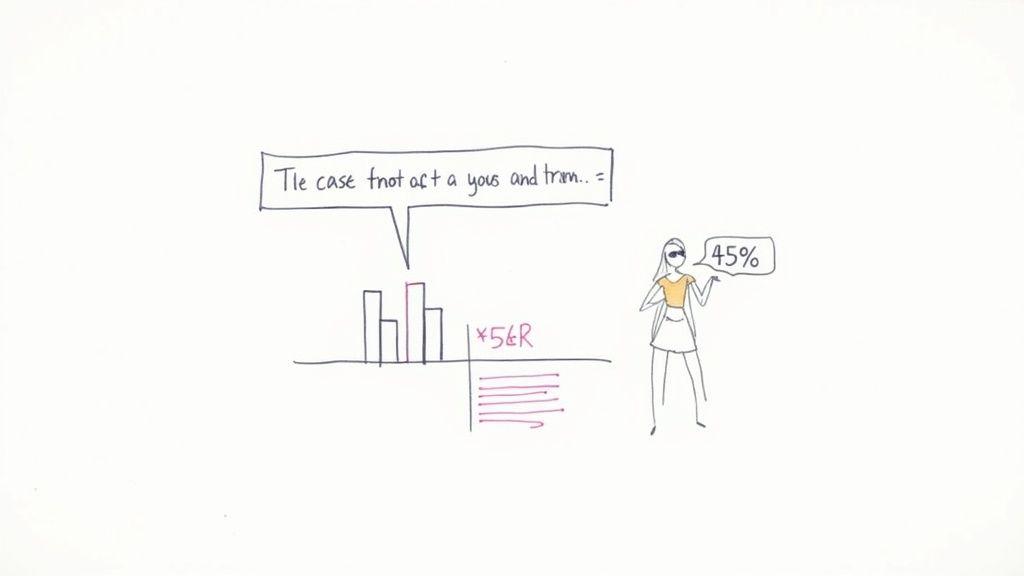
You’ve nailed the headline and hooked them with a great lede. Now, the body of your release has to deliver on that promise. This is where you bring your story to life, weaving together the facts, figures, and human perspectives that give your announcement credibility.
Think of it this way: you’ve made a big claim in your opening paragraph. The rest of the release is your evidence. The goal is to provide a journalist with everything they need to see this as a real story.
Remember, reporters are incredibly busy. They don't read press releases; they scan them for the good stuff—key facts, sharp quotes, and hard data. Your entire news release structure should be designed to make that scan as easy as possible for them.
Weaving in Credible Data Points
Numbers give your story teeth. Without them, your claims are just opinions. With them, they become objective facts a journalist can confidently cite. Instead of saying your new feature is popular, show it. Saying it drove a "35% increase in user engagement" in the first month is infinitely more powerful.
Get your strongest statistic in there early, usually in the second or third paragraph. This immediately backs up the claim you made in the lede and builds trust.
Here are a few types of data that work well:
- Product Metrics: User growth numbers, engagement rates, or how much time your product saves customers.
- Company Milestones: Revenue growth, total funding, new market penetration, or significant customer wins.
- Industry Trends: Data from a reputable source that gives context to why your announcement matters right now.
Even one or two well-placed data points can completely change how a journalist perceives your news. It signals that you're serious and that your announcement has a tangible impact.
A quote without personality is just a block of text. It's an opportunity to inject genuine emotion, perspective, and a human voice into an otherwise formal document. Avoid stiff, corporate jargon at all costs.
A reporter can pull facts from anywhere, but a great quote is a gift. It gives them a unique point of view they can't get anywhere else, making their story much more interesting to write—and to read.
Crafting Quotes That Sound Human
This is your single best chance to inject a human element into your release. Sadly, most press release quotes are filled with stiff, lifeless corporate jargon that no real person would ever say out loud. A journalist can spot a committee-written quote a mile away and will skip right over it.
A quote needs to add real value. A good one provides:
- Vision: It explains the why behind the news. Why did you build this? What problem does it solve for your customers or the industry?
- Emotion: It conveys genuine excitement or conviction. Let the founder’s passion come through.
- Perspective: It offers an insight or opinion that isn’t stated elsewhere in the release.
Let's look at the difference.
Bad Quote (Robotic):
"Our new integration is designed to optimize workflows and drive synergies across our enterprise client base."
Good Quote (Human):
"We saw our customers struggling to piece together different tools just to get through their day. We built this to finally give them one simple, central place to work, so they can spend less time managing software and more time focused on their own growth."
The second one feels real, doesn't it? It tells a quick story, shows empathy, and uses language a journalist can drop right into their article to add some color. A powerful, authentic quote is one of the most valuable parts of your entire news release structure.
Polishing It Off: Your Boilerplate and Media Contact
Don't let a strong announcement fizzle out at the end. The way you wrap up your news release—specifically with your boilerplate and media contact—is the last impression you leave on a journalist. These aren't just formalities; they're essential tools that provide context and a direct line for follow-up questions.
A weak finish can sabotage an otherwise great story. It might leave a reporter wondering who you are or, even worse, with no easy way to get in touch. Think of these final touches as your chance to solidify your brand and make a busy journalist's job much, much easier.
What’s a Boilerplate, Anyway?
Your boilerplate is your company's elevator pitch, neatly packaged at the bottom of every release. It’s a short, standardized paragraph explaining who you are, what you do, and what makes you tick. This isn't the place for breaking news; it's for consistent, evergreen information that gives a reporter instant context.
Keep it tight and factual, aiming for a word count between 50 and 100 words. It’s the final piece of the inverted pyramid, providing that broad background after all the specific news details are out of the way. For a deeper look, you can explore more about what a boilerplate is in a press release to really nail yours.
A great boilerplate is a critical branding tool. It should concisely answer: Who are we? What do we do? What's our mission or unique spot in the market? A journalist should be able to copy and paste it directly into their article, no questions asked.
While the news changes with every announcement, your boilerplate is the constant. It reinforces your core identity every single time you send something out.
Don’t Hide: Make Your Media Contact Obvious
This last part is arguably one of the most important sections in the entire release. If a journalist is intrigued by your story, they need to know exactly who to call or email. And that person needs to be ready to respond. Listing a generic "info@" email is a massive red flag.
Make your media contact section impossible to miss.
- Name: The actual person handling media inquiries.
- Title: Their role (e.g., Director of Communications, Founder).
- Email: A direct, individual email address.
- Phone Number: A direct line or cell number for those on-deadline requests.
The person you list here must be fully briefed on the announcement and prepared to field questions immediately. Reporters are always on a deadline, and a slow response usually means a missed opportunity for coverage. This isn't just a name on a page; it's your direct line to getting your story told.
Making Your News Release Work Harder with SEO
Back in the day, a news release had a single job: get a journalist interested. That’s still true, but now it has a second, equally important role. Today’s press release is also a permanent piece of your online marketing, capable of driving traffic and building credibility long after the initial news buzz fades.
This dual purpose means we need to think about search engines from the moment we start writing. It’s not about cramming in keywords until it sounds like a machine wrote it. The goal is to weave your most important search terms into the fabric of the release, placing them where they’ll make the biggest difference. This simple shift turns a one-off announcement into a long-term source of organic traffic.
Where to Place Your Keywords for Maximum Impact
First, put yourself in the shoes of someone looking for your news. What words or phrases would they type into Google? That’s your primary keyword, and it needs to show up in a few key spots to tell search engines what your announcement is all about.
Here’s where you’ll get the most bang for your buck:
- The Headline: This is SEO real estate gold. Your main keyword absolutely must be here.
- The Lede Paragraph: Reinforce the topic by including the keyword again in the first sentence or two.
- Subheadings: Breaking up your text with H2 or H3 tags? Pop your keywords in there to help both readers and search bots scan the content.
- Image Alt Text: Don't forget the images! Describing them with relevant keywords helps you show up in image searches.
Getting this right helps journalists and search algorithms immediately grasp the core of your story. If you want to dive deeper, we have a complete guide on how to create a search engine optimized press release that walks through more advanced tactics.
Think of it this way: every press release is a direct signal to Google about what your company is doing. Each one creates a new, indexable page that builds up your digital footprint and establishes you as an authority on that topic.
This is why a well-optimized release is such a powerful tool. It directly supports many of the core advantages of content marketing, like boosting brand authority and generating organic traffic, often for months or even years to come.
Don't Forget to Link Out
One of the most valuable—and most frequently missed—opportunities in a digital press release is the hyperlink. Links are your best tool for sending traffic back to your own website and building up its authority in the eyes of search engines.
A good rule of thumb is to include two to three high-quality links in the body of your release. The key is to be strategic. Don't just link to your homepage three times. Point people to specific, relevant pages that add value.
Consider linking to:
- A Product or Service Page: Announcing a new feature? Send them straight to the landing page where they can see it in action.
- Your About Us Page: This is a perfect link for your boilerplate, giving journalists and interested readers a quick way to learn your backstory.
- A Related Blog Post: If you’ve written an article that provides more detail or context, link to it. It shows you’re an expert.
These links do two things at once. They give curious readers and journalists an easy next step, and when your release gets published on news sites, they become valuable backlinks that boost your website’s overall SEO power.
Your Press Release Questions, Answered
Even with the best template in hand, you’re bound to have questions when you sit down to write. Getting the nuances right can feel like walking a tightrope, especially when you need every word to count.
Let's clear up some of the most common questions I hear from founders and marketing leads about structuring a news release. Think of this as the insider scoop to take your announcement from good to great.
How Long Should a Press Release Be?
Here's the golden rule: one page. That’s it.
For word count, you should be aiming for 400 to 500 words. This is the sweet spot—long enough to hit all the key points like your lede, supporting details, a great quote, and your boilerplate, but short enough that a busy journalist will actually read it.
If you find yourself creeping past the 500-word mark, take that as a sign. You're probably including too much fluff or background detail that belongs on your blog, not here.
A news release is a summary, not a novel. Its job is to give reporters the core story and make them want to call you for the juicy details. Keeping it brief shows you respect their time and forces you to focus on what’s truly newsworthy.
Is a Media Pitch the Same as a News Release?
Nope. They are two completely different tools, though they work as a team. A news release is the formal, structured announcement intended for wide distribution. A media pitch, on the other hand, is the short, personal email you send to a specific journalist to get them hooked on your story.
Here’s a simple breakdown of the difference:
- Format: The release follows that classic, rigid "inverted pyramid" structure. A pitch is just a simple, conversational email.
- Audience: A release might go out to a list of hundreds. A pitch is crafted for one person at a time.
- Goal: The release lays out all the official facts. The pitch is designed to spark curiosity and start a conversation.
The easiest way to think about it is this: the pitch is your cover letter, and the news release is your resume. You need that sharp, personalized pitch to convince them to even bother looking at the more detailed release.
Can I Use a News Release for Something Other Than a Huge Announcement?
Absolutely. While they’re the go-to for big-ticket items like a funding round or a major product launch, the news release format is surprisingly versatile. You can adapt it for all sorts of content, which is a great way to stay on the media’s radar between those tentpole moments.
For instance, you could draft a release to:
- Share original research: Announce the findings from a compelling industry survey you conducted.
- Announce a key hire: Bringing a well-known executive onto your team can be big news in your industry.
- Highlight a major customer milestone: A powerful case study offers social proof and a relatable, human-interest story.
- Promote your presence at a major conference: This signals that your company is a serious player in the space.
Using the format for these "smaller" stories helps keep your brand top-of-mind and builds your reputation as an authority. Each one adds another layer to your company’s story, showing consistent momentum.
Ready to get your story in front of the right journalists without the guesswork? PressBeat uses AI to find and pitch the most relevant reporters, securing you predictable media coverage in top outlets. See how it works.