
search engine optimized press release: A Practical Guide
November 28, 2025
A press release optimized for search engines is more than just a news announcement; it’s a strategic piece of content designed to be understood by both journalists and Google’s algorithms. It’s where classic PR meets modern SEO, using carefully chosen keywords, a specific structure, and smart linking to build long-term visibility. This approach turns a fleeting announcement into a digital asset that can actually rank and drive organic traffic for months, even years.
Why Press Releases Need SEO to Survive
Gone are the days when you could just blast a press release over the wire and call it a day. Today, everyone—from journalists looking for a story to potential customers researching a solution—starts their search on Google. If your announcement isn't built to be found there, it's essentially invisible.
A traditional press release is written for one audience: the media. But a search engine optimized press release has to serve two masters: journalists and search algorithms. This isn't just a nice-to-have anymore; it's critical for getting your news heard.
From Temporary News to Lasting Digital Assets
Think of a standard press release as a firework. It makes a big splash for a moment and then vanishes. Its value is intense but incredibly brief. An SEO-driven release, on the other hand, is like planting a tree. Your announcement is the seed, and with the right optimization, it grows roots in search results, becoming a durable source of value for your brand.
This simple shift in mindset turns PR from a pure cost center into an investment with a real, measurable ROI. The benefits go way beyond a single news cycle.
- Sustained Organic Traffic: When your release starts ranking for relevant keywords, it pulls in potential customers, partners, or investors long after the launch date.
- Enhanced Brand Authority: Owning a spot on the first page of Google for key industry terms instantly positions your company as a credible voice in the field.
- High-Quality Backlinks: When media outlets cover your story, they’ll link back to your website. These backlinks are SEO gold, boosting your entire site's authority.
A well-optimized press release doesn't just announce news; it builds a permanent footprint on the web. It's the difference between shouting your message into the wind and carving it into stone.
A Real-World Startup Scenario
Let's look at a practical example. Imagine a B2B SaaS startup launching a new AI-powered analytics tool. The old-school approach would be to send a generic release to a newswire, which might get them a few mentions on obscure sites and a tiny, temporary spike in traffic.
Now, let's see what happens with a search-optimized strategy.
The PR team does their homework and identifies their main keyword: "AI customer retention platform." They also find related terms like "predictive analytics for churn" and "SaaS customer success tool." They then write a compelling headline: "Innovate AI Launches New Platform to Predict Customer Churn with 95% Accuracy."
The release is formatted for easy scanning, includes an optimized screenshot of the tool's dashboard, and features a quote from the CEO explaining exactly how the tool solves a major pain point for their target customers. Crucially, they include a link back to their new product page using the anchor text "AI customer retention platform."
What happened? Not only did several tech blogs pick up the story, but within weeks, the press release itself started ranking on page one of Google for their main keyword. This drove a steady stream of highly qualified leads—demo requests from VPs of Customer Success who were actively searching for that exact solution. The press release transformed into a lead-generation machine, proving its value long after the initial launch buzz faded.
Finding Keywords That Journalists Actually Use
Before you even think about writing your press release, you need to get inside the heads of the people you want to reach. I'm talking about journalists, bloggers, and even your ideal customers. What are they actually typing into Google when they're hunting for a story or a solution?
This isn't about guesswork. It’s about being strategic.
Forget about just cramming your release with a bunch of generic industry terms. Real SEO for PR is about finding the specific phrases that signal genuine interest. A tech journalist covering fintech isn't just searching for "fintech news." They're digging deeper with phrases like "new open banking regulations" or "AI fraud detection startups." Your job is to unearth these terms and build your story around them.
Thinking Beyond Obvious Keywords
Good keyword research for PR is part art, part science. Sure, standard tools like Ahrefs or Google Keyword Planner are a great starting point, but you have to apply a journalistic filter to what you find. You're not just chasing high-volume keywords; you're looking for phrases that scream professional curiosity.
Here’s how to start thinking like a reporter:
- Focus on Problems, Not Just Products: Instead of your product name, think about the pain point it solves. Launching a new productivity app? A journalist might be searching for "tools to reduce team burnout" or "asynchronous communication software."
- Analyze Competitor Coverage: Go read the articles written about your competitors. Pay close attention to the headlines and subheadings. The language used in stories that got picked up is a goldmine—it tells you exactly what resonates with the media.
- Use Question-Based Keywords: I love using tools like AlsoAsked for this. They show you the actual questions people are asking online. A reporter might be exploring a story by searching, "What is the future of sustainable packaging?" If your press release answers that question, you’ve just made yourself an invaluable source.
Building Your Keyword List
Once you’re in that journalistic mindset, it's time to build your keyword list. I always like to organize it into a simple hierarchy.
- Primary Keyword: This is your main event, the core topic of your announcement. It's usually a 2-4 word phrase, like "AI-powered logistics platform." This absolutely must be in your headline, your URL, and your first paragraph.
- Secondary Keywords: These are supporting terms that give your story more context. For our logistics platform, this could be "supply chain optimization," "last-mile delivery solutions," or "warehouse automation." Sprinkle these naturally into your subheadings and body copy.
- Long-Tail Keywords: These are longer, super-specific phrases, often framed as questions. Think "how to reduce shipping costs with AI." Weaving these in helps you catch searchers with a very specific problem they need to solve.
A smart keyword strategy does more than help you rank. It forces you to frame your news in the exact language your audience and the media are already using. That makes your announcement instantly more relevant and easier to understand.
To really get an edge, running a keyword gap analysis can show you what your competitors are ranking for that you aren't. This is a fantastic way to uncover fresh story angles that others have missed.
Taking the time to get your keywords right is what gives your press release legs. In fact, data shows that a well-optimized online press release can reach, on average, 275% more readers than news sent only to a private journalist list.
Of course, once you have your keywords, you still need to get your news in front of the right people. Our guide on how to contact journalists can give you a clear roadmap for that.
Anatomy of an SEO-Friendly Press Release
Crafting a press release that gets noticed by search engines isn't just about good writing. It’s about building it with a search-first mindset. Every single element, from the headline down to the boilerplate, has a job to do—and that job is to grab the attention of both journalists and Google’s crawlers.
Think of it this way: a standard press release is like a basic car. It gets you from A to B. But an SEO-optimized press release? That’s a finely tuned machine. It has a powerful engine, an aerodynamic design, and a top-tier GPS, all working together to get your news to its destination faster and more efficiently.
Nail the Keyword-Driven Headline
Your headline is the most valuable piece of real estate in the entire document. It’s what shows up in search results, what gets shared on social media, and what convinces a reporter to open your email. A weak headline means your news is dead on arrival.
It's non-negotiable: your primary keyword must be in the headline, and the closer to the front, the better. But just dropping in a keyword isn't enough. It has to be genuinely newsworthy and compelling.
For example, don't just write: "Innovate Corp Announces New Software."
Instead, try something like: "Innovate Corp Launches AI-Powered Logistics Platform to Cut Shipping Costs by 30%."
The second version works because it:
- Includes the primary keyword ("AI-powered logistics platform").
- Shouts a specific, tangible benefit (30% cost reduction).
- Uses a strong, active verb ("Launches") that signals real news.
Craft the Lede and Body for Readability
Your first paragraph—the lede—has to get straight to the point. Answer the classic questions immediately: who, what, when, where, and why. This is also the perfect spot to naturally weave in your primary keyword again, alongside one or two important secondary keywords. Search engines pay close attention to terms that appear early in your content.
From there, structure the rest of the body for scannability. Nobody enjoys reading a dense wall of text. Use H3 subheadings to break your announcement into logical, digestible sections. These subheadings are also fantastic opportunities to work in your secondary and long-tail keywords.
A subheading like "How the Platform Optimizes Last-Mile Delivery" is not only helpful for the reader but also sends a crystal-clear signal to Google about what that section covers.
This simple workflow shows how keyword research should be baked into the process from the very beginning.
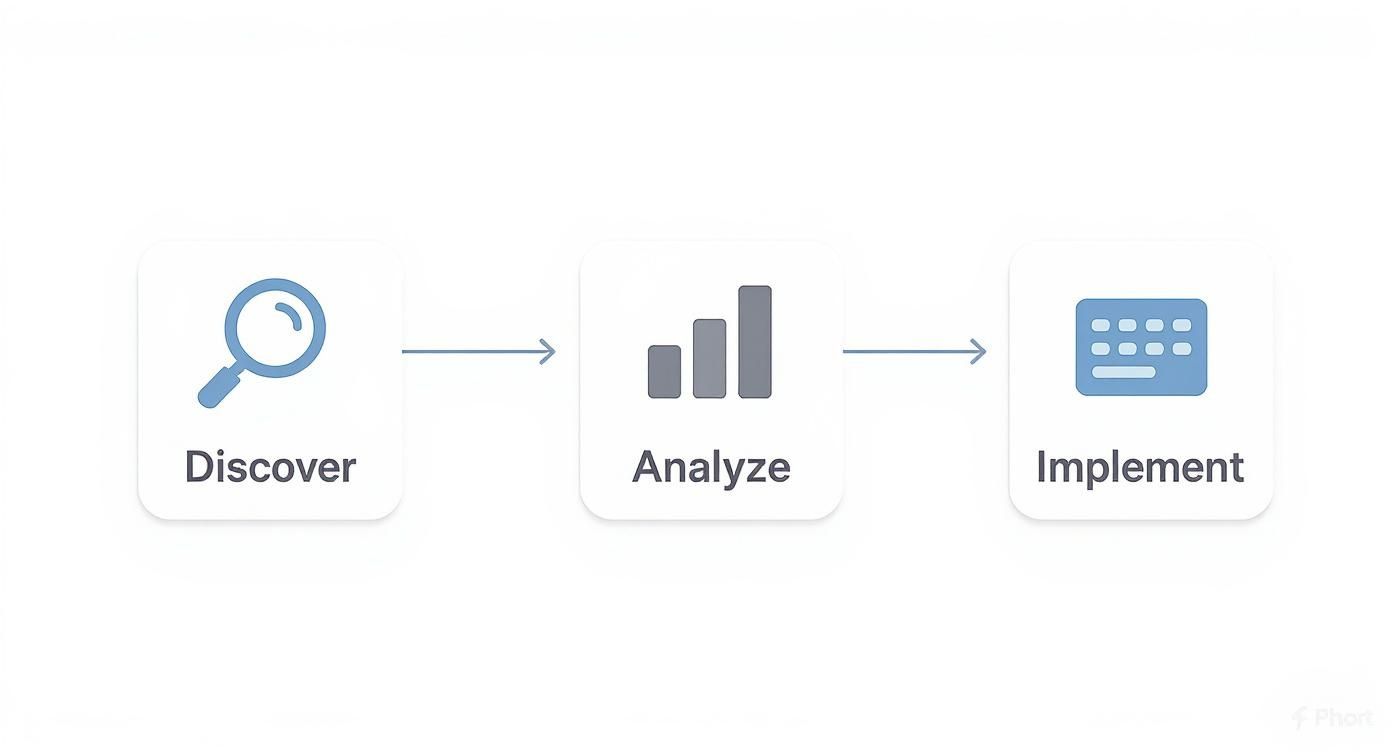
As you can see, implementing your keywords isn't an afterthought; it’s a core part of the writing process itself.
The Art of Linking Strategically
In the world of SEO, links are currency. In a press release, they serve two critical functions: driving interested readers back to your website and building your site's authority. But you can't just throw links in randomly. A thoughtful approach to your links and their anchor text is absolutely essential.
Aim for a natural mix of links—usually one or two well-placed ones are plenty. Overdo it, and you’ll look spammy to search engines.
The goal isn't to stuff your release with keyword-heavy links. It’s about creating valuable, context-rich pathways that guide both people and search engines to your most important online assets.
Let’s break down the main types of anchor text to use.
- Targeted Anchor Text: This is when the clickable text is your keyword. A link like "our new AI customer retention platform" directly tells Google what the linked page is about. Use this with care—once for your main keyword is usually enough.
- Branded Anchor Text: Here, the link text is just your company's name, like "Innovate AI." This is a very safe and natural way to build brand authority.
- Naked URL: This is simply pasting the full URL, like
https://www.innovateai.com/platform. While less common in the body, it can look natural and provides a direct path.
To make this even clearer, here’s a quick reference table to guide your linking strategy.
Table: Key Elements for an SEO-Optimized Press Release
This table breaks down the core on-page SEO components of a press release and why each one matters.
| Element | SEO Best Practice | Primary Goal |
|---|---|---|
| Headline | Include primary keyword near the beginning. Keep it under 70 characters. | Grab attention in search results and news feeds. |
| URL Slug | Use a short, keyword-rich URL (e.g., /ai-logistics-platform-launch). | Create a clean, shareable link that signals topic relevance. |
| Lede Paragraph | Naturally integrate primary and secondary keywords within the first 100 words. | Reinforce the main topic for search engines and readers. |
| Body Content | Use subheadings (H3s) with long-tail keywords. Break up text. | Improve readability and target a wider range of search queries. |
| Anchor Text | Diversify with branded, targeted, and naked URL links. | Build a natural link profile and drive contextual traffic. |
| Multimedia | Include optimized images/videos with descriptive alt text and file names. | Increase engagement and create opportunities for image/video search. |
By diversifying your anchor text and thoughtfully structuring each element, you signal to search engines that you're focused on providing real value, not just trying to game the system. That’s how you build trust and long-term SEO benefits.
If you want to see how all these pieces come together, checking out a well-built press release example and template can provide a solid blueprint. Sometimes, the best way to learn is by seeing these principles applied in a finished product.
Using Multimedia to Get Noticed by Google
Let's be honest: a wall of text is a dead end. In a world scrolling through visual feeds, a press release that’s just words is a massive missed opportunity. When you weave in images, videos, or infographics, you're not just making it easier on the eyes for a journalist; you're creating brand new ways for your news to get discovered through Google Images and video searches.
Think of modern press releases less as static documents and more as dynamic, shareable content hubs. A crisp product shot, a quick video demo, or a data-rich infographic can be the one thing that gets a reporter to stop scrolling and actually engage with your story.
Don't Just Add Visuals—Optimize Them
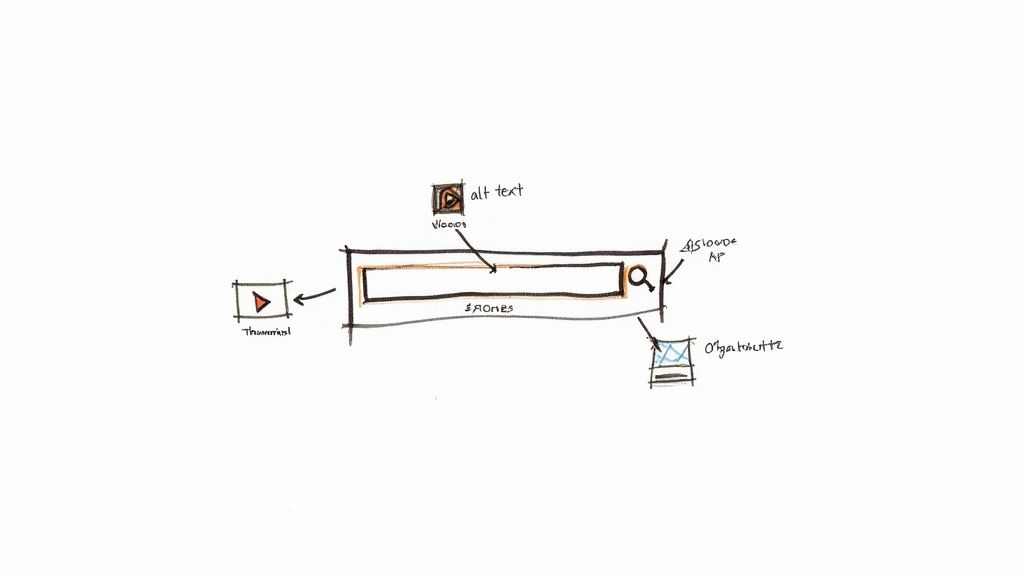
Dropping an image into your release and calling it a day won't cut it. You have to give search engines the context they need to understand what that visual is about. This is where a little behind-the-scenes optimization makes a huge difference for any search engine optimized press release.
Here’s how to put your visuals to work:
- Descriptive File Names are a Must: Before you even upload, ditch the generic
IMG_8432.jpg. Rename it to something a search crawler can actually understand, likenew-ai-logistics-platform-dashboard.jpg. It’s a simple step that provides instant context. - Write Alt Text That Works: Alt text is your chance to describe the image to search engines (and visually impaired users). Be concise, accurate, and try to include your target keyword naturally. For example: "Screenshot of the Innovate AI dashboard showing a 30% reduction in shipping costs."
- Transcribe Your Videos: If you're embedding a video, always include a full transcript. This not only improves accessibility but also gives search engines a crawlable text version of everything said, packed with valuable keywords.
If you really want to lean into a multimedia-first approach, look into the social media release format. It's built from the ground up to integrate and highlight these kinds of engaging assets.
Get a Leg Up with Schema Markup
Ready for a more advanced move? Let's talk about Schema markup. Think of it as a special vocabulary you add to your press release's code that speaks directly to search engines. It's like handing Google a cheat sheet that spells out exactly what your content is, who wrote it, and why it's newsworthy.
Implementing Schema is your best shot at earning those eye-catching "rich snippets"—like a headline and thumbnail showing up in the "Top stories" carousel. These enhanced listings are far more compelling and get significantly more clicks than a standard blue link.
Think of Schema markup as a VIP pass for your content. It doesn’t guarantee you’ll get into the club, but it tells the bouncer (Google) that you’re important and deserve special attention.
The Two Most Important Schema Types to Use
For any press release, you’ll want to focus on two specific Schema types to get the most bang for your buck: NewsArticle and Organization.
- NewsArticle Schema: This markup tells search engines loud and clear, "This is news." You can flag key details like the headline, author, publication date, and the main image. This helps Google categorize your announcement correctly and feature it in news-specific results.
- Organization Schema: This is all about reinforcing your brand's identity. It provides Google with verified info about your company—your official name, logo, website, and social profiles. This helps build your entity in Google's Knowledge Graph, which boosts your overall authority and credibility.
When you pair optimized multimedia with the right structured data, you turn a simple text announcement into a powerful, machine-readable asset. This isn't just theory; studies show that a fully optimized press release can boost online visibility by around 52% compared to one without these elements. To dig deeper into the data, you can discover more insights about press release statistics from SEO Design Chicago.
Smart Distribution for Maximum SEO Impact
Crafting a press release that Google loves is a fantastic start, but it's only half the job. A brilliant announcement that nobody sees is just a well-written document collecting digital dust. This is where your distribution strategy comes in—it's the engine that turns your news into a real SEO asset.
The old playbook of just carpet-bombing a generic newswire service is officially dead. While those services still have a role, the real SEO juice comes from a much smarter, more targeted game plan. It's about getting your news in front of the right people on the right platforms. We're talking about the places that will earn you high-authority backlinks and lasting search visibility, not just a fleeting mention.
Using Newswires for SEO, Not Just Reach
Let's be clear about what major newswires like PR Newswire and Business Wire are good for. Their massive syndication networks can push your release out to hundreds, sometimes thousands, of websites. This creates a wide net of brand mentions and nofollow links, which is great for getting your news into systems like Google News and for quick indexing.
From a pure SEO standpoint, their main benefit is the authority and speed they bring to the table. Search engines crawl these platforms constantly, meaning your announcement can pop up in search results almost immediately.
But here’s the catch: not all that syndication is created equal. A huge chunk of the sites your release lands on will be low-authority domains that offer little to no SEO value. Think of newswires as the foundation of your distribution house—they provide a solid base of visibility and citations, but the truly valuable parts are built on top of that.
The Real Power of Targeted Manual Outreach
The links that truly move the needle for your domain authority don't come from automated syndication. They come from earned media placements. This is when a real journalist, blogger, or industry influencer decides your news is worth writing about and links back to your website.
This is where you have to roll up your sleeves. Personalized, manual outreach is non-negotiable.
- Build Your "Dream 20" List: Before you even think about writing an email, create a curated list of 20-30 high-authority publications, niche blogs, and influential writers in your space. These are the outlets where a single mention would be a huge win.
- Find the Right Human: Don't just fire off a pitch to a generic
editor@publication.comaddress. That's a black hole. Use tools like LinkedIn or dig through the publication's website to find the specific journalist who actually covers your beat. - Make Your Pitch Irresistible: Your email needs to be personal. Reference a recent article they wrote. Get straight to the point and explain why your news is a perfect fit for their audience. Give them the story angle on a silver platter.
A single backlink from a respected industry publication is worth more to your SEO than a hundred syndicated links on spammy news portals. Earned media is, and always will be, the gold standard.
Diversify Your Channels for a Stronger Backlink Profile
Putting all your eggs in one distribution basket is a rookie mistake. A truly robust strategy involves creating multiple touchpoints for your announcement, which helps build a more natural and powerful backlink profile over time. A diverse link profile signals to Google that you're a credible and authoritative source.
Round out your distribution plan by adding these channels to the mix:
- Industry Forums and Communities: Drop your news in relevant subreddits or niche industry forums where your target audience actually hangs out.
- Social Media: Post your release on LinkedIn, X (formerly Twitter), and other key networks. Be sure to tag relevant people, companies, and publications to get more eyes on it.
- Your Own Website's Newsroom: This is a big one. Always publish the release on your own site first. This establishes your website as the canonical source—the original home of the information.
This multi-pronged approach ensures your news is more than just a flash in the pan. We've seen well-optimized press releases drive a 10–20% increase in website visitors in the days after launch, proving that a smart plan pays off in real traffic. For a deeper dive into the numbers, check out the full research on press release performance from SEO Design Chicago.
By combining the broad reach of newswires with the surgical precision of manual outreach, you create a powerful engine for long-term SEO success.
So, your press release is live. The work isn't over—not by a long shot. Now comes the part where you prove it was all worth it.
This means looking past vanity metrics. The number of syndication pickups is nice for a quick ego boost, but the real ROI of a search engine optimized press release shows up in tangible results that move the needle for your business.
Your first port of call should be Google Analytics. Head straight to your acquisition reports and start digging into referral traffic. Can you see new visitors trickling in from the news sites that picked up your story? A well-executed release should send a wave of qualified traffic your way. Keep an eye out for those spikes right after your distribution date.
Key Performance Indicators That Matter
To really understand the impact, you need to track a few specific metrics that tie your PR work directly to SEO performance. These are the numbers that tell the real story.
- New Backlinks: Fire up a tool like Ahrefs or Semrush and hunt for new backlinks. The key here isn't just quantity, it's quality. Honestly, one solid link from a high-authority, relevant publication is worth more than a hundred from those cookie-cutter syndication sites.
- Keyword Ranking Shifts: Remember those primary and secondary keywords you worked so hard to include? It's time to see if it paid off. Check if your product pages—or even the release itself—are climbing the search results for those terms. This is a direct sign of SEO success.
- Branded Search Volume: Are more people searching for your company by name? This is a fantastic signal of growing brand awareness. You can monitor this in Google Search Console. It’s a clear indication that your message is getting out there.
If you want to go deeper and connect these efforts to the bottom line, it's worth learning how to measure your overall SEO ROI.
Future-Proofing for Generative Engine Optimization
We also have to talk about what's coming next. With the rise of AI-powered search, or Generative Engine Optimization (GEO), high-authority media placements are becoming even more valuable.
Think about it: Generative AI models, like Google's AI Overviews, need to pull information from trusted, authoritative sources to build their answers. A great story in a top-tier publication is no longer just a backlink. It's now a source document that can directly shape the answers AI gives to millions of people.
This means that coverage in outlets like AP, Reuters, or respected industry journals is pure gold. These are the sources AI is more likely to trust and feature in generated answers. It's a fundamental shift that makes earned media in these channels more critical than ever. Tracking high-quality pickups isn't just about measuring past success anymore—it's a core part of your strategy for future visibility.
Got Questions? We've Got Answers
Even with the best game plan, a few questions always pop up when you're in the trenches writing a press release for search. Let's tackle some of the most common ones I hear from PR teams and founders.
What’s the Deal with Nofollow Links? Should I Worry About Them?
You’ll see this a lot, and in most cases, your newswire service will automatically tag your links as nofollow. Don't panic—this is actually standard practice. Google has been clear that since press releases are a form of paid distribution, the links shouldn't pass SEO equity.
But that doesn't mean they're worthless. Far from it. A nofollow link is still incredibly valuable for:
- Driving real, interested people straight to your website (referral traffic).
- Building brand recognition and getting your name out there.
- Most importantly, getting your news in front of a journalist who might write their own story about you—and give you a natural, followed link in the process.
So, forget about the nofollow tag. Your job is to make the anchor text so compelling that a human can't resist clicking it.
How Many Keywords Is Too Many?
This is a classic. People get so excited about SEO that they try to cram keywords into every sentence. Please don't. That's called "keyword stuffing," and it makes your announcement unreadable while also risking a penalty from search engines.
Think about it in terms of a simple hierarchy:
- One primary keyword: This is your star player. It goes in the headline and the first paragraph.
- Two to three secondary keywords: These are your supporting cast. Weave them into your subheadings.
- A few long-tail keywords: These are conversational phrases that you can sprinkle naturally throughout the body of the release.
The ultimate test is to read it aloud. If it sounds clunky or robotic, you've gone too far. Write for a person first, and the right keywords will find their place naturally.
What's the Perfect Length for a Press Release?
Keep it short and sweet. My rule of thumb is to aim for somewhere between 300 and 400 words.
That’s the sweet spot. It’s just enough space to cover the who, what, where, when, and why, but not so long that a time-crunched journalist will just skip it.
This conciseness also helps with SEO. A tight, focused document makes it easy for search engine crawlers to figure out exactly what your news is about, which can lead to faster indexing and better ranking for your target terms.
Ready to stop guessing and start getting your news in front of the right journalists? PressBeat uses AI to match your story with top-tier media outlets, guaranteeing publication and giving your SEO a serious boost. See how PressBeat can amplify your message.