
How Do You Send a Press Release That Gets Noticed
December 4, 2025
Sending a press release that actually gets results is about more than just writing up your news and blasting it out. It’s a game of strategy. The best approach I've seen—and used—is to pair a killer press release with personalized, one-on-one pitches to journalists who genuinely care about your industry.
Laying the Groundwork for a Winning Press Release

Before a single word is written, the real work begins. The difference between a press release that lands you a feature story and one that gets instantly archived is all in the prep work. You're not just making an announcement; you're crafting a story that a journalist will want to tell their audience.
This is where you have to be brutally honest with yourself. Is your announcement truly newsworthy, or is it just internal company news? The trick is to find an angle that hooks into a larger conversation, solves a real-world problem, or presents a fresh perspective people haven't heard before.
Defining Your Core Objective
First things first: what are you trying to achieve? Without a clear goal, you're just making noise. Your objective will dictate everything that follows, from the headline you write to the reporters you target.
For a startup, the goals are usually pretty specific:
- Driving inbound leads after a new product goes live.
- Catching the eye of investors by announcing a major funding round.
- Building brand authority with a new data report that reveals industry trends.
- Boosting market credibility by announcing a key partnership.
Think about it this way: a fintech startup launching a new budgeting app isn't just talking about its features. The real story is how this app helps millennials tackle student loan debt—that’s a timely, relatable hook a journalist can build a story around. You have to shift the narrative from "what we built" to "why anyone should care."
A press release should never be an advertisement in disguise. It must offer genuine value to a reporter and their readers by providing timely, relevant, and impactful information.
Assembling Your Media Assets
Journalists are always on a deadline. If you make their job easier, your odds of getting coverage skyrocket. So, before you even think about hitting 'send,' get all your assets bundled up and ready to go in a single, easy-to-access place.
Here’s a quick pre-launch checklist of what to get ready:
- High-resolution images: This means pro headshots of your execs, clean product shots, and your company logo in various formats.
- Compelling quotes: Have two or three punchy quotes from your CEO or another key stakeholder ready to go. They should add real personality and insight, not just corporate fluff.
- Company boilerplate: Your standard, one-paragraph summary of who you are and what you do. Keep it tight and clear.
- Media contact info: Make sure you have a dedicated email and phone number listed for any press inquiries.
Having all this ready to go shows you respect a reporter's time. It tells them you’re a professional source who can provide everything they need to turn your announcement into a story without a lot of back-and-forth. Honestly, this prep work is the secret sauce that turns a simple announcement into real earned media.
Crafting a Press Release Journalists Will Actually Read
Your press release is a direct line to the media, and to earn a journalist's attention, it needs to speak their language. It isn’t just an announcement; it’s a professional tool designed to make their job easier. The goal is to hand them a story on a silver platter—so clear and well-structured that they can almost copy and paste it into their own article.
Think of it as the blueprint for the news story you want to see published. Every single element, from the headline down to your media contact info, has a specific job to do. Nailing this structure is your first—and most important—step toward getting noticed.
The Anatomy of a Powerful Press Release
There's a reason great press releases follow a standard format. It's not about being rigid; it's about giving a busy journalist exactly what they need, right where they expect to find it. If they have to dig for the core details of your story, they'll simply move on to the next pitch in their overflowing inbox.
Here are the non-negotiable building blocks:
- A Killer Headline: This is your one and only chance to make a first impression. It needs to be active, punchy, and instantly communicate what makes your news newsworthy.
- The Lead Paragraph: No beating around the bush. Your first sentence or two must answer the classic questions: Who, what, when, where, and why. This is the heart of your story.
- Supporting Body Paragraphs: Once you've hooked them with the lead, you can flesh out the details. Use these paragraphs to add compelling data, context, and background that builds a complete narrative.
- Authoritative Quotes: A quote from a founder, CEO, or key partner adds a crucial human element. It gives journalists a ready-made soundbite and adds credibility to your announcement.
For a deeper dive into assembling these components, our comprehensive guide on how to write a press release offers templates and real-world examples to get you started.
Formatting for Maximum Scannability
Let's be honest: journalists don't read press releases—they scan them. Your formatting has to cater to this reality. A dense wall of text is an instant turn-off and the fastest way to get your email deleted.
A journalist spends less than one minute reading a press release. If your key message isn’t immediately obvious, you’ve already lost them. Make your most important information impossible to miss.
To keep them engaged, use short paragraphs—two or three sentences, max. Use subheadings to break up different ideas and pull out key features, stats, or benefits with bullet points. This creates a visual hierarchy that guides their eyes right to the good stuff.
Finally, every press release must conclude with two critical elements:
- Boilerplate: This is your "about us" paragraph. It's a short, standardized blurb that gives reporters essential context about your company without cluttering the main announcement.
- Media Contact: Make it incredibly easy for them to follow up. Clearly list the name, email, and phone number of the person they should reach out to. No contact info? Your odds of getting coverage just plummeted.
Choosing the Right Press Release Distribution Channels
You’ve poured everything into crafting the perfect press release. Now what? The hard truth is that a great announcement is useless if it doesn't reach the right people. Your distribution strategy is what separates a story that gets covered from one that gets ignored.
There are two main schools of thought here: a targeted, personal approach through direct outreach, or a wide-net approach using a wire service. Neither is inherently "better"—they just solve different problems. One builds relationships and targets a niche; the other provides massive scale and immediate syndication.
Let's break down when to use each.
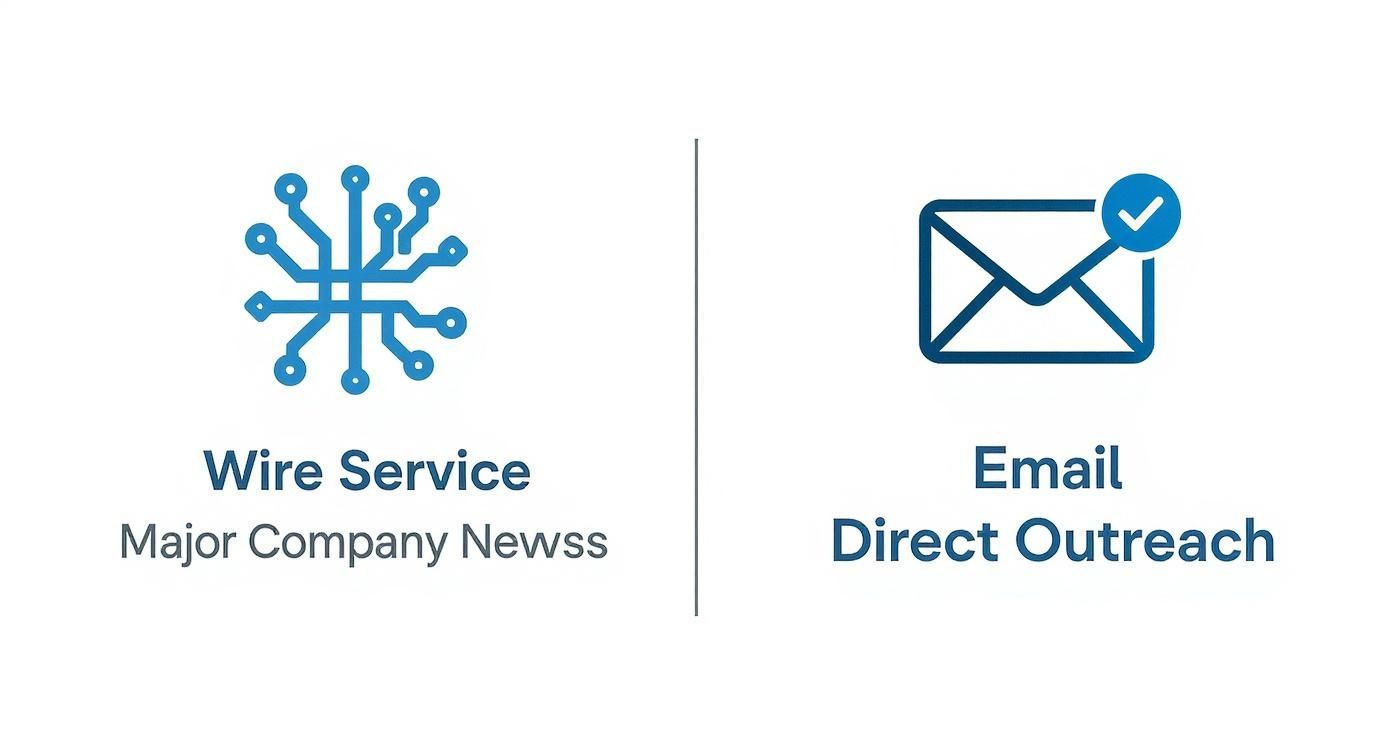
As you can see, major company milestones often justify the cost and reach of a wire service. For almost everything else, a personal touch is the way to go.
Direct Outreach: The Art of the Personal Pitch
Direct outreach is exactly what it sounds like: you, personally, emailing your press release and a tailored pitch to a hand-picked list of journalists. It's the PR equivalent of a sniper rifle, not a shotgun. For most day-to-day announcements, especially from startups and tech companies with specialized stories, this is your bread and butter.
Think about these real-world scenarios:
- You're launching a new feature for your B2B SaaS platform. Your news doesn’t belong on a generic news site. It needs to land in front of a handful of tech reporters who cover your specific industry. A personalized email explaining why their audience would care is infinitely more powerful than a mass blast.
- You're announcing a local partnership. A wire service is total overkill. Your real targets are the local news desk and community bloggers who are actively looking for stories about their area.
- You've published a deep data report. This is your chance to connect with industry analysts and editors who value substantive content. A personal pitch allows you to start a conversation and position yourself as an expert source for future stories.
The best part? Direct outreach costs nothing but your time. Its success hinges entirely on smart research, thoughtful personalization, and building genuine relationships—which is exactly what we’ll get into next.
Wire Services: When You Need to Make a Big Splash
Press release wire services, or newswires, are the broadcast system of PR. They send your announcement simultaneously to a massive network of newsrooms, websites, and media outlets. It’s a powerful tool, but it comes with a price tag and should be reserved for your most significant news.
A wire service guarantees your news gets placed on hundreds of online portals. This creates a huge digital footprint and lends instant credibility to major announcements. It’s less about earning a feature story and more about achieving widespread, syndicated visibility.
This channel is the right call for:
- Major funding rounds. Announcing a Series A or B is a huge signal of market validation. A wire service ensures that investors, partners, and potential customers see that news across financial outlets like Yahoo Finance or Business Insider.
- An IPO or acquisition. These are monumental company events that require broad, official, and simultaneous dissemination to the market. There's no room for error.
- A major product launch with mainstream appeal. If you're launching a consumer product that anyone could use, a wire service can get the news in front of a diverse range of media outlets, fast.
The investment can be substantial. Costs for a press release distribution range from $29 for basic online visibility to $1,999 for premium services. The top-tier platforms give you access to over 440,000 newsrooms and 270,000 journalists globally, often guaranteeing placement on 200+ major outlets. For more data, you can find great press release costs and statistics on seodesignchicago.com.
Press Release Distribution Channel Comparison
To make the decision even clearer, here’s a side-by-side look at the three primary distribution channels: direct email, wire services, and dedicated PR platforms.
| Distribution Method | Best For | Cost | Reach & Control |
|---|---|---|---|
| Direct Email Outreach | Niche stories, relationship building, thought leadership, most startup news. | Free (Time-intensive) | Low reach, high control. You choose exactly who sees your pitch. |
| Wire Services | Major funding, acquisitions, IPOs, high-impact product launches. | $$ - $$$$ | High reach, low control. Guaranteed syndication, but no control over who covers it. |
| PR Platforms (e.g., PressBeat) | Finding relevant journalists, managing outreach, tracking engagement. | $ - $$ | Medium reach, medium control. Simplifies finding contacts but still requires personalization. |
Ultimately, choosing the right channel comes down to a simple question: Are you trying to start a conversation with a few key people, or broadcast a message to the world? Answering that will tell you exactly where your time and money are best spent.
Mastering the Art of the Personalized Email Pitch
If you just attach your press release to a generic, mass-blasted email, you're practically guaranteeing it ends up in the trash. The real secret to getting results is the personalized pitch. This shifts your whole approach from just broadcasting your news to actually building relationships.
Sure, it takes more effort upfront. But the payoff is huge. Instead of just crossing your fingers, you’re creating a genuine connection with a journalist who is far more likely to see why your story matters.
Building Your Hyper-Targeted Media List
The foundation of any great pitch is a carefully curated media list. This isn't about how many contacts you have; it's about how precise you are. Your goal is to identify a small, focused group of journalists, bloggers, and editors who live and breathe your specific niche.
Start by looking for reporters who have already written about your competitors or topics in your orbit. A quick search on their publication's website or their social media profiles will tell you a lot about their recent work and what they care about.
Here’s what to look for:
- Recent Articles: Are they consistently covering your industry? One article from two years ago doesn't cut it.
- Story Angle: Do they gravitate toward data-driven reports, human-interest stories, or straightforward product reviews? Your pitch has to fit their style.
- Audience: Does their readership match your target customer? Getting a feature in the wrong publication won’t move the needle on your goals.
Once you've got your list, the real work begins. Read a few of their latest articles. Find a specific point, a unique angle, or even a quote that you genuinely appreciate. This little detail is what will make your personalized pitch feel authentic.
Crafting a Subject Line That Demands to Be Opened
A journalist's inbox is a warzone for attention. Your subject line is your first—and often only—shot at standing out from the hundreds of other emails they get every single day. Generic lines like "Press Release" are an instant turn-off.
The trick is to be specific, relevant, and just a little bit intriguing. Your subject line needs to scream value for the journalist and their readers.
To cut through the noise, PR pros are ditching mass blasts for personalized, one-to-one email pitches. In fact, a whopping 89% of PR professionals now prefer this method. It works, too—the average open rate for these tailored pitches hits 44%, showing just how much customized communication pays off.
Try framing your subject line around these proven formulas:
- For a Data Story: New Data: [Your Key Statistic] Reveals Surprising Trend in [Their Beat]
- For a Product Launch: Story Idea: How [Your Product] Helps [Their Audience] Solve [Specific Problem]
- To Offer an Exclusive: Exclusive for you: [Your Company] Announces [Your News] (Embargoed until [Date])
Each of these examples is tailored to the journalist's beat and positions your announcement as a story idea, not just a press release. Of course, none of this matters if your email lands in the spam folder. It's critical to enhance your email deliverability to make sure your pitch actually gets seen.
The Perfect Timing for Your Pitch
When it comes to pitching, timing really is everything. Sending your email at just the right moment can dramatically boost your chances of getting noticed.
As a rule of thumb, the sweet spot is mid-morning, somewhere between 10 AM and 12 PM, from Tuesday to Thursday.
Avoid Monday mornings at all costs—inboxes are overflowing from the weekend. And Friday afternoons are usually a dead zone, as reporters are scrambling to wrap up their week. Your goal is to land at the top of their inbox right when they're actively hunting for new stories.
For a deeper dive with more examples, check out our guide on crafting the perfect media pitch email example.
How to Measure Success and Follow Up Professionally
https://www.youtube.com/embed/VUtjQQAOkaY
Hitting ‘send’ on your press release isn't the finish line. Honestly, it’s just the starting gun. Your job now shifts from creator to tracker, and the real work of building relationships begins. What you do after the send is often what separates a forgotten email from a feature story.
First things first, you need to see who’s talking about you. Don’t just sit back and hope for coverage—you have to actively hunt for it. I recommend setting up alerts for your company name, your CEO's name, and the main keywords from your announcement. This way, you’ll catch every mention the moment it goes live and can react right away.
Key Metrics to Track
Getting a mention is great, but you need to understand the actual business impact. The right metrics don't just feel good; they prove the value of your work to your team, your boss, and your investors.
Here’s what I always keep a close eye on:
- Media Mentions and Placements: This is the most obvious one, but look beyond the raw number. Where did your story land? A single feature in a major industry publication is far more valuable than dozens of automated pickups on generic news sites. Quality over quantity, always.
- Backlinks: This is a huge win for your SEO. When a respected outlet links to your website, it’s a powerful signal to Google that you’re a credible source. Over time, these links can seriously boost your domain authority.
- Referral Traffic: Pop open your website analytics. Are people actually clicking the links in the articles and coming to your site? This is proof that your story didn't just get published; it actually got people interested enough to learn more.
- Social Media Shares: Check out how your news is spreading on platforms like X (formerly Twitter) and LinkedIn. A high number of shares means your announcement is genuinely sparking conversation and resonating with people.
Keeping tabs on these numbers gives you a clear picture of what worked and what didn't. For a deeper dive, our guide on how to measure public relations breaks down how to connect these activities to real ROI.
The Art of the Professional Follow-Up
Following up is a delicate dance. You have to be persistent, but you can't be a pest. The golden rule? Always add value. Never, ever just ask, "Did you see my email?"
Give journalists some breathing room. I usually wait about three to five business days before sending a follow-up. That’s enough time for them to have seen your pitch without feeling hounded.
The worst follow-up is a lazy one. Instead of just bumping your old email, offer something new—a fresh data point, a new customer quote, or an offer to connect them with an expert for a different story they're working on. Make yourself a resource, not just a pitcher.
When you do reach out again, keep it short and to the point. A simple reply to your original email is perfect. I sometimes mention a recent article they published to show I’m paying attention, then gently reconnect that to why my story is a good fit for their readers.
If you still don’t hear back after a second polite nudge, it’s time to let it go. Respect their silence and move on. There are plenty of other stories to pitch.
Got Questions? We’ve Got Answers.
Even with a perfect plan, sending out a press release can feel like shouting into the void. It’s totally normal to have questions. Let's walk through some of the most common ones I hear from founders so you can press "send" with confidence.
How Do I Even Find Journalists?
This is the big one. It feels intimidating, but you don't need a pricey subscription to a massive media database like Cision to get started. Honestly, a little bit of smart searching goes a long way.
Jump on LinkedIn and search for journalists by the publications you want to be in and the topics they cover (their "beat"). X (formerly Twitter) is also a goldmine; follow hashtags related to your industry and see which reporters are driving the conversation. It's about being resourceful, not just throwing money at the problem.
What’s the Perfect Length for a Press Release?
I know it's tempting to cram every single detail about your launch into the press release, but you have to resist. Shorter is always better.
The sweet spot for a press release is 400-500 words. That’s just enough room for the essential facts and a punchy quote, but short enough for a time-crunched journalist to scan in 60 seconds.
What Happens if Nobody Covers My News?
First off, don't panic. It happens to literally everyone, from the smallest startup to the biggest brands. If your announcement gets crickets, it’s not a failure—it’s a data point.
Take an honest look at your angle. Was it genuinely newsworthy for an external audience, or was it more of an internal milestone? If the story was solid, the next suspect is your media list. Did you pitch reporters who actually cover your specific niche? If not, it's time to get more targeted for your next announcement.
And remember, a press release that doesn't get picked up is far from useless. You've just created a great piece of content. Now, repurpose it!
- Make it a blog post: Go deeper into the story on your own website, adding more context for your customers and community.
- Chop it up for social media: Pull out the key takeaways and turn them into a series of posts for LinkedIn, X, or wherever your audience lives.
- Feature it in your newsletter: Share the news directly with the people who care most—your subscribers.
Every press release is a chance to learn, refine your pitch, and build better relationships.
Ready to stop guessing and start getting guaranteed media coverage? PressBeat uses AI to connect you with the right journalists and ensures your story gets published. See how PressBeat can amplify your news.