
How to Post a Press Release and Get Real Media Coverage
January 17, 2026
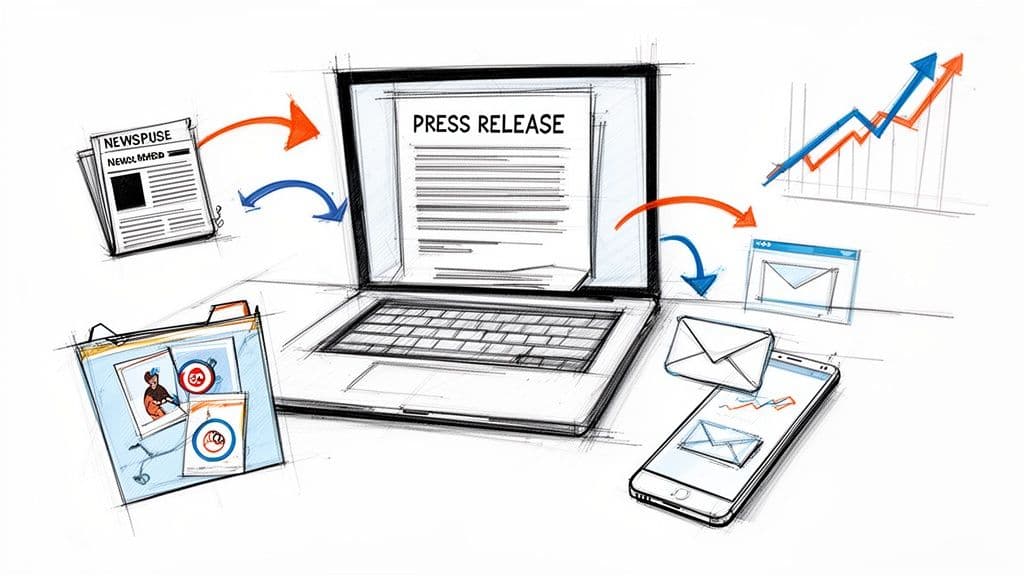
Posting a press release used to be simple. You’d write it up, blast it out on a newswire, and hope for the best. That "spray and pray" approach is a relic. Today, if you want real results, you have to think completely differently. It’s no longer about broadcasting; it’s about making a connection.
Success now hinges on finding the right journalists and crafting a personal, relevant pitch that actually helps them do their job.
Why Your Old Press Release Strategy Is Broken
We're all drowning in information, and the biggest challenge isn't making noise—it's getting someone to actually listen. Sending your announcement through a traditional wire service might get it posted on some obscure feed, but that’s a far cry from getting it published by a respected journalist.
For a startup or tech company trying to build credibility, that distinction is everything. A post on a newswire is just an entry in a database. A story written by a journalist is a stamp of approval that builds trust with your audience.
The Old Way vs. The New Way
Let's be real: the media world has changed. Journalists are overworked, understaffed, and their inboxes are a war zone. With tens of thousands of press releases flying around the globe daily and 49% of journalists getting hammered with up to 50 pitches a week, it's no surprise that generic outreach gets a dismal 3.43% response rate. You can dig deeper into these press release statistics to see just how tough it is out there.
This inbox overload means a generic blast is dead on arrival. The only way to cut through is with a precise, personalized approach. This shift from shouting at everyone to talking to the right someone is the core of modern PR.
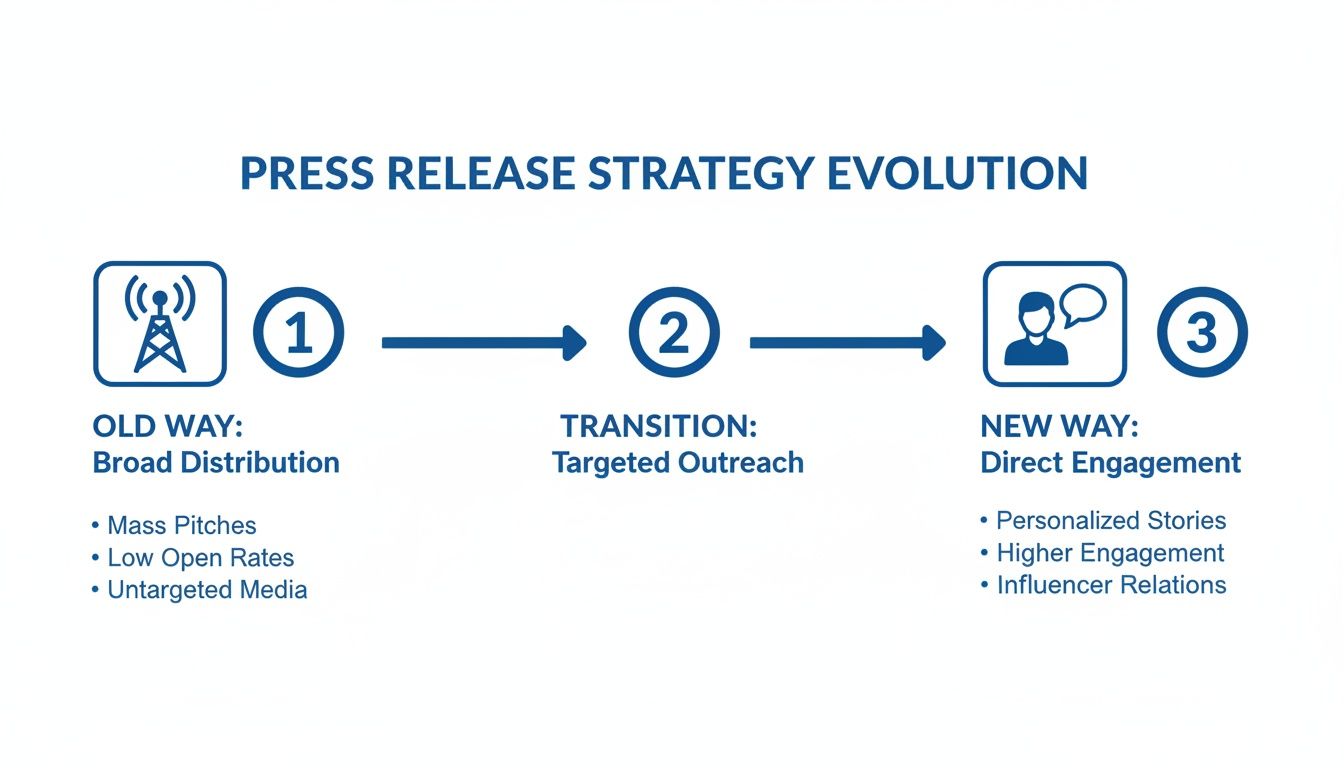
As you can see, the game has moved from volume to value. It’s about building relationships, not just sending emails.
To help illustrate the choice you're facing, here's a quick breakdown of the two main approaches.
Newswire Blast vs. Targeted Pitching: A Quick Comparison
| Feature | Traditional Newswire | Targeted Pitching (e.g., PressBeat) |
|---|---|---|
| Approach | "Spray and Pray"—distributes to a vast, generic network of sites and feeds. | "Find and Befriend"—identifies and engages specific, relevant journalists. |
| Reach | Broad but shallow. Hits thousands of endpoints with minimal human engagement. | Narrow but deep. Focuses on a curated list of high-impact contacts. |
| Cost | Can be very expensive, often $400-$2,000+ per release for wide distribution. | Cost-effective. Focuses on the tools and time for research and outreach. |
| Outcome | Guaranteed "posting" on syndicated sites, but very low chance of earned media. | No guarantees, but a much higher probability of landing genuine, high-quality coverage. |
| ROI | Typically low. You pay for distribution, not for results or relationships. | High. Builds long-term media relationships and generates valuable earned media. |
Ultimately, choosing a newswire is paying for guaranteed placement on sites no one reads. Targeted pitching is investing in the chance to earn a story in a publication your customers actually trust.
Start Thinking Like a Publisher
To win at this new game, you have to stop thinking like a marketer and start thinking like a publisher. Your job is to hand a journalist a great story on a silver platter, making their life easier.
This requires a whole new workflow:
- Story First, Send Button Second: Before you write a single word, ask yourself: is this genuinely newsworthy? What's the hook that will grab a reader's attention?
- Curate, Don't Collect: Ditch the massive, outdated media list. Instead, build a small, highly-relevant list of journalists who live and breathe your industry.
- Make it Personal: Every pitch needs to show you've done your homework. Mention a recent article they wrote. Explain exactly why your news is a perfect fit for their audience.
This shift isn't optional anymore. When you treat journalists like a valued audience instead of a distribution channel, your press release transforms from a static announcement into a catalyst for real media coverage—the kind that builds a brand and drives growth.
Crafting a Press Release That Earns a Response
Okay, before we even get into the weeds of distribution, we need to get one thing straight: you have to write a press release that someone actually wants to read. Too many people think of it as a corporate memo or a product brochure. It's not. It's a news story, packaged and handed to a journalist on a silver platter.
If you want to earn a reply instead of a one-way trip to the trash folder, you have to stop thinking in jargon and start thinking about the human story. The first question I always ask is the toughest: Why should anyone outside of my company care about this? What's the real-world impact on customers, the industry, or even the local community? If you can't answer that in a single, clear sentence, a journalist won't bother trying.
The Anatomy of a Magnetic Headline
Your headline is everything. It's the first—and often the only—thing a journalist will read. It needs to be sharp, specific, and deliver the core news in 10-20 words. Vague, clickbait-y headlines are a dead giveaway that there's no real story underneath.
Don't write: "InnovateTech Launches New AI Platform."
Instead, get right to the point: "InnovateTech Launches AI Platform That Cuts Small Business Marketing Costs by 40%."
See the difference? The second version instantly tells a busy reporter:
- Who: InnovateTech
- What: A new AI platform
- Why it matters: It saves a specific audience a significant amount of money.
That’s a story. A journalist can immediately see how that fits into a business or tech column.
Use the Inverted Pyramid—It's Your Secret Weapon
Journalists are wired to process information in a specific way, and it’s called the inverted pyramid. All this means is you put the most important stuff right at the top, then follow it with supporting details in descending order of importance. When you write this way, you're speaking their language and making their job a whole lot easier.
Your first paragraph (the "lead") has to do all the heavy lifting. It must crisply answer the five Ws: who, what, when, where, and why.
A journalist should be able to understand the entire story just by reading your headline and your first paragraph. The rest of the release just adds the depth, context, and proof they need to write their piece.
If you really want to master this structure, our complete guide on how to write a press release for maximum impact breaks it down with templates and real-world examples.
Bring Your Story to Life with Data and Quotes
Once you've nailed the lead, the body of your press release is where you build your case. This isn't the place for empty buzzwords or corporate fluff—that's the fastest way to get your email deleted. You need to back up your claims with hard evidence and human perspective.
Give your story some real substance with these elements:
- Hard Data: Numbers don't lie. They add credibility and weight to your announcement. Launching a new app? Tell them about your beta testing results. Announcing a funding round? State the amount and exactly how you'll use it. Instead of saying your app is "growing quickly," say it "hit 100,000 downloads in its first 90 days."
- Powerful Quotes: A quote from your CEO shouldn't just repeat what's already in the release. It’s your chance to inject some personality, vision, and the "why" behind the news. A good quote gives a reporter a unique insight they can't get anywhere else.
Here’s a perfect example from a funding announcement.
| Bad Quote (Generic & Lifeless) | Good Quote (Specific & Visionary) |
|---|---|
| "We are excited to have secured this funding, which will help us grow." | "This $10 million investment is a vote of confidence not just in our technology, but in our mission to make sustainable logistics accessible for every e-commerce business. With this capital, we're hiring 50 new engineers and expanding into the European market to help retailers cut their carbon footprint in half by 2028." |
The second quote is a goldmine for a journalist. It's packed with specifics: the funding amount, the hiring goal, the expansion plan, and the company's bigger mission. That single quote gives them multiple angles to build a story around.
Finally, wrap things up with a boilerplate (a short, one-paragraph "about us" section) and clear media contact information. Make it painfully easy for a journalist to get in touch. Include the name, email, and direct phone number of someone who can answer their questions immediately. Removing that friction shows you’re a pro and ready to work with them.
Assembling a Media Kit That Journalists Will Love
A great press release might catch a journalist's eye, but it's the media kit that helps them actually write the story. Think of it as the ultimate grab-and-go resource for your company. When a reporter is staring down a 4 p.m. deadline, the last thing they want to do is dig through your website for a high-res logo or search LinkedIn for an executive’s headshot.
Making their job easier is the fastest way to become their favorite contact. A solid media kit gets rid of all that friction and signals that you're a pro who respects their time. Instead of clogging up their inbox with a dozen huge attachments (a classic PR sin), just give them one clean link to a folder with everything they need.
Honestly, this simple step can be the difference between getting covered and getting your email deleted.
Core Components Every Media Kit Needs
Your media kit should be a one-stop shop. Don't overdo it—just focus on the essentials journalists always ask for. Keep it clean, organized, and label every single file clearly.
Here’s what you absolutely must include:
- High-Resolution Logos: Offer your logo in multiple formats. You'll want a vector file (.eps or .ai) for print and a .png with a transparent background for web use. Make sure to include full-color and single-color (black or white) versions.
- Executive Headshots: Add professional, high-quality photos of your key leaders, especially anyone quoted in the press release. Name the files logically, like "Jane_Doe_CEO.jpg."
- Product Photos or Screenshots: This is non-negotiable for any product-related news. Provide a mix of high-resolution images. Lifestyle shots showing the product in use are often far more powerful than sterile product-on-white-background photos.
- Company Boilerplate: Yes, it’s in your press release, but put it in a separate .txt or .docx file here, too. It makes it dead simple for a journalist to copy and paste your official company summary.
Think of your media kit as a self-service portal. The goal is to anticipate a journalist's every need so they never have to email you asking, "Can you send me a better version of your logo?"
Taking Your Media Kit to the Next Level
Got the basics covered? Great. Now you can add a few extra things that provide more context and make your story even juicier. These assets can help a reporter expand their article from a short blurb into a full feature.
Consider adding these items to really stand out:
- A Short Demo Video: A quick one-to-two-minute video showing your product in action can work wonders. It’s way more effective than trying to describe it in words.
- Case Studies or Testimonials: Brief success stories or a few powerful customer quotes provide instant social proof and real-world examples of your impact.
- Company Fact Sheet: Pull together a simple one-page PDF with key stats and milestones—founding date, funding details, number of customers, or important market data.
By providing these extra resources, you’re not just dumping information on them; you’re handing them ready-made story angles. You're making it almost effortless for them to say "yes" to covering you.
For a more detailed walkthrough, check out our guide on how to create a press kit that grabs attention. A polished kit is an essential part of knowing how to post a press release effectively.
Choosing Your Distribution Channel
You've polished your press release and assembled a killer media kit. Now comes the big decision: how are you actually going to get your story in front of the right people? This is where the rubber meets the road, and the choice you make can be the difference between a story that lands and one that vanishes into thin air.
Fundamentally, you're looking at two very different paths. There’s the old-school newswire service, and then there's the more modern, hands-on approach of pitching journalists directly. Each has its time and place, but for startups and tech companies fighting for meaningful media attention, one path is almost always more effective.
The Great Debate: Newswires vs. Direct Pitching
Newswire services like PR Newswire or Business Wire work on a simple model: you pay them a fee, and they blast your press release out to a massive network of websites and news feeds. It’s a classic shotgun approach, guaranteeing your announcement gets "posted" in hundreds, if not thousands, of places online.
On the surface, that sounds fantastic. Who wouldn't want that kind of reach? The catch is that most of these placements are on automated, syndicated feeds or buried deep within websites that actual humans—especially busy journalists—rarely, if ever, see. You end up with a report full of links but often with zero genuine articles written by a reporter who cared about your story.
Direct pitching is the sniper rifle to the newswire's shotgun. It's about carefully identifying the specific journalists, bloggers, and influencers who live and breathe your industry and sending them a personalized note. It definitely takes more work upfront, but the payoff is exponentially bigger because you're starting a real conversation, not just shouting into an empty room.
The core difference is this: Newswires get you listed. Direct pitching gets you covered. For a startup trying to build real credibility, a single article in a respected publication is worth more than a thousand mentions on automated news feeds.
When a Newswire Might Still Make Sense
Now, this isn't to say newswires are completely useless. Despite their drawbacks for most startups, there are a few specific situations where their broad, automated distribution is exactly what you need.
- Publicly Traded Companies: For public companies, using a newswire is standard practice for meeting financial disclosure requirements and getting material information out to investors and the market. It’s a necessary tool.
- Major Corporate Announcements: When a Fortune 500 company announces a massive acquisition or a new CEO, a wire service ensures the news is officially documented across financial terminals and news databases all at once.
- A Specific SEO Play: Some marketers use newswires to generate a high volume of backlinks. The quality of these links is debatable in the eyes of Google, but it’s a tactic some still use as part of a broader strategy.
For most growing businesses, however, the hefty price tag of a premium newswire service—often anywhere from $700 to over $3,000 per release—just doesn't deliver a good return on investment if earned media is your goal.
Why Direct Pitching Is a Startup’s Best Friend
When every dollar and every minute counts, direct pitching is the clear winner. The response rates from well-researched, personalized outreach are worlds away from the near-zero engagement you'll get from a wire blast. This is how you build real relationships with the media, relationships that can pay off for years to come.
This is exactly why platforms like PressBeat exist. Instead of just syndicating your text, it helps you find the right people to talk to. Using AI to scan recent articles and social profiles, you can build a highly targeted media list in minutes. This frees you up to focus on the most important part: the human element of crafting a pitch that truly connects with each journalist.
For a more detailed comparison, our deep dive into how to distribute a press release effectively breaks down the strategic considerations even further.
To really see the difference, it helps to look at the numbers. Here’s a quick comparison of the potential return on your investment for each method.
Press Release Distribution Method ROI
A data-focused look at the return on investment for different press release distribution strategies, highlighting key performance indicators.
| Distribution Method | Typical Cost | Average Journalist Response Rate | Likelihood of Earned Media Pickup | Best For |
|---|---|---|---|---|
| Newswire Service | $700 - $3,000+ | < 1% | Very Low | Public companies, major corporate filings. |
| Direct Pitching (Manual) | Time & Effort | 5% - 15% | Moderate to High | Startups with more time than money. |
| AI-Powered Pitching (PressBeat) | Platform Subscription | 15% - 30%+ | High | Startups focused on efficiency and results. |
The data tells a clear story. If your goal is genuine media coverage that builds your brand's authority and drives real traffic, investing your resources in targeted, personal outreach is the smartest move you can make. It puts your story in front of the people who actually want to tell it.
And don't forget to think beyond traditional journalists. Learning about influencer marketing best practices can open up entirely new channels to amplify your announcement. Ultimately, your choice of distribution channel comes down to what you value more: empty volume or meaningful connection.
Mastering the Art of the Personalized Pitch
Once you've got your press release and media kit polished, the real work begins. It all comes down to the pitch. This is your chance to turn a generic announcement into a genuine conversation, and frankly, it's where most people drop the ball. A bad pitch will get your story ignored, no matter how great it is.
The goal isn't just to blast out information; it's to build a connection. You have to show a journalist—in a matter of seconds—that you've actually paid attention and that your story is a perfect fit for their audience. Nailing this comes down to good communication, and brushing up on how to write professional emails that get replies can give you a serious edge.
The Subject Line: Your Only Shot at a First Impression
Let's be real: journalists delete emails based on the subject line alone. If they see something vague or salesy like "Exciting News" or "Press Release from [Your Company]," it’s going straight to the trash. Your subject line needs to be a tiny, powerful headline.
Think of it as a story idea, not an announcement you're making.
- Instead of: Press Release: InnovateTech Launches New App
- Try this: Story Idea: New app helps local restaurants cut food waste by 30%
See the difference? The second one instantly signals value to a reporter covering local business or sustainability. It tells them why their readers should care, not just what you've done.
Crafting an Email That Actually Gets Read
Your email needs to be short. Like, really short. Journalists are drowning in information and have zero time to waste. Get to the point immediately.
Here’s a simple, field-tested structure that works:
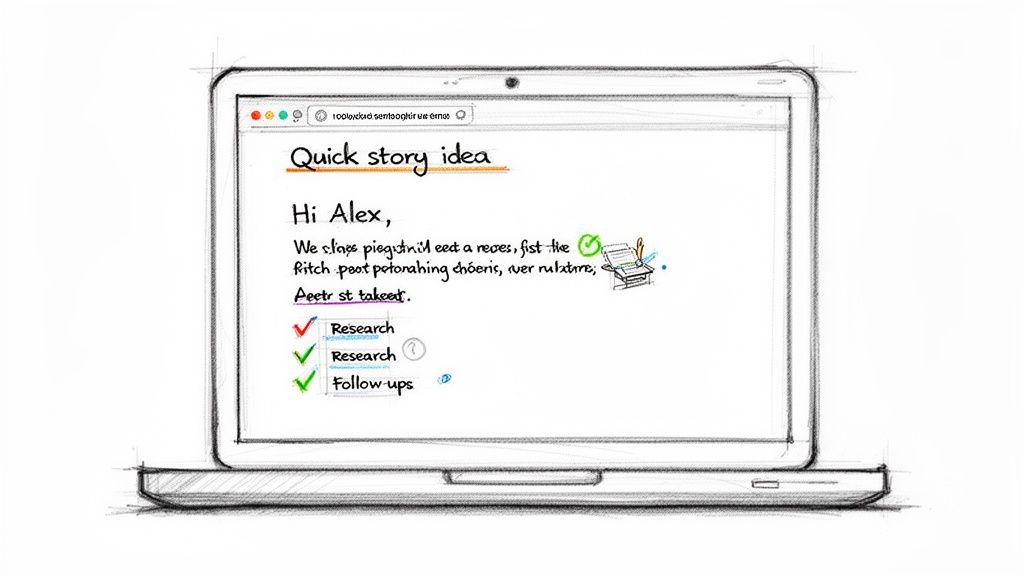
- The Personal Touch: Start with a genuine, specific compliment. Mention a recent article they wrote that you actually read and liked. This two-sentence opener proves you're a human, not a spam bot.
- The Hook: In one or two sentences, state your news and explain exactly why it's a fit for their specific beat. Don't make them guess—connect the dots for them.
- The Offer: Briefly summarize the key details and provide a link to your full press release and media kit. I can't stress this enough: Never attach files. Attachments get caught in spam filters and are a major security red flag for newsrooms.
- The Call to Action: End with a simple, direct question. Something like, "Is this something you'd be interested in covering?" makes it easy for them to reply.
Your entire pitch should be three or four short paragraphs, max. A journalist needs to be able to scan it and get the entire story in about 30 seconds.
The Dos and Don'ts of Journalist Outreach
Pitching is a delicate dance. Certain moves build trust, while others will get you blacklisted for good.
| Do | Don't |
|---|---|
| Do your homework. Read their work. Understand their beat. Know their audience. | Don't send a generic "Dear Editor" blast. Mass emails are the fastest way to get ignored. |
| Do keep it incredibly concise. Get straight to the point in the first few sentences. | Don't attach your press release. Always link to it in the body of the email. |
| Do follow up once, respectfully. A polite nudge after about a week is perfectly fine. | Don't be a pest. Bombarding them with follow-ups is annoying and will kill your chances. |
Remember, your job is to make their job easier. Every single part of your pitch—from the subject line to the media kit link—should be designed to remove friction. You're handing them a compelling story on a silver platter, making it an easy "yes." This is how you move beyond just posting a press release and start earning real media coverage.
What to Do After Your Press Release Goes Live
So, you hit “send” on your pitch. That’s a great feeling, but it’s a milestone, not the finish line. Honestly, what you do after the press release goes live is what separates a one-off mention from a lasting media relationship. Your first job is to start hunting for coverage.
Don't just sit back and wait for a journalist to email you. Many won't. It's on you to find your wins and see where your story landed.
Setting Up Your Monitoring System
You need a simple, effective way to track every mention. I've seen too many startups miss great coverage because they weren't looking for it. Put a system in place so you catch everything.
Here’s a solid starting point:
- Google Alerts: This is the easiest, no-cost method out there. Set up alerts for your company name, the names of key executives, and your product. It’s a reliable way to get a heads-up when you're mentioned online.
- Platform Dashboards: If you're using a tool like PressBeat, your dashboard becomes mission control. You can see everything from who opened your email to which publications ran the story, giving you a live look at how your campaign is doing.
This kind of proactive monitoring means you'll know the second a story breaks, which lets you jump on the momentum right away.
The real goal of public relations isn't just to get a story published; it's to build a network of media contacts who trust you. Your post-pitch conduct is where that relationship-building truly happens.
Nurturing the Relationship
When a journalist does cover your story, your job isn't over—it’s just getting started. How you handle this moment sets you up for future opportunities. This is your chance to turn a quick interaction into a genuine connection.
Your first move? Amplify their work. Share the article far and wide on your company’s social media channels. Make sure to tag both the journalist and their publication. This shows you appreciate their effort and helps drive traffic to their story—a small gesture they will absolutely notice.
Finally, send a personal thank-you email. Keep it brief, sincere, and human. Mention one specific thing you liked about their article. It’s that simple touch that makes a huge impression and keeps the door open for your next big announcement.
Got Questions? We've Got Answers
Even the most seasoned pros run into questions when it's time to send out a press release. Getting the small details right can make a huge difference, so let’s clear up a few of the most common ones I hear.
What’s the Absolute Best Time to Send a Press Release?
There's no single perfect time, but decades of industry data give us some pretty strong clues. You're almost always best off aiming for mid-week mornings. Think Tuesday, Wednesday, or Thursday, somewhere between 9 AM and 11 AM in the journalist's local time.
Why then? Mondays are a frantic catch-up day, and by Friday afternoon, everyone's already thinking about the weekend. Sending then is like shouting into the void. Of course, the real pro move is to know the specific deadlines and rhythms of your top-tier journalists, but this window is a fantastic starting point.
Are Free Press Release Distribution Services Worth It?
Honestly? For any serious brand, the answer is almost always no. I've seen it time and time again: free services just blast your release onto low-quality websites that real journalists never look at.
Worse, it can actually damage your brand's reputation by associating you with spammy-looking domains. Your time and budget are much better spent on targeted, personalized outreach to a curated list of journalists.
The real win isn't getting your release listed on a hundred obscure sites. It's getting a single, real journalist to care enough to write their own story about you. That's earned media, and it’s the only thing that truly matters.
How Do I Know if My Press Release Actually Worked?
Success is way more than just seeing how many emails you sent. The number one metric you should care about is earned media placements. How many actual articles did journalists write because of your announcement?
Once you have that, you can dig deeper and track the ripple effect:
- Referral Traffic: Are people clicking through from those articles to your website? Check your analytics.
- Search Volume: Head over to Google Search Console. Are more people searching for your brand name?
- Social Mentions: What's the chatter on social media? Are people sharing the stories and talking about your news?
- Business Impact: Can you trace any new sign-ups, leads, or sales directly back to the coverage? This is the ultimate proof.
Ready to stop guessing and start getting guaranteed media coverage? PressBeat uses AI to find the perfect journalists and craft personalized pitches that get results. Learn how we can secure your next press article.