
How to Send Out a Press Release That Gets Media Coverage
December 21, 2025
So, you have some news you want to share with the world. Before you even think about writing a press release, let’s be real for a moment. Just because it’s important to you doesn't mean it’s news to anyone else. The old "spray and pray" approach is dead. Today, getting noticed is about having a genuinely good story, finding the right people to tell it to, and making their job as easy as possible.
Rethinking the Modern Press Release Strategy
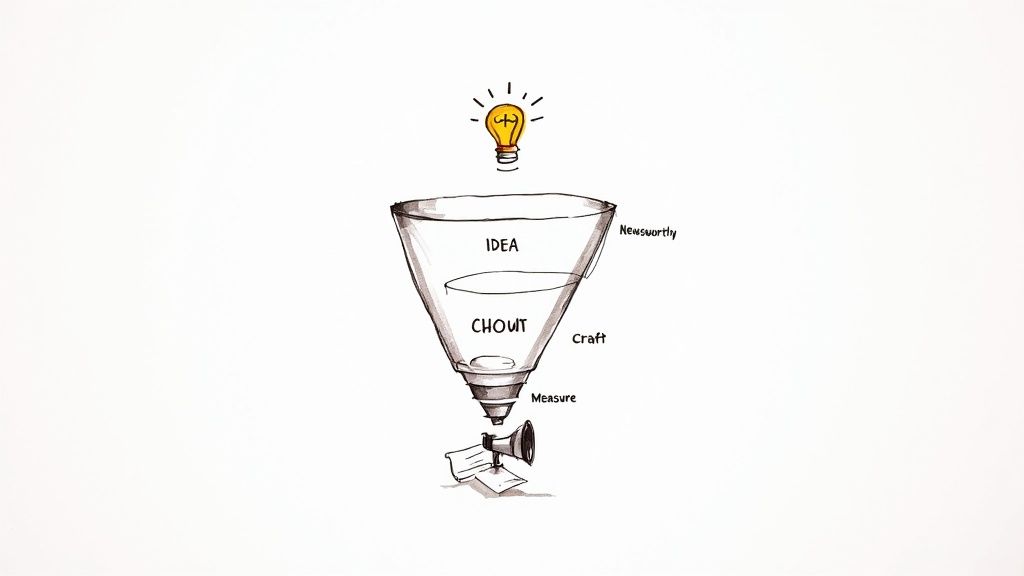
The game has changed. A press release isn't just a megaphone to shout your news from the rooftops anymore. Think of it as a carefully crafted pitch—a tool designed to give a busy journalist a compelling story they can actually use.
The public relations market is massive, expected to hit around $112.98 billion by 2025. With a quarter of all brands pushing out more than 10 press releases a year, you're not just competing for attention; you're fighting for it. You can dive deeper into PR market trends to see just how crowded it is.
This means you absolutely have to think like a journalist. Before you do anything else, ask yourself one simple question: "Would I care about this if I didn't work here?" If the answer is no, it's time to go back to the drawing board.
The Anatomy of a Newsworthy Story
Let’s be blunt: a new hire or a minor software update probably isn't going to make the evening news. To actually earn a journalist's time, your announcement needs a real hook.
Every great story has at least one of these ingredients:
- Timeliness: Does it connect to a current event, a hot trend, or something seasonal?
- Impact: Will this genuinely affect a lot of people or shake up an entire industry?
- Novelty: Is this a first? The only one? The biggest? Something truly new or surprising?
- Human Interest: Is there an emotional core to the story? A personal struggle, a relatable journey, or a major achievement?
I see it all the time—companies mistake their internal wins for public news. The real litmus test is simple: can a journalist build an entire article for their readers using your announcement as the foundation?
For instance, launching another generic e-commerce website isn't news. But launching a site that uses AI to create custom-fit clothing for people with disabilities? Now that's a story. It has novelty, human interest, and a clear impact. Your job is to find that angle.
Before you go any further, use this table as a quick gut check.
Quick Newsworthiness Checklist
| Element | What to Look For | Example |
|---|---|---|
| Timeliness | Does it tie into a current conversation or event? | Launching a tax-prep app right before tax season. |
| Impact | How many people does this affect, and how deeply? | A new study revealing a security flaw in 5 million devices. |
| Novelty | Is it the first, biggest, or most innovative? | The first-ever 3D-printed car made from recycled plastic. |
| Human Interest | Is there a relatable, emotional story? | A founder who overcame homelessness to build a million-dollar company. |
| Conflict | Does it challenge the status quo or an established player? | A startup releasing data that contradicts an industry giant's claims. |
If you can't tick at least one of these boxes with a strong "yes," your announcement probably isn't ready for a press release. It might be better suited for a blog post or a social media update instead.
Crafting a Press Release Journalists Actually Read
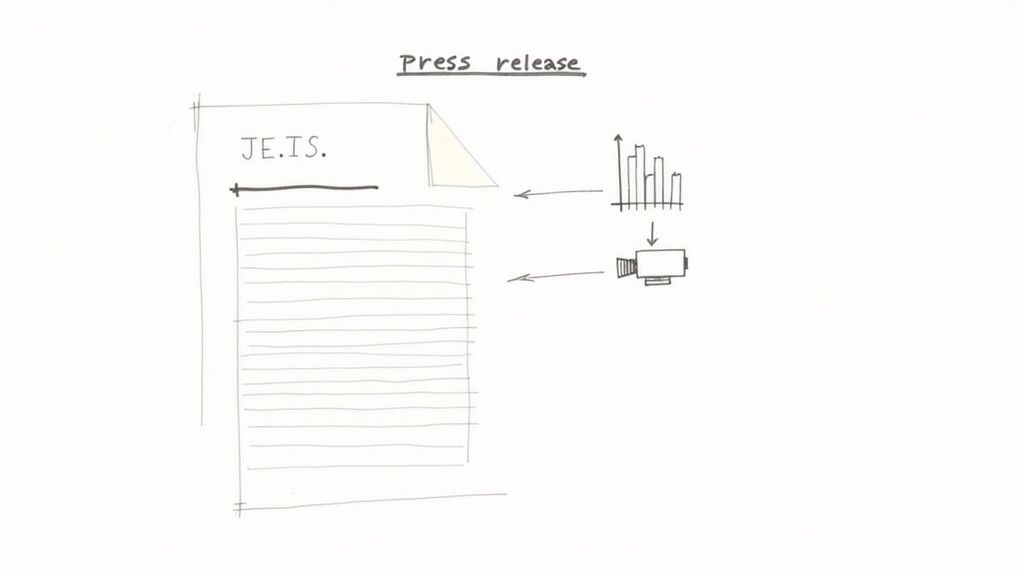
Let's be real: a journalist's inbox is a battlefield. Yours is just one of hundreds of pitches they'll see today. To have any chance of surviving the daily cull, your press release needs to be sharp, scannable, and built for a reporter's needs, not your marketing team's. It's time to kill the fluff and get straight to the point.
The entire story has to be in the first paragraph. I mean it. A busy reporter needs the who, what, when, where, and why in the first 15 seconds. If they have to dig for the core of your announcement, they won't. They'll just move on.
The Headline Is Your First and Only Impression
Your headline isn’t just a title; it’s the single most critical factor in getting your email opened. It has to be compelling enough to earn that click, yet completely factual. A clever but vague headline is worthless, and a descriptive but boring one is an invitation to be ignored.
You’re looking for that sweet spot where informative meets intriguing. It needs to scream "this is newsworthy" by highlighting the most important part of your announcement.
- Weak Headline: Company X Announces New Partnership (This tells me nothing.)
- Strong Headline: EcoTech Firm Partners with City of Austin to Launch First Solar-Powered Public Transit Fleet
See the difference? The second one immediately gives the reporter the key players, the specific action, and a crucial "first" that signals genuine news. That's the kind of detail that makes someone stop scrolling.
Your press release is a factual document, not marketing copy. Journalists have a finely tuned radar for promotional language. Ditch the buzzwords and exaggerated claims, or you’ll lose their trust before they even finish the first sentence.
Building the Body with Substance
Okay, you’ve hooked them with a great headline and a solid lead. Now, the body of your release needs to deliver the goods. This is where you back everything up with context, data, and a human angle that gives the story legs.
The structure itself is a huge part of this. A well-formatted release makes a journalist's job infinitely easier. For a deep dive on how to lay everything out, this guide on proper news release structure is a great resource.
Here’s how you can pack the body with real value:
- Include Meaningful Quotes: A quote should never just rehash facts from the paragraph above it. Use it to inject opinion, vision, or context from a key person—a CEO, a lead engineer, a customer. A good quote adds a human element that a reporter can lift directly into their story.
- Weave in Data and Statistics: Numbers give your story weight and credibility. Don't just say your new software is "faster." Say it "reduces data processing time by 45% for enterprise clients." Specificity is everything.
- Link to Multimedia Assets: Always, always, always include a link to a simple media kit. This should have high-resolution photos, logos, and maybe some B-roll video. Making visuals easy to grab saves the journalist a ton of time and makes your story much more likely to get a prominent feature.
When you think this way, you're not just firing off an announcement. You’re handing over a complete story kit that a busy journalist can turn into a published article with minimal effort.
Finding and Targeting the Right Media Contacts
Sending a brilliant press release to the wrong person is the fastest way to get exactly zero results. Hitting a generic "info@publication.com" address is like shouting into the void. If you really want to see your news get picked up, you have to master precision targeting. It’s all about building a hand-picked list of people who actually live and breathe your niche.
Spamming a massive list of reporters isn't just a waste of time—it actively hurts your reputation. Journalists are inundated, and they remember the people who send them irrelevant junk. In fact, Cision's latest State of the Media survey shows that what reporters really want are concise, data-rich pitches from sources they trust. Generic blasts? Not so much. It's proof that doing your homework matters more than ever. You can dig into the full report for more journalist insights yourself.
This focused, almost surgical approach is how you cut through the noise and get your story told.
Building Your Hand-Crafted Media List
First things first: forget about buying those massive, outdated media lists. Your mantra should be quality over quantity. A tight, well-researched list of 15 perfect contacts will outperform a sloppy list of 500 random names every single time. Your search should start where journalists hang out and talk about what they're working on.
Here are a few practical ways to find the right people:
- Social Media Sleuthing: X (Formerly Twitter) and LinkedIn are absolute gold mines for this. Search for keywords related to your world (think "fintech reporter," "SaaS journalist," or "AI startup news"). Pay close attention to their recent posts—it's a real-time feed of their interests.
- Smarter Google Searches: Don't just search for "tech reporter." Get specific. Use advanced search operators like
site:forbes.com "startup funding"to see who at Forbes is writing about that topic. Or tryauthor:"Jane Doe" + "cybersecurity"to track a specific journalist's work. - Look at Your Competitors: Who’s already covering companies like yours? Use a media monitoring tool to see which journalists have written about your competitors. These reporters have already proven they're interested in your space, making them incredibly warm leads.
Yes, this is a manual process. But it’s probably the most important work you’ll do in this entire campaign. For some more advanced strategies, our guide on how to contact journalists effectively dives even deeper.
PR software platforms often provide databases to help you identify relevant journalists based on their coverage areas and recent articles.
While these tools are great for speeding up the initial research, you should always manually verify that each contact is a good fit before adding them to your final list.
Do Your Homework and Personalize Your Pitch
Okay, so you have your short list. Now comes the part that separates the pros from the amateurs. Before you even think about writing your email, spend five minutes on each person and figure out:
- What's their actual beat? Do they cover seed-stage startups or massive enterprise companies? Are they interested in product launches or just big funding rounds?
- What have they written lately? Read their last two or three articles. Does your news genuinely fit with what they're covering right now?
- What's their style? Are their articles data-heavy and analytical? Or are they more focused on the human side of the story?
Pro Tip: When you finally send your email, mention one of their recent articles. It doesn’t have to be long. Something as simple as, "I really enjoyed your piece on the future of decentralized finance last week," instantly shows you've done your homework and aren't just another spammer.
This little bit of research is a game-changer. It allows you to frame your announcement in a way that connects directly to their work, which dramatically increases your odds of getting a reply. It's about showing respect for their time and expertise.
Choosing Your Press Release Distribution Channel
You've got a polished press release and a list of journalists who need to see it. Now comes the critical moment: how do you actually get it in front of them? The way you send your press release is just as important as the news inside it.
You're essentially at a crossroads with two main paths ahead. You can go broad with a wire service or get personal with direct email outreach. Neither one is universally "better"—the right choice really hinges on your goals, your budget, and the story you're telling.
The Wire Service Play
Think of a wire service as a massive broadcast system. These platforms, like PR Newswire or Business Wire, send your announcement to thousands of newsrooms, media outlets, and online portals all at once. It's like casting a giant net across the media ocean.
This approach is fantastic for a few specific scenarios. If you have regulatory disclosure requirements to meet or want to get your news indexed widely for SEO benefits, a wire service is a solid bet. You’ll hit countless smaller blogs and niche sites you would have never found on your own.
But that wide reach has its trade-offs. The biggest one? It's impersonal. Journalists get flooded with wire service releases and have become experts at filtering them out. Your announcement might land in a thousand inboxes but never be seen by a human reporter.
Cost is another huge factor. In 2025, you could find basic packages for as little as $29, but premium services with guaranteed placement on major sites often climbed to nearly $1,999 for a single release. As some recent public relations statistics show, you have to be very clear about your goals to justify the spend.
The Direct Outreach Advantage
Direct outreach is the artisan approach. Instead of a mass broadcast, you’re hand-delivering your news to a select group of journalists you’ve carefully researched. This entire strategy is built on relationships and respect for a reporter’s time and area of expertise.
The payoff can be massive. A personal, well-crafted pitch is infinitely more likely to be opened and seriously considered. It lets you connect the dots for the journalist, explaining exactly why your news matters to their audience. That’s how you land meaningful stories in top-tier publications.
The goal of direct outreach isn't just to get one story published. It's to become a trusted source that a journalist will turn to again in the future. That's a long-term asset you can't buy from a wire service.
Of course, this isn't the easy route. It demands more time and genuine effort. You can't just copy and paste; you need to write a compelling pitch for each individual you contact. We break down exactly how to do this in our guide on how to distribute a press release for the best results.
This decision tree helps visualize the thought process behind choosing the right path.
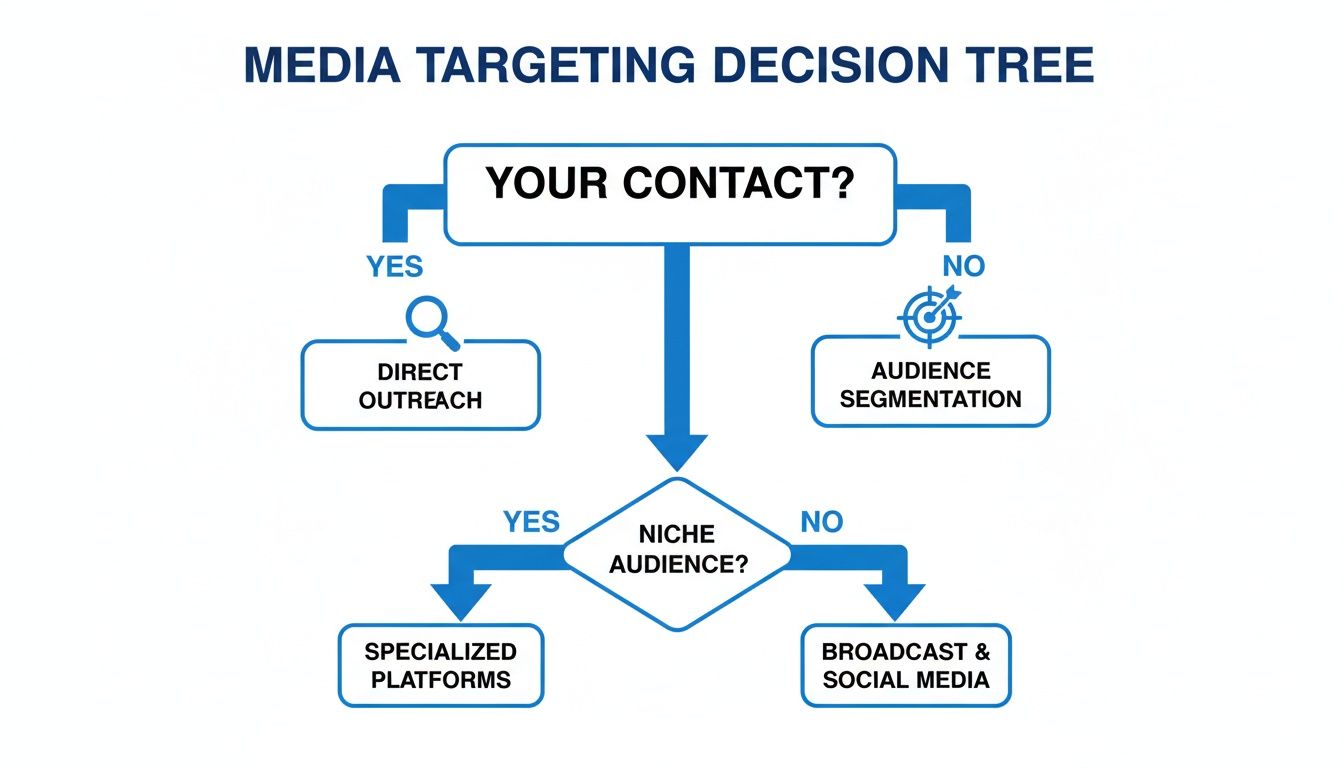
The takeaway here is pretty clear: if you have an existing relationship, a direct and personal approach is always best. If you're starting from scratch, you need a much more structured and thoughtful strategy.
Wire Service vs Direct Outreach Comparison
To make the decision easier, here's a side-by-side look at how these two methods stack up.
| Feature | Wire Service Distribution | Direct Email Outreach |
|---|---|---|
| Reach | Very broad; thousands of outlets, newsrooms, and online portals. | Highly targeted; only the specific journalists you select. |
| Personalization | Low; a standardized release is sent to everyone. | High; each pitch can be customized for the journalist. |
| Impact | Wide but shallow. Great for SEO and visibility, low story pickup. | Narrow but deep. High chance of securing meaningful stories. |
| Effort | Low; upload once and the service handles the rest. | High; requires research, list building, and personalized writing. |
| Cost | Can be expensive, from $29 to $1,999+ per release. | Mostly "free" in terms of cash, but costs significant time. |
| Relationship | None. It's a purely transactional distribution. | Builds long-term relationships with key media contacts. |
Ultimately, many of the best PR campaigns use a hybrid approach. They might use a wire service for broad SEO reach while simultaneously running a highly targeted direct outreach campaign to their dream list of top-tier journalists.
Mastering the Follow-Up and Measuring Your Impact
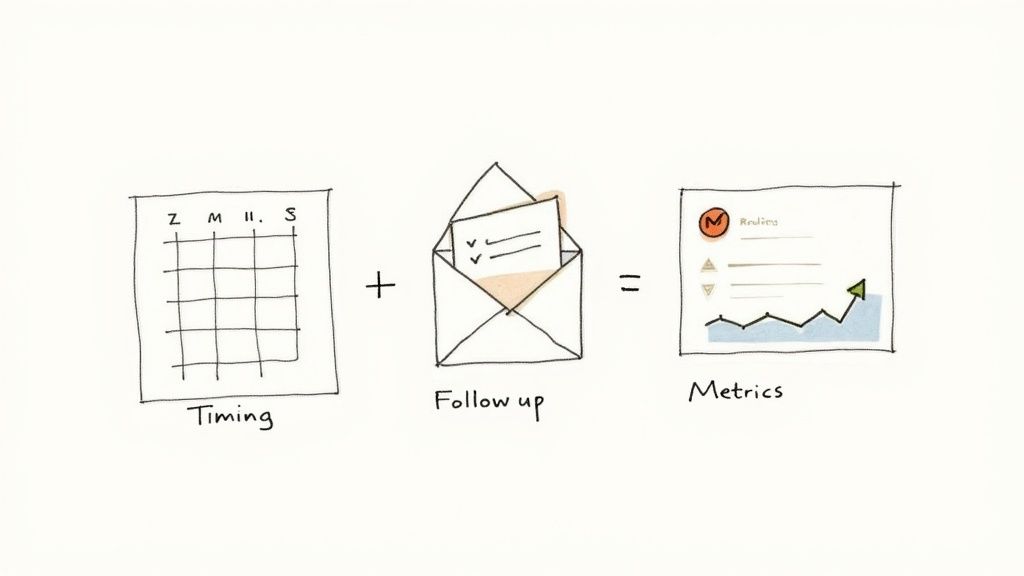
So you've hit "send." Don't pop the champagne just yet. Sending the press release is often just the beginning. A thoughtful, professional follow-up can be the exact nudge a journalist needs to turn their mild interest into a full-blown story.
But this is a delicate dance. Come on too strong, and you'll come across as annoying, earning a one-way ticket to their blocked list. The secret is to add value, not just ask for an update. Your follow-up should be a quick, helpful check-in that actually makes their job easier.
Whatever you do, don't follow up on the same day. Give them at least 48 to 72 hours to breathe and actually read your pitch before you even think about reaching out again.
The Art of the Gentle Nudge
When the time comes to follow up, keep it short and sweet. All you need to do is reply to your original email. This simple action bumps your message back to the top of their inbox while keeping the entire conversation in one convenient thread.
Your goal is to be helpful, not pestering. If you can, offer them something new. Maybe it’s a fresh data point you just uncovered or an offer for an exclusive interview with your founder. This small gesture instantly reframes the follow-up from "Did you see my email?" to "Here's something extra to make your story even better."
Here’s a simple playbook for your follow-up:
- Wait a Couple of Days: Patience is key. Give it at least two business days.
- Keep it in a Thread: Always reply directly to your original email.
- Be Quick and Courteous: Acknowledge how busy they are.
- Offer Something New: Provide a new statistic, a fresh quote, or exclusive access.
If you’ve followed up once and are still met with silence, it’s time to let it go. A second follow-up crosses the line from persistent to problematic. Take the hint and channel your energy into other opportunities.
Measuring What Actually Matters
Once your news starts getting picked up, the real work begins. Counting how many outlets ran your story is a vanity metric. Real success is measured by the tangible impact your press release has on your business goals. You have to look past the initial buzz and track the results that actually move the needle.
This means asking a different question. Instead of "How many clippings did we get?" start asking, "What did those clippings do for us?" The answer lies in connecting your PR efforts to concrete business outcomes.
Key Metrics to Track for Real Business Impact
To get a true picture of your return on investment, you need to track specific metrics that tell a much richer story than media mentions alone.
Here’s what you should be monitoring:
- Referral Traffic: Jump into your web analytics and see how many people visited your website from the articles covering your news. This is a direct measure of how engaged the audience was with your story.
- Lead Generation: Did any of those new visitors sign up for a demo, download a resource, or join your email list? Tracking these conversions shows whether you attracted the right kind of attention.
- Social Media Mentions: Keep an eye on platforms like X and LinkedIn. Who is sharing your news? Are industry influencers part of the conversation? This gives you a feel for the story's resonance.
- Backlink Acquisition: This is one of the most valuable outcomes. A successful press release can generate between 5 and 20 quality backlinks, giving your website's authority and SEO a significant, long-term boost. You can learn more about the SEO value of PR in recent reports.
When you track these metrics, you stop treating PR as just a communications function and start seeing it for what it is: a powerful engine for growth. This data doesn't just prove your value—it gives you the insights you need to make every future campaign even better.
A Few Press Release FAQs
Getting into the nitty-gritty of press releases always brings up a few key questions. Mastering the small details around timing, formatting, and general etiquette can genuinely make or break your campaign. Let's clear up some of the most common things people ask.
What’s the Best Time and Day to Send a Press Release?
I get this question all the time, and while there's no single magic answer, experience has taught me a few things. You’ll generally have the best luck sending your release mid-week, during the morning. Aim for Tuesday, Wednesday, or Thursday, somewhere between 9 AM and 11 AM in the journalist's local time.
Why then? Well, Mondays are a frantic catch-up day, and by Friday afternoon, most reporters are already checked out or rushing to meet their end-of-week deadlines. Hitting their inbox in that mid-week sweet spot means you're arriving right when they're actively hunting for new stories.
Should I Add Attachments to My Pitch Email?
Let me make this simple: no. Never, ever send a reporter an unsolicited attachment like a PDF or a Word doc. It’s a huge red flag for security. Most newsrooms have email filters that are set up to zap messages with unexpected attachments, meaning your pitch will likely land in a spam folder or get quarantined.
The professional way to do it is to paste the plain text of your press release directly into the body of your email, right after your personal pitch. If you have photos, videos, or other assets, host them in an online media kit on your website and just drop a clean link in the email. It’s safer for them and more effective for you.
How Long Should a Press Release Be?
When it comes to press releases, shorter is almost always better. The sweet spot is a tight 400 to 500 words. That’s just enough space to give a journalist everything they need without burying them in fluff.
Think of your first paragraph as the entire story in miniature—it has to nail the who, what, when, where, and why. The rest of the release is there to add the supporting details, a compelling quote or two, and any background context that makes the story more interesting.
It's a different game today. A press release isn't just for a human reporter anymore; it's also being read and processed by automated systems. We're seeing more and more organizations structure their releases with clear, digestible facts because they know they're being pulled into stories by both journalists and large language models. For a deeper dive, check out the 2025 State of the Press Release report.
Can I Send the Same Release to Multiple People at the Same Publication?
Please don't. Blasting your release to a bunch of contacts at the same outlet just looks like you haven't done your homework. It can create confusion on their end and, frankly, comes across as a bit amateur. The whole point is to find the one journalist who is the absolute best fit for your story.
Taking the time to pinpoint the right person shows you respect their beat and their time. A targeted pitch feels personal and is far more likely to get a positive response. A mass email, on the other hand, just encourages everyone to assume someone else will cover it—and you end up with no coverage at all.
Ready to stop guessing and start getting real media coverage? PressBeat uses AI to find the perfect journalists for your story and sends personalized pitches that get results. See how our platform can land you guaranteed press articles. Learn more about PressBeat.