
How to Write Pitches That Actually Get Read
December 30, 2025
If you want to write a pitch that actually gets a response, you have to understand why most of them fail. It's simple, really: they're generic, self-serving, and completely ignore what the journalist actually needs.
The secret isn't a bigger media list. It's about fundamentally changing your approach. Stop blasting out emails and start making genuine connections. Think of every pitch not as a request for a favor, but as a valuable story idea you've crafted just for them.
Why Most Pitches Fail and How Yours Will Succeed
Picture a journalist's inbox for a second. It's a firehose of press releases, bad ideas, and desperate follow-ups. Most of it gets deleted without a second thought. The old "spray and pray" method is a one-way ticket to the trash folder. In that chaos, your pitch has maybe three seconds to prove it's different.
The biggest reason pitches get ignored is a total misalignment of goals. Most of them scream, "Here's what I want!" (coverage), instead of whispering, "Here's a great story for your readers." That’s a fundamental misunderstanding of how media works.
The Journalist's Perspective
A reporter's job is to find and share stories their audience will care about. They're constantly hunting for ideas that are relevant, new, and credible. When a pitch lands in their inbox that has nothing to do with their beat or the last ten articles they’ve written, it’s an immediate red flag. It shows you didn’t bother to do the most basic research, and it instantly destroys any trust.
In the hyper-competitive world of PR, journalists are absolutely buried. A recent study found that 49% of them receive up to 50 pitches per week. That's more than 10 pitches every single workday. With that kind of volume, your email has to stand out from the get-go. This is where personalization becomes your superpower. Pitches that are thoughtfully tailored to a journalist's specific interests see dramatically higher pickup rates than generic blasts.
The most powerful mental shift you can make is this: You are not asking for a favor. You are offering a well-researched, relevant story idea that makes a reporter's job easier and gives their audience something valuable.
From Volume to Value
The key to successful pitching today is shifting your focus from volume to value. Stop measuring success by how many emails you can send in an hour. Instead, focus on the quality and relevance of every single one. Treat each pitch like a one-on-one conversation that starts with you knowing who you're talking to.
This value-first approach is built on a few core ideas:
Go Beyond Their First Name: True personalization isn't just a mail merge. Reference a specific article they just published. Connect your news to a theme they cover obsessively. Show them you understand why their specific readers would care about your story.
Be a Problem Solver: Frame your pitch as a solution. Does your founder have a contrarian take on a trending topic? Does your new data reveal something surprising about an industry problem? Offer them an angle or an expert that helps them tell a better story.
Find Your "Why Now": Your announcement needs a hook. What makes it timely, impactful, or genuinely surprising? Before you type a single word, you have to figure out what makes a story newsworthy and build your entire pitch around that angle.
When you adopt this mindset, you stop being just another name in a crowded inbox and start becoming a trusted source. You're showing respect for their time and their work, which is the fastest way to get your pitch not just opened, but seriously considered. This is how you build relationships and land coverage.
Laying the Groundwork Before You Write a Word
Let’s get one thing straight: a brilliant pitch isn't a flash of creative genius. It's built, piece by piece, through careful preparation. The hard truth of PR is that your success is decided long before you ever type a single word of your email. I've always worked by the rule that it’s 90% research and 10% writing. This simple formula is what separates a thoughtful pitch from the old "spray and pray" tactics that just don't work anymore.
This prep phase is where you transform a generic announcement into a story idea a journalist will actually care about. It means digging in to understand not just what a reporter covers, but how and why. This is the only way to stop being just another name in a crowded inbox and start being a genuinely helpful source.
The whole process is a fundamental shift in thinking, moving away from mass outreach and toward targeted, personal connection.
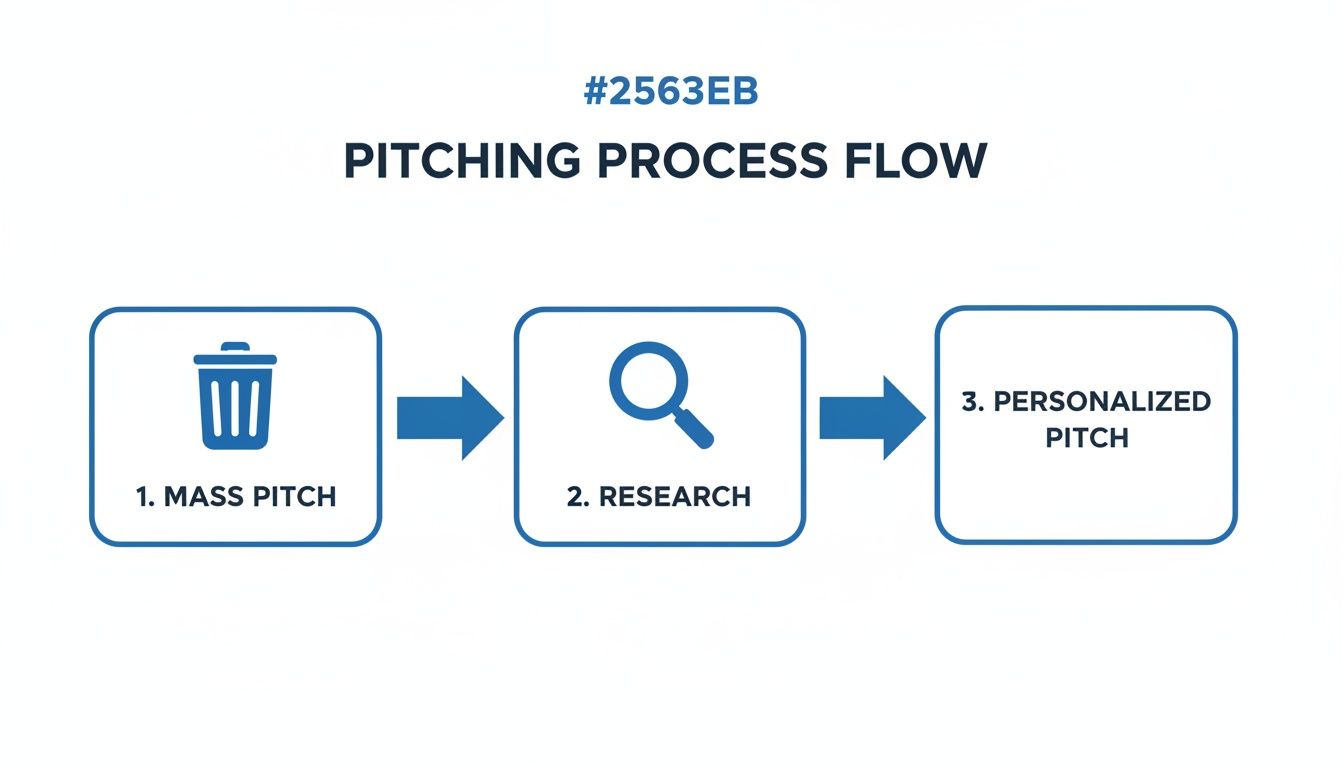
It’s about quality over quantity, every single time. It’s about making a deliberate, informed choice to connect with the right person with the right story.
Finding the Perfect Journalist
Your first mission is to build a curated media list, not a massive one. The goal isn't just to find reporters who might cover your story, but those for whom it’s a perfect fit. Forget chasing big names at top-tier outlets unless their beat is an exact match for what you have. Your focus should be on pure alignment.
A reporter’s true value isn’t just their publication's domain authority; it’s the relevance of their audience. Before adding anyone to your list, ask yourself:
- What’s their specific beat? Don't settle for broad categories like "tech" or "business." You need specialists. Are they covering "B2B SaaS funding" or "direct-to-consumer retail trends"? Get granular.
- What have they published lately? Seriously, go read their last five articles. This is the single most valuable piece of research you can do. It tells you their current interests and what kind of angles they find compelling right now.
- Who are they writing for? A story pitched to an audience of venture capitalists needs to be framed completely differently than one for small business owners. Understanding their readers helps you shape a pitch that serves them, which in turn serves the journalist.
Analyzing Their Work to Find Your Angle
Once you've got a shortlist, it's time to become a student of their work. This is where you uncover the little details that make your pitch feel personal and insightful. You’re essentially looking for patterns in their reporting that your story can hook into.
If you're feeling stuck, trying out different creative techniques can really help. I've found that using methods like brainwriting for better pitch ideas can unlock unique angles you might have missed otherwise.
A journalist's past work is a roadmap to what they'll cover in the future. If your story doesn't align with where they've been, it's unlikely to be a stop on their journey forward.
Before you pitch anyone, it's crucial to have a clear picture of their work. I use a simple checklist to make sure I've covered all the bases.
Essential Journalist Research Checklist
This checklist helps you gather the specific data points you need to tailor your pitch effectively. Going through these steps for each journalist ensures your pitch is not only relevant but also resonates with their personal style and audience needs.
| Information Point | Why It Matters | Where to Find It |
|---|---|---|
| Specific Beat/Coverage Area | Ensures your story is a direct fit for their focus, not just a near-miss. | Publication bio, LinkedIn profile, Muck Rack, personal blog, recent articles. |
| Last 5-10 Articles | Reveals current interests, recurring themes, and the angles they find compelling now. | Their author page on the publication's website, their Twitter/X feed. |
| Quoted Sources | Shows if they prefer academics, industry analysts, founders, or customers. | Scan their recent articles for patterns in who they interview and quote. |
| Story Structure & Tone | Helps you mirror their style—do they lead with data, anecdotes, or bold claims? | Read several articles to get a feel for their narrative voice and structure. |
| Audience Profile | Allows you to frame your pitch to serve their readers' interests directly. | The publication's media kit, "About Us" page, or by analyzing the article comments/shares. |
| Social Media Activity | Uncovers personal interests, recent conversations, or even pet peeves about pitches. | Check their professional Twitter/X or LinkedIn profiles for recent posts and interactions. |
Completing this checklist moves you from a stranger with a story to a prepared professional who understands their needs. This deep dive is the true foundation of every single successful pitch I've ever sent. It’s what gets you noticed and, ultimately, gets you the story.
Building an Email Pitch That Actually Gets Read
You've done the hard work of finding the right reporters. Now it's time to put all that research into action and craft the email itself. This is where the magic happens, turning a simple message into a story idea so compelling a journalist can't ignore it.
Think of your pitch email as a tiny, powerful engine. Every single component—from the subject line to your sign-off—has a critical job. If one part sputters, the whole thing can stall. Let’s break down the blueprint for an email that works.
The Subject Line: Your First and Only Impression
Let's be blunt: the subject line is the most important part of your pitch. It's the gatekeeper. Your story could be incredible, but if the subject line doesn't earn a click, it may as well not exist. It's shocking how often this crucial step is treated as an afterthought.
A huge piece of the puzzle is knowing how to improve email open rates in the first place, ensuring your message even gets a fair shot. The goal is to be clear, concise, and genuinely intriguing without ever sounding like clickbait. Ditch the generic stuff like "Story Idea" or "Press Release." Instead, lead with the most newsworthy angle of your story.
Here are a few formulas that I've seen work time and time again:
- The Data Hook: "[New Study] 75% of Remote Workers Face Burnout Without This Tool"
- The Exclusive: "Exclusive: First Look at [Company]'s New AI Platform for Retail"
- The Expert Angle: "Expert for your story on [Topic]: Our CEO on the future of FinTech"
See how each one is specific? They immediately signal value and tell the journalist what's inside and why it matters to their specific beat.
The Anatomy of the Perfect Pitch Body
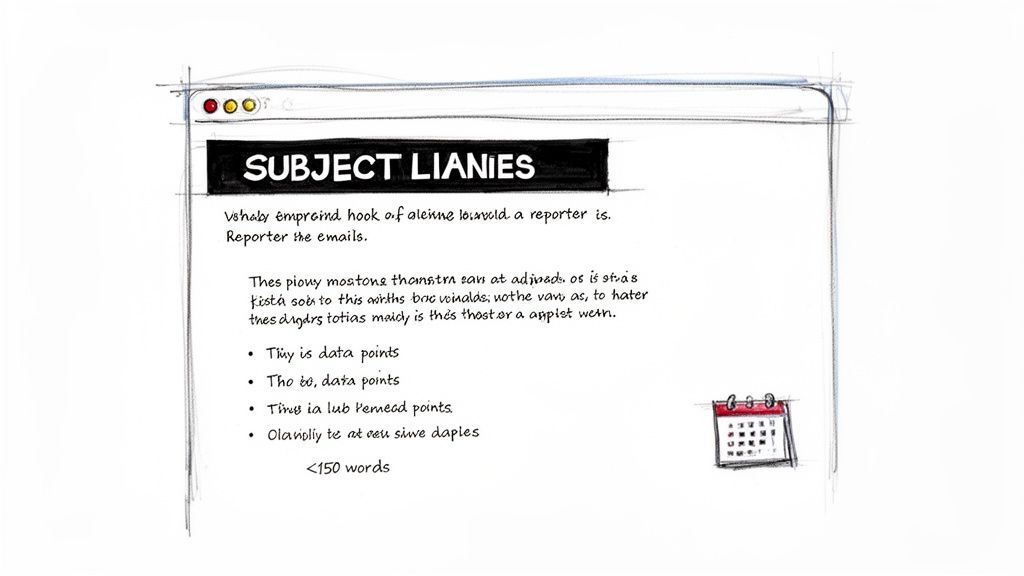
Once they open the email, the clock is ticking. You have just a few seconds to grab their attention. Brevity is everything. The ideal pitch is under 150 words—short enough to be scanned and understood on a phone while they’re waiting for coffee.
Forget long-winded introductions. Your pitch needs to get straight to the point with a powerful opening, a clear value proposition, and an undeniable "why now."
The structure should be clean and scannable. Long, dense paragraphs are your enemy. Use short sentences, bullet points, and plenty of white space to make your key points pop. A busy journalist will thank you for making their job easier.
Nailing the Opening Hook
Your very first sentence has one job: connect with the journalist. This is where your research pays off. Generic greetings like "To whom it may concern" or "Dear Editor" are a one-way ticket to the trash folder. Always use their first name.
Then, immediately show them you’ve done your homework by referencing one of their recent articles. Something simple like, "Hi [Journalist's Name], I just read your piece on supply chain challenges and thought your take on last-mile delivery was spot-on." This proves you're not just spamming a list. It frames you as a thoughtful reader, not just another PR person with an agenda.
That small, personalized touch builds instant rapport and earns you the right to their attention for the next few seconds.
The Value Prop: Why This Story Matters Now
After the hook, cut to the chase. What is the story, and why should they care about it today? This is your value proposition. It’s the core of your pitch, explaining the newsworthiness of your announcement in one or two clear sentences.
Timing and format are huge here. Interestingly, while 74% of journalists still prefer traditional press releases, a well-crafted email pitch can hit a solid 44% open rate. I’ve found the sweet spot for sending is Thursday between 10 a.m. and 2 p.m., when pickup rates seem to peak.
Here's an example of a clear value prop that builds on the opening hook: "Following up on that theme, my company, [Your Company], just launched a new platform that uses AI to reduce delivery delays by 30%, and we have exclusive data on its impact."
Now, make the key takeaways impossible to miss. Bullet points are perfect for this.
- Key Stat: "Our initial data shows a 30% reduction in last-mile delivery times for our beta partners."
- Unique Angle: "We have a contrarian view on the drone delivery trend and can explain why it won't solve the core issue."
- Available Asset: "Our CEO is available for an interview this week to discuss these findings."
This scannable format gives them everything they need to quickly see the story's potential. If you’re feeling stuck, looking at a solid media pitch email template can help you get the structure just right.
Finally, end with a simple, low-friction call to action. Don't ask them to commit to a full story. Instead, ask an easy, open-ended question like, "Does this sound like something your readers would be interested in?" This invites a conversation, which is the real goal of any great pitch.
The Art of the Follow-Up (Without Being Annoying)
You sent a killer pitch. You know it’s a perfect fit for the reporter. And then… crickets. It’s one of the most maddening parts of PR, but silence doesn't always mean "no." More often than not, it just means your email landed at a bad time. Journalists are swimming in deadlines and pitches, and a thoughtful follow-up is often what separates a buried email from a published story.
The trick is striking that delicate balance between persistence and becoming a pest. You want to stay on their radar and give them another reason to care, not just ask, "Hey, did you see my email?" This approach shows you respect their time and dramatically improves your odds of getting a response.
Nail Your Timing and Cadence
When it comes to following up, timing is everything. Jump the gun, and you look desperate. Wait too long, and your story goes stale. Finding that sweet spot shows you’re on top of your game without crowding their inbox.
Over the years, I've found a simple cadence that just works:
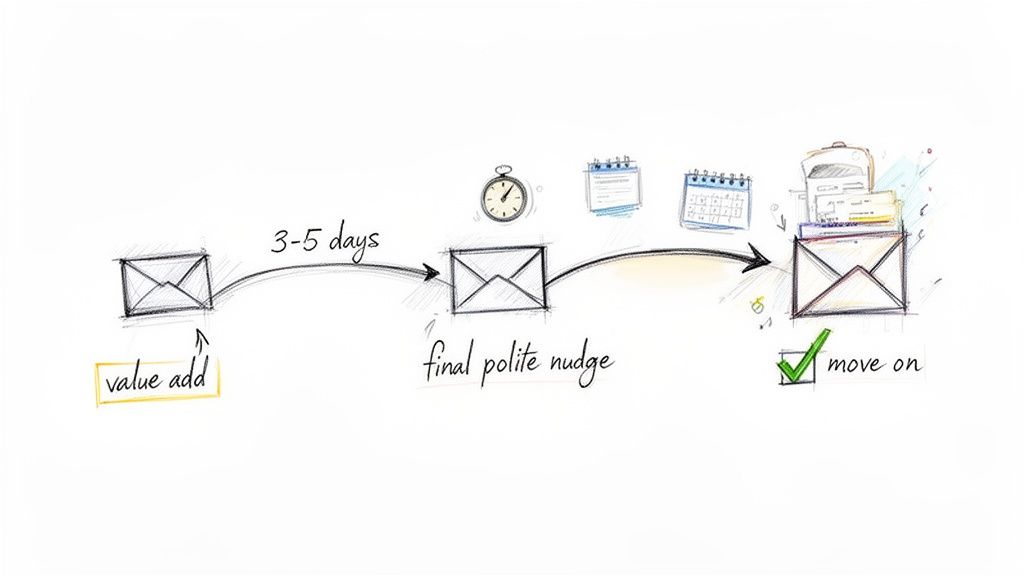
- The First Nudge: Give it 3-5 business days after your initial pitch. This is plenty of time for them to have seen it without feeling rushed.
- The Final Check-in: If you still haven't heard back, wait another 4-5 business days for one last, gentle nudge.
- Know When to Fold: After that second attempt, it's time to move on. Piling on more emails will only get you flagged as spam and can hurt your reputation.
Here's a rule I live by: Two is the magic number for follow-ups. One is a must. A second shows you’re serious. Anything more than that crosses the line into annoying. It’s better to respect their silence as a "no for now" and live to pitch another day.
This structured approach takes the guesswork out of the process and helps you maintain a professional relationship, even if the pitch doesn’t land this time. And for more strategies on building these connections, our guide on how to contact journalists has some great pointers.
Add Value, Don’t Just "Bump"
The absolute worst follow-up you can send is one that adds nothing new. An email that just says, "Just bumping this to the top of your inbox," is lazy and puts all the work back on the reporter. Your goal with every follow-up should be to offer something that makes your story even more interesting.
Think of it as adding a new piece to the puzzle. This simple shift turns your follow-up from a nag into a helpful update.
Here are a few ways I’ve successfully added value in a follow-up:
| Follow-Up Tactic | What It Looks Like in Practice |
|---|---|
| Share New Data | "Hi [Name], following up on my note about our launch—we just found that 78% of our beta users reported a major improvement in X..." |
| Connect to Breaking News | "Given today's headlines about [Industry Trend], I thought our expert's take on what this means for consumers might be especially timely." |
| Offer a New Asset | "Just wanted to add that we created a high-res infographic that breaks down the key data points I mentioned. Happy to send it over." |
| Provide a New Angle | "Another angle we've been exploring is how this trend impacts small businesses, not just enterprise clients. Might be an interesting hook for your readers." |
Each of these gives the journalist a fresh, legitimate reason to get back in touch. You’re not just asking for their attention; you’re giving them a new reason to care. This simple change is what separates the pros who consistently get great press from everyone else.
Pitch Templates and Common Mistakes to Avoid
Putting theory into practice is really the best way to get good at this. And while every single pitch you send needs to feel unique, it helps to have a solid framework to build from.
Think of templates less like a script you copy and paste, and more like a proven recipe you can adapt. The goal is to internalize the flow of a pitch that works: a genuine opening, a clear value prop, proof points that are easy to scan, and a simple, low-pressure ask.
Let's walk through a couple of common scenarios to see what this looks like in the real world.
A Flexible Product Launch Template
Launching a new product or a big feature is probably one of the most frequent reasons you'll be reaching out. The classic mistake here is getting lost in the weeds talking about your product's features. Journalists don't write stories about features; they write stories about the problems your product solves and the impact it has.
Here’s an annotated template to get you started:
Subject: Exclusive: [Your Company] tackles [Specific Problem] with new [Product Category]
Body:
Hi [Journalist’s Name],
I was reading your piece on [Relevant Topic They Covered] last week, and your take on [Specific Point] was spot on.
On that note, I'm reaching out to offer you an exclusive first look at [Product Name], a new platform we built to help [Target Audience] finally solve [Specific Problem]. We're officially launching on [Date], and I immediately thought of the challenges you write about.
In a nutshell, [Product Name] helps them get [Key Outcome]. Our early users are already seeing:
- A [Key Metric]% jump in [Specific Area]. For example, some cut their production costs by 40%.
- The ability to [New Capability]. This was either impossible or way too expensive for them before.
- Great feedback from companies like [Beta Tester Company], who said it was "[Quote Snippet]."
Would you be open to a quick demo or a chat with our founder, [Founder's Name], to dig into how this could shake up the industry?
Best,
[Your Name]
See how every line is there for a reason? It’s all about connecting the dots for the journalist, making it easy for them to see the story that their audience would care about.
Common Pitching Mistakes That Kill Your Chances
Knowing what not to do is just as important as knowing what to do. So many pitches are dead on arrival because they fall into the same old traps that scream "amateur" or "spam." Avoiding these is genuinely the easiest way to stand out.
The fastest way to get your pitch deleted is to make it clear you haven't done your homework. A generic, self-serving email is worse than sending no email at all because it can damage your reputation for future outreach.
Let's break down the biggest offenders. If you can sidestep these, you’re already ahead of 90% of the pitches landing in a reporter's inbox.
Pitching Dos and Don'ts Quick Guide
This little cheat sheet breaks down the simple mindset shifts that can make all the difference. It's really about moving from a "me-focused" approach to one that puts the journalist and their readers first.
| Do This | Don't Do This |
|---|---|
| Personalize the first sentence by referencing a recent, specific article. | Use a generic salutation like "Dear Editor" or "Hi there." |
| Keep the entire email under 150 words and use short, scannable paragraphs. | Write long, dense paragraphs that bury the lede and require effort to read. |
| Use bullet points to highlight your most compelling data or takeaways. | Send large, unsolicited attachments like huge PDFs or media kits. |
| Offer an exclusive angle or first look to add value and urgency. | Blast the same pitch to a massive list of unrelated journalists. |
| End with a simple, low-pressure question to invite a conversation. | Use a demanding call to action like "When can we schedule a call?" |
A few of these mistakes are so common they deserve a bit more attention.
Burying the Lede: Your most important, newsworthy point needs to be in the first sentence or two. Don't make them read a long-winded intro about your company's history. Get straight to the "why now" and you'll grab their attention.
Being Vague and Using Buzzwords: Empty jargon is a red flag. Instead of saying your product is a "paradigm shift," just explain what it does and who it helps in plain English. Use concrete numbers and specific results to make your case.
Ignoring Submission Guidelines: This one is huge. Many big publications have a specific contact form or instructions for how to submit a story idea. Ignoring those rules is a clear sign of disrespect for their process, and your email will likely get deleted on sight. Learning how to write pitches that work means learning to follow directions first.
Common Pitching Questions, Answered
Even with a solid game plan, you're bound to run into a few tricky situations when you're pitching reporters. Let's tackle some of the most common questions that come up.
Think of this as a quick-reference guide to help you smooth out the rough edges of your outreach and pitch with more confidence.
How Long Should a Pitch Email Actually Be?
Keep it short. Really short. Your target should be 100-150 words, max. Journalists are swamped and often clearing their inboxes on a phone between meetings. If they have to scroll, you've probably already lost them.
Long, winding emails are a surefire way to land in the trash folder. Stick to short, punchy paragraphs (just a sentence or two is perfect), and use bullet points or bold text to highlight the most important stuff. This makes your pitch easy to scan and helps the reporter see the value in just a few seconds.
Here’s a good rule of thumb: If you can't explain why your story matters in three sentences, you need to sharpen your angle before reaching out.
What's the Right Way to Follow Up?
Following up is a must, but it's a delicate dance. You want to be persistent, not a pest. The industry standard is to send one or two follow-ups, and that’s it. Pushing beyond that is a quick way to burn a bridge and get your emails flagged as spam.
Here's a simple cadence that works:
- First Nudge: Give it 3-5 business days after your first email. This is the sweet spot—enough time for them to have seen it, but not so long that it's ancient history.
- Final Try: Still crickets? Wait another 4-5 business days and send one last, polite message.
- Let It Go: After that second follow-up, it’s time to move on. A lack of response is usually a quiet "not for me."
And remember, every follow-up needs to offer something new. Don’t just send a "bumping this to the top of your inbox" email. Add a new statistic, a relevant piece of breaking news, or a fresh expert quote. Always add value.
What Metrics Should I Be Tracking?
If you're not tracking your results, you're just guessing. To really understand what's working, you need to look past vanity metrics like "total emails sent" and focus on what actually moves the needle.
These are the numbers that matter:
- Open Rate: This tells you one thing: are your subject lines working? If your open rate is consistently below 20%, it's a clear signal that you need to write more compelling, curiosity-driven subject lines.
- Reply Rate: This is where you see if your story idea is landing. Even a "no, thanks" is a good sign. A healthy reply rate means your pitch is relevant and clear enough to warrant a response.
- Publication Rate (Your "Hit Rate"): This is the bottom line. What percentage of your pitches turn into actual, published stories? This metric shows you which angles, reporters, and publications are your biggest wins.
Watching these metrics is how you turn guesswork into a repeatable strategy. You'll start seeing patterns and making smarter, data-backed decisions that consistently improve your results.
Ready to stop guessing and start landing guaranteed press coverage? PressBeat uses AI to find the perfect journalists and craft personalized pitches that get noticed, all managed through a transparent dashboard. See how our predictable, data-driven approach can elevate your brand. Learn more at PressBeat.io.