
Media Pitch Email Template: Craft Irresistible Pitches That Win Coverage
December 29, 2025

Let’s be real for a moment. If your media pitches are met with deafening silence, there's a good reason. Journalists are absolutely buried, sifting through hundreds of emails every single day. Most pitches get deleted in the blink of an eye because they're generic, off-topic, or just plain boring.
To cut through that chaos, your pitch needs to feel like it was written specifically for one person—because it should have been. It's all about personalization and showing you understand what a journalist actually covers and what their audience craves.
Why Your Pitches Are Landing in the Trash

Does sending out pitches feel like shouting into the void? You’re not alone. The modern journalist's inbox is a battlefield, and only the most relevant, well-crafted messages survive. Blasting out impersonal emails doesn't just fail; it actively harms your reputation with the very people you’re trying to connect with.
The root of the problem is a total disconnect. Too many startups fixate on what they want to announce—a new feature, another funding round, a company milestone. But journalists couldn't care less about your news. They care about what their audience wants to read. If your pitch doesn't immediately answer the "so what?" question for their readers, it's already dead on arrival.
The Overwhelming Reality of a Journalist's Inbox
To really get it, you have to appreciate the sheer volume of noise. Journalists are constantly inundated. It's not uncommon for them to get over 500 emails a week. For reporters on a hot beat like tech or finance, that number can easily jump to 100-300 pitches a day. That level of information overload creates a tiny, unforgiving window for your pitch to make an impression.
Here's a sobering statistic from The State of the Media Report: a massive 86% of journalists will instantly reject a pitch if it doesn't perfectly match their beat or audience. This isn’t a suggestion to personalize; it's a mandate. You can find more industry insights on prlab.co.
This goes way beyond a catchy subject line. It's about deep, demonstrable relevance. A pitch that feels even remotely generic screams, "I didn't do my homework." It tells the journalist you don't respect their work or their readers, and in this game, that’s a fatal error.
Core Components of a Winning Media Pitch
To move from the trash folder to a real conversation, your pitch needs a solid foundation. Here’s a quick-reference breakdown of the essential elements that make a pitch impossible to ignore.
| Component | Why It Matters |
|---|---|
| Personalized Hook | Shows you've done your research and respect the journalist's work, instantly setting you apart. |
| Clear News Angle | Answers the "why now?" and "why should my readers care?" questions upfront. |
| Compelling Data | Hard numbers, statistics, or unique insights add credibility and make the story more concrete. |
| Concise Body | Gets straight to the point. No fluff, no jargon—just the essential details. |
| Easy Call to Action | Tells the journalist exactly what the next step is, whether it's an interview, demo, or more info. |
| Relevant Assets | Provides easy access to images, press kits, or videos without cluttering the email. |
Think of these components as your checklist. If you're missing even one, you're weakening your chances of success.
From Deletion to Dialogue
The difference between a deleted email and one that sparks a conversation boils down to one word: newsworthiness. A pitch fails when it mistakes company news for public news. A truly effective pitch, however, is built around the core elements of a great story—things like timeliness, impact, conflict, or human interest.
Before you even think about writing, you have to understand this distinction. For a more detailed look, check out our guide on what makes a story newsworthy.
Ultimately, a great media pitch template isn't just a fill-in-the-blanks document. It’s a strategic framework that forces you to think like a journalist, put their needs first, and frame your story in a way they simply can't ignore.
The Anatomy of a Pitch That Gets a Reply
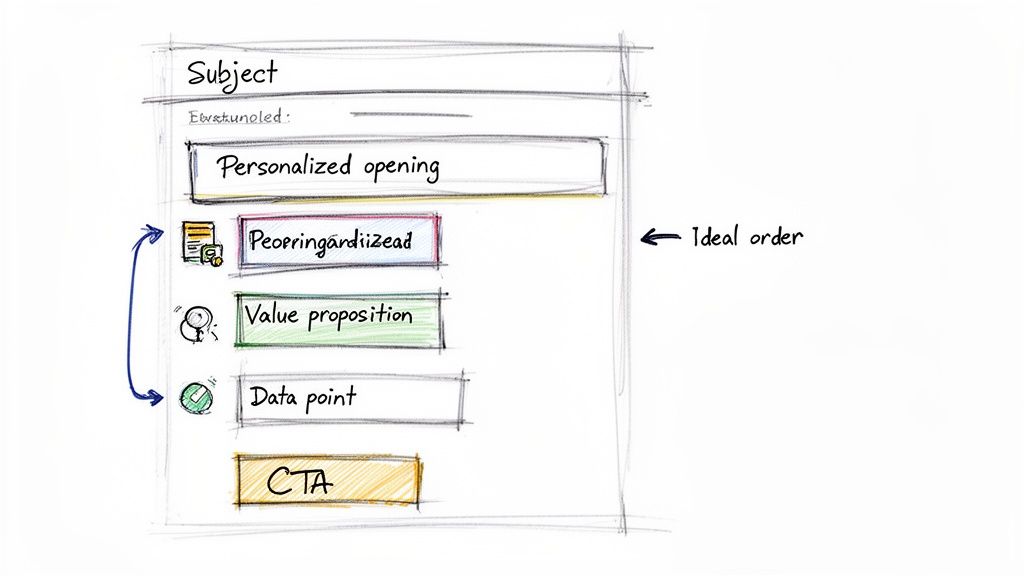
Before you grab a template and hit "send," let’s break down what actually makes a pitch work. A great pitch isn't just a block of text; it's a strategic message where every single word has a job to do. When all the pieces work together, your email becomes impossible for a busy journalist to ignore.
Think of it like building with LEGOs. You have different pieces: the subject line, the personalized opening, the core value, the proof, and the call to action. You can't just snap them together randomly and expect a masterpiece. But when you understand how they connect, you can build something that truly stands out.
The Subject Line That Demands a Click
Your subject line is the gatekeeper. It’s the first—and maybe the only—thing a journalist will see, and its sole purpose is to earn a click. Forget vague, clickbait-y lines like "An Exciting Story for You." Those are dead giveaways of a mass email blast and get deleted on sight.
Instead, your subject line needs to be a tiny, powerful preview of the value waiting inside.
- Lead with the angle, not your brand. Journalists care about the story you're offering, not your company name.
- Use a compelling statistic. Numbers create instant intrigue and signal that you have a data-backed story. Think: "Pitch: New data shows 78% of remote teams..."
- Keep it under 10 words. Anything longer gets cut off on mobile, which is where most emails get read first.
This first impression is everything. For a deeper dive into crafting outreach that works, it's worth understanding the core principles of how to write cold emails that get replies.
The Hyper-Personalized Opening Hook
Your first sentence or two must immediately prove this isn't a copy-paste job. This is where you connect your story to the journalist's actual work in a way that feels genuine. A generic "I love your work" is meaningless and gets you nowhere.
You have to be specific.
A truly effective opening shows you didn't just read their work—you understood it. Reference a specific point from a recent article and then explain how your pitch offers a new perspective or the next chapter in that conversation.
Here’s what that looks like:
"Hi [Journalist's Name], I just read your piece on the challenges of B2B SaaS scalability. Your point about technical debt resonated, which is why I'm reaching out with a story about how one startup is tackling that exact problem."
An opening like that immediately separates you from the 99% of pitches that are lazy and impersonal. It builds instant rapport and frames your pitch as a helpful tip, not a selfish request.
The Value Proposition: Why This Story Matters Now
Okay, you’ve hooked them. Now you have just a few seconds to deliver the core of your story. This is your value proposition, and it must answer two critical questions for the journalist:
- Why should my readers care about this?
- Why is this story timely and relevant right now?
This is where you need to be laser-focused. Ditch the corporate jargon and fluffy marketing speak. Get straight to the point and explain the impact, conflict, or novelty of your news. Your goal is to make it incredibly easy for them to picture the headline they could write.
Building Credibility with Data and Social Proof
Once you've presented your core idea, it's time to back it up. This is where you drop in a key data point, a sharp quote, or some social proof that gives your claim some weight. Journalists need evidence to justify a story, and when you provide it upfront, you make their job a whole lot easier.
- Original Data: Offer an exclusive statistic from a survey you ran.
- Expert Quote: Include a punchy, insightful quote from your CEO or another expert.
- Social Proof: Mention a notable investor, a well-known customer, or a major milestone you just hit.
How you present this matters, too. Clean, scannable emails almost always win. For a full breakdown, you can explore our guide on plain text emails vs HTML to see which format journalists actually prefer.
The Closing and a Crystal-Clear Call to Action
Finally, every great pitch wraps up with a simple, direct call to action (CTA). Don't leave the journalist wondering what you want. Your CTA should make the next step feel completely effortless.
Steer clear of vague closings like, "Let me know what you think." Be direct and propose a clear next step.
- "Are you available for a brief 15-minute call this week to discuss?"
- "I can connect you with our CEO for an interview. Does Tuesday or Thursday work for you?"
- "Would you be interested in seeing the full data report?"
This clear direction removes any friction and makes it incredibly easy for them to say yes. When you master each of these elements, your pitch stops being a template and starts being a powerful tool for winning coverage.
Actionable Pitch Templates for Startup Milestones

Alright, we've covered the theory. Now it's time to get practical.
Below are some battle-tested frameworks for the big moments every startup faces. But let’s be clear: these are not rigid, copy-and-paste scripts. Think of them more like strategic skeletons. They provide the structure, but you need to add the flesh and blood of your unique story.
Each media pitch email template is built for a specific milestone, hitting the notes I know journalists look for in that context. The goal here is to adapt, not just adopt. Use these to frame your own killer narrative.
The Product Launch Pitch Template
This is a classic. You're excited about your new product, but a pitch that just lists features is dead on arrival. A journalist's readers don't care about your bells and whistles; they care about how it solves a problem in their lives.
So, this template leans heavily into the problem-solution story. It’s all about the impact.
Subject Line Formula: Pitch: [Product Name] tackles [Major Pain Point] for [Target Audience]
Body:
Hi [Journalist’s Name],
I saw your recent article on [Relevant Topic They Covered], and your take on [Specific Point] made me think you'd be interested in [Your Product Name]. It's a new [Product Category] launching on [Date] to help [Target Audience] finally solve [The Big Problem].
For too long, [Target Audience] has been stuck with [Describe the Frustrating Old Way of Doing Things]. Current options just don't cut it because they [Mention a Key Limitation or Gap in the Market].
[Your Product Name] is different. We solve this by [Explain Your Core Solution in One Sentence]. A few things that make this possible:
- [Feature 1]: [Explain the direct benefit to the user, not just the function.]
- [Feature 2]: [Connect this feature to a major pain point it gets rid of.]
- [Feature 3]: [Highlight what makes this feature genuinely new or better.]
We think this is going to be a game-changer. Would you be open to an exclusive first look or a quick demo next week?
Best,
[Your Name]
Pro Tip: When you're launching, the "why now?" question is everything. Try to connect your product's release to a current trend, an industry shift, or even seasonal demand. It gives a journalist a timely hook and makes the story feel urgent.
The Funding Announcement Pitch Template
Securing funding is a huge win, but the money itself isn't the story. The real story is the vision and traction that convinced smart investors to write you a check. This template flips the script—it puts the focus on momentum, market validation, and what you’re building next.
Subject Line Formula: Pitch: [Company Name] raises [Amount] to solve [Industry Problem]
Body:
Hi [Journalist’s Name],
Following your coverage of [Relevant Startup or Market Trend], I wanted to give you a heads-up on some news from [Your Company Name]. We’ve just closed a [Amount] Series [A/Seed/etc.] round led by [Lead Investor Firm], with [Other Notable Investors] also participating.
This investment comes on the back of serious market demand for our solution to [The Big Problem Your Company Solves]. In the last year alone, we’ve:
- [Key Traction Metric 1]: [e.g., Grew our user base to 100,000+]
- [Key Traction Metric 2]: [e.g., Hit $1M in ARR]
- [Key Traction Metric 3]: [e.g., Onboarded key customers like Company X and Company Y]
[Quote from Lead Investor about why they invested]. We're putting this capital to work immediately to [Clearly state your top 1-2 goals, e.g., double our engineering team and launch in the European market].
I can connect you with our CEO, [CEO's Name], for an interview to dig into our vision for the future of [Your Industry]. Do you have time for a chat this week?
Thanks,
[Your Name]
The Thought Leadership Pitch Template
Here’s a secret: you don’t always need a massive announcement to land great press. A strong, data-backed opinion on a topic everyone is talking about can be just as newsworthy. This pitch positions your founder or executive as an expert with a perspective worth hearing.
Subject Line Formula: Idea: A counterintuitive take on [Trending Topic]
Body:
Hi [Journalist’s Name],
I'm a regular reader of your work on [Their Beat], and your recent piece on [Trending Industry Topic] really stood out. It seems like everyone is saying [Commonly Held Belief], but our data at [Your Company] points in a completely different direction.
Our CEO, [Executive's Name], has a strong perspective on this. She argues that [State the Contrarian or Unique Angle in One Bold Sentence].
This isn't just a hunch; it's based on [Mention the source of your insight, e.g., an internal analysis of 50,000 user interactions or a proprietary survey we just ran]. For example, we found that [Surprising Statistic or Data Point].
[Executive's Name] is available to talk more about:
- Why the current industry approach to [Topic] is fundamentally flawed.
- Three concrete steps companies should take to [Achieve a Better Outcome].
- Her predictions for where [Topic] is headed in the next 12 months.
Would this be a valuable angle for your readers? I'm happy to send over a full brief or set up a quick call.
Best,
[Your Name]
The Company Milestone Pitch Template
Hitting a big number—like 1 million users, $1 billion in transactions, or a major anniversary—is the perfect excuse to tell your bigger story. This pitch uses the milestone as a news hook to talk about your journey, what you’ve learned, and what it all means for your industry.
Subject Line Formula: Story: How [Company] reached [Milestone] by [Your Unique Approach]
Body:
Hi [Journalist’s Name],
Given your interest in [Relevant Industry/Theme], I thought you’d find our recent milestone at [Your Company Name] pretty compelling. We just crossed [Specific Milestone, e.g., 1 million active users], and the story of how we got here challenges a few common assumptions in [Your Industry].
When we started, everyone told us to [Describe the Standard Approach]. Instead, we made a bet on [Describe Your Contrarian or Unique Strategy], and it paid off. Hitting this number feels like validation that our approach to [Your Area of Focus] is what the market was missing.
I can offer you an exclusive interview with our founder, [Founder's Name], to unpack the key lessons from our journey to [Milestone], including:
- The unconventional growth tactic that got us our first 100,000 users.
- How we navigated [A Major Industry Challenge] when others struggled.
- What this milestone really signals for the future of [Your Market].
Is this a story you'd be interested in telling?
Regards,
[Your Name]
Finding the Right Journalist and Nailing the First Impression

Here's a hard truth: the best-written pitch in the world is completely useless if it lands in the wrong inbox. Sending your brilliant funding announcement to a reporter who only covers consumer product launches isn't just a waste of time—it can actually burn a bridge.
The secret to getting replies isn't just about what you write. It's about who you're writing to. This is where the real work starts. Genuine research and thoughtful personalization are what separate pitches that get opened from the thousands that are instantly deleted.
Go Deeper Than Just the Beat
A journalist's official "beat" is just a signpost, not the destination. A title like "tech reporter" is incredibly broad and tells you almost nothing. You have to dig in and figure out their specific niche and what they're obsessed with right now.
Start by reading their last five to ten articles. I’m serious—this isn’t optional, it’s the absolute bare minimum. As you read, pay close attention to the angles they take, the kinds of companies they feature, and who they quote.
- Look for patterns: Do they love stories backed by original data, or are they more interested in the human-interest side of a story?
- Pinpoint their focus: Is their "tech" coverage really about enterprise SaaS, AI policy, or the latest consumer gadgets?
- Check their sources: Who are the experts they trust? This gives you a massive clue about the level of expertise they expect from the people they talk to.
This quick analysis tells you if your story even has a fighting chance. If their last few articles are all about AI's impact on labor markets, your pitch about a new productivity app needs a very specific, relevant hook to even get a first glance.
A classic mistake is pitching a story that fits a journalist's beat from six months ago. A reporter's focus can shift on a dime with industry trends. Always, always prioritize their most recent work to make sure your angle is relevant today.
Use Social Media to See What They Really Care About
A reporter's articles show you their professional output, but their social media feed—especially on X (formerly Twitter) or LinkedIn—often reveals what they’re genuinely passionate about. This is where you find the personal hook that makes your pitch stand out.
Follow them. Observe. See what articles they share from other publications, what industry debates they jump into, and what topics they seem to be exploring for future stories. You might even get lucky and see them post a direct call-out for sources on a topic they're researching.
For example, you might notice a reporter constantly retweeting content about sustainable tech. If your startup has a strong environmental mission, referencing that interest shows you’ve done way more than just scan a media database. Our guide on how to contact journalists has a lot more tactical advice on this.
Craft an Opening That Proves You Did the Work
Once you have this intel, it's time to write an opening line that proves you’re not just another spammer. A generic "I love your work" is hollow and gets ignored. You have to get specific.
The goal is to connect your story directly to something they’ve recently written or shared. It needs to feel natural, not like you're just checking a box.
This is weak personalization:
"Hi Jane, I'm a big fan of your articles at Tech Weekly."
This is strong personalization:
"Hi Jane, I just finished your piece on the struggles remote teams face with asynchronous communication. Your point about the 'collaboration tax' really hit home, which is why I’m reaching out."
See the difference? The second example immediately shows you've not only read their article but actually understood its core argument. It creates a perfect, logical bridge to introduce your own story. This simple shift transforms your email from a cold pitch into a thoughtful contribution to a conversation they’re already leading.
Mastering the Follow-Up (Without Being Annoying)
Sending your pitch is really only half the battle. I can’t tell you how many positive responses I’ve seen come directly from a well-timed, strategic follow-up. Yet, this is where countless founders and PR pros get it wrong.
The line between a helpful nudge and an annoying pest is razor-thin. Crossing it can get you ignored, or worse, blacklisted. The trick is to stop thinking of it as "bumping" an email and start seeing it as a second chance to add value and demonstrate your professionalism.
Get Your Timing and Cadence Right
When should you follow up? It’s a classic question, and the answer is almost never "the next day." Sending a second email just 24 hours after the first one screams desperation. It shows you don’t understand how a newsroom operates—journalists are juggling multiple deadlines, and your pitch is just one of many things on their plate.
As a rule of thumb, wait 3-5 business days before sending your first follow-up. This gives the reporter enough time to see and process your original email without letting it get completely buried.
If you don't hear back after that first nudge, you can try one more time. Give it another 4-5 business days, then send one last, very brief message. That’s it. Two follow-ups should be your absolute maximum. Pushing beyond that is just counterproductive and starts to feel like spam.
A Follow-Up That Actually Adds Value
Your follow-up email has to be incredibly concise. More importantly, it should offer something new. A simple "just checking in" is a waste of everyone's time and is painfully easy to ignore.
Instead, use your follow-up as a chance to provide a fresh angle, a new data point, or a relevant piece of context that makes your original pitch even stronger.
Here’s an example of how to do it right:
Subject: Re: [Original Subject Line]
Body:
Hi [Journalist’s Name],
Just wanted to quickly follow up on my note from last week about [Briefly Restate Your Story Angle in 3-5 Words].
Since I reached out, a new industry report on [Relevant Trend] was released that makes this story even more timely. We noticed our data on [Your Key Stat] directly supports their findings on [Mention a Specific Finding].
Happy to share more if this feels like a fit for your readers.
Best,
[Your Name]
This approach works because it reframes the story with new, relevant information. It proves you're still thinking about their audience and gives them another solid reason to consider your pitch.
Remember, quality outreach always wins over quantity. Studies have shown that a targeted list of 50-100 emails with thoughtful follow-ups can yield far better results than a generic blast to 1,000 contacts. Reply rates can nearly double with just one good follow-up, but they drop off a cliff after that. For more on this, you can explore detailed findings on BuzzStream's blog.
Knowing When to Walk Away
Honestly, the most important skill in following up is knowing when to stop. Pushing a story on a journalist who isn’t interested is a surefire way to damage your reputation. Protecting your professional relationships is always more valuable than landing any single story.
Look for these clear signals that it’s time to back off:
- A direct "No, thank you." See this as a gift! They saved you time. Respect their decision, thank them for considering it, and move on. Never ask why or try to change their mind.
- Silence after two follow-ups. You sent the pitch and two polite, value-added follow-ups. If you’ve heard nothing back, it’s time to let it go. Assume it's a no and focus your energy elsewhere.
- An out-of-office reply. If their auto-reply says they’re out for a while, pause your sequence. You can try again when they’re back, but don’t keep sending emails into the void.
Mastering the follow-up turns any media pitch email template into a dynamic tool for building relationships. By being patient, adding value, and knowing when to stop, you position yourself as the kind of professional, reliable source that journalists actually want to work with.
Answering Your Toughest Media Pitch Questions
Even with the best templates in hand, you're going to run into weird situations and tricky questions. It just comes with the territory. Knowing how to handle these moments is often what separates a pitch that lands major coverage from one that gets deleted.
Here are some quick, no-nonsense answers to the questions I hear most often from startup teams trying to nail their PR outreach.
How Long Should My Pitch Email Be?
Short. Incredibly short. If you take away only one thing, let it be this: aim for under 150 words.
Journalists are absolutely buried in emails, so a pitch that gets straight to the point is a breath of fresh air. It shows you respect their time and know how the game is played.
Start with a hook, then give them two or three super-short paragraphs explaining the story and why their readers will care. A few bullet points with key stats or takeaways can make your pitch even easier to scan.
A journalist's inbox is a battlefield for attention. If your pitch takes more than 30 seconds to understand, it’s already lost. Brevity isn't just a suggestion; it’s a requirement.
What Is the Best Day and Time to Send a Pitch?
While there's no single magic window, the data (and my own experience) consistently points to mid-week mornings. Tuesday, Wednesday, and Thursday, somewhere between 8 AM and 10 AM in the journalist's local time, is usually your best bet. That's typically when they're planning their day and are most open to new ideas.
Mondays are often a catch-up day from the weekend deluge, and by Friday afternoon, everyone's focus is already shifting.
But honestly, a truly fantastic pitch will get noticed no matter when it lands. Focus on making your story irresistible first, and worry about the timing second.
Should I Attach a Press Release to My Email?
Absolutely not. Please don't do this. Attachments are a major red flag for two reasons: they can trigger spam filters, and they force a busy person to take an extra step. Your job is to remove friction, not create it.
So, what should you do instead? Just paste the most critical info directly into your email.
For everything else, use links. You can link out to:
- Your full press release living in your website's newsroom.
- A media kit you've put together in a Google Drive folder.
- A gallery of high-res images or videos.
This approach keeps your email clean, makes your assets instantly accessible, and won't set off any security alarms.
How Do I Pitch a Story Without Major News?
You don't always need a splashy launch or a massive funding round to get press. Some of the best stories come from a different angle entirely. Think about offering value through expertise or unique data.
You could pitch a sharp, opinionated take on a trend everyone in your industry is talking about. Journalists love a fresh perspective, especially if it's a bit contrarian.
Another great strategy is to create your own news. Run a small survey, analyze your internal user data, and find a surprising insight. Exclusive data and compelling human-interest angles tied to your company's mission can be just as powerful as a standard announcement—sometimes, even more so.
Ready to stop guessing and start getting featured? PressBeat uses AI to find the perfect journalists and craft personalized pitches that secure predictable media coverage. Get your story told today.