
A Modern Startup Guide to Media Contact Databases
January 24, 2026
Forget the old-school idea of a Rolodex or a simple phone book. A media contact database is more like a specialized, high-powered CRM built specifically for your startup's public relations efforts. These tools are the secret weapon for getting in front of the right journalists, bloggers, and influencers—the people who can actually tell your story. Their job isn't just to store names and emails; it's to provide the intel you need to cut through the static and get your brand noticed.
What Are Media Contact Databases Really For
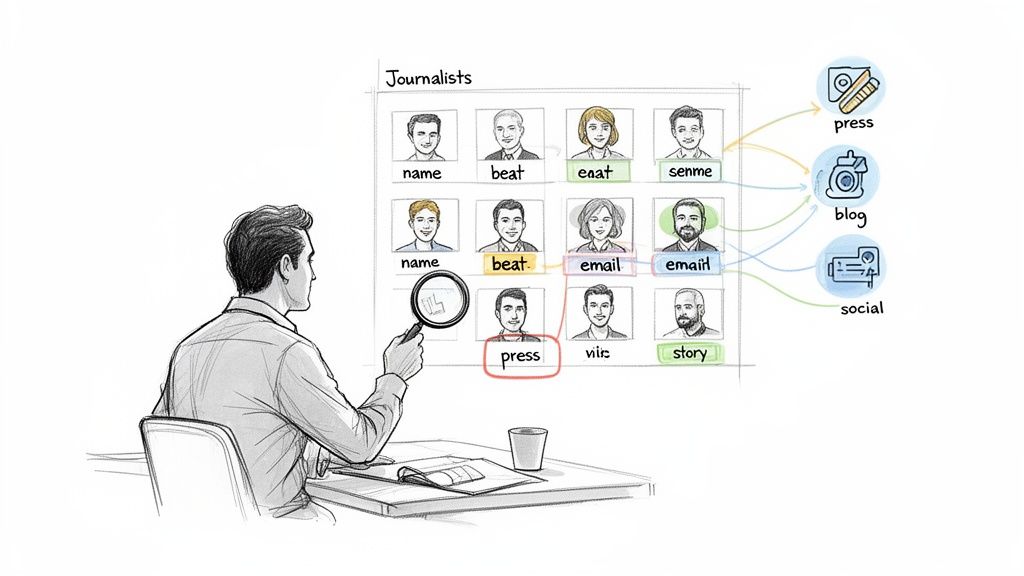
For any startup, the biggest hurdle is obscurity. You might have an incredible, industry-disrupting product, but if nobody knows you exist, you're not going anywhere. This is exactly where a good media contact database lays the groundwork for earning press coverage and building real brand credibility.
At its most basic, it's a curated collection of information about media professionals. But that's just scratching the surface. The true value lies in how it transforms a list of names into a strategic asset, making your outreach smarter, faster, and much more likely to succeed.
Moving Beyond Simple Contact Lists
Sure, you can keep a journalist's name and email in a spreadsheet. We've all done it. But a professional database gives you the critical context that turns that raw data into something you can actually act on. It’s this rich, layered information that makes the difference between a generic email blast that gets instantly deleted and a personalized, compelling pitch a journalist will actually read.
A high-quality database is packed with useful details, like:
- Detailed Profiles: You'll find a journalist’s specific beat, their recent articles, and the topics they're passionate about.
- Contact Preferences: Many profiles include notes on the best way to get in touch—whether it's email, a call, or even a message on social media.
- Publication Details: Get a feel for a publication's audience, its editorial calendar, and its specific submission guidelines.
- Social Media Handles: Links to their professional social accounts give you another way to research their work and engage with them authentically.
This depth of information lets you tailor your pitch with incredible precision. You can quickly find reporters who live and breathe your industry, understand what makes them tick, and craft a message that speaks directly to their interests.
A media contact database doesn't just tell you who to contact; it helps you understand why and how to contact them. It’s the difference between shouting into a crowd and having a meaningful one-on-one conversation.
The Foundation for Building Relationships
At the end of the day, PR is all about relationships. A database is the tool that helps you build and manage those connections, especially when you're trying to scale your efforts. By keeping track of all your interactions—every email you send, every reply you get, every piece of coverage you land—you build an institutional memory of your media outreach.
This history is pure gold. It stops your team from accidentally sending the same pitch twice and helps you nurture connections over the long haul. You can easily see which journalists have shown interest in your company before, making your follow-ups feel natural and relevant, not like a cold call. For a startup trying to drive growth, turning data into genuine media relationships isn't just a nice-to-have; it's essential for survival.
The Hidden Problem of Data Decay in Media Databases
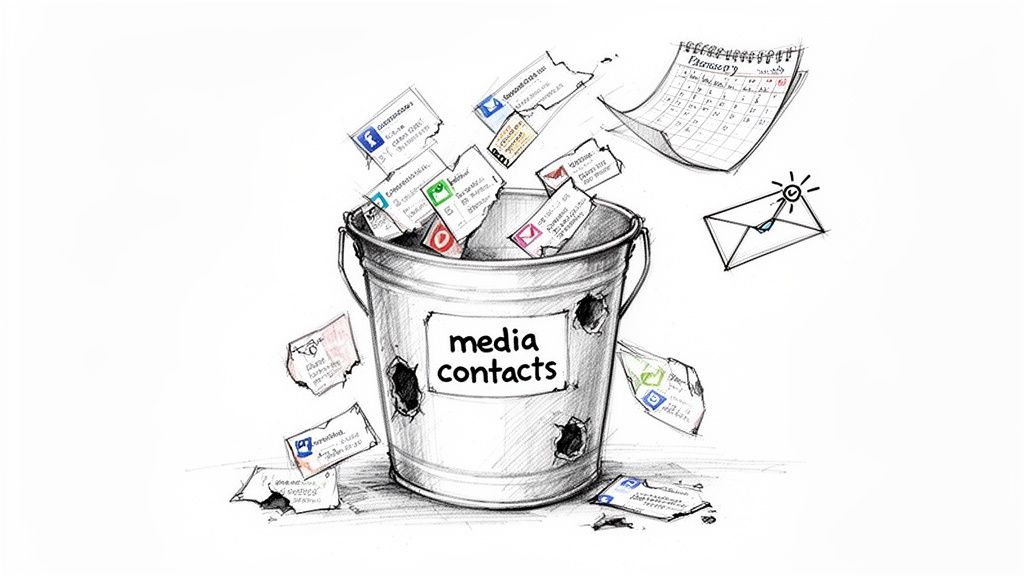
It’s tempting to think of a media contact database as a permanent asset, a solid foundation for your PR strategy. But the reality is far more fragile. A better analogy is a bucket of water with a slow, steady leak. That leak is data decay, and it's the single biggest problem undermining traditional, static media lists.
Journalists are constantly on the move. They switch roles, change beats, and hop between publications, making their contact information obsolete almost as soon as you get it. You pour your valuable budget, time, and strategic thinking into this "bucket," only to watch opportunities steadily drain away. Every bounced email and every pitch sent to the wrong beat is a wasted resource. For a startup, ignoring this decay is one of the costliest mistakes you can make.
Why Outdated Data Sinks PR Campaigns
Imagine spending weeks crafting the perfect story for a top tech reporter, only to find out they moved to the lifestyle desk three months ago. This isn't just a frustrating one-off; it's the daily reality of the media world. The constant churn means that even a perfectly curated list starts losing its value from day one.
The problem is so widespread that a staggering 68% of marketers now point to poor contact data quality as their biggest obstacle to revenue growth. The same study found that many companies' databases are decaying faster than they can be refreshed, creating a perpetual state of inaccuracy. For more insights on this trend, you can dig into the findings of Demand Gen Report's Database Strategies Benchmark Survey.
When your entire outreach strategy is built on this shaky foundation, the negative effects start to multiply fast.
The Real-World Costs of Bad Information
Working with poor-quality data from a decaying database isn't just inefficient—it actively harms your brand and burns through precious resources.
Damaged Sender Reputation: Internet service providers keep score. When you send too many emails that bounce, they start to see you as a potential spammer. This tanks your sender score, making it more likely that all your future emails will land in the junk folder, even the ones sent to the right people.
Wasted Time and Money: Every hour your team spends chasing dead-end contacts is an hour they could have spent building real relationships. For a startup, that squandered effort is a massive opportunity cost.
Missed Media Opportunities: The perfect journalist to tell your story is out there, but you’ll never reach them if your database is pointing you to their old job. You could miss out on the one article that puts your company on the map.
Relying on a static database is like navigating with an old map. You might eventually get where you're going, but you’ll waste a lot of fuel on wrong turns and dead-end roads along the way.
To really see what's at stake, it helps to put the two side-by-side. The quality of the contacts you start with determines the quality of your results, which is a principle that applies to any outreach list, including a social media database.
Here’s a clear breakdown of how data quality directly impacts your PR outcomes.
The Impact of Data Quality on PR Campaigns
The difference between clean, verified data and a stale list is night and day. It affects everything from your daily workflow to your company's public perception. This table shows exactly what you gain—and what you risk—based on the quality of your media contacts.
| Metric/Outcome | Impact of High-Quality Data | Impact of Low-Quality Data |
|---|---|---|
| Email Deliverability | High open and delivery rates build a strong sender score. | High bounce rates damage sender reputation and trigger spam filters. |
| Journalist Response Rate | Personalized pitches to relevant contacts lead to positive replies. | Irrelevant pitches lead to being ignored, blocked, or marked as spam. |
| Resource Efficiency | Team efforts are focused on building relationships and securing coverage. | Time is wasted on list cleaning, manual verification, and failed outreach. |
| Brand Reputation | Seen as professional, prepared, and respectful of journalists' time. | Perceived as spammy, unprofessional, and out of touch with the industry. |
Ultimately, high-quality data isn’t just a "nice-to-have"; it’s the engine of a successful PR program. Low-quality data, on the other hand, is an anchor that will drag your entire strategy down before it ever has a chance to succeed.
Choosing the Right Media Contact Database for Your Startup
With so many options out there, picking a media contact database can feel like a make-or-break decision for a startup. It's easy to get lost in flashy feature lists, but the real key is to focus on what actually drives results. You’re not just buying a list of names; you’re investing in a tool that should become a core part of your growth engine.
A smart choice comes down to a clear-eyed look at a few critical factors. It’s all about matching the platform’s real-world capabilities with your specific PR goals, your budget, and how your team actually works. Let's build a practical playbook for making the right call.
Evaluating Data Accuracy and Freshness
Honestly, this is the single most important factor. If the data is bad, nothing else matters. As we’ve covered, data decay is a relentless problem, so your first question to any vendor should be about how they keep their information current. A database that's only updated quarterly is already hopelessly out of date the day you sign up.
Look for providers that offer real-time or near-daily updates. For example, Muck Rack gets a lot of praise for its data accuracy, partly because it cleverly allows journalists to claim and update their own profiles. A giant like Cision will tell you they make over 20,000 updates a day to their massive database.
Before you commit, ask potential vendors these direct questions:
- How often do you update? Daily or real-time is the gold standard. Anything less is a compromise.
- How do you verify contact info? Is it just automated bots, or is there a human research team behind it? A mix of both is often best.
- What's your average email bounce rate? A low, transparent number is a great sign of a well-maintained list.
Assessing the Depth of Journalist Profiles
A name and an email address just aren't enough to get the job done. The best media databases give you deep, actionable context that helps you personalize your outreach and build genuine relationships. A shallow profile is a major red flag—it means you're basically just buying a glorified spreadsheet.
A truly robust profile gives you the intel you need to move beyond a cold, generic email and start a warm, relevant conversation.
Think of it this way: a basic contact is a business card, but a detailed profile is a LinkedIn page brought to life. It tells you not just who they are, but what they care about right now, making your pitch instantly more relevant.
You should be looking for detailed profiles that include:
- Recent Articles: This is non-negotiable. Seeing what a journalist has published recently is the fastest way to understand their current beat and what they're truly interested in.
- Social Media Links: Their professional social handles (especially Twitter/X) offer priceless insight into their personality and the topics they engage with beyond their official articles.
- Pitching Preferences: Some platforms, like Muck Rack, let journalists specify how they prefer to be contacted. That’s like getting a cheat sheet for your outreach.
Considering Workflow Integration and Usability
The most powerful tool in the world is useless if your team finds it clunky and frustrating to use. A clean, intuitive interface saves a ton of time and reduces friction, freeing up your team to focus on strategy instead of fighting with the software. Platforms like Prowly and Telum Media are often noted for their straightforward, user-friendly design.
Also, think about how the database will slot into your existing PR and marketing stack. Does it integrate with your CRM or the email tools you already use? A seamless connection between your media database and other systems saves you from mind-numbing manual data entry and ensures all your relationship-building efforts are tracked in one place.
Understanding Pricing Models and ROI
Pricing for these databases is all over the map, from a few hundred dollars a month to tens of thousands per year for an enterprise-level subscription. Don't just get sticker shock from the monthly fee; you need to understand the total cost and, more importantly, the value you're getting in return.
Most platforms use one of a few common pricing models:
- Annual Contracts (Enterprise): Big players like Cision and Meltwater often require annual commitments, which can be a serious investment for a startup.
- Monthly Subscriptions: Services like Prowly or BuzzSumo offer much more flexibility with monthly plans, which is perfect for startups that need to stay nimble.
- Usage-Based Models: Some tools, like BuzzStream’s ListIQ feature, let you pay with credits for building lists. This pay-as-you-go approach is great for aligning your costs directly with your activity.
When you're looking at the cost, try to calculate the potential return on that investment. If a more expensive but highly accurate database helps you land just one key piece of coverage in a major publication, it could easily pay for itself for the entire year. Focus on the value and the results, not just the price tag.
Mastering the Art of Journalist Outreach
Getting your hands on a premium media contact database is like being handed the keys to a high-performance race car. It's a powerful tool, but your success really boils down to how you drive it. The classic mistake is treating it like a megaphone for blasting out press releases—a quantity-over-quality approach that’s a one-way ticket to the trash folder.
The real secret to great journalist outreach is a complete mental shift from mass communication to meaningful connection. It’s about using all that rich data not just to snag an email address, but to actually understand the person on the other side of the screen. This quality-first strategy is what turns a simple contact list into career-defining media coverage.
From Blasting to Building Relationships
Modern journalists are drowning in emails. Their inboxes are a relentless flood of generic pitches, making it nearly impossible for genuinely good stories to cut through the noise. As a result, they've become incredibly selective about what they open and who they engage with.
The numbers back this up. Recent PR stats show that only 38% of journalists are even open to receiving new, relevant story ideas, and a mere 33% appreciate invites to industry events. It's not that they're unfriendly; it's a survival tactic against inbox overload. And while 55% use social media to connect with their audience, a surprisingly low 17% actually want to be pitched there. You can dig into more of these trends in the 2026 PR statistics from Ranko Media.
The message here is loud and clear: the old "spray and pray" method is officially dead. Winning today is all about building genuine, professional relationships, and that journey always starts with a perfectly personalized pitch.
Crafting Pitches That Actually Get Read
Personalization is so much more than just using a mail merge to drop in a journalist's first name. Real personalization shows you've done your homework and that you genuinely respect their work. It’s the proof that your story is a perfect fit for their specific beat and their audience.
Here’s a simple, three-step process for putting together a pitch that truly connects:
- Reference Their Recent Work: Kick things off by mentioning a recent article they wrote. Get specific. Don't just say, "I liked your recent article." Try something like, "Your piece last week on AI's impact on supply chains was fantastic, especially your point about predictive analytics."
- Connect Your Story to Their Beat: Draw a straight line from their work to your news. Make it obvious why your story is relevant to them. For instance, "Building on your analysis, our startup just launched a tool that solves the exact predictive analytics challenge you highlighted."
- Provide Clear, Actionable Value: Make their job easy. Offer an exclusive interview with your founder, give them a demo account, or share a compelling data report. End with a simple, low-pressure call to action, like, "Would you be open to a brief 15-minute chat next week to discuss this?"
This targeted approach flips your pitch from being an interruption into a valuable opportunity. For a deeper dive into these strategies, check out our guide on how to contact journalists effectively.
The Unwritten Rules of Follow-Up
Even the most perfect pitch can get buried in a chaotic inbox. A polite, professional follow-up is often necessary, but there’s a very fine line between being persistent and being a pest.
Think of a follow-up as a gentle nudge, not an aggressive push. Your goal is to be helpful and stay top-of-mind without becoming a nuisance that gets you blocked or marked as spam.
Stick to this simple etiquette to keep the relationship positive:
- Wait a Few Days: Give them at least three to five business days before you even think about following up.
- Keep It Brief: Your follow-up should be a simple, two-sentence reply to your original email. Something like, "Just wanted to gently bump this up in your inbox in case it's a good fit for your current reporting."
- Know When to Stop: If you don’t get a response after one or two follow-ups, it’s time to let it go. Pestering a journalist will only burn that bridge and hurt your chances of connecting with them down the road.
The Evolution From Static Lists To AI-Powered Platforms
The old-school media contact database has been a PR staple for decades, but its cracks are starting to show. Think of it like a printed phone book. It gives you a list of names and numbers, but it’s outdated the moment it’s printed and tells you nothing about who’s actually interested in your call.
We're seeing a major shift away from these static lists toward dynamic, AI-powered platforms. This isn’t just a small tweak; it’s a complete rethinking of how PR pros connect with the media. While a database gives you the "what" (contact info), an AI platform tells you the "how," "when," and "why"—the actual intelligence you need to get noticed.
From Manual Research To Automated Intelligence
In the past, working with a media database meant putting in serious manual labor. You'd pull a massive list of journalists and then spend days—or weeks—sifting through their articles, trying to guess their current beat, and piecing together a pitch. It was slow, tedious, and often felt like a shot in the dark.
AI-powered platforms completely flip that script. They automate the deep, time-consuming research that used to be the biggest bottleneck in any campaign.
These modern systems can:
- Analyze Content in Real-Time: AI is constantly scanning millions of articles, podcasts, and social posts to understand what a journalist is covering right now, not what they wrote about six months ago.
- Identify Pitching Windows: They can spot patterns in a journalist's publishing schedule and engagement to find the perfect moment to send your story.
- Personalize Pitches at Scale: Many platforms can now help draft highly relevant pitches that reference a reporter's recent work, making your email feel less like a blast and more like a thoughtful suggestion. For more on this, see how an AI press release generator can help.
This change frees you up to focus on what humans do best: building relationships and refining strategy, not getting bogged down in data entry. This is a familiar story across many industries, as we see how AI SEO agents are shaping the future by moving beyond outdated service models.
Beyond A List: A Strategic Partner
Here’s the fundamental difference: a traditional database sells you a list. That's it. An AI-powered platform, on the other hand, acts more like a strategic partner that’s invested in your success. They go beyond just handing over data and actively guide you toward your goals.
This flowchart maps out the modern approach to outreach, moving away from ineffective mass emails toward smart, personalized relationship-building.
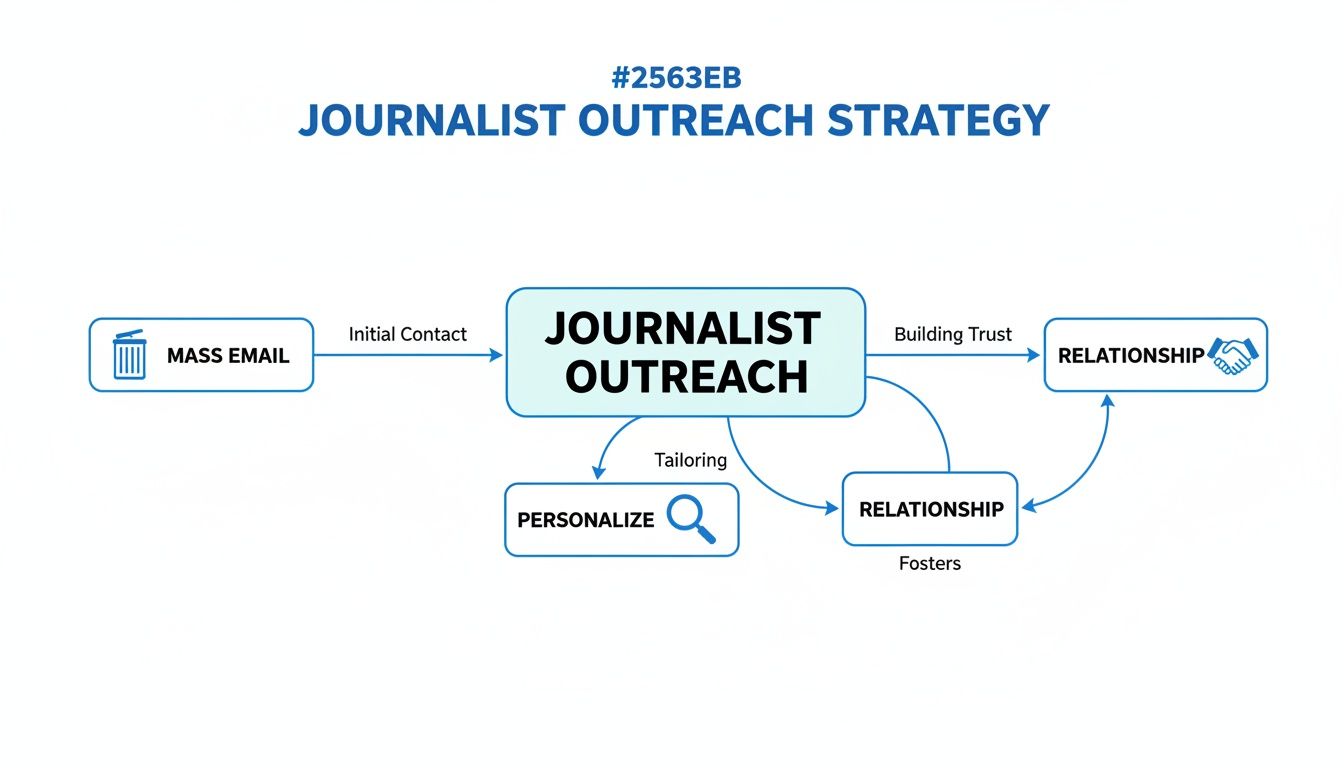
As the graphic shows, real PR success today comes from targeted, intelligent engagement, not just spraying and praying.
This new wave of PR tech also brings features that were once pipe dreams. You get performance analytics showing which pitches are landing and why. Even more impressively, platforms like PressBeat are starting to offer guaranteed outcomes—promising a set number of media placements or your money back.
An AI-powered earned press platform doesn't just give you a fishing pole and point you to the lake; it analyzes the water, baits the hook with what the fish are biting, and helps you cast your line at the perfect moment.
This focus on predictable results is a huge win for startups and any business that needs to justify every dollar spent on marketing.
Traditional Databases vs. AI-Powered Platforms
To make the distinction crystal clear, let's break down how these two approaches stack up side-by-side. The table below highlights the key differences in everything from the core data to the workflow and ultimate outcomes.
| Feature/Aspect | Traditional Media Database | AI-Powered Platform (e.g., PressBeat) |
|---|---|---|
| Data Type | Static contact information (name, email, publication) | Dynamic, real-time data on journalist interests and recent activity |
| Data Freshness | Updated quarterly or annually; often contains outdated information | Continuously updated by AI; reflects current coverage and needs |
| Workflow | Manual list pulling, vetting, and individual pitch research | Automated research, list building, and personalized pitch assistance |
| Targeting | Broad and based on general "beats" or publication categories | Hyper-targeted based on specific articles and real-time conversations |
| Outcome | Unpredictable; success depends entirely on manual effort and luck | Outcome-focused, often with performance guarantees and analytics |
| Time Investment | High; requires significant hours for research and outreach | Low; automates the most time-consuming tasks to focus on strategy |
| Best For | Large teams with dedicated staff for manual research | Startups and lean teams needing efficient, measurable results |
This comparison shows a clear evolution. While databases were once the only tool for the job, AI platforms are built to solve the modern challenges of a crowded and fast-moving media world.
Why The Shift Is Happening Now
The pressure on PR pros has never been greater. Everyone knows media relations is the core of the job, yet most feel that securing earned media is only getting harder. With the global PR market expected to reach $132.52 billion by 2029, the demand for smarter, more efficient tools is exploding.
CEOs and marketing leaders no longer accept vague metrics; they want to see a clear line connecting PR activity to business goals. This push for measurable ROI is what’s really driving the migration away from static databases. Startups, in particular, can't afford to gamble on old methods that don’t guarantee a return. The move to AI isn't just about shiny new tech—it's about meeting the urgent need for transparency, efficiency, and predictable results in public relations.
Navigating the Legal and Ethical Rules of Media Outreach
Getting your hands on a powerful media contact database is one thing, but using it responsibly is a whole different ball game. It’s not just about smart strategy; you're stepping into a world with some serious legal and ethical responsibilities. Think of these rules as the guardrails on the highway—they keep you from veering off a cliff.
Ignoring them can lead to more than just hefty fines. It can completely torch your startup's reputation with the very journalists you’re trying to build relationships with. At the heart of it all are data privacy regulations. These aren't just for massive corporations; they apply to any business handling personal information, and yes, that includes the journalist contacts in your database.
Understanding Key Data Privacy Laws
The two big players you absolutely need to know are the GDPR in Europe and the CCPA in California. While they have their differences, they’re built on the same foundational idea: people should have control over their own data.
When you're dealing with contacts in Europe, that means following a strict GDPR compliance checklist to the letter. You can’t just email someone because you found their address; you need a legitimate, documented reason for contacting them.
It all boils down to respecting a journalist's rights, which include:
- The Right to Be Forgotten: If a reporter asks you to delete their information, you do it. No questions asked, no delay.
- The Right to Object: Journalists have every right to opt out of your emails. Your unsubscribe process needs to be dead simple and immediate.
Moving Beyond Compliance to Professional Ethics
Staying on the right side of the law is the absolute minimum. Real success in PR comes from ethical outreach that builds genuine, lasting relationships. The public relations world runs on trust and professionalism. Breaking the unwritten rules of engagement can get you blacklisted way faster than breaking a law.
Treat every journalist not as a name on a list to be spammed, but as a professional colleague you hope to work with.
The golden rule of media outreach is simple: Don't do anything you wouldn't want done to you. If a pitch feels spammy or intrusive to send, it almost certainly is.
Sticking to a solid ethical code isn't complicated. Always be transparent about who you are and why you're getting in touch. Never resort to clickbait subject lines or bend the truth just to get an open.
Most importantly, respect opt-out requests instantly. When someone asks to be removed, a prompt, polite confirmation shows you value their time and preserves your reputation. It leaves the door open for another day.
Common Questions About Media Contact Databases
Even with a solid plan, wading into the world of media contact databases can feel a bit overwhelming. For a startup, every choice matters, and getting straight answers is crucial. Let's tackle some of the most common questions I hear to give you clear, practical advice for your PR.
How Often Should a Database Be Updated?
The honest answer? In real-time. The media world is constantly shifting—journalists change beats, jump to new publications, or go freelance all the time. A list that's only updated every few months is practically obsolete the moment you get it.
Think of it this way: using a quarterly-updated list is like navigating with a map from last year. You'll probably end up on a road that doesn't exist anymore. This is exactly why dynamic, AI-powered platforms are becoming the norm. They handle the nonstop work of verifying contact info, which saves you from the high bounce rates that can get your domain flagged as spam. It ensures your pitch actually makes it to the right person.
Can I Build My Own Media Database?
You absolutely can. But the real question is, should you? Piecing together a list by hand using spreadsheets and sifting through social networks is a massive time sink. For a startup, time is your most valuable asset, and every hour spent on manual data entry is an hour you can't spend on strategy or actually talking to people.
Building your own list from scratch is like trying to build a car when all you need to do is get across town. A pre-built database gives you a working vehicle, and a modern platform is like a self-driving car that navigates the best route for you.
The biggest mistake startups make is treating a media contact database like a simple mailing list for press releases. This tactic completely ignores the 'relations' part of public relations and is the fastest way to get your emails marked as spam.
Quality or Quantity in My Contact List?
Quality, every single time. It's not even a fair fight. A thoughtful, well-researched pitch sent to 10 carefully chosen journalists will get you further than a generic email blasted out to 1,000. Reporters have a sixth sense for spotting a copy-paste job, and it's an instant trip to the trash folder.
When you focus on a smaller, highly relevant list, you can actually put in the effort to personalize your outreach. This is what gets a reporter’s attention. It results in higher open rates, more thoughtful replies, and a much better shot at landing the kind of story that actually moves the needle for your business.
Ready to stop guessing and start getting guaranteed press coverage? PressBeat uses AI to connect you with the right journalists and automate personalized outreach, so you can focus on your business while we build your brand's visibility. Discover how PressBeat delivers predictable PR results.