
8 Perfect PR Pitch Examples to Steal in 2026
January 16, 2026
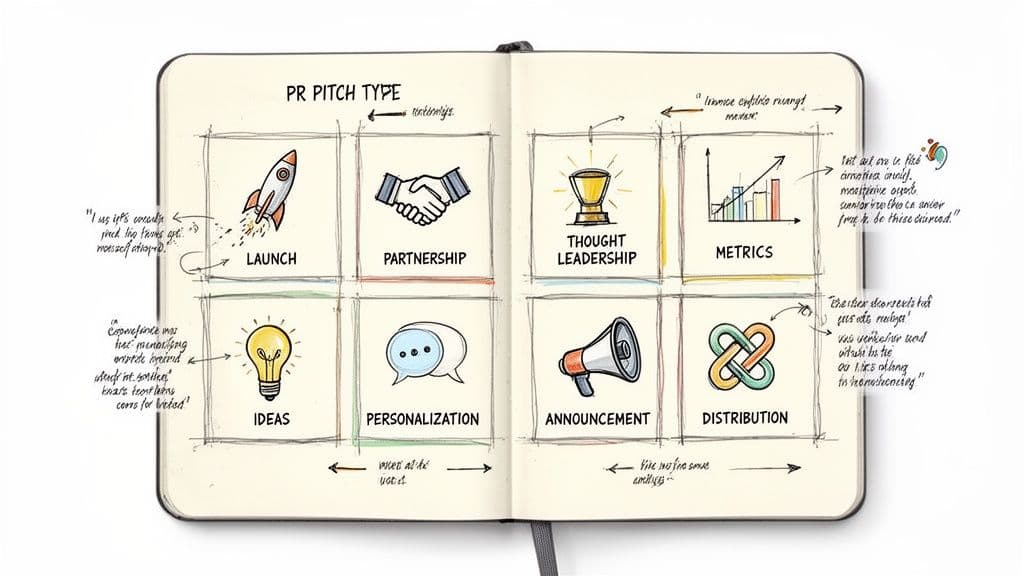
In the crowded world of tech media, getting a journalist's attention is harder than ever. A generic, poorly-timed pitch gets deleted in seconds, while a strategic, personalized one can land you on the front page of top publications. The difference lies entirely in the approach, and a strong pitch is one of the most powerful, cost-effective tools a startup has for building authority and driving growth.
This guide breaks down the science and art behind effective media outreach. We will move beyond theory and dive straight into 8 battle-tested pr pitch examples, each tailored for a specific, high-stakes goal from a product launch to a funding round announcement. Understanding the underlying mechanics of outreach is essential. To truly unlock the secrets of successful pitches, understanding the mechanics of getting a response is crucial. For specific guidance, explore strategies on achieving high reply rates for your PR pitches.
For each example in this article, we'll dissect not just the words, but the complete strategy behind it:
- The subject line that gets the email opened.
- The specific personalization cues that build instant rapport.
- The distribution context and timing.
- A clear breakdown of why it works.
You'll get actionable takeaways and replicable frameworks you can use immediately to craft pitches that journalists actually want to read. The goal is simple: to help you secure predictable, high-authority coverage your startup needs to accelerate its growth and establish its brand in a competitive market. Let's get started.
1. The Product Launch Pitch
The product launch pitch is a foundational tool for any startup, designed to transform a new product or feature announcement into a compelling news story. It moves beyond a simple "we launched this" statement by framing the news within a problem-solution narrative. This approach grabs a journalist's attention by first establishing a clear market pain point their readers face, then introducing the product as the innovative solution.

This structure is highly effective because it aligns with a reporter's need for a strong narrative hook. By focusing on the "why" behind the launch-how it impacts an industry or solves a common frustration-the pitch provides immediate context and newsworthiness. It's a go-to strategy for tech companies, from SaaS startups introducing a new AI-powered feature to fintech firms launching a novel payment solution.
Anatomy of an Effective Product Launch Pitch
A strong product launch pitch, one of the most vital pr pitch examples you can master, contains several key components that work in tandem to secure coverage.
- Compelling Subject Line: Clearly states the company name and the nature of the launch (e.g., "Company X Launches [Product Name] to Solve [Problem]").
- Executive Summary: A 2-3 sentence "TL;DR" at the top that summarizes the what, why, and who. Journalists are busy, and this respects their time.
- Problem-Solution Narrative: The body of the pitch should lead with the problem your product solves. Use a data point or a relatable anecdote to set the stage.
- Clear Call-to-Action (CTA): End with a specific next step. Offer an exclusive briefing, a demo account, or access to the embargoed press kit.
Why This Pitch Works
This format succeeds by directly addressing a journalist's core needs: a newsworthy angle, a clear story, and easy access to information. By leading with the problem, you provide a hook that connects your product to a broader trend or industry challenge, making it more than just a commercial announcement. Including quantifiable impact (e.g., "cuts processing time by 40%") provides concrete evidence of your product's value. For startups seeking to build momentum and establish market relevance, this structured pitch is an indispensable tool. Mastering this format is a critical step in a successful media outreach strategy. To dive deeper into the fundamentals, you can get more information about pitching the media on PressBeat.io.
2. The Funding Round Announcement Pitch
The funding round announcement pitch is a high-stakes communication designed to transform an investment into a powerful narrative of market validation and future growth. More than just stating a dollar amount, this pitch frames the funding news as a signal of investor confidence, industry disruption, and accelerated momentum. It’s a critical tool for startups to leverage a major internal milestone into significant external credibility.

This pitch is highly effective because it appeals directly to business and tech journalists who cover the venture capital ecosystem. The involvement of notable investors (like Sequoia or Andreessen Horowitz) and a substantial investment amount are inherently newsworthy. The pitch provides reporters with a multi-faceted story: company growth, market trends, and a forward-looking vision, making it a go-to for startups announcing everything from a seed round to a major Series C.
Anatomy of an Effective Funding Round Pitch
A well-crafted funding announcement, one of the most impactful pr pitch examples a startup can deploy, must contain specific elements to capture media interest and convey the significance of the milestone.
- Embargoed Subject Line: Clearly states the news under embargo (e.g., "EMBARGOED: [Startup Name] Raises $[Amount] Series A Led by [Lead Investor]").
- The Key Details Upfront: The first sentence must state the core news: the company name, the amount raised, the funding round, and the lead investors.
- Use of Funds and Vision: The body should detail exactly how the capital will be used (e.g., "to double the engineering team" or "expand into the APAC market") and connect it to the company's broader mission.
- Powerful Quotes: Include compelling quotes from both the CEO (explaining the vision) and the lead investor (validating the market opportunity).
Why This Pitch Works
This format is successful because it delivers a pre-packaged, newsworthy story that aligns perfectly with the interests of tech and business reporters. The funding amount serves as a quantifiable measure of success, while the investors' names provide third-party validation. By clearly outlining the use of funds, the pitch moves beyond the present moment and tells a story about the future, giving journalists a compelling angle on what's next. Providing this information under embargo respects the reporter's workflow, giving them time to prepare a quality story and increasing the likelihood of securing high-profile coverage on announcement day.
3. The Thought Leadership Expert Pitch
The thought leadership expert pitch shifts the focus from a company’s product to the unique insights of its key people. Instead of announcing news, this pitch positions a founder, executive, or team member as a go-to expert on a specific industry topic. The goal is to offer valuable, non-promotional perspective that enriches a journalist’s story, securing bylines, expert quotes, or speaking opportunities.

This strategy is effective for building long-term media relationships and establishing brand authority. By providing genuine expertise-such as a CTO commenting on cybersecurity trends or a CFO on startup fundraising-you become a trusted resource for reporters. It's a powerful way to gain visibility in top-tier publications without needing a major company announcement.
Anatomy of an Effective Thought Leadership Pitch
A successful thought leadership pitch, a versatile tool among pr pitch examples, is built on credibility and relevance. It proves expertise rather than just claiming it.
- Expert-Centric Subject Line: Clearly identify the expert and their area of insight (e.g., "[Expert Name] on the Future of Responsible AI").
- Credibility Snapshot: The opening lines must quickly establish why this person is an authority. Mention their role, years of experience, or a key accomplishment.
- Specific Story Angles: Instead of a generic offer to "talk about the industry," provide 3-5 concrete, newsworthy story ideas or contrarian takes the expert can discuss.
- Clear Value Proposition: End by explaining exactly how the expert's perspective will benefit the journalist’s audience and offer a clear next step, like contributing a quote or writing a bylined article.
Why This Pitch Works
This pitch succeeds because it provides journalists with something they constantly need: credible, expert sources to add depth and authority to their reporting. By tying your expert’s insights to current news cycles or trending topics, you make their commentary timely and irresistible. This approach builds the personal brand of your leadership, which in turn elevates the company's reputation. It’s a strategic long game that pays dividends in brand credibility and media relationships.
4. The Partnership or Integration Announcement Pitch
The partnership announcement pitch is a strategic move to signal growth, market validation, and enhanced customer value. Instead of focusing on an internal development, this pitch frames news around a collaboration between two companies. It tells journalists a story of synergy, where two entities join forces to solve a bigger problem than either could alone.
This pitch type is compelling because it creates a "1+1=3" narrative. It demonstrates momentum and an expanding ecosystem, which is highly attractive to B2B, tech, and industry-specific media. The announcement of a startup integrating with a major platform like Salesforce or two complementary SaaS tools launching a joint offering provides a strong news hook rooted in industry advancement.
Anatomy of an Effective Partnership Pitch
To craft a partnership announcement that stands out among other pr pitch examples, it's crucial to highlight the combined strength and mutual benefits of the collaboration.
- Benefit-Oriented Subject Line: Lead with the outcome, not the partnership itself (e.g., "[Company A] & [Company B] Partner to Bring [Key Benefit] to [Industry]").
- Joint Executive Summary: Open with a concise summary explaining who the partners are and why this collaboration matters to the market right now.
- Focus on Customer Value: The pitch body must clearly articulate the tangible benefits for customers. How does this integration save them time, reduce costs, or unlock new capabilities?
- Quotes from Both Leaders: Include a quote from an executive at each company. This reinforces the strategic importance of the partnership and provides ready-to-use content for journalists.
- Clear Call-to-Action (CTA): Offer a joint briefing with leaders from both companies, provide demo access to the integrated solution, or share a press kit with logos and headshots.
Why This Pitch Works
This pitch is effective because it broadens the story's appeal. By involving two companies, you double your potential audience and tap into the media contacts of your partner. It positions your company as a collaborative player actively building value within its ecosystem, which signals maturity and strategic vision. Highlighting how the partnership addresses a significant industry pain point makes the story more than a simple business update; it becomes a report on market evolution. To ensure your pitch reaches the right audience, it's essential to understand how to contact journalists at PressBeat.io who cover both your industry and your partner's space.
5. The Data-Driven Insights or Research Report Pitch
The data-driven pitch leverages original research, survey findings, or proprietary data to offer journalists a story that is both newsworthy and exclusive. Instead of asking for coverage of your company, you are offering valuable, hard-to-find information that can serve as the foundation for a reporter’s article. This positions your brand as an industry authority and a credible source of insights.
This strategy is highly effective because it directly provides reporters with what they crave: new, quantifiable, and trend-setting information. In a media landscape saturated with opinions, data-backed stories cut through the noise. This pitch is perfect for SaaS companies analyzing user trends, cybersecurity firms releasing threat reports, or HR tech platforms surveying the future of work.
Anatomy of an Effective Data-Driven Pitch
A powerful data-driven pitch, one of the most authoritative pr pitch examples available, turns your internal knowledge into a public asset. It requires several key elements to succeed.
- Intriguing Subject Line: Highlight a surprising or key statistic from your research (e.g., "New Report: 78% of Remote Workers Face [Unexpected Challenge]").
- Key Findings Upfront: Immediately present 2-3 of the most compelling, counterintuitive, or impactful data points in bulleted format. This gives journalists the story's hook instantly.
- Link to the Full Report & Assets: Provide a clear, easy-to-access link to the full report, an executive summary, and any accompanying visuals like infographics or charts.
- Offer Exclusive Access: Propose an embargo, giving a specific journalist or publication the chance to break the story 24-48 hours before it goes public.
Why This Pitch Works
This pitch works because it fundamentally changes the dynamic from a request to a collaboration. You are not just pitching your company; you are providing a pre-packaged news story, complete with headlines, data, and expert commentary. Highlighting a contrarian finding (e.g., "Why open offices actually decrease collaboration, according to new data") creates a compelling narrative that journalists are eager to explore.
By offering well-researched, original data, you provide tangible value that helps reporters do their job better. This approach not only secures immediate coverage but also builds long-term relationships, establishing your company as the go-to source for industry insights.
6. The Award, Recognition, or Industry Accolade Pitch
The award or industry accolade pitch leverages third-party validation to generate media coverage. Instead of telling journalists your company is great, this pitch presents credible, external proof from a respected organization. It’s a powerful way to announce achievements like being named to the Inc. 5000, receiving a "Best Workplace" certification, or being recognized in a Gartner Magic Quadrant.
This approach is effective because journalists are naturally drawn to stories with built-in credibility. An award serves as a pre-vetted news hook, signaling that a company has met a high standard of excellence or innovation. This pitch is especially useful for startups looking to build authority and trust, transforming a milestone into a tangible media asset that validates their market position and company culture.
Anatomy of an Effective Award Pitch
A successful award pitch, a high-impact type among pr pitch examples, frames the recognition as a newsworthy event by highlighting the prestige and significance of the honor.
- Credibility-First Subject Line: Lead with the award, not the company (e.g., "[Company Name] Named to Forbes 30 Under 30"). This immediately signals third-party validation.
- The "Why It Matters" Context: Quickly explain the significance of the award. Why is it a big deal in your industry? Mention the rigorous selection criteria or the prestige of the awarding body.
- Founder/CEO Quote: Include a brief, powerful quote from a leader explaining what this recognition means for the company’s mission, customers, or future growth.
- Supporting Assets: Provide easy access to the official award announcement from the third party, a high-resolution award logo or badge, and a link to your press kit.
Why This Pitch Works
This format succeeds because it offers journalists a low-risk, high-credibility story. The award itself is the news, and your company is the proof point. By contextualizing the award’s importance, you elevate the announcement from a simple brag to a meaningful industry development. It provides a clear signal of momentum, making it an attractive story for business, tech, and industry-specific publications. For startups, securing coverage for accolades like Y Combinator acceptance or G2 Leader status can be a pivotal moment in establishing brand legitimacy and attracting talent.
7. The Hiring, Expansion, or Milestone Achievement Pitch
The milestone achievement pitch leverages internal company growth into a public narrative of success and momentum. Rather than focusing on a product, this pitch frames news around key business inflection points like hiring a prominent executive, expanding into a new market, or hitting a significant user or revenue goal. It’s designed to tell a story of trajectory and market validation.
This approach is highly effective for startups looking to build credibility with investors, partners, and potential talent. By translating internal wins-like reaching $10M ARR or opening a new office in a major tech hub-into a media-friendly announcement, a company demonstrates its health and future potential. It transforms a data point into a compelling signal of market leadership.
Anatomy of an Effective Milestone Pitch
A strong milestone pitch, one of the most versatile pr pitch examples for a growing company, must contextualize the achievement to make it newsworthy.
- Specific Subject Line: Clearly states the milestone (e.g., "Startup X Hits 1 Million Users, Hires Ex-Google Exec to Lead Expansion").
- Lead with the Number: Start the pitch with the most impressive, quantifiable achievement. Don't bury the lead.
- Provide Critical Context: Explain why this milestone matters. For a user milestone, what does this signal about market demand? For an executive hire, what specific experience are they bringing to solve the company's next big challenge?
- Forward-Looking Vision: Connect the achievement to the company's future plans. Frame it as a launchpad for the next phase of growth, not just a pat on the back.
- Clear CTA: Offer access to the new executive for an interview or a briefing with the CEO to discuss the company’s roadmap.
Why This Pitch Works
This pitch succeeds because it provides journalists with tangible proof of a company's progress. Reporters covering specific industries or business trends are always looking for evidence of market shifts and emerging leaders. A quantifiable milestone (e.g., "profitability achieved 24 months after seed round") offers a concrete hook for a story about sustainable growth or market disruption. Highlighting the "why"-the market rationale for an expansion or the strategic importance of a new hire-gives the journalist a deeper angle to explore, elevating the announcement from a simple press release to a meaningful business story. For more guidance on finding the right journalists for these stories, resources like PressBeat's blog offer valuable insights.
8. The Timely, Trend-Jacking, or News-Pegged Pitch
The timely or "news-pegged" pitch connects your company's expertise or data to a current news event, trending topic, or industry development. This agile strategy capitalizes on existing news cycles, positioning your brand as a relevant and authoritative voice in a conversation journalists are already having. It's about inserting your perspective into the story of the day.
This approach is incredibly effective because it provides reporters with exactly what they need: expert commentary, unique data, or a fresh angle on a topic their audience is actively following. It transforms your pitch from a cold outreach into a helpful, timely resource. This strategy is ideal for a cybersecurity firm responding to a major data breach, an HR tech company commenting on new remote work trends, or a fintech startup reacting to regulatory changes.
Anatomy of an Effective Trend-Jacking Pitch
A successful news-pegged pitch, a powerful tool among various pr pitch examples, requires speed, relevance, and a unique point of view.
- Urgent & Relevant Subject Line: Immediately connects your expertise to the news (e.g., "RE: [Breaking News Story] - Expert Commentary on [Specific Angle]").
- Direct News Hook: The first sentence must reference the specific news event or trend you are commenting on. No preamble is needed.
- Unique Perspective or Data: Clearly state your unique insight. What new angle, proprietary data point, or contrarian opinion can you offer that isn't already being reported?
- Clear Expert Attribution: Explicitly name the executive available for comment and briefly state their credentials (e.g., "Our CEO, [Name], a 20-year veteran in cybersecurity, can explain why...").
- Immediate Availability: Emphasize that your expert is available for a quick comment or interview today to meet the journalist's deadline.
Why This Pitch Works
This format succeeds by offering journalists a solution to their most immediate problem: adding depth and credibility to a breaking story. By monitoring news cycles and acting within hours, you make their job easier. Instead of asking them to cover your company, you are helping them cover the day's biggest news, which builds goodwill and establishes your brand as a go-to source. Providing a specific, data-backed perspective ensures your contribution is valuable and not just a generic opinion. For companies aiming to build thought leadership and react to market shifts, mastering this pitch is essential. If you want to refine your approach, you can find a guide on how to write pitches on PressBeat.io.
8 PR Pitch Types Comparison
| Pitch Type | Process / Complexity 🔄 | Resource Needs ⚡ | Expected Outcomes ⭐ / 📊 | Ideal Use Cases | Key Advantages & Tips 💡 |
|---|---|---|---|---|---|
| The Product Launch Pitch | Medium — craft problem-solution narrative and differentiation | Medium — product demos, media kit, brief copy | ⭐ High engagement; 📊 strong launch coverage and demo interest | Startups launching products or features | Lead with quantifiable impact; include exec summary and demo access |
| The Funding Round Announcement Pitch | Medium–High — embargo/legal coordination and investor approvals | Medium — funding figures, investor quotes, metrics | ⭐ Very newsworthy; 📊 broad business coverage and credibility boost | Funded startups announcing seed–Series/exit activity | Offer embargo/exclusives; detail use of funds and milestones |
| The Thought Leadership Expert Pitch | Medium — requires high-quality insights and exec time | Low–Medium — expert time, bylines, supporting data | ⭐ Builds long-term authority; 📊 recurring bylines and interviews | Founders/executives aiming to build personal brand | Tie ideas to news cycles; provide 3–5 specific angles and prior credentials |
| Partnership / Integration Announcement Pitch | Medium — messaging coordination with partner(s) | Medium — joint quotes, integration details, demos | ⭐ Expanded reach via partner networks; 📊 multiple story angles | Companies announcing integrations or strategic partnerships | Lead with customer benefit; include both companies’ credentials and launch dates |
| Data-Driven Insights / Research Report Pitch | High — rigorous methodology and quality validation required | High — dataset, analysis, visuals, possible third-party validation | ⭐ Strong authority and long shelf life; 📊 high citation and SEO value | Data-rich companies publishing original research | Publish methodology; offer embargoed access and reusable visuals |
| Award / Recognition / Accolade Pitch | Low — straightforward announcement with award details | Low — award credentials, quote, badge/logo | ⭐ Quick credibility lift; 📊 fast press pickup for prestigious awards | Companies winning notable industry awards or rankings | Lead with award prestige; include selection criteria and high-res badge |
| Hiring / Expansion / Milestone Achievement Pitch | Low–Medium — needs clear, quantifiable context | Low–Medium — metrics, exec bios, growth visuals | ⭐ Demonstrates company health; 📊 attracts local and business media | Growth-stage startups hitting revenue/users/hiring milestones | Lead with specific metrics; provide context and timeline |
| Timely / Trend-Jacking / News-Pegged Pitch | High — rapid monitoring and authentic angle required | Low–Medium — real-time monitoring, exec availability, quick assets | ⭐ High immediate relevance; 📊 short-lived but high-impact coverage | Agile teams responding to breaking news or trends | Pitch within 24 hours; offer unique perspective and avoid opportunism |
Your Blueprint for Predictable Media Coverage
The journey through these eight distinct pr pitch examples reveals a powerful, underlying truth: successful media outreach is never a game of chance. It's a calculated, strategic discipline built on a foundation of relevance, personalization, and undeniable value. We've dissected everything from the high-stakes product launch to the nuanced thought leadership pitch, and each one reinforces that a template is merely a starting point, not the final destination.
Your real success will come from internalizing the core principles demonstrated in each example. It’s about moving beyond simply filling in the blanks and instead adopting the mindset of the journalist on the receiving end of your email. The frameworks provided in this article are your strategic toolkit, designed to be adapted, customized, and deployed with precision.
From Examples to Execution: Your Actionable Takeaways
As you move forward, keep these three pillars of effective PR at the forefront of every campaign you build. They are the common threads that connect every successful pitch we’ve analyzed.
Master the Art of Relevance: The most creative pitch in the world will fail if sent to the wrong person. Your primary task is to connect your story to a journalist's specific beat, recent articles, and audience interests. This isn’t just about name-dropping an article they wrote; it's about demonstrating a genuine understanding of why your news is a perfect fit for their readers.
Embrace Radical Brevity: Journalists are overwhelmed. Your ability to convey the most critical information in the first few sentences is your greatest asset. Lead with the hook, deliver the core value proposition immediately, and make it incredibly easy for them to say "yes" or ask for more information. Every word must justify its existence.
Deliver Tangible Value: A pitch is a transaction of value. You are offering a story, an expert source, or unique data that will help a journalist do their job better and create compelling content for their audience. Always frame your pitch around what the journalist and their readers gain, not just what your company wants to announce.
Activating Your PR Strategy
With these principles in mind, your next steps are clear. Start by auditing your current outreach process. Are you building targeted media lists or using a spray-and-pray approach? Are your subject lines compelling enough to earn an open? Is the core of your story evident within the first five seconds of reading?
Use the pr pitch examples in this guide as a diagnostic tool. Compare your current pitches against these structures and identify areas for immediate improvement. For instance, if you're preparing for a funding announcement, revisit that specific template and ensure your pitch clearly articulates market impact and future vision, not just the dollar amount.
Remember, securing coverage is a significant milestone, but it's not the final step. Once your story is published, its value can be amplified exponentially across your own marketing channels. Exploring effective content repurposing strategies can help you transform a single media hit into a wealth of marketing assets, from social media content and blog posts to sales collateral, maximizing the return on your PR efforts.
Ultimately, mastering the art of the pitch transforms public relations from a reactive, unpredictable activity into a consistent, powerful engine for brand growth, authority, and market validation.
Ready to stop guessing and start getting featured? The principles and pr pitch examples in this guide are your manual for success, but PressBeat is the AI-powered platform that automates the execution. Let us find the perfect journalists, craft personalized outreach, and turn your media relations into a predictable growth channel. Get your story heard with PressBeat.