
Mastering the Modern Press Release Structure
December 5, 2025
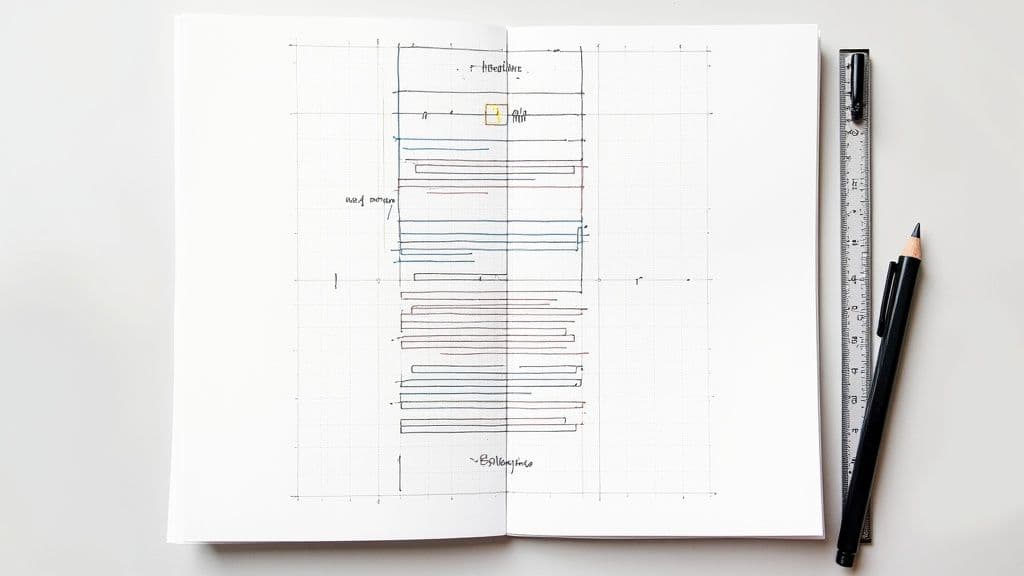
Think of a standard press release format as a universal language spoken between you and the media. It’s a predictable structure—headline, dateline, intro, body, boilerplate, and contact info—that journalists are trained to scan for the good stuff. Nailing this blueprint is your first, and most important, step to getting noticed.
Why a Standard Press Release Structure Matters
A press release isn't just a document; it's a carefully drawn blueprint for a story. Just like an architect’s plan tells a construction crew exactly how to build a house, a well-structured press release gives a journalist everything they need to build a news story. Each component has a specific job to do, and when they all work together, they create a clear, compelling narrative that a busy reporter can grasp in seconds.
This isn't about being stuffy or following old-school rules for the sake of it. It’s about efficiency and credibility. Journalists are flooded with hundreds of pitches every single day. A familiar structure lets them instantly find the crucial information—the who, what, when, where, and why—without having to dig. When you follow this industry-standard anatomy, you're sending a clear signal: you understand how their world works and you respect their time. That alone sets a professional tone.
The Blueprint Analogy
Let's imagine you're building this story from the ground up:
- The Headline is your foundation: It has to be strong enough to support the entire story and grab attention immediately.
- The Lead Paragraph is the framework: It quickly outlines the most critical parts of the story, giving it shape and purpose.
- The Body Paragraphs are the walls and rooms: They add the details, context, and supporting evidence—like data and quotes—that flesh out the narrative.
- The Boilerplate is the address on the mailbox: It clearly identifies who you are, providing essential background on your company.
- Contact Information is the key to the front door: It gives journalists the access they need to unlock more information.
If you skimp on any part of this blueprint, the whole structure can wobble. A weak headline means no one even bothers to look at the house. A confusing body means they get lost inside. And without contact info, they can't ask you for a tour.
What Journalists Actually Want Today
The modern media world moves fast, and it demands clarity and brevity above all else. The press release has adapted, becoming much more streamlined. The sweet spot for length is now around 400 words.
This isn't just a hunch; it's driven by what journalists prefer. One survey revealed that 72% of reporters still see press releases as their go-to source for PR content, but they need that information to be concise and laser-focused. You can dig into more PR statistics to see how these trends are shaping the industry. The takeaway is clear: mastering the fundamental press release structure is non-negotiable.
A press release is your first, and often only, chance to make an impression on a journalist. A sloppy or unconventional format is an immediate red flag that suggests the news itself might be just as disorganized.
Before we break down each piece in detail, let’s get a bird's-eye view of the essential anatomy of a press release.
Anatomy of a Press Release At a Glance
This table sums up the core components of a standard press release, what each part is for, and how to get it right.
| Component | Purpose | Key Best Practice |
|---|---|---|
| Headline | To capture attention and summarize the core news in one line. | Be specific, newsworthy, and use action-oriented language. |
| Dateline & Lead | To provide location/date and immediately answer the 5 Ws. | Place the most critical information in the first 25 words. |
| Body Paragraphs | To expand on the lead with supporting details, context, and data. | Build the narrative logically and keep paragraphs short. |
| Quotes | To add a human element, perspective, and credibility. | Use quotes to provide insight, not just repeat information. |
| Boilerplate | To provide a standard, concise overview of your company. | Keep it consistent across all releases, around 50-100 words. |
| Contact Info | To give journalists a clear point of contact for follow-up. | Include a name, title, email, and phone number. |
Getting these elements right turns a simple announcement into a powerful tool for earning media attention. Now, let's dive into each one.
Nailing the Headline and Opening Paragraph
Think of your press release headline as the make-or-break moment. It’s the subject line of an email popping into a swamped journalist's inbox. If it doesn't instantly scream "this is newsworthy," your entire release gets archived without a second thought. It's the gatekeeper to your whole story.
This is your one shot to boil down your entire announcement into a single, punchy statement. Your goal isn't to be mysterious or cute; it's to be brutally clear. A journalist should be able to look at your headline and immediately have a good idea of what their own article's headline could be. The best ones are active, specific, and answer the "So what?" question in about 10-20 words.
The Art of the Can't-Ignore Headline
A great headline is a masterclass in clarity. It cuts through the corporate fluff—no "synergistic partnerships" here—and gets right to the point with strong verbs and tangible details. For instance, "Company X Announces New Software" is forgettable. But what about this? "Tech Startup LaunchPad Unveils AI-Powered Platform to Cut Project Timelines by 40%."
See the difference? The second version actually tells a story. It has:
- The Who: Tech Startup LaunchPad
- The What: An AI-powered platform
- The Why: It cuts project timelines by a massive 40%
This structure gives a reporter immediate context and a hard number to latch onto—which is exactly what they're scanning for. If you want to see this in action, checking out some solid press release headline examples can really help these principles click.
As the image below shows, everything in a press release flows from the top down. The headline is your first and most powerful hook.
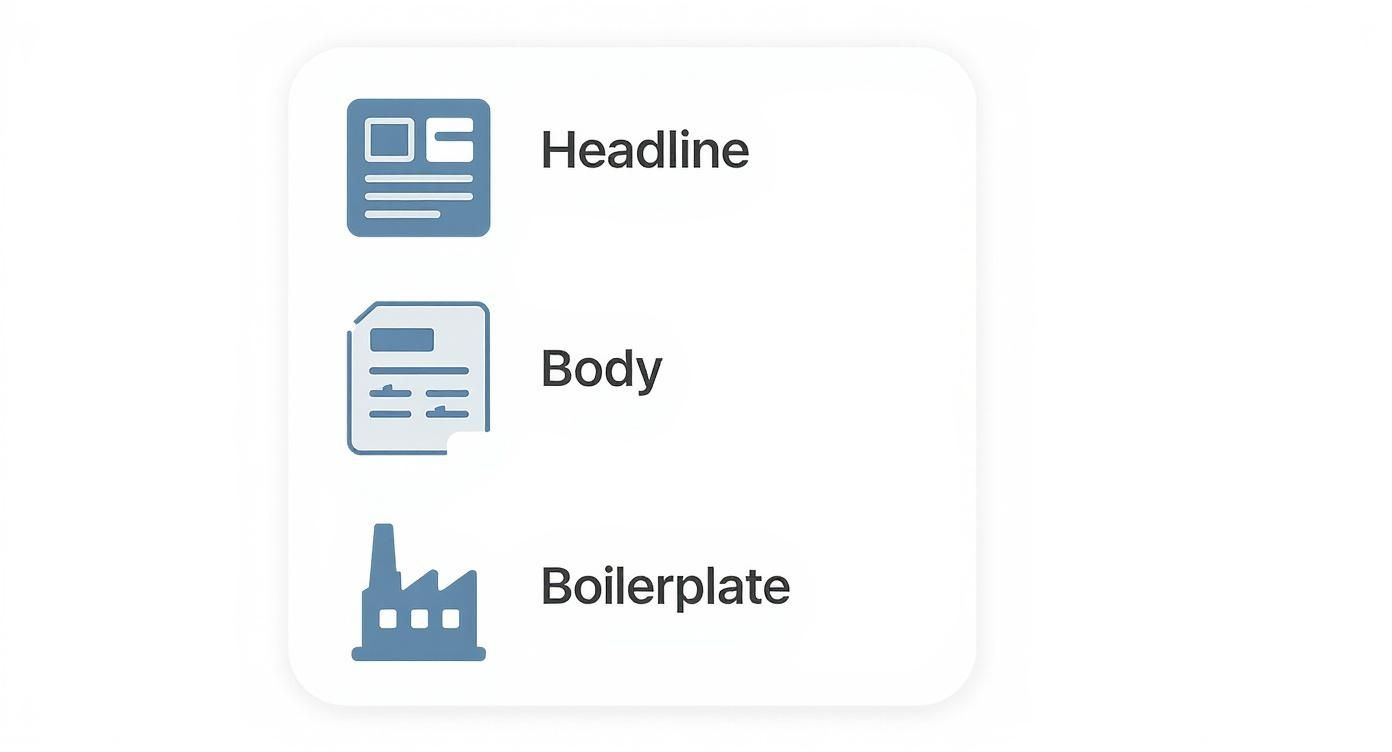
This visual drives home the point: your headline leads the charge, the body fills in the details, and the boilerplate provides the foundational who-we-are.
Mastering the Lead Paragraph
Okay, your headline worked. You've got their attention. Now the opening paragraph—what we call the lead—has to deliver on that promise. Fast. This isn't the place for a slow-burn narrative. Your very first sentence needs to summarize the entire announcement.
Think of the lead paragraph as the entire story in a nutshell. If a journalist only reads this single paragraph, they should have everything they need to understand the core news.
Your mission here is to knock out the classic "5 Ws" as quickly and cleanly as you can:
- Who: Who is this story about?
- What: What's the actual news here? (A new product, a funding round, a key hire?)
- When: When is this happening or when did it just happen?
- Where: Where is this all taking place? (The city, the market?)
- Why: Why does this news even matter?
The 5 Ws in Action
Let's see this in practice. Imagine a company launching a green-tech product.
Weak Lead: Evergreen Innovations is excited to announce the latest addition to its product family. After years of research and development, we are proud to introduce a new solution designed for modern consumers.
This is pure fluff. It tells the reader absolutely nothing.
Strong Lead: SAN FRANCISCO, CA – October 26, 2024 – Evergreen Innovations, a leader in sustainable consumer goods, today launched the "AquaPure," a home water filtration system that eliminates 99.9% of microplastics using a plant-based filter. The new product addresses growing consumer demand for healthier drinking water and a reduced environmental footprint.
Now that's a lead. It immediately nails the 5 Ws:
- Who: Evergreen Innovations
- What: Launched the "AquaPure" water filter
- When: October 26, 2024
- Where: San Francisco, CA
- Why: It tackles microplastics and meets the demand for sustainable products.
By front-loading your release with the most important facts, you give journalists everything they need to justify running your story, right from the very first sentence.
Building the Narrative with Body Paragraphs and Quotes
If your headline and lead paragraph are the hook, the body paragraphs are where you start reeling the journalist in. This is the heart of your press release, the place where you build on your initial promise by adding the depth, context, and supporting details that turn a simple announcement into a genuine story.
Think of it like this: your headline and lead are the architectural sketch. The body is where you start furnishing the rooms and giving the structure a purpose.

Adding Credibility and Context
The body is your chance to preemptively answer a journalist's questions. Don't just announce a new product; explain the real-world problem it solves for people. Don't just say you've formed a partnership; detail what the collaboration will actually achieve for your customers or the industry.
To make your story believable, you need to back it up with facts. Instead of saying your new software is “fast,” you should say it “reduces processing time by 30% compared to the industry standard.” Hard data always trumps vague, subjective claims.
This is also where your word choice matters immensely. Journalists are allergic to salesy buzzwords like 'unique,' 'cutting-edge,' or 'exciting'—they often see them as red flags. The trend is moving away from hype and toward more authentic, visually supported communication, a shift you can explore further in these press release statistics.
The Strategic Power of a Good Quote
Quotes are easily one of the most powerful—and most frequently botched—parts of a press release. A weak quote is just filler, repeating information you've already stated. A strong quote, on the other hand, injects personality, perspective, and a human touch that pure data can't deliver.
"A quote should offer an opinion or an insight, not just regurgitate facts. It’s your chance to give your company a voice and share the 'why' behind the 'what' in a way that feels authentic and memorable."
A quote from a key figure, like your CEO or a product manager, needs to convey passion and vision. It's their opportunity to speak directly to the journalist, offering a peek behind the curtain at the strategic thinking that drove the news. Please, avoid generic corporate-speak at all costs.
Weak Quote:
"We are thrilled to launch our new product. This product will serve our customers well."
Strong Quote:
"We saw a major gap in how creative teams were collaborating on remote projects, leading to burnout and missed deadlines," said Jane Doe, CEO of InnovateCorp. "We built this platform not just to streamline workflow, but to give teams back the creative energy that gets lost in administrative chaos."
See the difference? The second one tells a mini-story. It identifies a pain point and frames the solution with a clear mission. It's something a journalist can actually lift and use in their article.
Structuring Your Body for Maximum Impact
To keep your reader engaged, structure your body paragraphs like a mini "inverted pyramid" inside the larger one. The most critical supporting details go first, followed by information of secondary importance.
Here’s a simple framework to follow:
- Paragraph 2 (First Body Paragraph): Get right to it. Expand on the hook from your lead paragraph with the most important context or data.
- Paragraph 3: Drop in that powerful quote from a key executive that adds color and perspective.
- Paragraph 4: Layer in additional details. This could be secondary features, relevant market stats, or more background on the problem you're solving.
- Paragraph 5 (Optional but Recommended): Add a second quote from a partner, a happy client, or an industry expert. This provides third-party validation and adds another layer of credibility.
Following this flow creates a narrative that’s easy to scan and digest. You're giving journalists exactly what they need, in the order they need it, to see the value in your story. This thoughtful approach to the press release structure is what separates a release that gets ignored from one that gets published.
Finishing Strong with Your Boilerplate and Contact Info
You've nailed the headline, crafted a compelling story, and backed it up with a great quote. Now it’s time to bring it home. The final pieces of your press release—the boilerplate and media contact info—are what ground your story in reality, anchoring your credibility and giving journalists a clear path to learn more.
Think of it like this: the body of your release is the exciting conversation, but these last two sections are the firm handshake and the exchange of business cards. They signal professionalism and open the door for a real relationship.
Perfecting Your Company Boilerplate
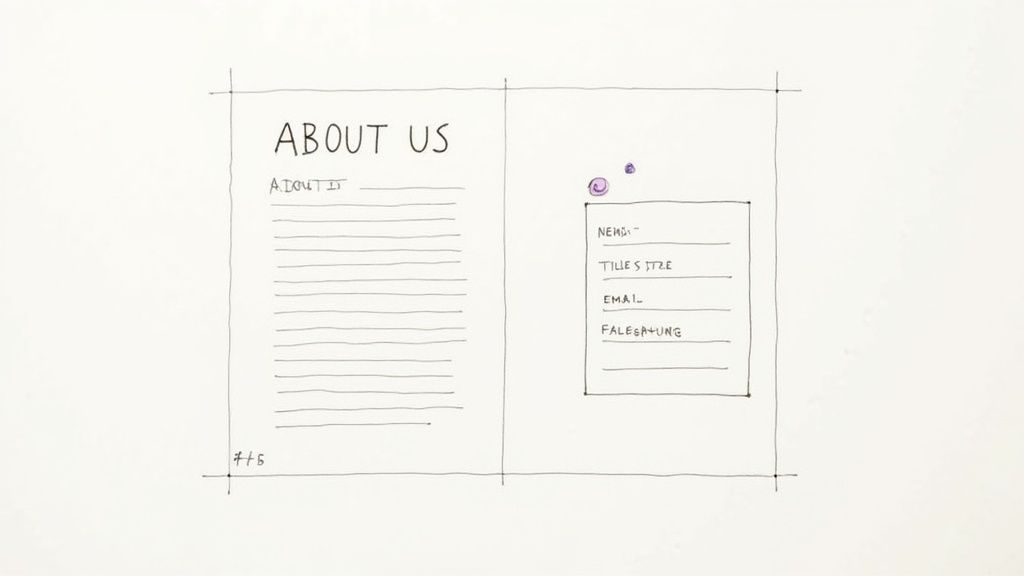
Your boilerplate is your company's official "About Us" blurb. It’s a standardized paragraph that you’ll use at the end of every single press release. Its job isn't to break news; it's to provide a quick, consistent snapshot of who you are, what you do, and why you matter.
Keep it tight—no more than 50-100 words. This is your elevator pitch in print, designed to instantly orient a busy journalist. For a much deeper look at getting this just right, check out our guide on what a boilerplate is in a press release.
A well-written boilerplate acts as your company’s calling card. It should be instantly recognizable and consistent across all communications, reinforcing your brand identity every time a journalist encounters it.
Here’s a simple formula that works every time:
- Sentence 1: Start with your company's full name and explain what you do in plain English. No jargon.
- Sentence 2: Briefly touch on your mission or the specific audience you help. What problem are you solving?
- Sentence 3: Drop in a key differentiator or a big win, like "trusted by over 50,000 users" or "backed by top-tier investors."
- Sentence 4: Always end with a direct link to your website’s homepage.
Providing Clear Media Contact Information
This part is absolutely non-negotiable. If a journalist is intrigued by your story, they need to know who to call or email right now. Hiding this information is like locking the door after inviting someone over—it kills the opportunity instantly.
Label this section clearly as "Media Contact" or "Press Contact" and provide the essential details for your go-to person:
- Name: The full name of your primary media contact.
- Title: Their role (e.g., Director of Communications, Founder, PR Manager).
- Email Address: A direct email address. Avoid generic "info@" or "press@" inboxes.
- Phone Number: A direct line or cell number is best for time-sensitive questions.
Make sure the person you list is actually ready and able to talk to the press. Nothing torpedoes a potential story faster than a slow, unhelpful, or unavailable contact.
Finally, to signal the end of the document, use the classic journalistic sign-off: three centered pound signs (###). It’s a simple, old-school trick that tells editors and reporters, "That's all, folks."
Adapting the Structure for Different Announcements
Think of the standard press release format as a great starting point—a reliable blueprint. But the real art is knowing when and how to remodel that blueprint to tell a specific story. You wouldn't use the same language to announce a new product as you would a major funding round, even if the core sections are the same.
This is what separates a generic, forgettable announcement from a sharp, strategic piece of communication. It’s all about shifting the focus of each element—the headline, the lead paragraph, the quotes—to instantly highlight what makes this piece of news so important. You have to guide the journalist to the heart of the story immediately, and that heart changes with every announcement.
Structuring for a New Product Launch
When you’re launching a product, the entire story revolves around the customer. Your press release should be built from the ground up to answer one simple question for the reader: "What problem does this solve for me?" The spotlight has to be on the benefits, not just a dry list of features.
Your headline needs to scream value. Instead of a flat "InnovateCo Launches New CRM Platform," try something like, "InnovateCo's New CRM Cuts Sales Admin Time by 50%." Your opening paragraph must then immediately explain how it does that, introducing the product and its core promise. From there, the body paragraphs can dig into specific use cases, and the best quotes will come from a product leader or CEO who can speak with real passion about solving the customer's pain point.
Framework for a Major Funding Round
A funding announcement completely shifts the narrative from the customer to the company’s future. The story here is all about momentum, investor confidence, and the massive vision you’re building. Journalists on this beat care less about product specs and more about the market opportunity and whether your team can actually pull it off.
The headline has to get straight to the point: state the amount raised and who led the round (e.g., "AI Startup QuantumLeap Secures $25 Million Series A Led by Venture Capital Firm"). The first paragraph should follow up with the key details: the total funding amount, the specific round, the key investors, and exactly what you’ll use the money for—like expanding into new markets or doubling down on R&D. For quotes, you'll want one from your CEO talking about the big picture and another from the lead investor validating why they believe in your company.
Announcing a Strategic Partnership
When two companies team up, the story is all about synergy. The press release has to clearly explain what this collaboration can achieve that neither company could do on its own. The news hook is the combined strength and the new value you’re creating for a shared audience.
Your headline should name both companies and the main benefit of the partnership: "TechCorp and DataStream Partner to Deliver Real-Time Analytics to Enterprise Clients." The opening paragraph then needs to nail the "why" behind the deal and the immediate impact it will have on customers or the industry.
The most effective partnership releases feature quotes from leaders at both organizations. This shows mutual excitement and presents a unified front, which adds a ton of credibility to the announcement.
The body of the release should then get into the nitty-gritty of the collaboration—what each company is bringing to the table and what the joint offering actually looks like.
Press Release Structure Variations
To really see how these approaches differ, it helps to put them side-by-side. Here’s a quick breakdown of how the focus of each key element changes depending on the announcement.
| Announcement Type | Headline Focus | Lead Paragraph Key Info | Primary Quote Source |
|---|---|---|---|
| Product Launch | Customer Benefit & Problem Solved | What the product is, who it's for, and its main value proposition. | CEO or Head of Product, focused on the customer's pain point. |
| Funding Round | Amount Raised & Lead Investor | Total funding, round details, and planned use of capital. | CEO (vision) and Lead Investor (validation). |
| Strategic Partnership | Both Company Names & Joint Value | The "why" behind the partnership and its impact on the market. | Executives from both companies, highlighting mutual goals. |
As you can see, a few intentional shifts in focus can completely reframe your story for the right audience.
And don’t forget to bring your announcement to life with visuals. Around 63% of companies now include multimedia in their press releases, and for good reason—releases with multiple images can get up to six times more engagement. Timing also matters; Thursday is often considered the best day for distribution to catch a journalist's eye before the weekend. You can discover more insights about press release engagement to help fine-tune your strategy.
Mastering how to adapt your press release structure is a powerful skill that makes sure your news always lands with the right message for the right people.
Optimizing Your Release for Digital and SEO
The classic press release format is a great starting point, but it's not enough anymore. In today's world, your release has to work for Google just as hard as it works for journalists. A press release that just sits in a reporter's inbox is a huge missed opportunity. One that ranks in search results, however, can keep building your brand's authority and driving traffic for months.
Think of your press release as a permanent piece of content living on the web. The basic structure we've discussed still holds, but every single part needs to be tweaked for online visibility. The goal is to make your news easy for everyone to find, not just the handful of reporters on your media list.
Weaving in Keywords and Strategic Links
Good SEO for a press release begins with keywords. Figure out what terms your ideal customer or reader would type into Google to find news like yours. Then, work those phrases naturally into your headline, your first paragraph, and throughout the body of the release. This is how you signal to search engines what your announcement is all about.
Links are just as crucial. Everyone puts a link to their homepage in the boilerplate, but you can be much smarter about it. Link specific, relevant phrases in the body copy directly to product pages, detailed blog posts, or new case studies on your website. This gives journalists a quick path to more info and also passes along some SEO authority to those pages, helping your entire website's search performance.
The modern press release structure is evolving to prioritize digitization and visual appeal, catering directly to the fast-paced nature of digital media and social networks. As you build your release, remember that tools for AI and data analytics are now being used to optimize distribution and track impact in real time. For more on this trend, explore the latest research on digital PR strategies.
The Power of Multimedia and Readability
Let’s be honest: a wall of text is a recipe for being ignored. When your press release lives online, you have to use more than just words to grab and hold someone's attention. Adding multimedia isn't a "nice-to-have" anymore; it's essential if you want people to actually engage with your news.
- High-Resolution Images: Always include professional photos of your product, your team, or your event in action.
- Infographics: Have a lot of data? Turn it into a clean, easy-to-understand infographic that people will want to share.
- Video: Embed or link to a product demo, a short interview with your CEO, or an animated explainer video.
Beyond the visuals, how you format your text is a game-changer. Keep your paragraphs short and sweet—1 to 3 sentences is a good rule of thumb. Use bullet points and clear subheadings to break up the text and guide the reader’s eye. This scannable approach makes your news easy to absorb on any screen, from a desktop monitor to a smartphone.
For a deeper dive into making your release work for search engines, check out these guides on SEO content optimization and how to build a truly search engine optimized press release. Mastering these elements is what separates a press release that gets deleted from one that gets discovered.
Got Questions? Let's Talk Press Release Structure
Even with a solid template in hand, you’re bound to hit a few snags when finalizing your announcement. It happens to everyone. Let's walk through some of the most common questions that pop up, so you can send your release out with total confidence.
Think of this as your last-minute checklist before your story goes live. We’re just reinforcing the fundamentals to make sure every part of your release works hard for you.
What’s the Sweet Spot for Press Release Length?
Keep it between 300 and 500 words. That’s the magic number. It’s long enough to tell your story but short enough to respect a journalist’s packed schedule.
Go any longer, and you risk your key message getting lost in the noise—or worse, your release getting ignored altogether. Be direct, be clear, and get straight to the good stuff.
How Many Quotes is Too Many?
One or two strong quotes are perfect. You're looking for a dash of personality and perspective, not a wall of text.
A quote from your CEO offers vision, while one from a key partner or a happy customer adds that crucial outside validation. This combination gives your story depth without bogging down the facts.
Should I Bother with Images or Videos?
Absolutely, yes. In today's media world, a press release without visuals feels incomplete. High-resolution images, a link to a short video, or a compelling infographic can dramatically increase your chances of getting picked up.
Just make sure everything is hosted somewhere easy to access and download. The last thing a journalist on a deadline wants to do is hunt for your assets.
How Should I Format My Press Release for Email?
When you’re pitching via email, you need to make it incredibly easy for the journalist to say "yes." The best way to do this is to cover all your bases.
Here's a simple, three-step process that works every time:
- Paste the Plain Text: Drop the full text of your release right into the email body. This is non-negotiable. It allows a reporter to scan your news instantly without opening anything.
- Attach a Clean Copy: For those who prefer a more formal document, attach a well-formatted PDF or Word doc.
- Link to Your Newsroom: Always include a link back to where the press release lives on your company’s website.
This approach lets every journalist engage with your story in the way that works best for them, which seriously improves your odds of getting coverage.
Ready to get your story in front of the right journalists without the guesswork? PressBeat uses AI to build your media list, craft personalized pitches, and guarantee publication in high-authority outlets. See how our platform can land you predictable press coverage at https://pressbeat.io.