
Public Relations Plans Template: Proven Tactics for High-Value Press Coverage
February 3, 2026
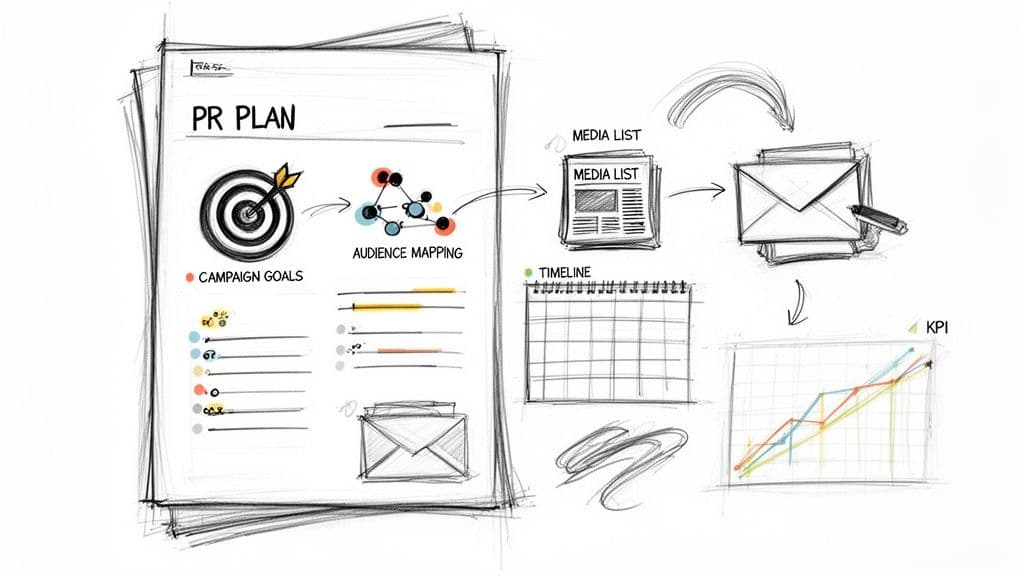
Just sending out a press release and hoping for the best is a surefire way to get ignored. The media world is incredibly noisy, and you need a solid game plan to cut through it. A good public relations plans template is that roadmap, giving your startup a clear path to landing consistent, high-impact media coverage.
Why Your Startup Needs a Real PR Strategy, Not Just Press Releases
Let's get real for a second: random acts of PR are a waste of time. Firing off a generic press release to a massive, untargeted media list is like shouting into a hurricane. It's a classic startup mistake that burns time and money, and in the end, your brand remains invisible.
Journalists get hundreds of pitches every single day. A structured public relations plan is what separates the startups that get noticed from the ones that get deleted without a second thought. This isn't just about sending emails; it’s about building a story and telling it with surgical precision.
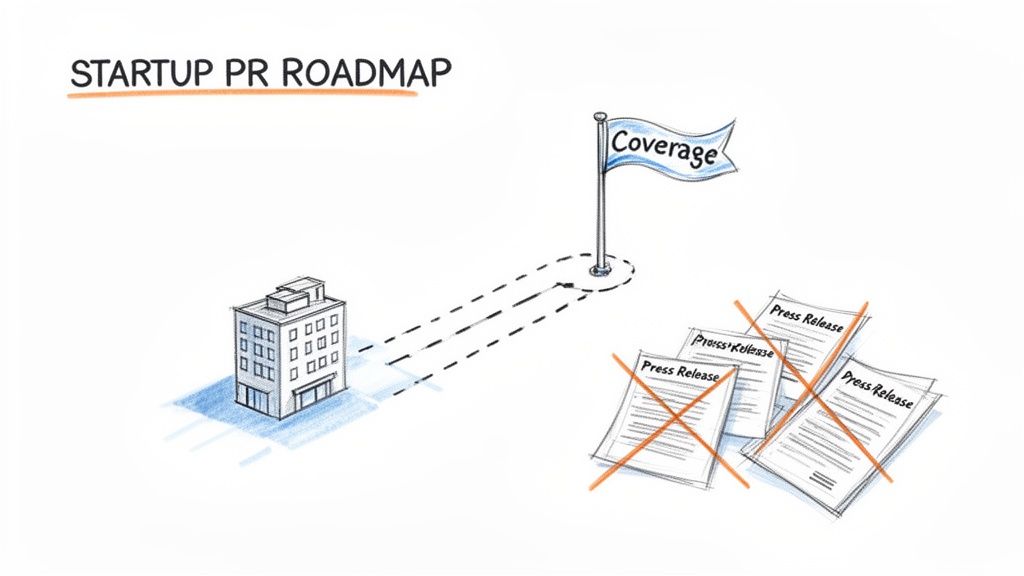
Moving Beyond Random Tactics
A strategic plan makes you stop and think about your goals before you even draft a pitch. It’s the difference between throwing darts in a dark room and aiming for the bullseye with the lights on. Without a plan, your efforts are scattered, and it's impossible to know what’s actually moving the needle.
A well-crafted public relations plan helps you:
- Define Success: Tie your PR work to real business goals, like grabbing investor attention, boosting sign-ups, or simply building credibility in your industry.
- Target Precisely: Figure out exactly which journalists and outlets your ideal customers read and trust. This gets your story in front of the right eyeballs.
- Craft a Compelling Narrative: Nail down a core message that clicks with both the media and your audience, making your startup memorable.
- Execute Consistently: Build a timeline with repeatable actions to create momentum over time, instead of just banking on one-off announcements.
The Power of a Proven Framework
Think of a public relations plans template as the scaffolding for your strategy. It gives you a structure to organize your thoughts, set clear objectives, and map out every single step of a campaign. It's what lets you be proactive, not just constantly putting out fires.
This is why modern PR platforms like PressBeat are built around this kind of strategic thinking. By focusing on a planned method, startups can hit up high-authority publications with personalized pitches that have a much higher chance of success. It takes the guesswork out of the equation and gives you a reliable system for getting press.
A documented strategy forces you to think through every angle, from your core message to your follow-up cadence. It's the foundational work that ensures your outreach is intentional and effective, preventing you from becoming just another piece of inbox clutter.
At the end of the day, a real PR strategy turns your outreach from a gamble into a calculated investment. It puts you in control of your brand’s narrative and lays out a clear path to getting the kind of media attention that can seriously accelerate your startup’s growth. It's time to stop just sending press releases and start building a real public relations machine.
Building Your PR Foundation with Clear Goals and Audiences
Before you even think about writing a pitch, you need to lay the groundwork. Great PR isn't about throwing things at the wall to see what sticks; it's a strategic game built on knowing exactly what you want to achieve and who you need to reach. This means getting real about your goals and moving past fuzzy metrics like "impressions."
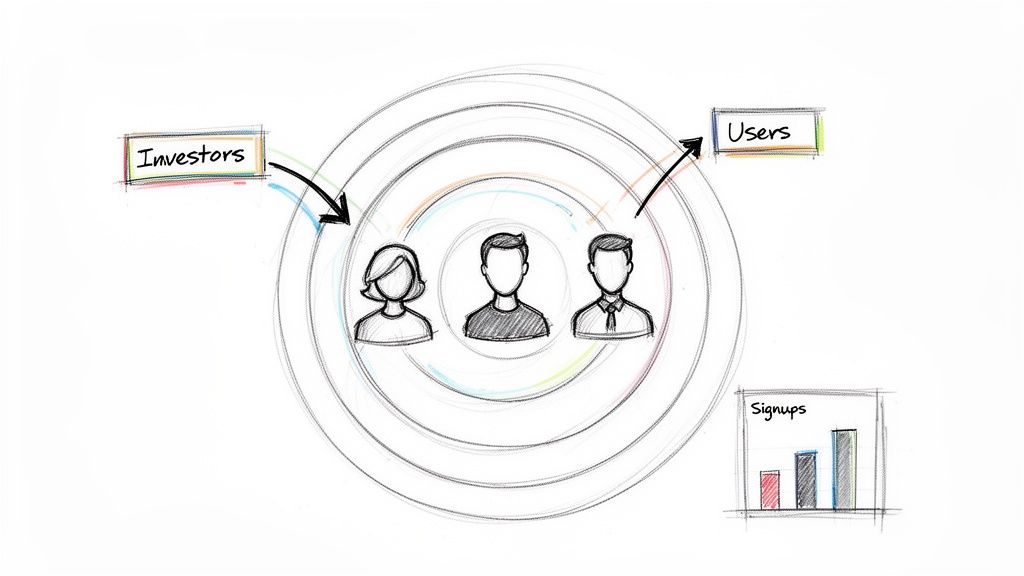
Let's be honest: are you trying to get on the radar of investors for your next funding round? Or is the immediate need to drive qualified leads and get more people to sign up for your product? Each of these goals requires a completely different playbook—a different story, a different angle, and a different list of journalists to contact. Without that clarity, you're just making noise.
Defining Goals That Drive Business Outcomes
Your PR goals should be a direct reflection of your company's most important objectives. The trick is to make them specific, measurable, achievable, relevant, and time-bound (yep, the classic SMART framework).
Imagine a B2B SaaS startup gearing up to announce its Series A. A weak goal is "get more press." A powerful, business-driven goal looks more like this:
- Objective: Land coverage in 3 top-tier financial and tech publications like TechCrunch, Axios Pro, or Forbes within one month of the announcement.
- Key Result: Generate at least 15 inbound inquiries from verified VC firms that came directly from that media coverage.
- Key Result: Boost referral traffic from news sites by 40% in the quarter after the announcement.
See the difference? This approach turns PR from a line item on the budget into a measurable engine for growth. It’s a shift many are still making. A recent report showed that while over 90% of PR teams use AI, there's a 40% lag in tying their work to actual business outcomes. Many are still just counting clips instead of conversions.
Identifying and Understanding Your Target Audiences
With your goals locked in, it's time to figure out who you're talking to. The answer is never, ever "everyone." A focused message aimed at the right people will always outperform a generic blast. And remember, your audience isn't just your end-user. It's anyone who can help your business succeed.
You need to map out and prioritize these key groups. They often include:
- Potential Investors: The VCs, angel investors, and financial analysts who live and breathe industry news.
- Potential Customers: The specific decision-makers inside companies who have the authority to buy what you're selling.
- Industry Influencers: The respected journalists, bloggers, and key opinion leaders everyone in your niche listens to.
- Potential Talent: The rockstar engineers, marketers, and leaders you need to recruit to scale your company.
Don't just make a list of audiences; get inside their heads. What do they read every morning? Who do they trust? What problems are keeping them up at night? Answering these questions is how you craft a message that actually connects.
Creating Actionable Audience Personas
To make these groups tangible, you need to build out detailed audience personas. A persona is a semi-fictional profile of your ideal audience member, cobbled together from market research and real-world data. To really nail your messaging, you need to understand who you're talking to. Learning how to create effective buyer personas is a crucial step that guides everything from your pitch angle to your media list.
For that B2B SaaS startup, a persona for an investor might be:
- Name: "Venture Capitalist Victor"
- Role: Partner at a mid-sized VC firm that focuses on enterprise software.
- Media Habits: Reads the Term Sheet newsletter daily, skims TechCrunch for funding news, and never misses an episode of the "Acquired" podcast.
- Pain Points: Drowning in pitch decks, trying to find the few startups with genuine product-market fit and a solid competitive edge.
- What He Cares About: Market size, founder experience, real traction metrics, and a compelling story.
This level of detail is gold. It tells you exactly where to pitch your story (financial newsletters, tech publications) and what angle to lead with (focus on your market traction and the team's deep expertise). For a deeper dive into this foundational work, check out our guide on the essentials of public relations planning. Getting this part right—clear goals and well-defined audiences—is the single most important thing you can do for your PR success.
Finding Your Story: How to Craft a Message That Lands Press
You've set your goals and know who you're talking to. Now comes the part where most startups get it wrong: building a story that reporters actually care about. It's so easy to get wrapped up in what your product does, but journalists (and their readers) care about what it means.
A killer message isn't just a laundry list of features. It's a real story that answers the one question every editor has: "So what?" Your core message needs to be simple, stick in people's minds, and tie what you're doing to a much bigger conversation.
Nailing Your Core Message
Think of your core message as the single idea you want someone to remember, even if they forget all the details. It's the common thread weaving through every press release, email pitch, and interview you do.
A simple but incredibly effective way to build this is the Problem + Your Solution = Impact formula.
First, paint a clear picture of the specific, nagging problem your startup exists to solve. Then, position your company as the only one with the answer. And finally, show the real, tangible change your solution creates for people.
Let’s run through an example. Picture a new fintech startup using AI to fight fraud.
- A weak message sounds like this: "We use an AI algorithm to detect fraud." (That’s a feature, not a story.)
- A strong message sounds like this: "Every year, small e-commerce businesses lose over $20 billion to sophisticated fraud rings (Problem). For the first time, our new AI tool gives them the same firepower as the big corporations (Solution). This levels the playing field, helping Main Street businesses not just survive, but thrive (Impact)."
See the difference? The second one has stakes. It has a hero (the small business owner) and a clear resolution. It’s a story.
Finding Angles That Are Actually Newsworthy
Okay, you've got your core message. Now you need to find fresh ways to tell it. A product launch is a great hook, but it's a one-time thing. To get consistent press, you have to start thinking like a journalist and find news where others don't.
Here are a few tried-and-true ways to uncover newsworthy angles:
- Turn Your Data into a Headline: Are you sitting on unique data about how your customers behave or what's happening in your industry? Package it up. A project management tool, for instance, could release a report on "The Productivity Shock of Asynchronous Work." This instantly positions you as an expert.
- Ride a Bigger Wave: What’s the big conversation everyone is having right now? Connect your company's mission to that trend. A startup making sustainable packaging could time its launch with new data on plastic waste, making their news feel urgent and important.
- Tell a Customer’s Story: Let’s be honest, sometimes the best way to show your impact is through someone you’ve helped. A powerful case study about a customer who got amazing results with your product is often far more convincing than any spec sheet.
The real magic happens when you find the sweet spot between what your company is doing and what people are already talking about. Don’t just announce things; connect your news to a larger narrative that people genuinely find interesting.
For a deeper dive on this, our guide on what makes a story newsworthy is packed with insights from the trenches.
Matching Campaign Angles to Business Goals
Choosing the right story angle is a strategic decision. The hook you'd use to get an investor's attention is completely different from one designed to get customers to sign up. A smart PR plan maps specific angles to business goals.
Think about what each audience truly cares about. An investor is looking for market disruption and a massive potential return. A customer just wants to know if you can solve their problem.
This table breaks down how to choose the right PR angle for your startup's goals.
| Matching Campaign Angles to Business Goals | |||
|---|---|---|---|
| Campaign Angle | Primary Business Goal | Best For | Example Pitch Hook |
| Data-Driven Report | Build Authority & Credibility | B2B SaaS, Fintech | "Our new data shows a 300% surge in a key industry trend, and we know what's coming next." |
| Customer Success Story | Drive Sales & Sign-ups | E-commerce, Consumer Tech | "How a small business owner doubled her revenue in 60 days with one simple change." |
| Funding Announcement | Attract Investor Interest | All VC-backed Startups | "This startup just closed a $10M round to go after a billion-dollar problem everyone else is ignoring." |
| Founder Profile | Build Brand Trust & Vision | Mission-Driven Companies | "Meet the founder who left a top job at Google to solve a personal problem that affects millions." |
By carefully picking your angle, you make sure your message doesn't just get heard—it gets you the results you need. This is how PR stops being just about "getting your name out there" and becomes a real engine for growth.
Putting Your Media Outreach Plan Into Action
Alright, this is where the rubber meets the road. All that strategic planning around your goals and messages is about to get tested in the real world of journalism. Executing an outreach plan isn't about firing off emails and hoping for the best; it's about building genuine connections that get you the kind of coverage that actually moves the needle.
First things first: you need a solid media list. And I mean solid. The old-school approach of scraping a thousand generic emails is a surefire way to get ignored. In today's media world, a hyper-targeted list of 20 perfect contacts will smoke a list of 200 irrelevant ones every single time. Your mission is to find the specific journalists who aren't just in your industry but are actively looking for a story exactly like yours.
Building Your Hyper-Targeted Media List
Start by figuring out which publications your ideal customers and investors actually read. Don't just chase big names for vanity's sake; focus on the outlets that carry real weight with the people you need to reach. Once you've got a list of 5-10 dream publications, the real detective work begins.
Use the search bar on each publication's website. Type in keywords related to what your company does. Who's writing about the problems you solve? Who's covering your competitors? These are your people.
From there, you can get a little more creative to find the right contacts:
- Listen to the Social Chatter: Follow industry hashtags on platforms like X (formerly Twitter) and LinkedIn. You'll quickly see which journalists are part of the conversation and what kinds of stories grab their attention.
- Check Out the Competition: Use a PR tool or even just a simple Google News search to see who has covered your competitors in the last six months. These reporters have already proven they're interested in your space.
- Dig Into the Beats: Look past broad keywords. A reporter’s “beat” is their specialty. You don’t want a generic "tech" reporter; you want the journalist who specifically covers "B2B SaaS" or "fintech for millennials."
Think of your media list as a living, breathing document, not a static spreadsheet. You should be tracking who you've pitched, when you followed up, and any notes about their interests. This is how a simple list becomes a powerful relationship-building tool.
This detailed approach makes sure your pitch arrives as a welcome tip, not another piece of inbox clutter. With newsrooms shrinking, journalists are relying more on trusted sources. This means personalized, thoughtful outreach is no longer a "nice-to-have"—it's essential. Mass emails just don't cut it anymore, a reality supported by the latest future PR trends that all point toward deeper relationship-building.
Mapping Your Outreach Timeline and Cadence
With your list of contacts ready, it's time to plan your attack. Good outreach is a marathon, not a sprint. One of the biggest mistakes I see founders make is sending a single email, hearing crickets, and giving up. The truth is, the follow-up is often where the magic happens.
A standard, effective outreach cadence might look something like this:
- Initial Pitch (Day 1): Send your personalized email. Keep it short and sweet with a killer subject line.
- First Follow-Up (Day 4): This is just a simple, polite "bump." A quick, "Just wanted to make sure this didn't get buried" is perfect.
- Second Follow-Up (Day 8): Add some value here. Maybe link to a new industry report or a relevant article and briefly explain how it connects to your original story.
- Final Attempt (Day 14): Time for a courteous close. Something like, "I'll assume the timing isn't quite right, but please feel free to reach out if this becomes a fit for you down the road."
This structure is persistent without being a pain. It shows you respect the journalist's time while giving your story multiple shots to land on their radar.
This whole process is about turning your core idea into a story that a journalist can't wait to tell.
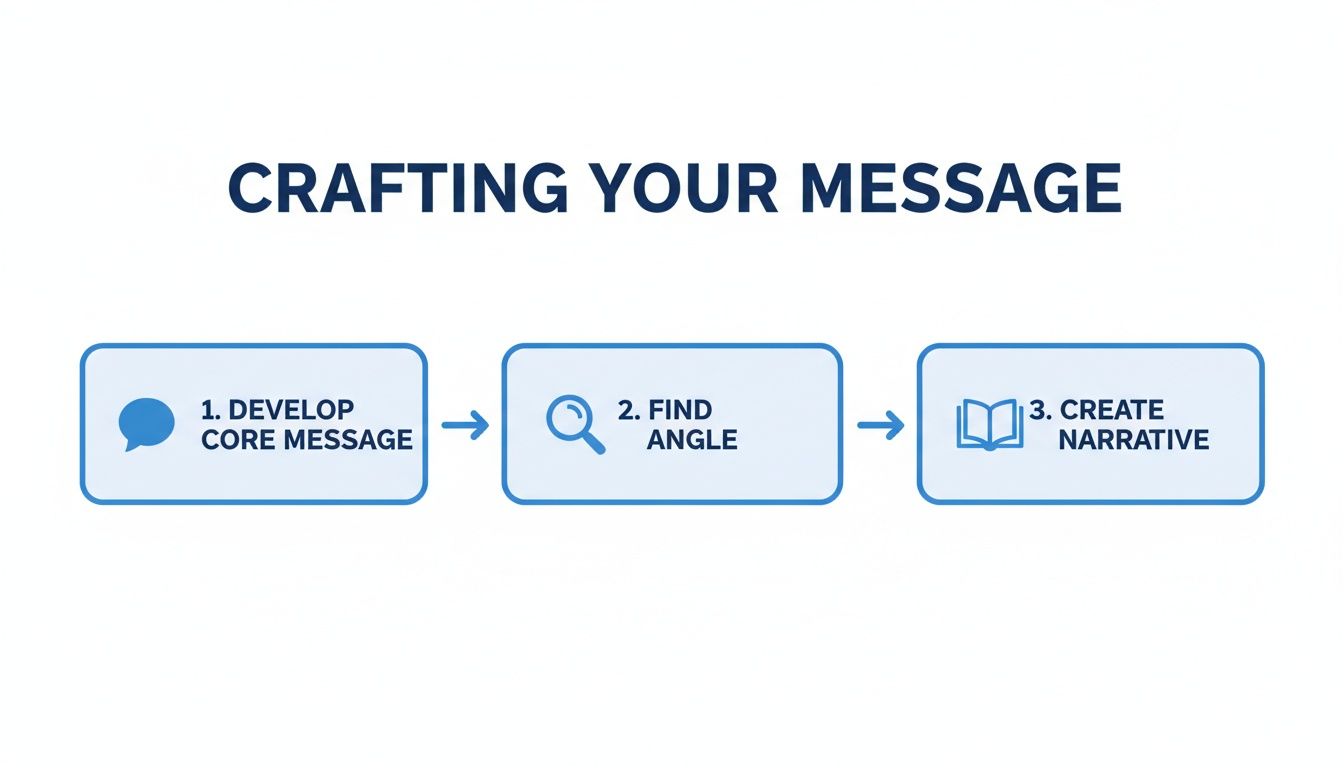
This flow—from a core message to a specific angle and finally a full narrative—is what separates a company announcement from a genuinely newsworthy story.
Battle-Tested Pitch Templates You Can Adapt
While every single pitch needs to be personalized, you don't have to reinvent the wheel every time. Starting with a proven structure from a public relations plans template can save you a ton of time and make sure you're hitting all the right notes.
Scenario 1: The Cold Introduction
- Subject: Story Idea: [Your Compelling Angle in <10 Words]
- Body: Hi [Journalist Name], I saw your recent piece on [Their Relevant Article] and thought you might be interested in [Your One-Sentence Pitch]. We help [Your Target Audience] solve [Problem] by [Your Solution]. Happy to share more if this aligns with your current focus.
Scenario 2: The Exclusive Offer
- Subject: Exclusive: [Your Big News]
- Body: Hi [Journalist Name], I’m reaching out because your coverage of [Their Specific Beat] is a must-read. We are about to announce [Your News] and I'd like to offer you the exclusive story. This is significant because [Explain the Impact]. Let me know if you're interested in seeing the details before anyone else.
These are just starting points. The real secret is in the personalization. Mentioning a specific article they wrote or a recent post they shared on social media shows you’ve done your homework. It proves you respect their work and instantly boosts your chances of getting a reply.
Measuring PR Success That Matters
How do you really know if your PR plan is working? Landing a huge feature feels great, but the celebration is short-lived if it doesn't translate into something tangible for the business. It’s time to look past the vanity stats and measure what actually moves the needle.
Proving the value of your work comes down to tying it back to the goals you set in the first place. If your objective was to drive product sign-ups, you'd better be tracking website traffic from every article. If you were trying to woo investors, you’d focus on brand sentiment and how your share of the conversation is growing. This is how you shift the conversation from "PR is a cost" to "PR is an investment."
Moving Past Vanity Metrics
For years, PR reports were filled with impressions and clip counts. While those numbers give you a rough idea of reach, they don't tell you if the right people saw your message or, more importantly, if they did anything about it. Modern PR measurement is all about impact, not just activity.
Here are the metrics that paint a much clearer picture of your success:
- Referral Traffic: Jump into your Google Analytics. You can see exactly how many people clicked through to your website from a media article. This draws a direct line from a press hit to a potential customer.
- Lead Generation and Conversion: Take it a step further. Did that referral traffic lead to demo requests, free trial sign-ups, or actual sales? You need to have conversion goals set up specifically for traffic coming from your earned media.
- Brand Sentiment: What’s the vibe out there? Tools can scan mentions across social media and news sites to tell you if the conversation about your brand is positive, negative, or neutral. This shows the qualitative impact of your campaigns.
- Share of Voice (SOV): This is all about how you stack up against the competition. A rising SOV means your PR efforts are successfully carving out a bigger piece of the conversation in your industry.
The most powerful PR measurement framework answers one simple question for your stakeholders: "How did this coverage get us closer to our business goals?" When you can answer that with data, PR is no longer a line item—it's a growth engine.
A Modern Framework for Measuring PR Impact
Organizing your metrics into different categories helps you tell a complete story, from the work you put in to the money it brought in. This approach is perfect for analyzing results and making smarter bets on your next campaign. If you want to go even deeper, our guide on public relations reporting breaks it all down.
This table provides a simple but powerful way to think about measurement in tiers, moving from basic activity to real-world outcomes.
A Modern Framework for Measuring PR Impact
This table categorizes PR metrics to help you measure what truly matters, from initial activity to tangible business results.
| Metric Category | Description | Key Performance Indicators (KPIs) |
|---|---|---|
| Output Metrics | Measures the direct results of your PR activities. These are foundational but shouldn't be your only focus. | Number of articles secured, domain authority of placements, total media impressions. |
| Outcome Metrics | Measures the effect your PR has on your target audience's awareness and perception. | Website referral traffic, social media engagement (likes, shares), change in brand search volume. |
| Business Metrics | Connects PR directly to tangible business results and demonstrates clear ROI. | Qualified leads generated, new customer conversions from earned media, cost per acquisition. |
By tracking metrics across all three buckets, you build a narrative that’s impossible to ignore. You can show how securing 10 high-quality articles (Output) led to a 30% spike in referral traffic (Outcome), which ultimately generated 50 qualified leads for the sales team (Business). Now that’s a story that proves the undeniable value of your work.
Your PR Plan Questions Answered
Even the most seasoned pros have questions when they sit down to map out a PR strategy. A template gives you a fantastic starting point, but the real work happens when you start trying to apply it to your own business.
Let’s get into some of the most common questions and roadblocks I see founders run into when they move from planning to actually pitching. Think of this as your practical, in-the-weeds troubleshooting guide.
How Often Should I Update My Public Relations Plan?
Your PR plan should be a living document, not a "set it and forget it" file. As a general rule, a quarterly review is a solid baseline. This gives you a chance to make sure your goals, messaging, and target media still line up with where the business is heading. Things change fast, and your strategy needs to keep up.
That said, some events demand an immediate refresh. Don't wait for your quarterly check-in if something big happens.
You’ll want to revisit and tweak your plan right away after:
- A new funding round: Fresh capital changes your story and brings in new stakeholders (like investors) with their own expectations.
- A major product launch or pivot: Your core messages, audience, and the angles you pitch will need a complete overhaul.
- A big market shift: If a competitor gets acquired or new regulations shake up your industry, your plan has to adapt to the new reality.
- Getting unexpected feedback: Are journalists asking the same confusing question over and over? Is a campaign falling flat? That’s a clear signal your messaging needs work.
For any active campaigns, I'd also recommend a quick monthly check-in on your metrics. It helps you stay agile and make small adjustments before they become big problems.
What Are the Biggest Mistakes People Make with a PR Plan Template?
A template is a great guide, but it's not magic. The single biggest mistake is treating it like a fill-in-the-blanks worksheet. When you do that, you end up with generic, soulless messaging—exactly the kind of thing reporters are trained to spot and ignore from a mile away.
Another huge pitfall is building a massive, untargeted media list. It's so tempting to think more is better, but in PR, quality crushes quantity every time. I guarantee a list of 20 highly relevant, well-researched journalists will get you better results than a blast to 200 random email addresses.
Don't forget to define what success looks like from day one. Without clear KPIs tied to actual business goals, you have no way to prove the value of your PR efforts. A plan without measurement isn't a plan; it's a wish list.
Finally, a close second is giving up too early. So many people send one pitch, hear crickets, and assume it’s a "no." The reality is that a polite, well-timed follow-up is often what gets a busy reporter’s attention. Your plan needs to account for that follow-up cadence.
Can I Really Do PR Myself with a Template?
Absolutely. For a lean startup, a solid public relations plans template gives you the strategic bones to run an effective campaign without the hefty agency price tag. It puts a proven framework directly into the hands of the person who knows the story best: you.
The real challenge isn't the strategy—it's the sheer time commitment. Researching the right people, personalizing every single pitch, and keeping track of follow-ups is a grind. This is where you can be smart and use technology to your advantage.
You can definitely DIY your PR, but you’ll be far more effective if you get some help. AI-powered tools can handle the heavy lifting of building media lists and automating outreach, giving you agency-level power while you keep full control over your story.
How Do I Find the Right Journalists to Pitch?
Finding the right media contacts is more like a strategic hunt than a guessing game. It just takes a little digital detective work.
First, identify 5-10 publications your ideal customers and investors are actually reading. Forget the vanity outlets; focus on where your audience really spends their time. That's your starting point.
From there, dive into those sites. Search for keywords related to your industry and pay close attention to the bylines.
- Who is covering your competitors?
- Who writes about the specific problems your startup solves?
- Who seems to have a genuine interest in your niche?
Once you have a shortlist of names, follow them on platforms like X (formerly Twitter) or LinkedIn. This gives you a real-time feed of what they care about, what stories they're working on, and what catches their eye. Instead of just finding a reporter who covers "tech," find the one who just wrote an in-depth piece on the very problem your startup is built to solve. That's how you cut through the noise.
If you need more help structuring your high-level strategy, this comprehensive guide on how to write a marketing plan offers a great broader perspective.
Ready to stop guessing and start getting noticed? PressBeat transforms your PR strategy into predictable, high-impact press coverage. Our AI-powered platform automates the heavy lifting of finding journalists and personalizing pitches, so you can focus on telling your story.
Secure your spot on top-tier publications with PressBeat today!