
A Modern Guide to Public Relations Planning
January 5, 2026

Public relations planning is all about creating a strategic roadmap to manage how the world sees your brand. It’s the difference between just reacting to things and proactively shaping your company's story. By setting clear goals, figuring out who you need to talk to, and crafting the right messages, you can turn PR into a powerful engine for growth.
Why Modern Public Relations Planning Matters

Gone are the days of just blasting out a press release and hoping a journalist bites. Today’s PR world is a crowded, fast-paced space where data, AI, and measurable results are king. If you don't have a structured plan, you’re simply not going to get noticed.
The global public relations market is on track to hit $112.98 billion in 2025, which means the fight for media attention is only getting fiercer. Consider this: in the US, there are now about five PR professionals for every one journalist. A sharp, well-researched plan is your only real shot at cutting through that noise.
This reality is changing how the work gets done. Today, 61% of press releases involve AI assistance to make them more efficient and personal, and using PR tech can boost returns by an average of 23%. These numbers tell a clear story—successful PR isn't a game of luck anymore; it's a predictable part of growing a business.
From Reactive Tactics to Proactive Strategy
Shifting from reactive PR means you stop waiting for news to happen and you start making the news. A proactive plan puts your team in the driver's seat, letting you control the narrative and tie every press mention back to a real business goal.
What does that look like in practice?
- Securing Funding: Imagine a targeted campaign focused on tech and finance publications. The goal? Build the investor confidence you need to close your next round.
- Launching a Product: Instead of just an announcement, strategic outreach can turn your launch into a compelling story that grabs the market's attention and drives those crucial early sign-ups.
- Building Authority: By consistently placing thought leadership articles in key trade journals, you establish your founders as go-to experts, building brand credibility that lasts.
A strong PR plan doesn't exist in a vacuum. It should be a direct extension of your larger business goals, much like the principles found in effective B2B Marketing Planning. Every piece of coverage should serve a clear purpose.
The Impact of a Data-Driven Approach
Modern PR planning runs on analytics. It lets you trade guesswork for informed decisions, so you can put your time and money where it will count the most. You're no longer just chasing any mention; you're targeting the specific outlets that your ideal customers read, which can directly contribute to lead generation or even boost your SEO.
By keeping a close eye on key metrics and staying on top of https://www.pressbeat.io/blog/public-relations-trends, you can tweak your campaigns on the fly. This playbook is designed to help you build that kind of proactive, tech-driven PR plan—one that delivers the results your startup needs to win.
Defining Goals That Drive Business Growth
Let’s get one thing straight: PR without clear goals is just wishful thinking. Before you even think about writing a pitch or dreaming up a media list, you have to know what you're aiming for. We need to move past fuzzy ambitions like "getting more press" and start treating public relations like the predictable growth engine it can be.
Vague goals lead to scattered efforts and, worse, an inability to prove your worth when someone asks about ROI. That’s why your PR objectives have to be welded directly to your company's bigger business goals. This alignment is what makes every media mention, backlink, and feature actually count for something.
Think about it. If your main business goal is to close a Series A funding round, your PR goal isn’t just "getting attention." It's a targeted mission: secure features in the specific tier-1 financial and tech publications that investors read and respect. That's how you build credibility where it matters most.
Connecting PR Goals to Business Objectives
The real magic happens when you translate high-level business needs into specific PR outcomes. This is the shift that turns PR from a cost center into a strategic investment. Every single campaign you run should be able to answer the question, "How does this actually help the business grow?"
Here are a few scenarios I see all the time with startups:
- Business Objective: Increase Q3 user sign-ups by 15%.
- PR Goal: Land five positive product reviews in popular industry blogs and tech outlets we know send qualified traffic.
- Business Objective: Position our CEO as a go-to expert to attract top engineering talent.
- PR Goal: Place three bylined articles from her on reputable online publications in the next six months.
- Business Objective: Climb the organic search rankings for our key commercial terms.
- PR Goal: Earn 10 high-quality backlinks from websites with a Domain Rating (DR) of 70 or higher.
This direct line from business need to PR action is the bedrock of solid public relations planning. It gives your team clarity and makes it a whole lot easier to justify your budget and show a real return to the C-suite.
The most impactful PR plans are built on a foundation of data, not just intuition. Your goals should be ambitious, sure, but they also need to be grounded in what you can realistically measure and achieve.
Choosing Metrics That Actually Matter
Once your goals are set, you need a way to track them. This is where Key Performance Indicators (KPIs) come in, but it’s critical to focus on the right ones. Don't get distracted by vanity metrics. A million social media impressions might look great in a report, but they mean very little if they don't lead to something tangible for the business.
Data is everything in modern communications. A recent report found that a staggering 96% of comms teams rely on data more than they ever have before. Two-thirds of them even have dedicated analysts on staff now. This is a huge shift. It lets us move beyond guesswork and use real-time insights to sharpen our pitches and find the perfect journalists. If you want to dive deeper into this, you can explore the findings of the 2025 Cision and PRWeek Comms Report.
To make this easier, I've put together a simple table that shows how to connect the dots from what the business wants to what PR needs to deliver.
From Business Goals to PR Metrics
| Business Objective | Corresponding PR Goal | Key Performance Indicator (KPI) |
|---|---|---|
| Increase Sales Leads | Drive qualified traffic to the website | Referral traffic from media placements; Conversion rate of that traffic |
| Secure New Funding | Build investor confidence and credibility | Features in top-tier financial publications; Positive sentiment analysis in coverage |
| Boost Brand Awareness | Increase recognition within a target market | Branded search volume growth; Share of Voice vs. competitors |
| Improve SEO Performance | Acquire authoritative backlinks | Number of backlinks from DR 70+ sites; Improvement in keyword rankings |
When you start focusing on these kinds of measurable outcomes, your public relations planning becomes a seriously powerful tool. You can track progress, justify your work with hard numbers, and constantly tweak your approach to get even better results. This data-driven mindset is what separates the campaigns that make a real impact from those that just make noise.
Researching the Right Media and Your Audience
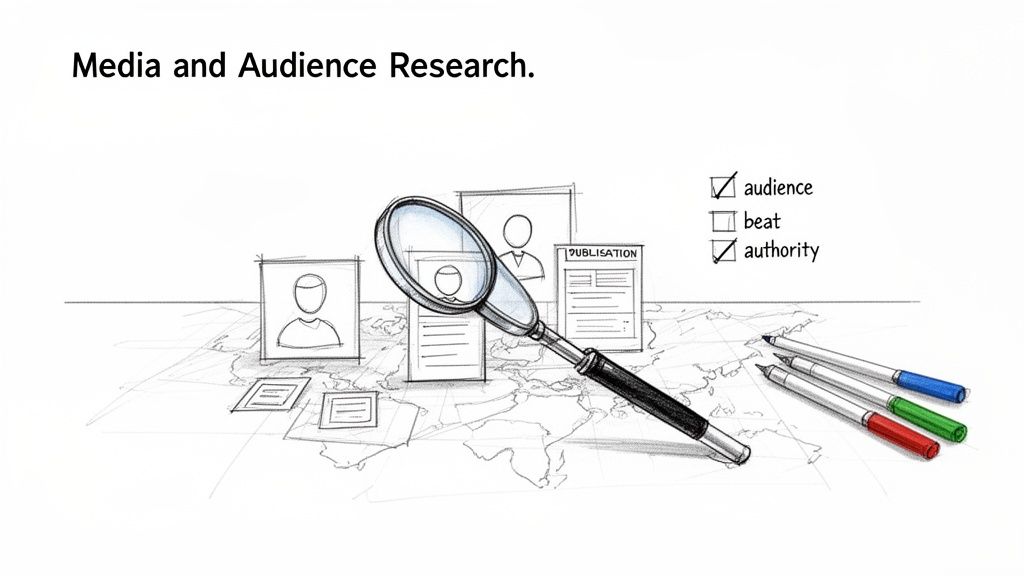
Alright, you’ve got your goals. Now, the focus pivots from the "what" to the "who" and "where." Let’s be honest: even the most brilliant pitch is just noise if it lands in the wrong inbox. Effective PR is all about getting your story in front of the right journalists, publications, and influencers who speak directly to your ideal customers.
This isn't a numbers game. Forget about blasting your announcement to a massive, generic list. The goal here is to build a curated, high-impact media list where every single contact is a genuine, strategic fit. That means digging deeper than just a publication's masthead to understand its audience, its editorial vibe, and the specific reporters covering your beat.
The most logical place to start? Your customer. Before you can find the right media, you have to know who you're trying to reach. Taking the time to learn how to identify your target market is non-negotiable. Once you have a crystal-clear picture of your end-user, you can simply work backward to find out what they read, watch, and listen to.
Pinpointing Your Ideal Media Targets
First, let's map out the media landscape in your corner of the world. Don't just chase the big, flashy names. Think about the niche blogs, trade journals, and influential newsletters that your target audience actually trusts. A thoughtful feature in a smaller, respected outlet can drive more qualified traffic than a fleeting mention in a massive, general-interest publication.
A great way to start is by seeing where your competitors are getting coverage. Set up some Google Alerts or use a media monitoring tool to track who's already writing about your space. You're not looking to copy their strategy, but to identify the journalists who have a proven interest in your industry.
As you pull together a preliminary list, it's time to vet each target. I recommend a simple spreadsheet to track what you find. Focus on the data that really signals a good fit.
Media Vetting Checklist:
- Audience: Does their readership actually match your ideal customer profile?
- Editorial Focus: Do they regularly cover topics, companies, or trends that align with what you do?
- SEO Value (DR): What’s the site’s authority? A backlink from a high DR site (think 70+) gives you a serious SEO boost.
- Journalist’s Beat: Is the specific reporter you're eyeing the one who consistently writes about your niche?
This methodical approach takes the guesswork out of it, ensuring you build a list based on solid data, not just brand recognition.
Analyzing Individual Journalists for a Smarter Pitch
Once you have your list of publications, the real work begins. You have to zoom in on the people. A generic pitch lobbed at a publication's "tips@" inbox is almost guaranteed to fail. A personalized pitch sent directly to the right reporter, on the other hand, can work wonders.
Go read their last five articles. Seriously. What angles do they favor? Do they lean into data-driven stories, founder interviews, or hands-on product reviews? Look for patterns in their style and the kinds of sources they quote. This deep dive gives you the context to craft a pitch that feels less like a press release and more like a genuinely helpful story idea.
A personalized pitch proves you’ve done your homework. Mentioning a recent article they wrote or connecting your story to a theme they often explore shows you respect their work and understand their audience. It immediately sets you apart from the 90% of pitches that are totally generic.
This research also clues you into the best way to contact them. Some reporters live in their email; others are more responsive on social media. Building a simple journalist profile in your media list is a great way to track these preferences. For startups looking to find key media and influencer contacts more efficiently, a comprehensive https://www.pressbeat.io/blog/social-media-database can be a game-changer.
Ultimately, this level of smart research transforms your public relations planning from a shot in the dark into a strategic operation. It makes sure that when you're finally ready to hit send, your pitch lands in the right inbox, with the right message, at the right time.
Crafting Your Core Message and Story Angles
Now that you’ve mapped out your goals and know who you’re talking to, it’s time to build the engine of your PR campaign: your story. This is where we move from research to creativity. A great product or a visionary founder isn’t enough on its own—you need a narrative that grabs the attention of journalists and, ultimately, their audience.
Your story begins with a core message. This isn't just a tagline you stick on a website; it’s the fundamental truth of your company. It’s a clear, consistent statement that answers three questions: who you are, what problem you solve, and why you are the only one who can solve it this way. Think of it as your North Star for every piece of communication that leaves your company.
Developing Your Messaging Framework
To keep your story straight, you need a messaging framework. This is a simple but powerful document that ensures everyone on your team—from the CEO in an interview to a sales rep on a demo—is telling the same story. Consistency is everything.
A solid framework is built on a few key pillars:
- The Mission: Beyond making money, why do you exist? This is your big-picture "why."
- The Problem: Get specific about the pain point you’re solving for your customers. Make it feel real and urgent.
- The Solution: Explain how your product or service makes that pain go away. Focus on the benefits and the outcome, not just a list of features.
- The Differentiators: What are the one or two things that genuinely set you apart from everyone else in the market? Be specific and be ready to prove it.
Once you’ve nailed these down, you can write your official company boilerplate. This is the short, one-paragraph description of your company that you’ll tack onto the end of every press release. It needs to be tight, powerful, and packed with your core value proposition.
A strong messaging framework acts as a filter. Before any public statement, ask yourself, "Does this support our core message?" If the answer is no, it's probably not worth saying. This discipline prevents mixed signals and keeps your brand identity sharp.
From Message to Newsworthy Angle
Here’s a hard truth many founders learn the tough way: your core message is for you, not for a journalist. A reporter's job isn't to parrot your marketing copy; it's to tell a compelling story that their readers will actually care about. Pitching your internal message instead of a real story is probably the most common mistake startups make.
The real art is turning your internal message into an external, newsworthy angle. An angle is the hook—the timely, surprising, or relevant element that makes your announcement part of a much bigger conversation. The success of your public relations planning lives or dies on the strength of your angles.
Let’s say you’re a fintech company launching a budgeting app. Your internal message is clear. But "We launched a new app" is an announcement, not a story. It has no hook.
So, how do you find the angle?
- Tie it to a Trend: Are rising interest rates forcing people to get serious about budgeting? Suddenly, your story is about how economic pressures are reshaping personal finance.
- Use Unique Data: Maybe you surveyed 1,000 beta testers and found that 78% are cutting back on streaming services to save money. Now the story is about your exclusive data insight into consumer behavior.
- Offer a Contrarian View: If everyone in your industry says one thing, your angle can be a compelling argument for why they're all wrong.
- Find the Human Story: Did a single mom use your app to finally save enough for a down payment? That's a powerful human-interest story that brings your product to life.
This is all about shifting your perspective from "what we're announcing" to "why this matters to the world right now." The table below breaks down this transformation.
PR Campaign Angle Development
The key is to connect your company's news to something bigger—an industry trend, a societal problem, or a tangible impact. The weak angles are all about "us," while the strong angles are about "them" (the readers).
| Company News | Weak Angle (Internal Focus) | Strong Angle (External/Newsworthy Focus) |
|---|---|---|
| SaaS platform adds new AI feature | "We are excited to announce our new AI-powered workflow automation." | "New data shows AI is saving small businesses 10 hours a week, leveling the playing field against enterprise giants." |
| Health tech startup secures funding | "Our company has successfully closed a $5 million seed round." | "As doctor shortages worsen, this newly-funded startup uses tech to cut patient wait times by 40%." |
| New e-commerce brand launches | "We are launching a new line of sustainable home goods." | "This brand's innovative supply chain creates zero plastic waste, setting a new industry standard amid consumer pressure." |
See the difference? The strong angles immediately answer the journalist's silent but all-important question: "Why should my audience care?" Developing these angles is the creative leap that turns a simple company update into a potential headline.
Assembling Your Outreach Toolkit and Timeline
Alright, you've defined your goals and sharpened your story angles. Now it's time to roll up your sleeves and shift from pure strategy to hands-on execution. This is where you build the actual assets that make your outreach look and feel professional. A journalist's first impression of your brand is formed right here, so getting these materials right is absolutely critical.
Think of it like getting your team ready for game day. You wouldn't send them onto the field without the right gear. In the same way, you never, ever send a pitch without having a polished, comprehensive toolkit ready to go. The two essentials you'll need are a modern digital press kit and a smart outreach timeline.
Building a Modern Press Kit
Let's be clear: we're not talking about some old-school folder stuffed with papers. A modern press kit is a digital hub—usually a dedicated page on your website or a cleanly organized cloud folder (like Dropbox or Google Drive). Its entire purpose is to give a journalist everything they could possibly need to write about you, without them having to chase you down for basic info.
When you make a reporter's job easier, you immediately earn their gratitude. A well-stocked press kit shows you're a pro who respects their time.
So, what goes inside? Make sure your kit has these must-haves:
- Company Fact Sheet: A simple one-pager that covers who you are, what you do, key milestones, and founder info. Keep it scannable.
- Founder Bios and Headshots: You need professional, high-resolution photos of your key people alongside short, compelling bios. No blurry selfies.
- High-Resolution Logos: Give them everything they need. That means your logo in various formats (PNG, SVG) ready for both light and dark backgrounds.
- Product Screenshots and Videos: If you're a tech company, this is non-negotiable. High-quality images and short demo videos of your product in action are gold.
- Case Studies or Testimonials: Nothing tells your story better than a happy customer. Include short, powerful examples of how real people are winning with your solution.
This kit should be a living asset, not a one-and-done project. Update it after every major announcement or funding round. And don't forget to drop a link to it in your email signature and at the bottom of every press release.
Your press kit isn't just a file dump; it's a strategic tool. By providing everything upfront, you control the narrative and make sure any coverage uses your approved messaging and high-quality assets.
Mapping Your 90-Day PR Calendar
With your assets locked and loaded, the next piece of the puzzle is timing. Honestly, timing is everything in PR. A brilliant story pitched in the middle of a chaotic news week will just disappear. A strategic PR calendar is your secret weapon for mapping out announcements, sequencing your pitches, and piggybacking on external events to get more attention.
I've found that a 90-day window is the sweet spot—it’s long enough to plan ahead but short enough to stay flexible.
First things first, block out your key dates. Plug in any known product launches, major feature updates, or partnership announcements. These are your "owned" news moments—the stories you control.
Next, start layering in external events. Are there big industry conferences, holidays, or seasonal trends you can connect your story to? For instance, a fintech startup might plan a pitch around Financial Literacy Month in April.
The infographic below shows how a core idea gets refined into a timely story angle, which is really the building block for every entry on your calendar.
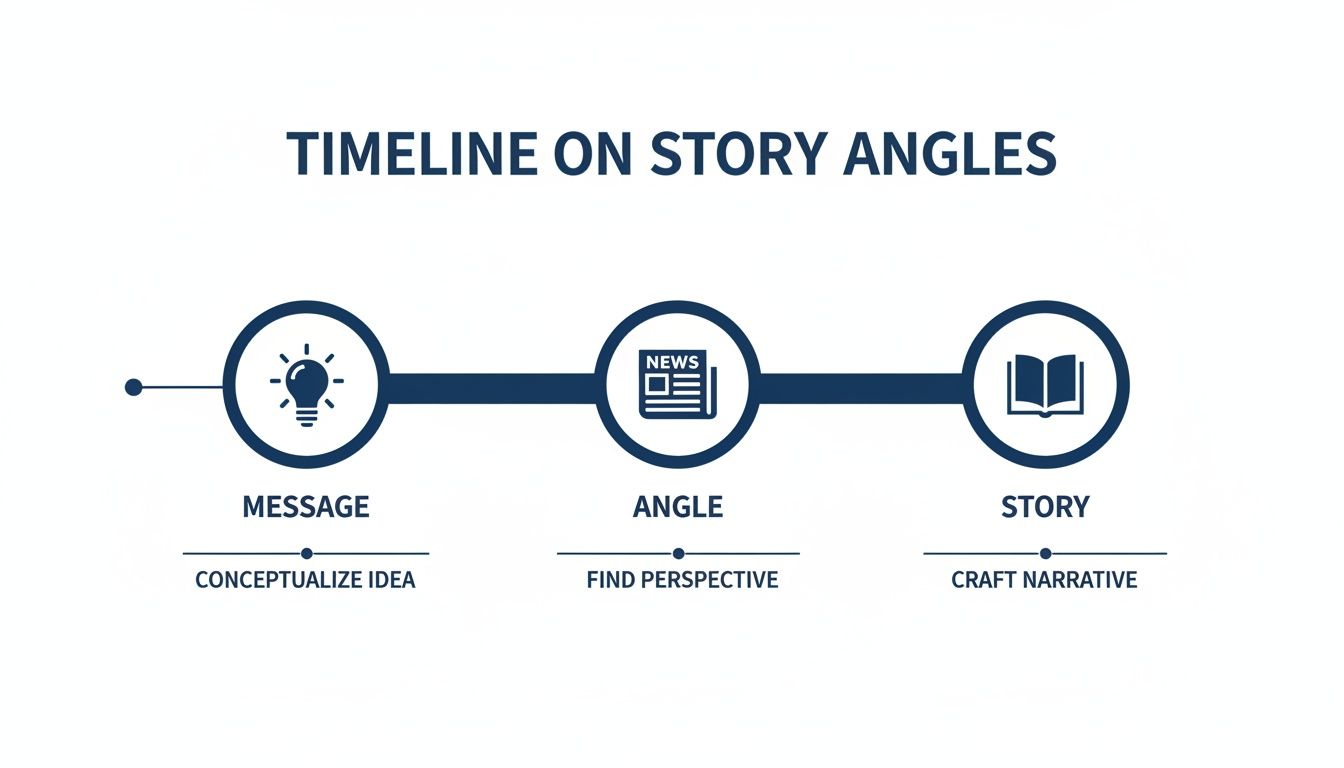
As you can see, great outreach starts with a solid message. That message is then shaped into a newsworthy angle before it’s fully fleshed out into a story ready for a journalist.
Sequencing and Timing Your Pitches
Your calendar can't just be a random collection of dates. The real magic is in how you sequence your outreach. Common sense rules here: avoid pitching big news on a Friday afternoon or right before a national holiday. From my experience, Tuesday and Wednesday mornings are prime time for getting a reporter's attention.
You also have to read the room. If a massive, industry-wide story is breaking, just wait. Your news, no matter how important it is to you, will get completely buried. Patience is a true virtue in public relations planning. Waiting just a few days for the news cycle to clear up can be the difference between getting tons of coverage and hearing crickets.
For a major product launch, a smart timeline might look like this:
- T-minus 4 Weeks: Offer exclusive, embargoed briefings to a tiny handful of your top-tier, trusted journalists.
- T-minus 1 Week: Send the press release under embargo to a wider—but still carefully targeted—list of media contacts.
- Launch Day: Announce the news publicly on your blog, social media, and newsletter. Follow up with all the reporters who received the embargoed info.
- Launch Day + 1 Week: Start the next phase of outreach by pitching bylined articles and founder interviews that expand on the launch's core themes.
This kind of structured approach turns your strategy into a coordinated, powerful campaign, making sure all your hard work actually pays off with the media attention your story deserves.
Executing and Measuring Your PR Campaign
Alright, you’ve done the hard prep work. Your plan is solid, your press kit is polished, and your calendar is set. Now it's time to hit "send" and bring your strategy to life. This is where your public relations planning moves from theory to practice.
Executing a campaign well starts with that first carefully personalized pitch, but it’s so much more than that. It's about managing the entire back-and-forth with professionalism and a human touch.
Remember, you're not just blasting out news to get a single hit. The real goal is to build genuine, lasting relationships with journalists. When someone replies, be ready to respond quickly and helpfully. If they ask for an interview, make sure your spokesperson is prepped and knows the key messages inside and out. Every single interaction is a chance to prove you're a reliable, valuable source they can count on down the road.
This is how you build credibility that pays dividends long after the campaign is over. A reporter who has a great experience with you is far more likely to open your emails in the future.
Tracking What Truly Matters
Once your story starts getting picked up, your job shifts from pitching to proving. Did the campaign actually work? This is where you circle back to those concrete KPIs you set at the very beginning. It's time to draw a clear line from your PR work to real business results, leaving behind vanity metrics like "impressions."
Focus on the numbers that actually tell the story of your campaign's impact. These are the metrics that will justify your budget and your next big idea.
Key Metrics to Monitor:
- Media Mentions & Sentiment: Don't just count the articles; evaluate their quality. Was the coverage positive? Did it appear in a top-tier publication that your audience truly trusts?
- SEO Impact: Keep an eye on the number and quality of backlinks you've earned. Even one link from a high-authority site (think Domain Rating 70+) can give your search rankings a serious boost.
- Website Referral Traffic: Dig into your analytics. How many people clicked through to your website from the article? Did they stick around? Did they sign up for a demo or download a whitepaper?
Measuring the right things is what turns PR from a "nice-to-have" into a proven growth driver. When you can show that a feature story directly led to a 20% spike in branded search traffic and a tangible lift in demo requests, you’re speaking the language of ROI.
This data is gold. It creates a powerful feedback loop that shows you what worked, what didn't, and why. You can learn much more about how to measure public relations effectively in our detailed guide. By constantly tracking, analyzing, and refining your approach, your public relations planning will only get smarter and more impactful with every campaign you run.
Common Questions About PR Planning
Even with a solid playbook, a few questions always pop up when startups get into the nitty-gritty of PR planning. Here are the ones I hear most often from teams just getting started.
How Long Does PR Planning Really Take?
Plan on spending two to four weeks on foundational work before you even think about sending your first pitch. This isn't just busywork; it's the time you need to set clear goals, dig into media research, nail down your messaging, and assemble a press kit that makes a journalist's job easy.
I've seen so many teams try to rush this part, and it almost always backfires. A well-thought-out plan is what separates a targeted, successful campaign from a spammy email blast that gets you blacklisted.
What's the Biggest PR Mistake Startups Make?
Hands down, the single biggest mistake is thinking PR is just free advertising. Startups often send pitches that are 100% self-promotional, screaming "look how great my product is!" without offering a shred of news value. A journalist's job is to inform or entertain their audience, not to publish your marketing copy.
The secret to great PR is finding where your story overlaps with a bigger conversation. Maybe it’s a new industry trend, a surprising piece of data you’ve uncovered, or just a really compelling human story behind your company. That’s your hook.
How Do I Actually Measure PR ROI?
Forget about fuzzy metrics like "impressions." To prove PR is working, you have to connect it directly to business goals. You need to track tangible outcomes that show how media coverage is impacting your company's growth.
Here’s what you should be looking at:
- Placement Quality: Are you landing stories in high-authority publications (think DR 70+)? One great placement beats a dozen low-quality ones.
- Referral Traffic: How many people are clicking through to your website from the articles you're featured in?
- SEO Impact: Track the number and quality of backlinks you earn from media coverage. This is a huge long-term win.
- Branded Search Lift: Are more people searching for your brand name after a big media hit? This is a great indicator of rising awareness.
When you track these metrics on a dashboard, you can clearly see the value PR brings. It's not just about "buzz"; it's about measurable business results.
Ready to turn your PR efforts into predictable, measurable results? PressBeat uses AI to secure guaranteed media coverage in high-authority publications, giving you the visibility you need to grow. See how it works.