
Elevate Your Campaign with a seo press release that Drives Results
January 13, 2026
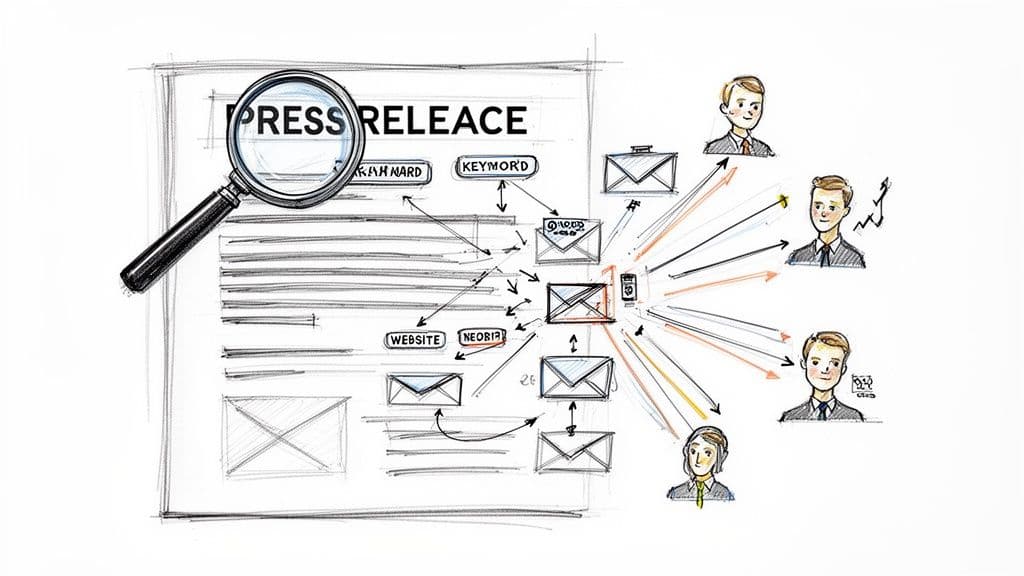
An SEO press release is more than just a news announcement. It's a carefully crafted piece of content designed to land media coverage, earn valuable backlinks, and boost your website's search engine rankings. Think of it as the intersection of classic public relations and modern SEO, where keywords, link building, and strategic distribution work together to build brand authority and drive real traffic.
Why Your Press Release Strategy Needs an SEO Overhaul
Let's get one thing straight: the old "spray and pray" method of sending out press releases is a relic of the past. Blasting a generic announcement across every wire service you can find is just adding to the digital noise. Journalists don't read them, and search engines ignore them. It's a surefire way to get zero return on your investment.
In a world where Google's E-E-A-T (Experience, Expertise, Authoritativeness, and Trustworthiness) signals and AI-powered search results call the shots, you need a much smarter approach.
The Shift from Announcements to Authority Building
The real change is moving from just announcing things to creating stories that build genuine authority. It's no longer about simply getting your name out there. It's about securing placements on high-authority publications that send powerful ranking signals back to your website.
This means targeting outlets with a high Domain Rating—think DR 70+—and making sure your news is fresh and timely. This isn't just a PR goal anymore; it's a fundamental SEO tactic that directly grows your backlink profile, boosts organic traffic, and builds credibility that paid ads can't buy.
Every link from a respected publication is a vote of confidence in your brand. It tells search engines you’re a trustworthy source, which is critical when you consider that organic search is projected to drive 53% of all web traffic by 2026. With Google handling around 8.3 billion searches a day, can you afford to be invisible?
To put this shift into perspective, let's compare the old way with the new.
Table: Traditional vs. SEO-Driven Press Releases
This table breaks down the fundamental differences between the outdated approach and a modern, SEO-focused strategy.
| Attribute | Traditional Press Release | SEO Press Release |
|---|---|---|
| Primary Goal | Broad media exposure, brand mentions | Earned media, high-quality backlinks, SERP visibility |
| Target Audience | Journalists, editors, wire services | Journalists, search engines, potential customers |
| Key Tactics | Mass distribution via wire services | Targeted outreach, keyword optimization, link building |
| Success Metrics | Number of pickups, impressions | Referral traffic, SERP rankings, backlink quality (DR) |
| Outcome | Temporary spike in brand awareness | Long-term organic growth, improved domain authority |
The contrast is clear. A modern strategy delivers compounding value that continues to pay dividends long after the initial announcement.
The goal has evolved from mere distribution to strategic placement. A single link from a top-tier publication can provide more SEO value than dozens of syndicated pickups on low-quality sites.
Embracing the New Search Landscape
AI's growing role in search engines only makes this strategic shift more urgent. Features like Google’s AI Overviews are designed to find and feature timely, well-structured, and authoritative content. A properly optimized SEO press release is tailor-made to feed these AI systems the exact signals they’re looking for.
As you rethink your strategy, it's worth getting familiar with the concepts of Generative Engine Optimization (GEO) and exploring the best AI SEO tools for 2025 that can give you an edge. When you start treating your press release as a strategic asset for link building and brand signaling, you stop seeing it as a cost and start seeing it for what it truly is: a powerful engine for sustainable organic growth.
Writing a Press Release That Journalists and Algorithms Actually Love
Let's get practical. To get real results, your press release needs to pull double duty. It has to catch the eye of a busy journalist looking for a story and satisfy the complex algorithms that decide who sees what online. Nail both, and you've got a winning SEO press release.
The work starts long before you ever type a single sentence. The foundation of any great SEO press release is solid keyword research. But you need to think beyond traditional SEO tactics here. A crucial first step is learning how to do keyword research effectively with a journalist's mindset. You're hunting for timely phrases and questions that reporters are actually searching for when they're on a deadline.
This isn't your old-school PR blast. It's a fundamental shift in strategy.
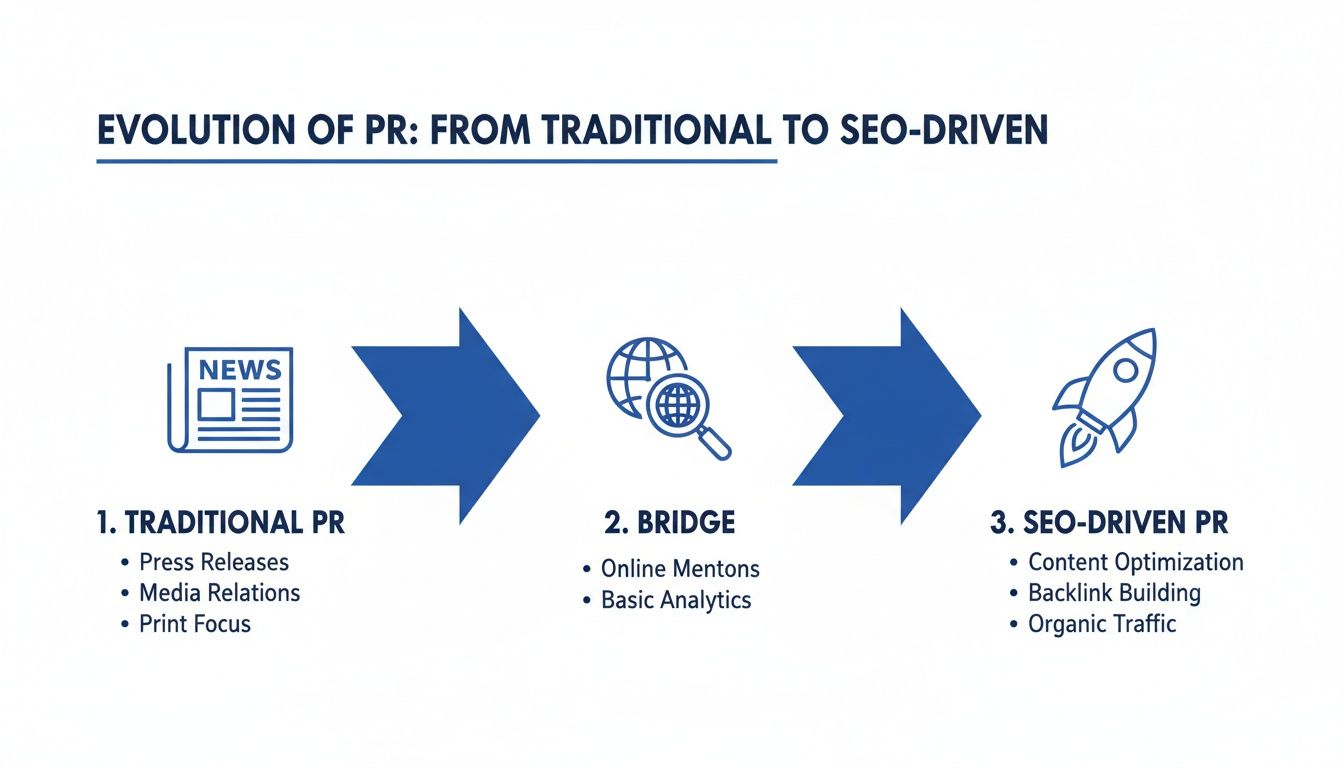
The point is, an SEO-driven press release is a strategic asset built for long-term visibility, not just a one-off announcement that disappears after 24 hours.
Weaving Keywords into Your Story
Once you've got your target keywords, the art is in weaving them into your narrative so they feel completely natural. Forcing them in is a surefire way to get ignored by an editor and penalized by Google. Keyword stuffing is dead.
Focus on placing your main keyword in the most valuable spots to immediately signal what your news is about.
- The Headline: This is your most powerful tool. Lead with the news, not your brand name, and get your primary keyword in as early as possible. "New AI Platform Launches to Automate ESG Reporting for Startups" is infinitely better than "Acme Corp Announces New Product." One is a story; the other is an ad.
- The Lede Paragraph: Your first paragraph needs to nail the "who, what, when, where, and why." This is where you summarize the entire story, and it's the perfect place to include your main keyword again to reinforce the topic.
- Body Copy: Throughout the rest of the release, sprinkle in your main keyword and its variations. This is also where you'll use related terms (like "sustainability compliance" or "corporate responsibility software") to build context and show search engines you're covering the topic in depth.
If your keywords are truly relevant to your announcement, they should fit right into the story you're telling. For a deeper look at getting this right, our guide on the modern press release structure is a great resource.
Make it Scannable, Make it Matter
Journalists don't read; they scan. You have about three seconds to grab their attention. That’s why your press release has to be structured for instant understanding.
This is where the inverted pyramid principle comes in. It’s simple: put the most important information right at the top, then follow with details in decreasing order of importance. This isn't just a journalism school lesson; it’s also great for SEO. Search crawlers give more weight to content that appears higher up on the page.
A well-structured press release is, in essence, the ideal story you want a journalist to write. By giving them a strong narrative in a familiar format, you drastically increase the chances of getting earned media coverage.
To do this, use short paragraphs (2-3 sentences, max). Use bullet points to highlight key features, data, or benefits. Break up the text with clear subheadings. Make it easy for someone to pull out the key information in seconds.
And please, write good quotes. Journalists often lift them directly. Give them something with a human element or a sharp insight—not corporate jargon.
Get a Technical Edge with Schema Markup
Finally, there’s a simple technical step that gives you a huge advantage: NewsArticle schema markup.
This is just a small snippet of code you add to your press release page. It doesn't change how it looks, but it speaks directly to search engines, telling them exactly what your content is. It spells out things like:
- The article headline
- The date it was published
- Who wrote and published it
- A short summary
By spoon-feeding this info to Google in a language it understands, you dramatically improve your chances of showing up in the "Top Stories" box and other high-visibility news features. It’s a small bit of effort for a massive potential payoff in traffic and credibility.
Building a Powerful Link Strategy Into Your Release
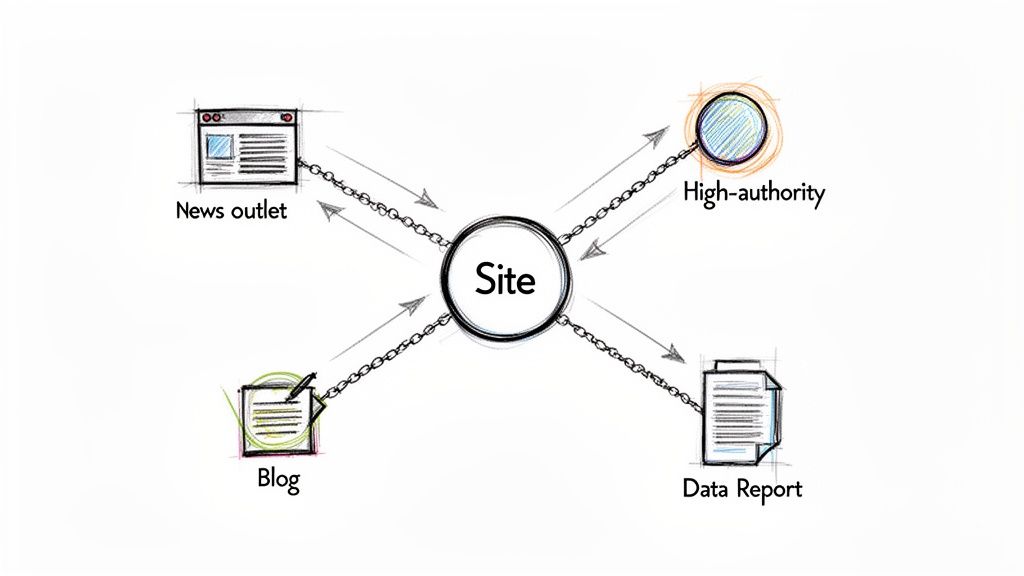
Links are still the currency of the internet, and a smart SEO press release is one of the best ways to earn them. But here's the thing: just hoping a journalist decides to add a link to your site isn't a strategy. A truly effective approach means embedding links into your release with purpose, guiding both journalists and search engines.
It’s not just about getting any link; it’s about earning the right links. You’re aiming for backlinks that build real authority. The data doesn't lie—a staggering 92.3% of the top 100 ranking domains have at least one backlink, which shows just how crucial they are. You can find more stats on the power of backlinks and their connection to high rankings. Every link you build needs to have a job.
Different Links for Different Goals
Your press release should have a healthy mix of links, each serving a distinct purpose. Be careful not to overdo it, though. Jamming too many links into the text can look spammy and turn off journalists. A handful of well-chosen, strategically placed links is all you need.
Here are the essential types to work into your release:
- Homepage Link: This one almost always goes in your company boilerplate at the very end. It's your foundational link, building brand authority and giving anyone who's interested a direct path to your front door.
- Deep Links to Product or Service Pages: These are your "money" links. If your news is about a new product, link directly to that product's page. This sends highly qualified referral traffic where you want it and funnels link equity to your most important commercial pages.
- Contextual Links to Supporting Content: Did your announcement mention an internal study or reference a detailed blog post? Link to it. This is a pro move. It gives journalists a verifiable source and encourages them to link to your valuable content assets, not just your homepage.
Crafting Natural Anchor Text
The actual words you use for your links—the anchor text—are incredibly important. The old days of stuffing keywords into anchor text are long gone; in fact, it can get you penalized now. The goal is to make your links descriptive, natural, and genuinely helpful.
Forget generic phrases like "click here" or "learn more." Instead, use anchor text that clearly tells the reader what they'll find on the other side.
| Bad Anchor Text | Good Anchor Text |
|---|---|
| "Check out our new tool" | "...our new AI-powered ESG reporting tool..." |
| "Read the study" | "...our recent study on startup funding trends..." |
| "Click here for more info" | "...full details on the strategic partnership..." |
The best anchor text just flows. It fits seamlessly into the sentence while giving both people and search engines a clear preview of the linked page.
A great press release link strategy isn’t just about getting a backlink. It's about controlling the narrative and guiding journalists to the exact pages you want them to see, explore, and ultimately link to in their coverage.
Prioritizing High-Authority Placements
At the end of the day, the SEO value of your backlinks comes down to the authority of the sites they're on. A single link from a major publication is worth far more than hundreds of links from low-quality directories.
When you're planning your distribution, zero in on outlets with a DR of 70 or higher. In Google's eyes, these are established, trusted sources. Getting a backlink from one of them sends a powerful signal that your brand is credible and newsworthy. That "link equity" then flows to your website, boosting the authority of your entire domain and making it easier for all your pages to rank.
Mastering Distribution for Real SEO Impact
Crafting a brilliant SEO press release is only half the battle. A perfect story that never reaches the right audience is like shouting into the void. This is where a modern distribution strategy comes in, and it’s a world away from the outdated “spray and pray” tactics that still linger from the past.
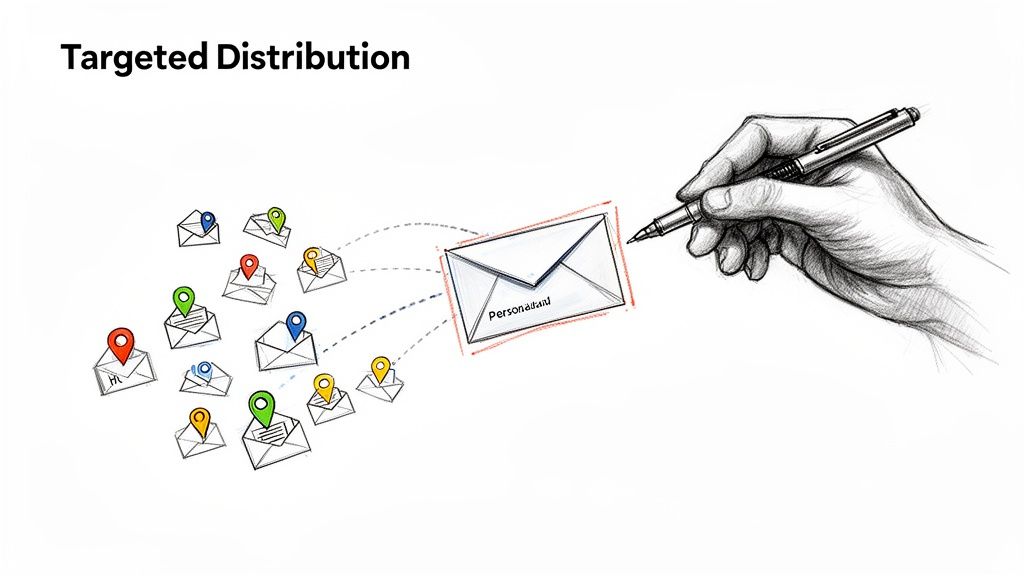
The goal isn't just to get your news out there; it's to get it in front of the right people—the journalists and editors who can give your story the platform it deserves. A mass blast to a generic list is a surefire way to get ignored. Journalists get hundreds of pitches a day, so a generic email is just more noise to them.
Building Your Targeted Media List
Your entire distribution effort hinges on a well-researched, curated media list. I'm not talking about some massive database you buy online. I mean a list of specific journalists, editors, and influencers who have actually covered your industry, your competitors, or topics directly related to your announcement.
Start by thinking about where you want to be featured. Which publications do your customers actually read? Once you have a list of target outlets, dig in to find the individual writers who cover your specific beat.
- Analyze their past work: Have they written about similar funding rounds or product launches before? A quick search of their author page tells you everything.
- Check their social channels: What are they talking about on X or LinkedIn right now? This gives you a great feel for their current interests and beat.
- Use modern tools: AI-powered platforms like PressBeat can do the heavy lifting, pinpointing the most relevant journalists and even analyzing their recent articles to help you find the perfect hook.
This focused approach means your pitch lands in an inbox where it actually belongs, which dramatically increases your chances of getting it read.
Personalizing Your Pitch for Maximum Impact
Once you have your list, it's time to personalize your outreach. A one-size-fits-all email template is a death sentence for your pitch. Each email needs to be tailored to the journalist you’re contacting.
Reference a recent article of theirs that you genuinely liked. Briefly explain why your news is a perfect fit for their audience. This little bit of effort shows you've done your homework and respect their work, making them far more likely to consider your story.
Keep the pitch email itself incredibly concise:
- A Compelling Subject Line: Make it newsworthy and clear, not clickbaity. "New Report Shows 50% Rise in Remote Work" is better than "Exciting News!"
- A Quick, Personal Intro: Show you’re not a robot by mentioning their work.
- The Core News Hook: Get straight to the point. In one or two sentences, explain what your news is and why it matters to their readers.
- A Clear Call to Action: Offer the full press release and high-res media for their convenience.
When it comes to following up, less is more. A single, polite follow-up a few days later is perfectly fine. Anything more, and you risk becoming a nuisance. If they're interested, they'll respond.
A personalized pitch transforms your outreach from a cold email blast into a professional correspondence. It signals to the journalist that you see them as a respected professional, not just a name on a list.
Choosing the Right Distribution Channel
Not all distribution methods are created equal, especially when SEO is the goal. Old-school newswires cast a wide net but often result in low-quality placements, while modern platforms offer surgical precision. Understanding the trade-offs is key.
Here's a breakdown of how different channels stack up for generating real SEO value.
Distribution Channel Effectiveness for SEO
| Distribution Method | Reach | Relevance | Backlink Quality (Avg. DR) | Cost-Effectiveness |
|---|---|---|---|---|
| Traditional Newswires | Very High | Very Low | Low (10-40) | Poor |
| Manual Email Pitching | Low-Medium | Very High | High (50-90+) | Good (Time Intensive) |
| PR Agency Outreach | Medium-High | High | High (50-90+) | Low (Very Expensive) |
| AI Pitching Platforms | High | Very High | High (50-90+) | Excellent |
As you can see, the path to high-quality backlinks and meaningful coverage lies in targeted, relevant outreach, which is where AI-powered platforms and focused manual pitching shine.
The Critical Role of Recency in Search and AI
In the world of news, timing is everything. This is doubly true for search engines and the new AI Overviews. Google and other platforms prioritize fresh, timely content for news-related queries. A story that’s even a week old is ancient history to an algorithm.
This is why having a swift, targeted distribution plan is so important. The faster you get your story published on high-authority sites after your announcement, the stronger the "recency" signal you send to Google. This can directly impact your visibility in SERP features like the "Top Stories" carousel and in AI-generated answers.
A well-run distribution campaign ensures your news doesn’t just get published—it gets published quickly by the right people, maximizing its SEO impact when it matters most. For a complete walkthrough, see this guide on how to distribute a press release for the modern media landscape. By focusing on a targeted, personalized, and rapid approach, you turn your press release into a powerful tool for generating real SEO momentum.
Measuring the True ROI of Your Press Release Efforts
So, your press release is live. Congratulations. But the real work? That starts now. The big question is, how do you prove your campaign actually made a difference? It’s time to move beyond vanity metrics and focus on the data that truly impacts your SEO and business goals.
Just counting the number of outlets that picked up your story is an old-school approach that doesn't tell you much. A truly successful campaign generates tangible results you can track and present as a clear return on investment. This means thinking of PR less as a fuzzy brand-building exercise and more as a measurable performance channel.
Beyond Impressions to Actionable SEO Metrics
To really get under the hood of your campaign's performance, you'll need the right tools. Your new best friends are platforms like Google Analytics, Ahrefs, and Semrush. They give you the hard data needed to draw a straight line from your press release to your bottom line.
Your measurement framework should zero in on three core areas.
- Referral Traffic: Pop open Google Analytics and see which publications are actually sending visitors to your website. This is your first real signal of success—it means the story was compelling enough to make someone click.
- Backlink Acquisition and Quality: Use a tool like Ahrefs to keep an eye on new backlinks. What you’re really looking for is the Domain Rating (DR) of the linking sites. Trust me, one link from a DR 70+ publication is worth far more than a dozen from low-authority blogs.
- Keyword Ranking Improvements: You need to track the SERP positions for the keywords you targeted. A well-executed campaign should give you a noticeable bump in rankings for those specific terms as Google starts associating your brand with them.
Tracking Brand Visibility and Sentiment
Great SEO isn't just a game of links and keywords; it's also about building authority. Keeping tabs on how your brand is being discussed online gives you crucial context for your campaign's impact.
I recommend setting up alerts with a tool like Google Alerts or more advanced media monitoring software. You're hunting for unlinked brand mentions—those moments when a publication writes about you but doesn't link back. These are golden opportunities. A quick, polite outreach can often turn that mention into a valuable backlink.
Measuring the ROI of a press release means connecting every action to a specific outcome. It’s about building a data-driven narrative that shows how earned media directly contributes to organic growth, lead generation, and brand authority.
Things are definitely changing. As press releases get smarter for search and AI, they’re becoming a core part of SEO strategy. In fact, 87% of companies using these modern campaigns report a significant increase in brand visibility. This shift makes meticulous tracking more critical than ever.
Building a Comprehensive Measurement Workflow
For a complete picture, you need to track the entire process—from your initial pitch to the final article and beyond. This transparency shows you exactly what’s working and what you can tweak for the next round.
Here are the key performance indicators (KPIs) that should be in your workflow:
- Pitch Performance: How are your emails doing? Track open rates and reply rates. If engagement is low, it’s a strong sign that your subject lines or pitch angles need a rethink.
- Publication Success: Keep a running log of every article published. Note the outlet's DR and, crucially, whether the placement included a dofollow backlink.
- Traffic and Conversions: Inside Google Analytics, create a specific segment for referral traffic coming from your PR placements. Watch how these visitors behave. Do they convert? Do they browse key pages on your site?
By connecting these dots, you stop reporting on vague "coverage" and start demonstrating real business impact. This level of detail doesn't just justify your PR budget; it gives you the insights to make your next campaign even more successful.
For a deeper dive, check out our guide on how to effectively measure public relations impact and learn how to turn your data into a powerful story.
Answering Your Top SEO Press Release Questions
Even with the best plan in hand, you're bound to have questions when you start putting SEO press releases into practice. I get these all the time from founders and marketing teams, so let's clear up some of the most common sticking points.
Getting these details right can be the difference between a campaign that flies and one that falls flat.
How Many Links Should I Actually Use?
This one comes up constantly, and my answer is always the same: focus on quality, not quantity. Stuffing a release with a dozen links is a major red flag for spam filters and makes journalists instantly skeptical. It just looks desperate.
For a standard release around 400-500 words, two or three smart links is the sweet spot. This is more than enough to guide readers and signal relevance to search engines without cluttering your message.
Here’s my go-to formula:
- One deep link: Point this directly to the most relevant page—the new product, the event signup, the feature announcement. This is your main call-to-action link.
- One homepage link: Always include this in your company boilerplate at the very end. It’s standard practice and a great way to reinforce your brand.
- One contextual link (optional but powerful): If you mention a stat, a case study, or a detailed blog post, link out to it. This gives reporters extra resources and can land you a fantastic, high-authority backlink.
Remember, the point of a link isn't just to get a click. It's to offer a logical next step for a reporter digging into your story or a potential customer who wants to know more. Too many links just creates noise.
What’s the Perfect Length for a Press Release?
Keep it tight. Journalists are buried in pitches and don't have time to read a novel. Search engines also tend to favor concise, direct content.
The magic number is somewhere between 300 and 500 words.
This gives you enough room to cover the essentials—the who, what, when, where, and why—but keeps it short enough to be scanned and understood in less than a minute. Anything longer and you risk burying your key message. Cut the fluff, ditch the corporate jargon, and get straight to the point.
Wire Service or Direct Pitching—Which is Better for SEO?
This is a huge strategic decision. Wire services promise massive distribution, but the reality is often a flurry of low-quality placements on sites that provide zero SEO value. Worse, the links you get are almost always "nofollow," meaning they pass no ranking authority to your website.
For real, tangible SEO results, direct, personalized pitching wins almost every time.
| Factor | Wire Service | Direct Pitching |
|---|---|---|
| Placement Quality | Low (Syndication) | High (Earned Media) |
| Backlink Type | Mostly "nofollow" | Often "dofollow" |
| SEO Value | Minimal | Significant |
| Journalist Relations | None | Builds Relationships |
When you pitch directly, you're targeting high-DR publications and building actual relationships with journalists in your niche. A single earned placement from a site like that is worth more in SEO and referral traffic than hundreds of syndicated pickups from a wire.
When Is the Best Time to Send My Press Release?
Your send time can absolutely make or break your open rates. While there’s no magic bullet that works for everyone, decades of PR have revealed some pretty clear patterns.
The general consensus is that mid-week and mid-morning are your best bet. Mondays are a frantic catch-up day, and by Friday afternoon, everyone’s focus is on the weekend.
- Best Days: Tuesday, Wednesday, and Thursday.
- Best Times: Between 10:00 AM and 2:00 PM in the journalist's local time zone.
This window gets your email in their inbox after they've dealt with the morning chaos but before the afternoon slump hits. And please, unless your news is specifically about a holiday, avoid sending on weekends or major holidays. Always think about the reporter's time zone—it shows you’ve done your homework.
Ready to stop guessing and start getting guaranteed media coverage? PressBeat uses AI to connect you with the right journalists and secures placements on high-authority outlets, turning your announcements into powerful SEO assets. See how PressBeat can transform your PR strategy.