
What Is Press Coverage and How Can It Fuel Your Startup's Growth
January 14, 2026

When someone talks about press coverage, they're talking about any time your company, product, or brand gets mentioned by a media outlet—think news sites, industry blogs, podcasts, or even TV segments.
It’s the digital equivalent of powerful, word-of-mouth marketing, giving you a stamp of approval from a trusted third party.
What Is Press Coverage? A Simple Explainer
Let's use a simple analogy. Imagine you’ve just launched a new tech startup. You could run a bunch of digital ads. That's advertising. You control the message completely, and everyone knows you paid for that space. It works, but it often lacks a certain punch.
Now, imagine a respected tech journalist discovers your product, loves how it solves a real problem, and writes an in-depth feature about it. Suddenly, their entire audience—people who trust their judgment—is curious about what you've built. That glowing feature? That's press coverage. It’s an endorsement you earned, not one you bought.
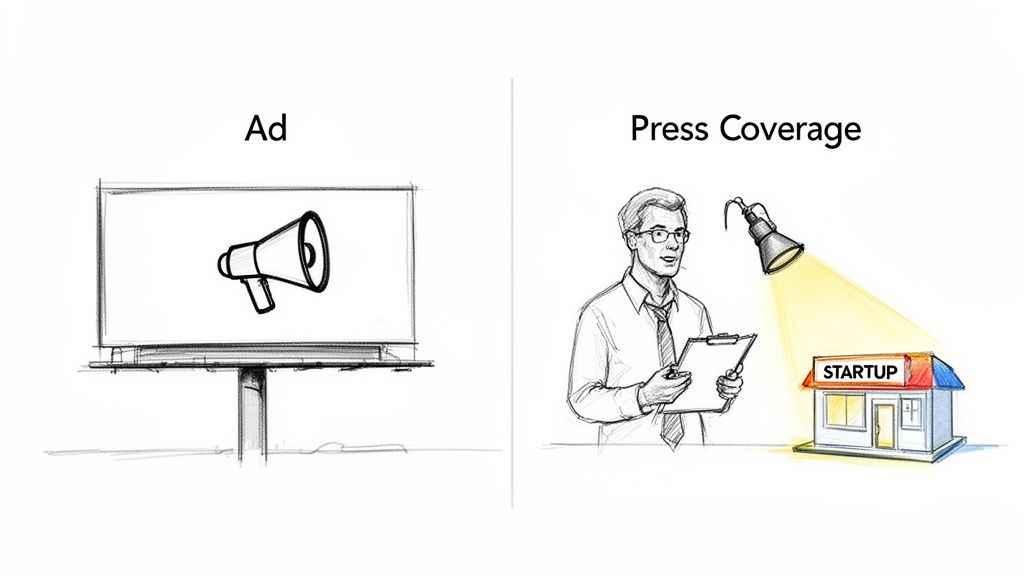
The Power of an Earned Spotlight
That distinction is everything. Advertising shouts a message from a megaphone, but great press coverage tells a story. It comes with an implied seal of approval from an impartial source, which is exactly why customers, partners, and investors find it far more compelling. For a startup, that kind of credibility is pure gold.
Press coverage provides proof that your story is resonating with an audience beyond your own marketing channels. It builds authority and trust in a way that paid ads simply can't.
This type of media attention is often called earned media because you have to earn it with a great story, an innovative product, or fascinating data. It stands apart from owned media (like your website) or paid media (like ads). You don’t have total control over the final article, but that's precisely what gives it so much power.
If you're curious to learn more, you can explore our deep dive into what is earned media in our detailed guide.
To help you quickly grasp the key ideas, here’s a simple breakdown of what press coverage really means in practice.
Press Coverage at a Glance
This table quickly breaks down the core concepts of press coverage, giving you a simple reference for understanding its fundamental components.
| Concept | What It Means for a Startup | Real-World Example |
|---|---|---|
| Third-Party Validation | An independent source confirms your value, building trust with new audiences. | A well-known industry blog reviews your software and calls it a "must-have tool." |
| Credibility Building | It shows customers, investors, and talent that you're a serious player. | Getting featured in a TechCrunch article about emerging AI companies. |
| Audience Reach | Taps into the established readership of a media outlet you couldn't reach alone. | A podcast host mentions your product to their 50,000 loyal listeners. |
| SEO Impact | High-quality backlinks from news sites boost your search engine rankings. | Forbes links to your company's homepage in an article, driving referral traffic and SEO authority. |
As you can see, the benefits go far beyond just a temporary spike in website traffic.
Understanding this difference is the first step toward building a smarter growth strategy. A single, well-placed article can often do what thousands of dollars in ad spend can’t.
- Build authentic trust with potential customers who are skeptical of ads.
- Catch the eye of investors looking for externally validated businesses.
- Boost your website’s SEO with valuable backlinks from authoritative domains.
- Cement your brand’s position as an expert in your niche.
At the end of the day, press coverage isn't just about getting your name out there. It’s about having a respected voice tell your story for you. That single asset can become a powerful engine for attracting customers, securing funding, and building a reputation that lasts.
The Three Pillars of Media: Earned, Owned, and Paid
Before we dive deep into press coverage, it’s helpful to see where it fits in the grand scheme of things. Think of all the ways a brand can get its message out there. Everything falls into one of three buckets: earned, owned, or paid media.
Let's use a simple analogy. Imagine a fantastic new restaurant opens up in your town. The way it gets people talking and walking through the door perfectly illustrates these three concepts.
Owned Media: Your Direct Voice
First up is owned media. This is everything the restaurant creates and has total say over. We're talking about their slick website with the online booking system, the beautifully designed menu, the official Instagram account posting drool-worthy photos of the daily specials, or the email newsletter that goes out to regulars.
For a startup, your owned media is your company blog, the case studies on your website, your social media channels, and any whitepapers you publish. You have 100% control over the message. It's your story, told your way, on your turf.
Paid Media: Guaranteed Exposure
Next, you have paid media. This is advertising, plain and simple. The restaurant pays for a glossy, full-page ad in a local magazine, runs sponsored posts on Facebook targeting local food lovers, or buys a radio spot during the morning commute. They're paying to "rent" space in front of someone else's audience to guarantee they get seen.
In the tech world, this looks like Google Ads, sponsored articles in trade publications, paying an influencer to talk about your product, or running a LinkedIn ad campaign. You pay to play, and you get predictable exposure in return. It works for driving quick traffic, but everyone knows it’s an ad.
Earned Media: The Ultimate Endorsement
Finally, we get to earned media—the true essence of press coverage. This is what happens when a respected food critic visits the restaurant on their own dime and writes an incredible, unbiased review. The restaurant didn't pay for it. They couldn't dictate what the critic wrote. They earned it by delivering an amazing experience.
This is by far the most powerful of the three pillars. Why? Because that critic's rave review is a credible, third-party endorsement that people trust. For a startup, this is that feature story in a top industry journal, an unsolicited positive write-up from a well-known blogger, or a mention in a national newspaper.
Earned media is the most authentic form of brand validation. Because you can't buy it, audiences trust it more than any advertisement, giving it a level of credibility that paid and owned media can't replicate.
While a smart marketing plan uses all three, earned media delivers a kind of impact you just can't buy. Understanding how they differ is key, and our guide on earned media vs paid media breaks down this relationship even further. At the end of the day, real press coverage builds the kind of lasting reputation and trust that an ad campaign never will.
Why Press Coverage Is Rocket Fuel for Startups
It’s one thing to know what press coverage is, but the real magic happens when you see what it can do. For a startup finding its footing, getting mentioned in the media isn't just about bragging rights; it's a powerful tool that pushes your business forward when it matters most. Think of it less as a nice-to-have and more as a high-octane accelerant for your biggest goals.
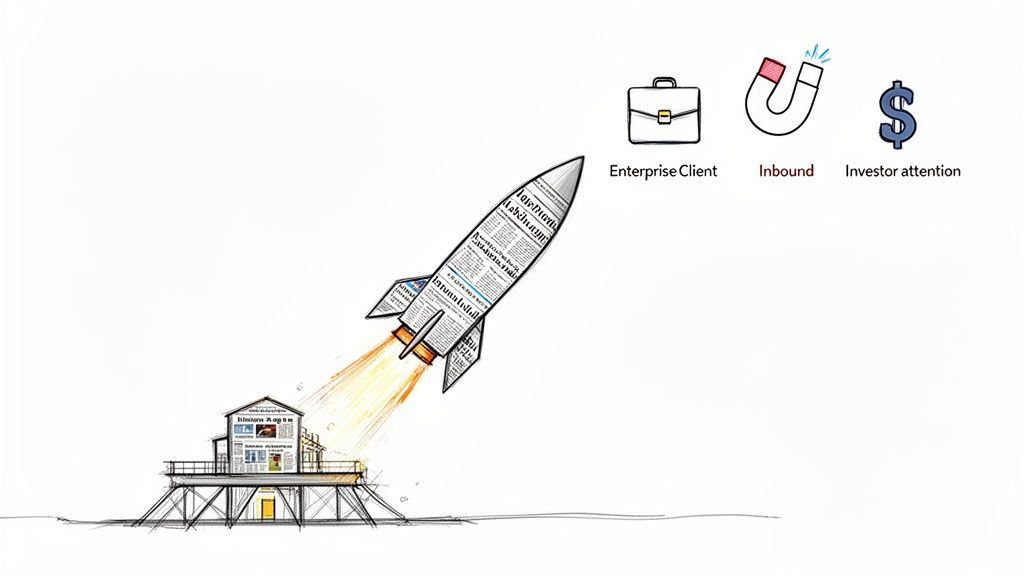
Just one solid article in a well-regarded publication can give you the instant credibility you need to land that first major enterprise client. It signals to cautious decision-makers that you're a legitimate, validated player in the space. That kind of third-party endorsement can often open doors that months of cold emails couldn't budge.
Driving Inbound Growth and Catching an Investor's Eye
Beyond just closing big deals, good press acts like a magnet for high-quality leads. When a feature story explains how you solve a real, nagging problem, you'll see a wave of potential customers who are already sold on the idea. This kind of organic interest is gold—it lowers your acquisition costs and dramatically shortens the sales cycle.
At the same time, venture capitalists and angel investors are constantly scanning the media, hunting for the next big thing. Getting featured in the right places puts you squarely on their radar.
A well-placed media mention is powerful social proof for investors. It shows them your market position is real and that your story is strong enough to get an industry expert’s attention.
This kind of visibility can be the tipping point that gets you a meeting and, ultimately, helps you close a funding round. It shows investors you have momentum and know how to make noise in a crowded market.
Boosting Your Digital Authority with SEO
The benefits of press coverage also run deep into your online presence. Every time a reputable news site links to your website, it's a huge thumbs-up to search engines like Google. These high-authority backlinks are the bedrock of good SEO.
Here's how that turns into real-world results:
- Better Search Rankings: Backlinks from credible sources lift your website's Domain Rating (DR), helping you climb the rankings for the keywords that matter.
- More Organic Traffic: Higher rankings mean more eyes on your site, driving a steady, sustainable flow of visitors.
- Stronger Brand Trust: Showing up at the top of search results builds your brand’s authority and makes potential customers trust you more.
But here’s the catch: getting these valuable mentions is tougher than ever. Media outlets are facing intense economic pressures, leading to staff cuts and fewer chances for earned media. This makes every placement you do get even more valuable. In this climate, using an AI-driven tool to find the perfect journalist is no longer a luxury—it's a necessity. You can learn more about the economic pressures on global journalism at RSF.org.
From building trust with your first customers to securing the capital you need to scale, press coverage is an essential piece of the startup puzzle.
Navigating Today's Competitive Media Landscape
The old PR playbook? It’s officially broken. The days of blasting out a generic press release and waiting for the phone to ring are long gone.
Today’s media environment is a completely different beast. It's faster, more fragmented, and everyone is under immense pressure. Journalists are drowning in pitches, and their attention is now their scarcest and most valuable resource.
Getting this is the first step to actually earning press coverage. Outdated tactics like mass email blasts aren't just ineffective—they actively work against you. They just add to the noise reporters are desperately trying to filter, burying your genuinely newsworthy story in the process.
The Shift to a Digital-First World
The power has shifted. It no longer sits with a handful of traditional media gatekeepers. News now breaks and spreads across countless platforms, from social feeds and newsletters to niche blogs and podcasts. This chaos is actually a huge opportunity for startups that are quick enough to adapt.
In a world where journalists receive hundreds of pitches a day, the winning strategy isn't about shouting the loudest. It's about delivering the right story to the right person at the exact right time.
This new environment rewards precision, relevance, and a real understanding of what a journalist needs to do their job. It’s less about broadcasting a message and more about building authentic, one-to-one relationships.
Thriving in the New Media Environment
Instead of being intimidated by these challenges, smart startups can flip the script and use this new landscape to their advantage. Data-driven outreach and personalization are the keys to cutting through the clutter.
When you focus on what a specific journalist actually covers and give them a story that helps their audience, you start building the meaningful connections that lead to high-impact press coverage.
This audience-first mindset is more critical than ever, especially when you look at how people find their news. Recent reports show a massive shift, with social media becoming a dominant news source. Its use for news in the US alone jumped from just 4% in 2015 to 34%. Visibility is no longer controlled by a few editors; it’s driven by relevant content that people want to share. You can learn more about how audiences consume news on weforum.org.
To truly measure your impact and win in this environment, you need to get familiar with metrics like What Is Share of Voice and How to Win Your Market. By adapting to this new reality, you can turn the challenge of a crowded media landscape into your greatest strength.
How to Earn Your First Media Mention
Landing your first piece of press coverage can feel like a daunting task, but it's really just a process. Once you break it down into a few manageable steps, the whole thing becomes much less intimidating. It's not about luck; it's about building a smart strategy to get noticed.
The key is to shape your news, find the right people to share it with, and then present it in a way that makes a journalist's job easier, not harder.
Think of it as a simple, three-part workflow: figure out your story, target the right journalists, and send a pitch they can't ignore.
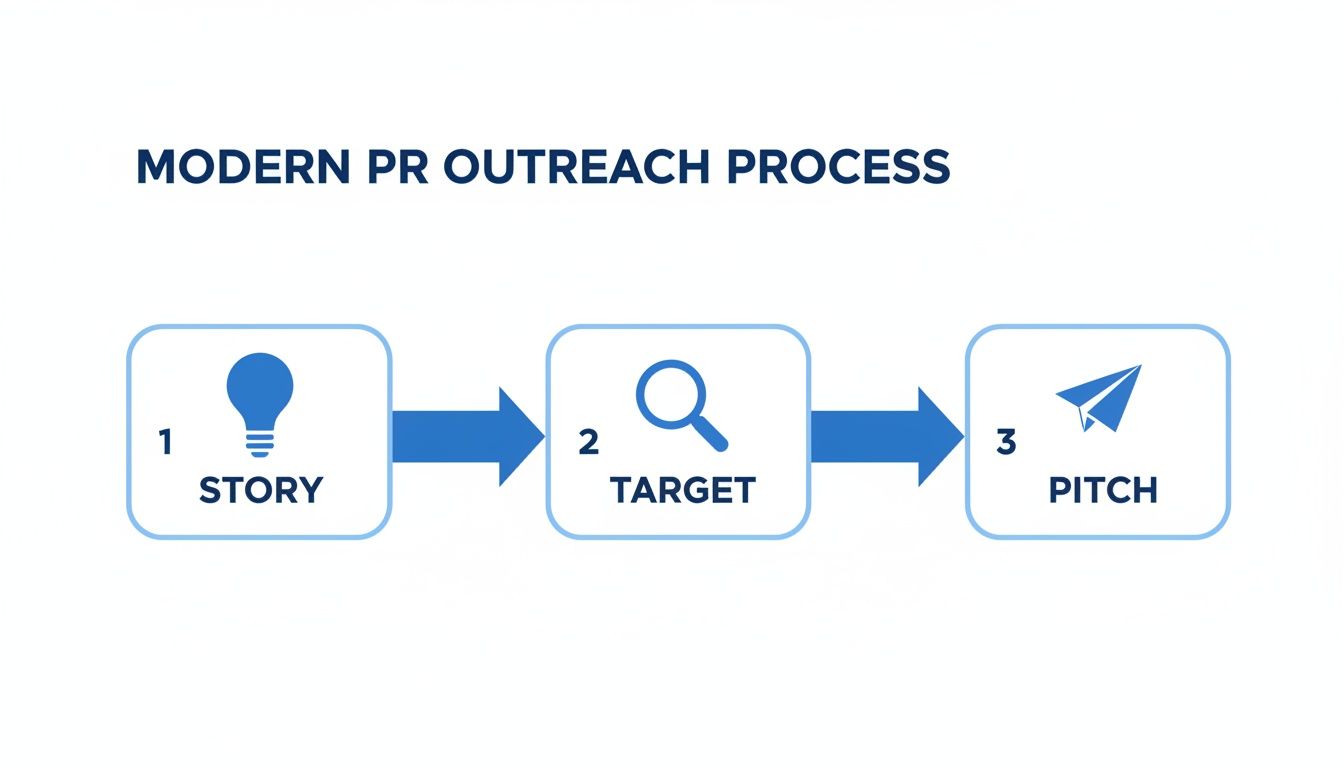
This Story, Target, Pitch model is the bedrock of any solid media relations effort.
Define Your Newsworthy Story
First things first, you need a story that a journalist will actually want to write about. Let's be honest: not everything your company does is news. A reporter’s goal is to inform, educate, or entertain their audience, so your announcement has to help them do that.
So, what makes a story compelling enough to get a reporter's attention?
- A product launch that genuinely solves a nagging industry problem in a fresh way.
- A major partnership with a well-known brand that lends you credibility.
- A significant funding round that proves investors believe in your vision.
- Original data or research you've conducted that uncovers a surprising trend.
Your story is the hook. Without a good one, even the most well-crafted outreach campaign will fall completely flat.
Identify the Right Journalists
Once you’ve nailed down your story, you need to find the right people to tell it to. Spraying and praying—blasting your news to a massive, generic list of contacts—is a surefire way to get your email deleted. Precision is your best friend here.
Look for journalists who have actually covered your industry or niche before. If you’re a SaaS company, find reporters who live and breathe software. Got a new consumer gadget? You need to find the journalists who review tech products for a living. Relevance is everything.
Building these targeted media lists takes some work, but it’s arguably the most important part of the entire process. For a deeper dive, check out our guide on how to contact journalists the right way.
Craft a Personalized Pitch
Finally, it's time to write an email that actually gets a response. A great pitch is not a copy-and-pasted press release. It's a short, direct, and personalized message that proves you’ve done your homework.
A successful pitch respects a journalist's intelligence and their time. It gets straight to the point, explains why their specific audience would care about your story, and makes it incredibly easy for them to find all the information they need.
This whole process gets even more complex when you look at the global media picture. The 2025 World Press Freedom Index found that over 4.25 billion people live in countries where press freedom is severely restricted. In places where journalists face budget cuts and immense pressure, you have to be even more thoughtful about their challenges.
By following these steps, you can start building real relationships with the media and earn the press coverage that will help your startup grow.
The Modern Approach to Securing Press Coverage
For any startup hungry for predictable growth, the old-school PR playbook can feel like rolling the dice. It's a slow, manual grind that often depends more on who you know than the quality of your story.
Frankly, that model is broken. This is where a smarter, technology-driven strategy completely flips the script.
Instead of burning weeks digging for contacts or blasting generic emails into a black hole, modern platforms use AI to bring surgical precision to the entire process. This solves the classic PR headaches: the soul-crushing research, the struggle to personalize outreach at scale, and the nagging uncertainty of it all.
A Smarter Workflow for Modern PR
This new way of working maps out a clear path from a simple idea to a published article, making high-impact press coverage something you can plan for, not just hope for. The whole system is built on data and smart automation, designed for speed and reliability.
It really breaks down into four key stages:
- Validate Your Story First: Before you do anything, you need to know if your announcement—whether it's a new product or a seed round—actually has legs. The first step is getting a quick, honest assessment of its newsworthiness.
- Pinpoint the Right People with AI: Next, powerful algorithms scan thousands of articles and reporter profiles. They find the exact journalists who have a track record of covering your specific topic, eliminating the guesswork.
- Craft Pitches That Actually Work: Armed with data, the system helps you write personalized pitches that resonate with each journalist's beat and recent coverage. This alone can dramatically boost your response rates.
- Track Everything Transparently: Finally, you see everything as it happens on a real-time dashboard. No more wondering. You know who opened your email, who replied, and exactly when your story is published.
This dashboard gives you a bird's-eye view of every campaign, from the first pitch sent to the final article going live.
This level of insight gives you a clear picture of your ROI—something traditional PR agencies rarely offer. Many modern strategies also incorporate tools for comprehensive news monitoring to keep track of every mention you get.
This technology-first approach treats PR less like a mysterious art and more like a measurable science. It turns press coverage from an unpredictable gamble into a reliable part of your startup's growth engine.
By pairing smart automation with human expertise, this method delivers the efficiency and tangible outcomes that today's fast-moving companies need to win.
Your Press Coverage FAQs, Answered
Even with the best strategy, media relations can feel like a bit of a black box. It's totally normal for founders and marketers to have questions about how it all really works. Let's clear up some of the common uncertainties and demystify the process of getting great press.
Here are the questions I hear most often from teams just starting their PR journey.
How Long Does It Take to Actually Get a Story Published?
This is the million-dollar question, and the honest answer is: it depends. If you’re going the old-school route—manually building lists, sending cold emails, and hoping for the best—it can take months. And even then, there are no guarantees. Your success often comes down to pure luck, timing, and whether you already have a connection.
But a modern, tech-forward approach changes the game completely. When you use AI to find the right journalists at the right time and send a pitch that’s backed by data, you can dramatically shorten that timeline. We’ve seen startups land their first media mentions within a few weeks. It makes the whole process much more predictable.
What's the Real Difference Between a Press Release and a Pitch?
This one trips a lot of people up, but the distinction is crucial. A press release is a formal, almost legalistic document announcing company news. It’s written in a rigid format and usually blasted out far and wide using a paid wire service. Think of it as a public bulletin.
A pitch, on the other hand, is a short, personal email you send directly to a journalist. Its only job is to convince that one person that you have a story their specific readers will love. For earning genuine, high-impact coverage, a sharp, targeted pitch beats a generic press release every single time.
A press release announces news to everyone. A great pitch sells a story to someone specific. Understanding this difference is key to building genuine relationships with the media.
How Can I Actually Measure the ROI of Press Coverage?
Tracking the return on your PR investment isn't about finding one magic number. It’s about looking at a blend of hard data and brand impact to see the full picture.
Quantitative metrics are the tangible results you can track:
- Referral traffic coming to your website directly from the article.
- New sign-ups or leads who say they saw the story.
- Mentions, shares, and comments about the article on social media.
- A bump in your website’s Domain Rating (DR) thanks to a quality backlink.
Qualitative metrics are about the bigger brand story:
- Building credibility and trust with potential customers.
- Catching the eye of investors and potential partners.
- Attracting top talent who want to join a company they’ve read about.
The easiest way to see this all come together is by using a platform with a built-in dashboard. That way, you can draw a straight line from your outreach efforts to these meaningful business outcomes.
Ready to turn unpredictable PR into a reliable growth channel? With PressBeat, our AI-powered platform validates your story, targets the perfect journalists, and guarantees up to three high-quality press articles per month. See how we deliver transparent, predictable results by visiting our website.