
A Perfect News Release Format Example Journalists Actually Read
February 4, 2026
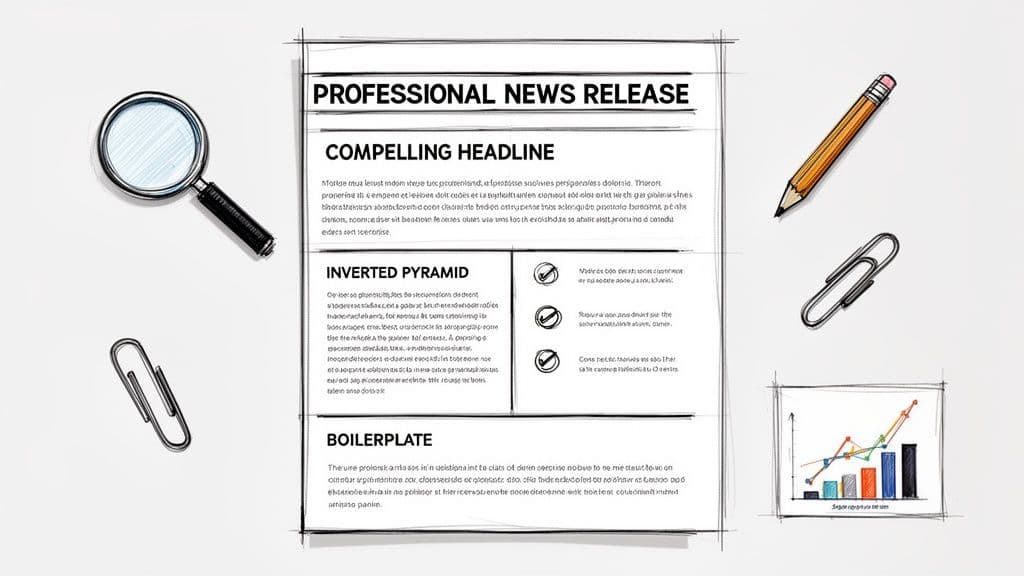
A proper news release format is non-negotiable. At a glance, it should have a bold headline, a dateline, an opening paragraph that gets right to the point, followed by body paragraphs that add detail and quotes, an "about us" section (the boilerplate), and clear media contact details.
Sticking to this structure is one of those unwritten rules of PR. It’s what journalists expect to see, making your announcement feel professional and easy to scan.
The Core Elements of a Professional News Release Format
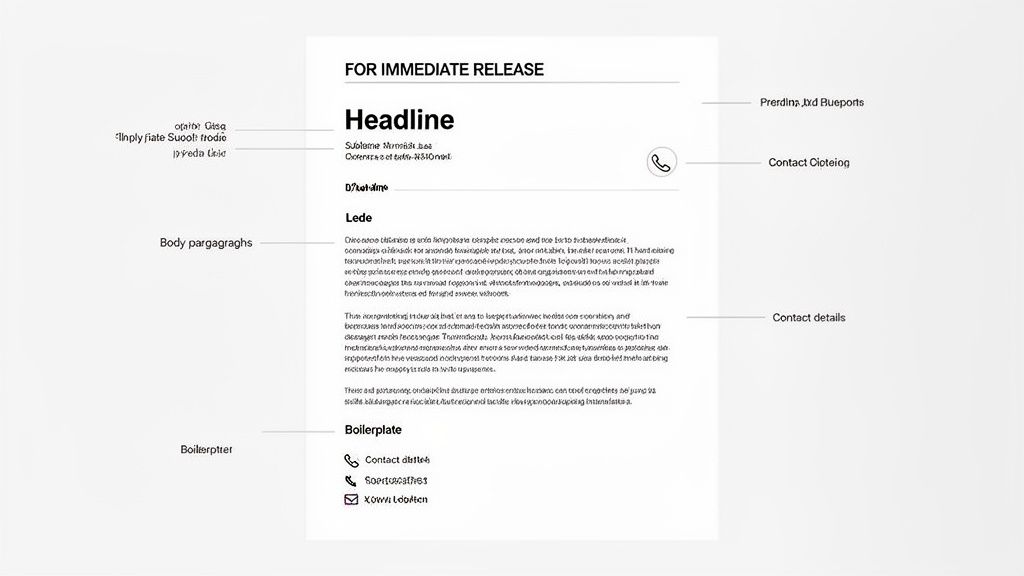
Before you even start writing, you need to know the anatomy of a press release. Think of it as a universal blueprint that every reporter and editor recognizes.
When your release follows this conventional layout, you’re signaling that you understand their world and respect their time. This instantly boosts your credibility and dramatically increases your chances of getting noticed. Stray from the path, and you risk your email getting deleted before it's even fully read.
Every piece of this structure has a job to do, guiding the reader from the most critical information down to the finer details. This isn't just about following rules for the sake of it; it's about delivering your news in the most effective way for a very busy audience.
To help you get it right every time, here’s a quick breakdown of what goes where.
Table: Essential Components of a News Release
| Component | Purpose | Best Practice Tip |
|---|---|---|
| Release Date | Tells journalists when the news can be shared. | Almost always use "FOR IMMEDIATE RELEASE" at the top left unless there's a specific embargo. |
| Headline | Grabs attention and summarizes the entire announcement in one line. | Keep it under 100 characters. Make it active, specific, and compelling. |
| Dateline | Establishes the location and date of the news. | Format it like this: CITY, State – Month Day, Year –. |
| Introduction (Lede) | The first paragraph. It must cover the essential "5 Ws" (Who, What, When, Where, Why). | Write this first and make it concise—no more than 2-3 sentences. This is the most crucial part. |
| Body Paragraphs | Expand on the lede with more details, context, and supporting facts. | Keep paragraphs short. Use the second paragraph to add important context and the third for quotes or data. |
| Quotes | Add a human voice and credibility to the story. | Attribute the quote to a key stakeholder (e.g., CEO, project lead). Make it sound authentic, not robotic. |
| Boilerplate | A short, standardized "About Us" paragraph. | This is your company's elevator pitch. Keep it consistent across all your press releases. |
| Media Contact | Provides contact information for follow-up questions or interviews. | Include a name, title, email, and phone number. Make it easy for them to reach a real person. |
| End Notation | Signals the end of the release. | A simple, centered ### is the professional standard. |
Getting these elements in the right order is the foundation of a solid press release. It shows you’re a professional who understands how the media works.
A journalist’s inbox is a battlefield for attention. A correctly formatted news release is your armor; it shows you respect their time and understand their workflow. It's the first test of your professionalism, and passing it is mandatory.
Mastering this format is the first step toward crafting a release that journalists will actually take seriously. For a more detailed look at how these pieces all fit together, check out our complete guide to the ideal news release structure.
How to Craft a Headline That Captures Media Attention
Let's be blunt: your headline is everything. It's the first—and often the only—thing a journalist sees in their crowded inbox. It’s your single shot to stop them from hitting the delete key. A weak headline means your news, no matter how important, is dead on arrival.
A great headline isn't just clever; it's a tight, powerful summary of what makes your announcement newsworthy. It needs to be active, specific, and immediately communicate why this story matters right now. Think of it as the ultimate subject line for your entire story.
Go Beyond the Obvious Announcement
The most common mistake I see is companies writing headlines that read like internal memos. "Company X Launches New Product" is a classic example. It’s boring, it’s all about you, and it gives a reporter zero reason to care.
You need to shift your mindset from announcing to storytelling. What’s the most compelling outcome of what you’re doing? Are you solving a massive pain point in your industry? Did you just hit a major growth milestone? Have you landed a game-changing partnership? That's your story.
- Weak Headline: "Innovate Inc. Hires New Chief Technology Officer"
- Strong Headline: "Innovate Inc. Taps Former Google AI Lead to Spearhead Aggressive Machine Learning Expansion"
See the difference? The second one has sizzle. It drops a credible name (Google), uses action-oriented words ("taps," "spearhead"), and hints at a much bigger story about the company's future.
A headline has to answer the reporter's silent question: "Why should I care?" If you can't do that in a few seconds, you've lost them.
Use Numbers to Prove Your Point
Journalists love numbers. Why? Because they're concrete, specific, and add instant credibility. Weaving data, funding figures, or key statistics into your headline gives it immediate weight. This is non-negotiable for funding announcements, but it works wonders for almost any story.
Which of these would you rather click on?
- Generic: "FinTech Startup Secures Series A Funding"
- Specific & Quantified: "Propel Finance Raises $15M Series A to Automate Small Business Invoicing"
It’s not even close. The second one gives the journalist everything they need: the company name, the exact funding amount ($15M), and what the money is for. In one glance, they understand the story's scale and scope.
Frame the Story with a Subheading
Your headline is the hook; the subheading is what reels them in. This is the short, one-sentence line directly below the main headline that adds that crucial bit of context. It’s the next logical step in your pitch.
Think of it as the follow-up sentence after your attention-grabbing opener. Use it to add a key detail or highlight the primary impact of the news.
- Headline: "AI-Powered Logistics Platform 'ShipSwift' Launches to Cut Shipping Costs by 30%"
- Subheading: New solution uses predictive analytics to optimize routes for e-commerce businesses, directly combating rising fuel prices and supply chain delays.
This one-two punch is incredibly effective. Leading with a hard number grabs their attention, and the subheading immediately connects it to a broader trend they’re already covering.
Especially now, with journalists facing an expected 40% drop in traffic from search engines, they're looking for stories that are easy to understand and share. Crafting a compelling press release for the modern media landscape means giving them a narrative, not just an update.
This approach is a cornerstone of any news release format example that actually works. When you start thinking like a journalist, you stop just making announcements and start pitching stories they can’t afford to ignore.
Crafting a Powerful Press Release Body: The Inverted Pyramid
You’ve nailed the headline and hooked the journalist. Now, the body of your release has to deliver on that promise. This is where you lay out the real story, and there's no better way to do it than with the inverted pyramid. It's the gold standard in journalism for a very good reason.
The idea is simple: lead with your most important, newsworthy information, then follow it up with details of diminishing importance. Journalists are trained to edit stories from the bottom up, so structuring your release this way ensures your key message survives, even if an editor has to trim it for space.
This process is all about turning an idea into a story that sticks.
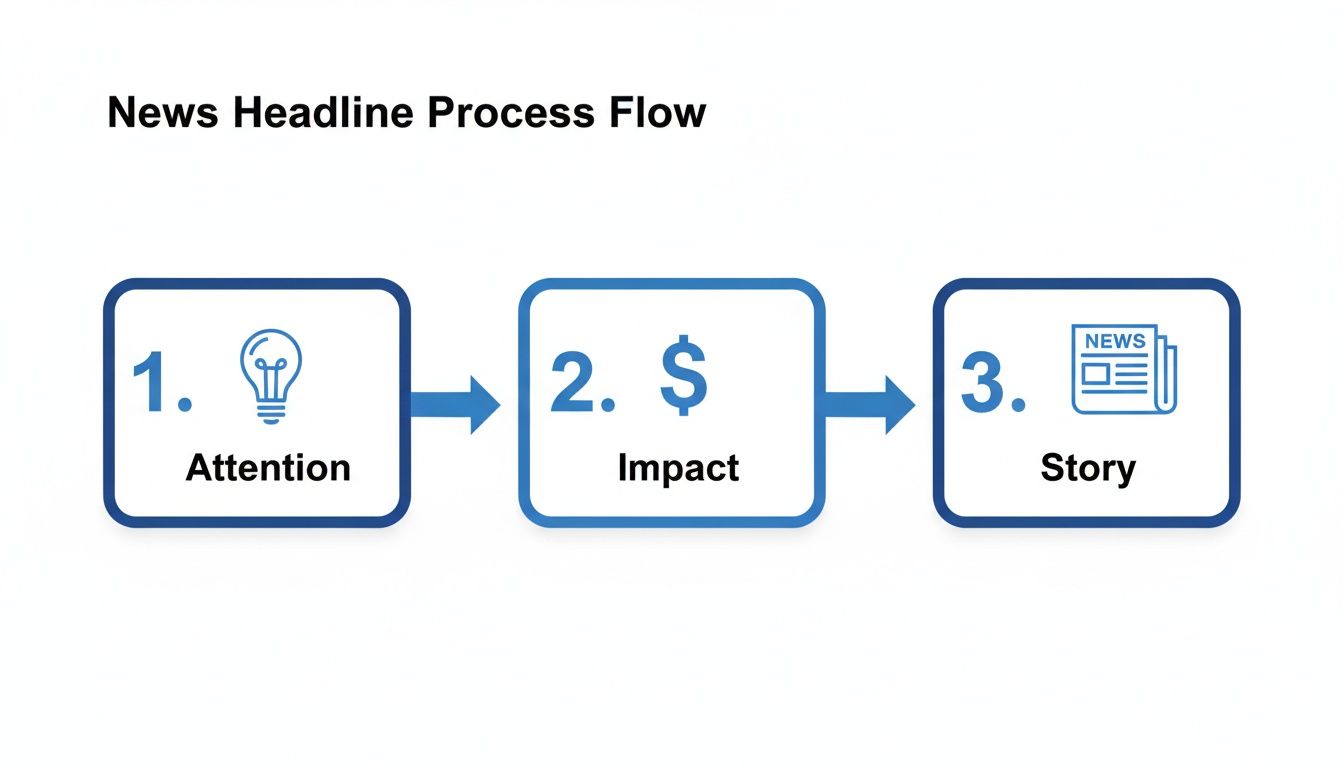
As you can see, you start by grabbing attention, then you demonstrate the impact, and finally, you wrap it all into a cohesive narrative.
Nail the Lede Paragraph
The very first paragraph, known as the lede (or lead), is the single most important part of the body. Its job is to summarize the entire story in about 30-40 words. No pressure, right? You absolutely must answer the classic "5 Ws":
- Who: Who is this news about?
- What: What is actually happening?
- When: When is this taking place?
- Where: Where is the event or announcement located?
- Why: Why should anyone care? What makes it newsworthy?
Your lede must come directly after a properly formatted dateline. The dateline establishes the origin and timing of your news, giving it immediate context and credibility.
Here’s the correct format:
NEW YORK, NY – June 1, 2024 –
Your lede should be a dense, fact-based summary. This isn't the place for flowery marketing jargon or vague promises—just a straight, concise delivery of the facts.
Flesh Out the Story with Supporting Paragraphs
With the critical info out of the way, the next few paragraphs are all about adding depth, context, and proof. This is where you bring your story to life with the details you couldn't fit into the lede.
Your second paragraph should immediately provide the most important context. If you're launching a product, use this space to explain the problem it solves. For a funding announcement, you might touch on the market opportunity you're tackling.
Think of your press release like a conversation. The headline and lede are your opening line—the icebreaker. The body paragraphs are where you prove you’re worth listening to by backing up your claims with evidence and perspective.
From here, you can weave in supporting data, statistics, and, crucially, quotes. A good quote from a CEO, a key partner, or an industry expert adds a much-needed human element. It also gives journalists a unique perspective they can lift directly for their article. Making a reporter's job easier is always a win. If they can copy and paste key elements, your chances of getting coverage skyrocket.
Stick to an Objective, AP Style Tone
If you want your release to be taken seriously, it needs to be written in a professional, objective tone. The industry standard is Associated Press (AP) Style. This means writing in the third person (using "they," "he," "she," or the company's name) instead of the first person ("we," "our").
This is more than just a stylistic quirk. It positions your release as a factual news document, not a biased advertisement. Journalists are far more likely to work with a release that requires minimal editing to fit their publication's standards. By following AP Style, you're signaling that you understand and respect how their world works. For a more detailed breakdown, our guide on how to write a press release covers these rules extensively.
Investing time in getting this right really pays off. It's no surprise that PR pros spend nearly half (48%) of their time just on writing press releases. And in a world where 93% of Americans get their news online, only the releases that are journalist-ready, factual, and easy to edit will cut through the noise.
Boosting Engagement with Multimedia and Data
Let's be honest. In a world drowning in content, a plain text press release is fighting a losing battle. To really cut through the noise and grab a journalist’s attention, you need to offer more than just words. You have to hand them the visual and data-driven assets that make your story pop.
Think of it from a reporter's point of view. Their job is to craft a compelling story for their audience. When you provide high-resolution images, an embeddable video, or a sharp-looking chart, you're not just pitching an idea. You're giving them the actual building blocks for a better, more engaging article. That makes their job easier, which makes your story far more appealing.
Making Visuals Easy to Access
One of the most common mistakes I see is companies making their assets a pain to find and download. Whatever you do, never attach large image files directly to your pitch email. It’s the quickest way to clog an inbox and annoy the very person you’re trying to impress.
The right way to do it is with a simple, easy-to-find online media kit. This can be a dedicated page on your website or even a well-organized folder on Google Drive or Dropbox. Just make sure your press release includes a direct link to it.
So, what should you put in this kit?
- High-Resolution Product Shots: Clean, professional photos of your product from multiple angles. Include some with a plain background and some "in-action" shots.
- Company Logos: Make sure you have your logo available in different formats (like PNG and SVG) to cover all design needs.
- Founder Headshots: Professional photos of your key people add a human element and are frequently used in stories.
- Action Shots: If it makes sense for your product, include images of it being used in a real-world setting.
As you get your materials ready, think about where they might end up. Preparing content in the right format is crucial, especially when optimizing your content for platforms like saucial.app.
The Power of Video and Infographics
Video is an incredibly powerful storytelling tool. A short, one-to-two-minute product demo, a customer testimonial, or a quick animated explainer can often say more than several paragraphs of text ever could. Always host your video on a platform like YouTube or Vimeo and provide the simple embeddable link.
This screenshot from PRWeb's homepage really drives home their focus on multimedia press release formats, a trend that has completely reshaped digital PR.
You can see how the layout integrates visuals and data right into the announcement, which is what makes them so much more engaging and shareable for online audiences.
A well-designed infographic can take complex data and make it simple, understandable, and incredibly shareable. If you're announcing survey results or market growth, a chart is always going to be more impactful than just listing numbers in a sentence.
This approach has been a total game-changer. Since the early 2010s, distribution services have championed these video-infographic hybrids, and it’s easy to see why. They can multiply a story's reach on platforms that are built for embeddable content. With data showing that 93% of Americans now get at least some of their news online, journalists are always on the hunt for content that's easy to skim and visually interesting. Give it to them upfront, and you've got a huge advantage.
Weaving Data into Your Narrative
Finally, don't just state your data—show it. If your announcement is about hitting a major revenue milestone, a simple bar chart showing that growth trajectory is perfect. Launching in a new market? A map highlighting your expansion can be incredibly effective.
These data visualizations do two things at once. First, they act as "thumb-stoppers" that catch a reader's eye when scrolling through social media. Second, they provide journalists with credible, easy-to-digest evidence to back up the claims you’re making in your release. The right visual can turn a simple announcement into a story that people feel compelled to share.
Wrapping It Up: The Boilerplate and Final Touches
How you wrap up your press release is just as important as that killer headline you spent an hour on. Once you've laid out the core of your announcement, the final two pieces—your boilerplate and media contact details—are what give a journalist the context and the direct line they need to follow up. Don't treat them like an afterthought; they're the professional bookends to your story.
Think of your boilerplate as your company's official bio. It’s a tight, consistent paragraph that sits at the very end of every press release you send. It gives reporters a quick snapshot of who you are, what you do, and what makes you tick, saving them a trip to your website for the basic facts.
More than just a convenience, a well-written boilerplate is a powerful tool for brand consistency, reinforcing your clear branding and messaging with every announcement.
What Goes Into a Boilerplate?
Crafting a good boilerplate isn't rocket science. The goal is to be concise but comprehensive, usually landing somewhere between 50 and 100 words. A solid boilerplate gives a journalist the full picture without the fluff.
Here are the key ingredients you should always include:
- Who you are: Start with your company's full name and its core mission.
- What you do: Briefly mention your main products or services.
- Who you serve: Name your target audience or the industry you operate in.
- What makes you special: This is your unique value proposition. It could be your unique tech, a major milestone, or your market position.
- Your digital front door: Always, always include a link to your company’s website.
A great boilerplate answers the question, "Who is this company?" before a journalist even has to ask. It’s your elevator pitch, standardized for the media, ensuring your core identity is communicated consistently every single time.
Taking the time to get this small section right adds a layer of professionalism that busy reporters really appreciate. If you want to dig deeper, we have a whole guide on what a press release boilerplate is and how to make it shine.
Don't Forget Your Media Contact
Right after the boilerplate, you need a crystal-clear media contact section. If a journalist is hooked, they need to know exactly who to call or email for a quote, an interview, or more details. Hiding this information is one of the fastest ways to lose out on potential coverage.
Keep the format clean and simple. Use a straightforward heading like “Media Contact:” and list the information so it’s easy to scan.
Here’s how it should look:
Media Contact: Jane Doe Communications Manager jane.doe@examplecompany.com (555) 123-4567
The Final Sign-Off:
Last but not least, every press release officially ends with a simple, universally recognized symbol: three pound signs (or hashtags) centered on their own line right below your contact info.
###
This might seem like a small, quirky detail, but it’s a long-standing tradition in journalism that signals the end of the release. It tells an editor, "That's all, folks," leaving no room for confusion. Including it is a subtle nod to the fact that you know how the game is played, adding one final touch of professionalism to your announcement.
News Release Format Examples for Common Scenarios
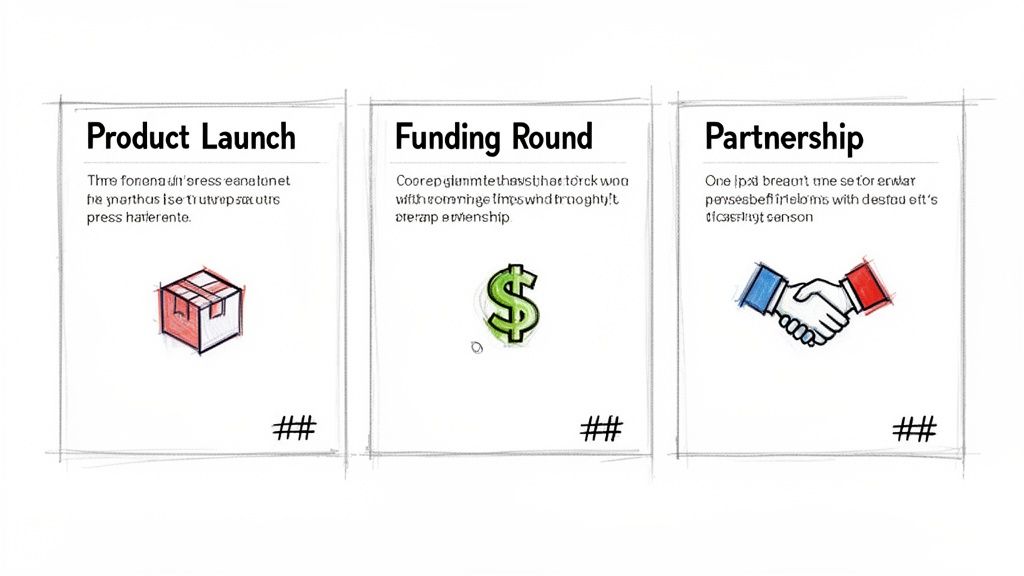
Knowing the rules of a press release is one thing; seeing them in action is another. The foundational structure—headline, dateline, body, boilerplate—is your constant, but the story you tell within that framework changes with every announcement.
A product launch needs to buzz with excitement, while a funding announcement has to project confidence and a clear path forward. It's all about tailoring your message to the news itself.
Let's walk through a few of the most common scenarios you'll encounter. I’ll break down what makes each one work, so you can adapt these strategies for any announcement that comes your way.
Example for a New Product Launch
When you're launching a new product, your press release is all about generating excitement and answering the "so what?" question for reporters and potential customers. It’s not enough to list features. You have to connect those features to real-world benefits.
Your headline needs to pack a punch and lead with the value proposition. A generic "Company Launches New Software" is a guaranteed snooze. Instead, try something specific and benefit-driven like, "InnovateTech Unveils 'ConnectSphere,' an AI-Powered Platform Proven to Reduce Meeting Times by 40%." Now that's a story.
Once you’ve hooked them, the body of the release should deliver on that promise:
- Your opening paragraph should quickly summarize the what, who, and why of the launch.
- Include a sharp quote from your CEO or Head of Product that explains the vision—the big problem you're solving.
- Use a bulleted list to highlight 3-4 key features and tie each one to a tangible benefit. Think "Automated Scheduling: Say goodbye to the endless email chains trying to find a time that works."
- Always include clear details on pricing and availability, with a direct link to the product page so journalists can see it for themselves.
A product launch release isn’t just an announcement; it’s your first sales pitch to the media. Frame your product as the solution to a well-known industry headache, and you’re handing reporters a story angle on a silver platter.
Example for a Major Funding Round
Announcing a funding round is about signaling momentum. The story here is one of investor confidence, market validation, and ambitious plans for the future. The focus shifts from the product itself to the trajectory of the business.
Your headline needs to be direct and impressive, stating the amount and the lead investor. For example: "HealthTech Innovator Medivise Secures $25M Series B Led by Venture Capital Firm Growth Equity Partners to Expand Telehealth Services."
The body of the release needs to build on that initial punch by covering a few key points:
- Clearly state the total funding amount and the round (e.g., Seed, Series A, Series B).
- Name the key investors who participated. This is a crucial credibility marker.
- Get a powerful quote from your CEO that explicitly states how the capital will be used. Will you be expanding into new markets, doubling the engineering team, or scaling a new product line? Be specific.
- A supporting quote from the lead investor is gold. It provides powerful, third-party validation that speaks volumes.
Example for a Strategic Partnership
When you announce a partnership, you’re telling a story of collaborative strength. The narrative should highlight how the partnership creates value that neither company could achieve alone—and most importantly, what that new value means for customers.
The headline should clearly name both partners and the primary outcome. Something like: "E-Commerce Leader ShopFast and Global Logistics Giant DeliverAll Partner to Offer Same-Day Delivery to 50 Million New Customers."
The body of the release needs to explain the "why" behind the deal. It's crucial to include quotes from leaders at both companies to show a united front. The more you can focus on a concrete outcome—like a newly integrated feature, access to an expanded market, or a co-developed product—the more newsworthy the announcement becomes.
Not sure which angle to take for your announcement? This quick guide can help you choose the right template and focus your message.
News Release Template Selector
| Announcement Type | Key Focus Element | Example Headline Angle |
|---|---|---|
| New Product Launch | Customer Benefits & Innovation | "Company X Launches [Product Name] to Solve [Customer Pain Point] with [Key Feature]" |
| Funding Round | Growth & Investor Confidence | "[Company Name] Secures [$X Million] in Series [X] Funding to [Specific Goal]" |
| Strategic Partnership | Mutual Benefit & Combined Strength | "[Company A] and [Company B] Partner to Deliver [Combined Benefit] to [Target Audience]" |
| New Hire/Executive | Expertise & Strategic Vision | "[Industry Veteran Name] Joins [Company] as [New Role] to Drive [Company Goal]" |
| Company Milestone | Scale & Market Leadership | "[Company] Celebrates [Specific Milestone, e.g., 1 Million Users] as Demand Soars" |
| Event Announcement | Value & Attendee Experience | "[Company] to Host [Event Name] Featuring [Keynote Speaker/Theme] for [Audience]" |
Each announcement has a unique story to tell. By focusing on the right elements from the very start, you make it much easier for a journalist to see the news value in your release.
Answering Your Top Press Release Formatting Questions
Even with the best templates in hand, a few common questions always seem to pop up. Nailing these small details can make a huge difference in how a journalist receives your news, so let's clear up a few of the most frequent ones.
How Long Should a Press Release Be?
This is probably the number one question I get. The sweet spot is between 400 and 500 words.
Why that specific range? It's just enough space to give the essential who, what, when, where, and why, but short enough to fit on a single page. Remember, reporters are swimming in pitches. Keeping it concise respects their time and forces you to get straight to the point.
If you follow the inverted pyramid model, you can be confident that even a quick scan will deliver the core message. Anything longer, and you risk it being skimmed over or, worse, ignored completely.
How Do I Write a Good Quote?
Another common sticking point is the quote. A great quote should inject some personality and perspective into your announcement; it shouldn't just be a dry restatement of the facts. Think of it as the place to explain the why behind the news.
Pro Tip: A strong quote gives your announcement a human voice. Ditch the generic 'We are excited to launch this product.' Instead, try something with impact: 'After talking with hundreds of our customers, we built this to solve their biggest pain point—it will save them an average of 10 hours a week.'
Should I Send My Release as a PDF Attachment?
In a word: no. Please, don't do this. It’s one of the fastest ways to get your pitch deleted.
Here’s why sending a PDF is a bad idea:
- Security Risks: Many journalists and entire media outlets have filters that block emails with attachments, or they have policies against opening them from unknown senders.
- Extra Work: It creates an unnecessary barrier. Forcing a busy reporter to download and open a file is adding friction to a process that needs to be seamless.
Always paste the full text of your press release directly into the body of your email. Make it as easy as possible for them to read and copy-paste your content.
For high-res images, videos, or logos, simply link to a cloud folder (like Dropbox or Google Drive) or an online press kit. Convenience is everything.
Ready to secure guaranteed media coverage without the guesswork? PressBeat uses AI to connect your story with the right journalists, delivering predictable press articles from high-authority outlets. See how our platform can land you in the headlines. Learn more and get started today.