
What Do Press Releases Look Like in Today's Media
December 9, 2025
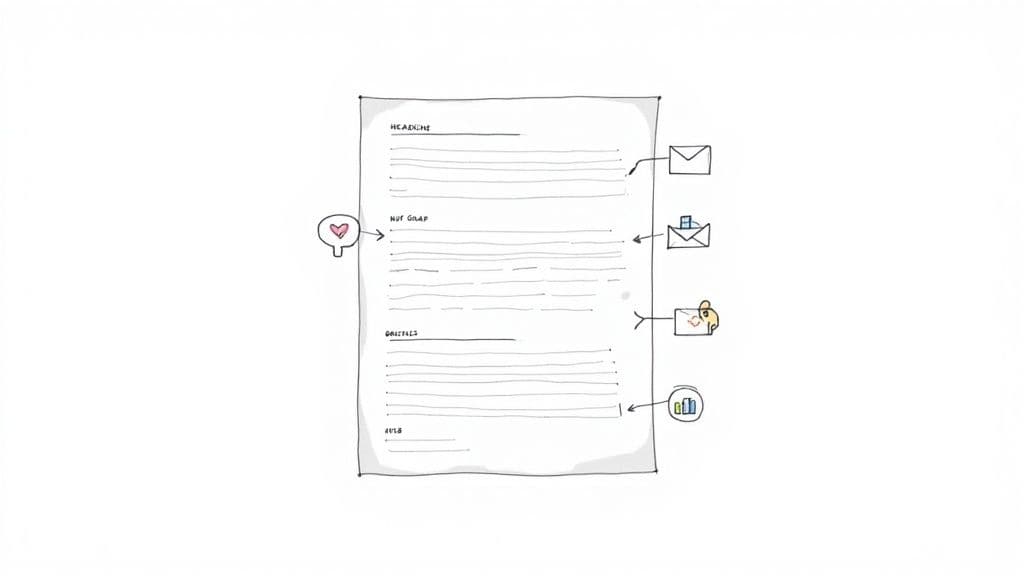
Think of a modern press release as a professional news document, not a sales pitch. It’s built on a specific, time-tested framework that journalists instantly recognize and respect. This isn't about being stuffy; it's about being clear, credible, and efficient.
The Anatomy of a Modern Press Release
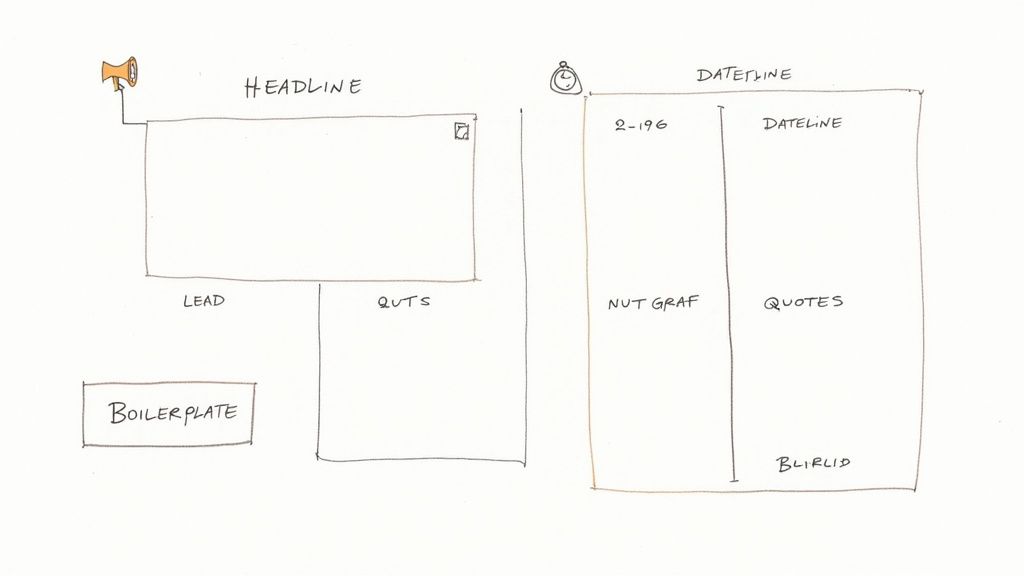
The best way to understand the structure is to see it as a toolkit you're handing to a journalist. Every single piece, from the headline down to the contact info, has a job to do. This isn't just a random document; it's a carefully assembled package designed to give a busy reporter everything they need, exactly where they expect to find it.
This predictable layout is your friend. It signals that you know what you’re doing and makes the information incredibly easy for a journalist to scan and digest. When they see this format, they know you're speaking their language.
Core Structural Components
Each part of the press release plays a critical role in telling your story. From the very first word to the last, the layout guides the reader logically through the announcement. We'll get into the specifics of how to write a press release that gets results, but first, let's break down the essential building blocks.
- Headline: This is your hook. It has to be a powerful, attention-grabbing statement that gets straight to the most newsworthy angle. No fluff.
- Dateline: Simple but crucial. It lists the city, state, and date of release (e.g., "NEW YORK, NY – October 26, 2024"). This immediately grounds the story in a time and place.
- Introduction (The Lead): Arguably the most important paragraph. It must concisely answer the "who, what, when, where, and why" right at the top. If a journalist only reads this part, they should still get the gist of the story.
- Body Paragraphs & Quotes: Here’s where you add the supporting details and context. Quotes are vital—they bring a human voice to the story, whether from your CEO or a key project lead, adding a layer of personality and authority.
- Boilerplate: This is your "About Us" section. It's a short, standardized paragraph at the end that gives a quick snapshot of your organization.
- Contact Information: Makes it dead simple for a journalist to follow up. Include a name, email, and phone number for your media contact. Don't make them hunt for it.
For a deeper dive into how to piece these elements together flawlessly, check out our complete guide on the proper https://www.pressbeat.io/blog/press-release-structure.
A Quick-Reference Blueprint
To help you visualize how these components work together, here’s a quick-reference table. It breaks down each part of a press release and its specific job, giving you an at-a-glance guide to the format journalists expect.
Anatomy of a Standard Press Release
| Component | Purpose and Key Characteristics |
|---|---|
| Headline | Grabs a journalist's attention and summarizes the core news in one powerful, punchy line. |
| Dateline | Establishes the location and date of the news, providing essential context and timeliness. |
| Introduction | Delivers the most critical information upfront, answering the 5 Ws (Who, What, When, Where, Why). |
| Quotes | Adds a human element and an authoritative voice, usually from company leadership or an expert. |
| Boilerplate | Provides a standardized, concise "About Us" paragraph for consistent company branding. |
| Contact Info | Allows journalists to easily connect for more information, interviews, or clarifications. |
Mastering this structure isn't just about following rules; it's about building a bridge between your announcement and the journalists you want to reach.
Crafting Each Element for Maximum Impact

Knowing the components of a press release is one thing. Knowing how to write them to actually get a journalist's attention is a whole different ballgame. The key is understanding that journalists are swamped. They don’t have time to dig for your story. That's why the entire format is built on a classic journalistic principle: the inverted pyramid.
Think of it like a funnel. You pour all the must-know, critical information in at the top. The further down you go, the more specific and supplemental the details become. This isn't just a quirky tradition; it’s a tool built for efficiency. A reporter should be able to get the gist of your entire announcement just from the headline and the first paragraph. Everything after that is just context and color.
The Headline and Lead Paragraph
Your headline is your first—and maybe only—shot to make an impression. It has to be active, direct, and interesting enough to stop a journalist from hitting the delete key. In about 10-15 words, it needs to nail the core of your announcement. It's less of a title and more of an email subject line that demands to be opened.
Right below it comes the lead paragraph, your 30-second elevator pitch. This is where you have to immediately answer the "Five Ws":
- Who is this about?
- What is the actual news?
- When is this happening?
- Where is the location or area of impact?
- Why should anyone care?
This paragraph has to stand on its own. If a busy reporter ripped out just this section for a quick news brief, they should have every critical fact they need to do it accurately.
Pro Tip: A press release is built for speed. If a journalist can't figure out your main point within 15 seconds, they're gone. They have hundreds of other emails to get through.
Modern Formatting Best Practices
While the inverted pyramid is timeless, the look and feel of a press release have definitely changed. We're not just sending out pages of dense text anymore. Today’s releases are built to be scanned quickly and are packed with multimedia.
To make sure your release looks professional and is actually useful for a modern newsroom, stick to these guidelines:
- Keep it Tight: The sweet spot for a press release is between 300 and 500 words. Any shorter, and it feels flimsy; any longer, and you're asking too much of a busy reader. This isn't just about brevity—we've seen that releases in this range often generate between 5 and 20 quality backlinks. If you want to dive deeper, check out these public relations statistics that show just how much impact a well-crafted release can have.
- Add Visuals: Don't just attach a photo and hope for the best. Embed a high-resolution image, your logo, or even a small infographic right into the document. It breaks up the text and gives the journalist a visual they can use immediately.
- Use Smart Hyperlinks: Link your company name, key products, or technical terms directly to relevant pages on your site. This gives reporters instant access to more information and, as a nice bonus, helps your SEO.
- Include a Clear Call to Action: Tell the journalist exactly what you want them to do next. End with a clear, direct instruction like, "To schedule an interview, please contact..." or "For a full media kit and product demos, visit..."
By paying attention to these details, your press release stops being just an announcement and becomes a powerful tool that works with a journalist, not against them.
Real-World Press Release Examples

The fastest way to truly grasp how press releases work is to see them in action. While the core structure—headline, lead, quotes—is universal, the tone, angle, and details change dramatically based on the industry and the news itself. A tech startup launching an app will sound completely different than a nonprofit announcing a community project.
By looking at a few examples from different sectors, you can see just how flexible this format is. Let's break down a few common scenarios to see how the same blueprint is adapted for a product launch, a corporate update, and a new partnership.
Tech Startup Product Launch
Picture a fictional tech company, "InnovateAI," launching its brand-new productivity software. The main goal here is to whip up excitement and show tech journalists and potential customers exactly what the product does.
Their press release would look something like this:
- Headline: InnovateAI Launches 'Momentum,' an AI-Powered Project Management Tool Proven to Boost Team Efficiency by 40%.
- Lead Paragraph: It would get straight to the point: what Momentum is, who it's for (remote teams, agile developers), and the big problem it solves (messy workflows).
- Quote: A quote from the CEO would bring the vision to life. Something like, "We built Momentum to eliminate the friction in modern collaboration, giving teams their time back to focus on what truly matters."
- Body: The next few paragraphs would dig into specific features, maybe mention some glowing results from beta testers, and include pricing details. It’s all about being factual and benefit-driven.
- Boilerplate: This final section would offer a quick, tight summary of InnovateAI—its mission and where it sits in the SaaS market.
This example is direct, data-heavy (40%!), and focused on a real solution. If you want more inspiration, check out this curated collection of examples of great press releases that nail these best practices.
Corporate Restructuring Announcement
Now, let's shift gears to a much more sensitive topic. Imagine a major retailer having to announce a corporate restructuring. The goal here isn't buzz; it's clarity, reassurance, and tightly controlled messaging.
The tone has to be formal, empathetic, and authoritative. The whole point is to manage the narrative and give clear, consistent information to everyone from employees and investors to the general public.
An announcement about restructuring needs to project stability and confidence. The language is carefully chosen to address concerns head-on while framing the changes as a strategic step toward future growth.
Here’s how that blueprint gets adapted:
- Headline: Global Retail Inc. Announces Strategic Realignment to Strengthen Customer Focus and Drive Long-Term Growth.
- Lead Paragraph: This would state the decision—the restructuring—but immediately frame it as part of a larger, forward-thinking strategy. It’s all about explaining the "why" behind a tough call.
- Quote: The CEO’s quote would need to acknowledge the human impact while stressing why the change is critical for the company's future. For example: "While these decisions are difficult, they are necessary to build a more resilient company."
- Body: This part would give more context, like the number of roles or locations affected, but without getting bogged down in messy details. It would also be sure to highlight the positive—like new investments in other parts of the business.
- Call to Action: The release would probably point journalists to a detailed FAQ page or an upcoming investor call for more information.
Non-Profit Partnership Announcement
Finally, let's look at a non-profit, "GreenFuture Foundation," partnering with a corporation to fund a new environmental program. Here, the goal is to celebrate collaboration and shine a spotlight on positive social impact.
The press release would be structured for inspiration and credibility:
- Headline: GreenFuture Foundation and EcoCorp Partner to Plant One Million Trees in Urban Communities.
- Lead Paragraph: It would introduce both organizations right away and state the shared goal of the initiative, putting the community benefit front and center.
- Quotes: This kind of release works best with quotes from both the non-profit's Executive Director and the corporation's Head of Sustainability. This shows it’s a genuine partnership, not just a transaction.
- Body: The details would cover the program's scope, the timeline, and which regions will benefit. A powerful statistic about the impact of urban green spaces would be a great addition here.
Each of these examples uses the same press release skeleton, but they all tailor the language, tone, and focus to hit a very specific communication goal.
A Fill-in-the-Blank Press Release Template to Get You Started
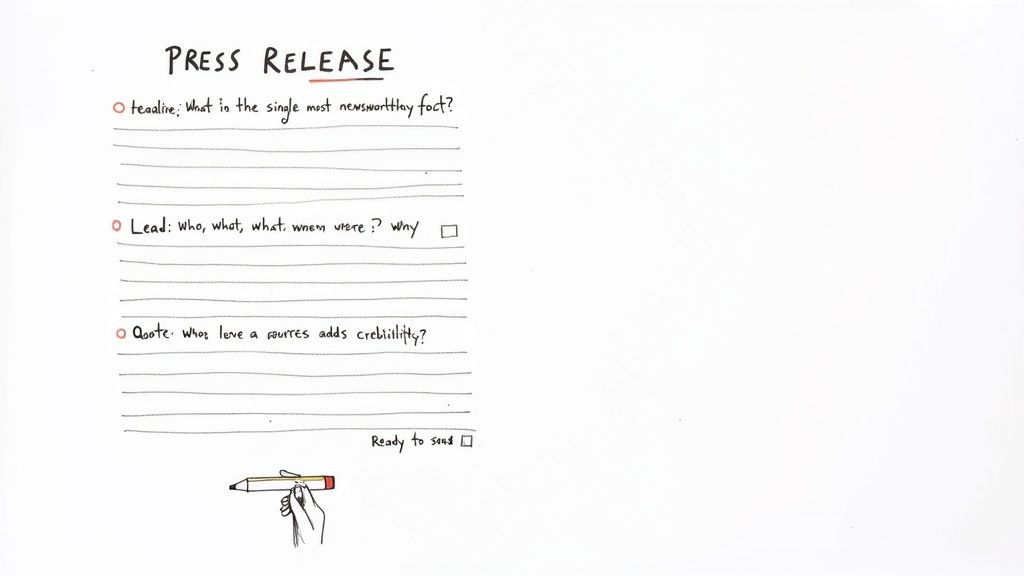
Knowing the theory is one thing, but the fastest way to get comfortable with the press release format is to actually write one. To make it easier, I’ve put together a simple, fill-in-the-blanks template you can use right away.
Think of this less as a rigid set of rules and more as a guide to keep you on track. It’s designed to make you think like a journalist by prompting you to include every critical piece of information, right where they expect to find it. The headline field pushes you to find that one newsworthy angle, and the quote section reminds you to add a human voice, not just dry facts.
The Plug-and-Play Template
Just copy this structure and replace the bracketed text with your information. It’s that simple.
- FOR IMMEDIATE RELEASE
- HEADLINE: [Action Verb + Specific, Newsworthy Announcement with a Key Number or Benefit]
- Sub-headline: [Optional: One Sentence Elaborating on the Headline's Main Point]
- DATELINE – CITY, State – (Month Day, Year) – [Start with your introductory paragraph here. Nail down the who, what, when, where, and why in just 2-3 sentences.]
- [Body Paragraph 1]: [Give the reader more context. What problem does your news solve? What opportunity does it create?]
- [Quote]: [Drop in a powerful quote from someone important, like the CEO, a client, or the project lead. It needs to add personality and perspective, not just echo the facts.]
- [Body Paragraph 2]: [Back up your claims. Add more supporting details, data, or information about the real-world impact of your announcement.]
- About [Your Company Name]: [This is your boilerplate. A short, professional paragraph about your company, its mission, and what it does.]
- Media Contact:
- [Name]
- [Title]
- [Email Address]
- [Phone Number]
- [Company Website]
- ###
Remember, this format is all about making a journalist's job easier. A clean, well-structured release shows you respect their time, which instantly makes them more likely to read what you've sent.
Want to see how this framework looks in the wild? You can check out some of the best press release templates, samples, and examples for more inspiration. For a fully built-out version of this structure, take a look at our own press release example template to see it all come together.
Getting Your Press Release into the Right Hands
Crafting a perfect press release is only half the battle. If it never lands in front of a journalist, it's like writing a brilliant book and leaving it locked in a drawer. The next critical step is distribution—the art of getting your announcement in front of the right people who can amplify your story.
This isn't about just hitting "send" and hoping for the best. A solid distribution strategy is key. You really have two main paths to choose from: using a newswire service or building your own media list for a more personal touch. Each has its own strengths, and the best choice depends entirely on what you're trying to achieve.
Newswires vs. Direct Outreach
Think of a newswire service as a massive megaphone. These platforms blast your release out to hundreds, sometimes thousands, of media outlets all at once. It's an incredible way to get broad exposure, especially for getting your news indexed by search engines and picked up by news aggregators. It’s all about volume and sheer reach.
Direct outreach, on the other hand, is like using a sniper rifle instead of a shotgun. You carefully build a list of specific journalists who live and breathe your industry, then send them a personalized pitch. It’s more work, no doubt, but this targeted approach often results in higher-quality, more thoughtful coverage because you're reaching reporters who are genuinely invested in your world.
The core question to ask is: Do I need mass awareness or a few high-impact stories? Your answer will determine which distribution method is right for your announcement.
How to Pitch a Journalist Effectively
If you go the direct outreach route, your email pitch is your first and only impression. Journalists are swimming in emails; their inboxes are a constant flood of pitches, requests, and follow-ups. In fact, a single journalist can get around 100 press releases every day.
Even with that volume, 74% of journalists say they still prefer to get news this way. This tells us one thing loud and clear: a good pitch still works. You can learn more by exploring these press release statistics and data-driven insights.
To make sure your pitch isn't one of the dozens that gets deleted, stick to these simple rules:
- Nail the Subject Line: Keep it short, specific, and compelling. Instead of a generic "Press Release from [Your Company]," try something like, "New Study: 75% of Remote Workers Face Burnout." Lead with the headline.
- Show You've Done Your Homework: A little personalization goes a long way. Address the journalist by name and maybe mention a recent article of theirs you found interesting. It shows you see them as a person, not just a contact.
- Get Straight to the Point: In the first sentence or two, tell them what the news is and why their readers should care. Don't bury the lead.
- Attach, Don't Paste: Attach the press release as a PDF or Word doc. Pasting the entire thing into the email body is a classic rookie mistake—it's clunky, overwhelming, and looks unprofessional.
At the end of the day, the single biggest factor for getting coverage is newsworthiness. Before you send anything, take a step back and ask yourself: Is this actually interesting to someone outside my company? Is it timely? Does it have a real impact? If you can honestly say yes, then a well-written release and a thoughtful pitch will give your story the best possible shot.
Answering Your Top Press Release Formatting Questions
Even when you know the basic structure, a few common questions always pop up about how to format a press release for today's media. Let's dig into some of the most frequent ones I hear from clients, because getting these details right can make all the difference.
What's the Single Most Important Part of a Press Release?
If you get nothing else right, nail the headline and the first paragraph. No question. Think of it like a movie trailer—if it doesn't hook you in the first 30 seconds, you're not going to watch the film. Journalists are exactly the same; their inboxes are overflowing, and they make snap judgments.
Your headline needs to be a strong, clear summary of your actual news. The lead paragraph right below it has to quickly deliver the "who, what, when, where, and why." If a reporter can't grasp the entire point of your announcement from just those two elements, they'll hit delete without a second thought. The rest of your beautifully crafted press release won't even get a glance.
Should I Bother Including Images or Videos?
Yes, you absolutely should. A few decades ago, press releases were just walls of text. That's not the world we live in anymore. Including high-resolution images, your company logo, a helpful infographic, or a link to a short video isn't just a nice-to-have; it's what journalists expect.
Visuals accomplish two critical things:
- They make it easier to read. Big blocks of text are intimidating on a screen. Images break things up and make your release more inviting.
- They give journalists ready-to-use assets. You're not just sending information; you're sending a story kit. This makes it far easier for them to quickly build a post or article around your news.
A press release packed with relevant multimedia is much more likely to catch a journalist's eye. It shows you’re a professional who has prepared a complete package for them.
How Have Press Releases Changed Over the Years?
The biggest evolution has been the shift from a format designed for print to one built for the internet. This has completely changed how they look and function. With the global PR market expected to reach $133.82 billion by 2027, adapting to this digital-first mindset is non-negotiable. You can read more about how digital PR is changing the game.
Here are the key differences:
- Hyperlinks are everywhere: You don't just mention your company; you link directly to your website, the new product page, or the report you're citing.
- SEO is part of the game: Smart PR pros weave in relevant keywords to help their news get discovered on Google.
- They’re built for scanners: Short paragraphs, bullet points, and clear subheadings are now mandatory for anyone reading on a screen (which is everyone).
Forget the old fax machine mentality. The modern press release is an interactive tool designed for clicks, shares, and search engines.
Ready to stop guessing and start getting your news in front of the right journalists? PressBeat uses AI to find and pitch reporters who actually cover your industry, guaranteeing you high-quality media placements. See how we can get your story featured in top publications.