
Mastering the Public Relations Pitch to Earn Media Coverage
December 16, 2025
A brilliant public relations pitch can land you incredible media coverage, but let's be real—sending one often feels like shouting into the void. If you're tired of your emails getting ignored, you need to understand one simple truth: a journalist's inbox is one of the most competitive places on the internet.
Getting your head around this is the first, and most important, step to crafting a pitch that actually gets opened.
Why Your Pitches Are Getting Deleted (and What to Do About It)

Before we even get into the nuts and bolts of writing a great pitch, you have to appreciate the sheer volume of noise you’re up against. A modern journalist’s inbox is an absolute warzone for attention. Sending a generic, mass-blasted email isn't just a bad idea; it's a one-way ticket to the trash folder.
The numbers don't lie. Recent data shows that 49% of journalists get hit with up to 50 pitches every single week. That’s more than 10 pitches a day for many of them. The problem is only getting worse, with more and more reporters saying they receive 11-20 pitches daily. If you want to dig deeper, you can find more insights on PR statistics and trends that highlight just how competitive the field has become.
Welcome to the Era of Pitch Fatigue
This relentless flood of emails has created a very real phenomenon: pitch fatigue. Journalists are swamped, working against impossible deadlines. They simply don’t have the bandwidth to wade through pitches that are irrelevant, poorly written, or self-serving.
Over time, they develop an incredibly fine-tuned filter. They scan a subject line and the first sentence for immediate value. If your pitch doesn't scream relevance, personalization, and newsworthiness in those first few seconds, it’s gone. Deleted.
This is why some of the most common pitching mistakes are so fatal:
- Zero Personalization: A "Dear Editor" or "To Whom It May Concern" is an instant giveaway that you haven't done five minutes of research.
- Wrong Beat: Pitching your new SaaS platform to a food blogger? You've just wasted their time and burned a potential bridge.
- Purely Promotional: If your pitch is all about how great your company is without connecting it to a bigger story, trend, or audience interest, it’s not news—it’s an ad. And it will be treated as such.
Here’s the bottom line: The burden of proof is on you. It's your job to prove, in a matter of seconds, that your story is worth a journalist's incredibly limited time and attention.
It’s All About a Mindset Shift
Getting this reality check is actually a good thing. It forces you to stop broadcasting and start communicating. You have to move away from just blasting out information and toward strategically earning a journalist's consideration.
Think of it this way: every single pitch is a chance to build a relationship, not just a one-off request for a story.
To cut through all that noise, your pitch needs to be the solution to their biggest problem: finding a great story for their readers. When your email lands with a tailored idea, exclusive data, or a unique expert source, it stops being an annoying interruption. Suddenly, it becomes a welcome opportunity for collaboration. That mindset is the foundation for every single successful pitch you'll ever write.
We've seen these issues derail countless PR campaigns. Here's a quick summary of the most common pitfalls and how to start thinking differently.
Common Pitching Mistakes and Their Consequences
| The Challenge | The Impact on Your Pitch | The Strategic Solution |
|---|---|---|
| Sending Generic Blasts | Your email looks like spam and is immediately deleted. It shows a lack of respect for the journalist's time. | Research each journalist and their recent work. Personalize the opening and tailor the angle to their specific beat. |
| Ignoring the Journalist's Beat | You pitch a story that is completely irrelevant, damaging your credibility and ensuring future emails are ignored. | Read their articles. Understand their audience. Only pitch stories that are a perfect fit for what they cover. |
| Writing a Self-Serving Pitch | Your "news" reads like a press release or an advertisement, offering no value to the journalist or their readers. | Frame your story around a larger trend, a human-interest angle, or a problem your company solves for their audience. |
| Burying the Lede | Your key point is hidden in the third paragraph, but the journalist stopped reading after the first sentence. | Get straight to the point. Your subject line and opening sentence must clearly state the story and why it matters. |
By understanding these common traps, you can begin to craft pitches that not only avoid the trash folder but actually get journalists excited to learn more.
How to Prepare for a Winning Pitch
A great PR pitch isn't just about clever writing; it's built on a foundation of smart prep work. Firing off a pitch without doing your homework is like walking into a job interview and having no idea what the company actually does. It's an instant deal-breaker. This upfront research is what separates a pitch that gets noticed from one that gets deleted.
Think of this prep phase as your opportunity to find a genuine connection. It’s how you turn a basic announcement into a compelling story a journalist will be excited to tell.
Find the Right Journalist, Not Just the Right Publication
This is probably the single biggest mistake I see people make: pitching a fantastic story to the completely wrong person. Your angle could be perfect, but if the journalist you're emailing covers a different beat, you've wasted your time and theirs. Your first real task is to build a seriously targeted media list.
Forget just looking at the name of the publication. You need to dig deeper and find the specific writers who work there.
- Analyze Their Beat: What topics are they really passionate about? Go read their last five to ten articles. Get a feel for their style, their focus, and the kind of stories that clearly get them excited.
- Check Their Social Media: Many journalists are active on platforms like X (formerly Twitter) or LinkedIn, where they share their recent work, talk about industry news, and sometimes even put out calls for sources. This is a goldmine for understanding what's on their mind right now.
- Understand Their Audience: Who are they writing for? A pitch aimed at a B2B tech journal needs to be framed very differently than one for a glossy consumer lifestyle magazine.
This level of detail is non-negotiable because irrelevance is the #1 pitch killer. In fact, a shocking 47% of journalists say they rarely get relevant pitches, a number that has jumped by nearly 20% recently. This is the top reason they ignore emails—more than a weak story hook or bad timing.
The goal isn't to blast a pitch to a hundred "okay" contacts. It's to find ten perfect ones. A smaller, highly-targeted list will always crush a massive, generic one.
Sharpen Your Story Into a Newsworthy Angle
Okay, so you've found the right journalist. Now what? The next step is to shape your core message into something that's actually newsworthy. Your product launch or company update isn't automatically a story. You have to connect it to a bigger conversation that matters to that journalist's audience.
A huge part of this is learning how to identify your target audience within the media's readership. This helps you frame your message in a way that truly connects with the people a journalist is trying to reach.
Start by asking yourself some tough questions:
- Why now? What makes this timely? Can you tie it to a current event, a seasonal trend, or a breaking industry report?
- Why should their readers care? How does your news solve a real problem, offer a surprising insight, or impact their community?
- What makes this unique? Are you bringing exclusive data to the table? A powerful human-interest angle? A controversial expert opinion?
This is the moment you graduate from writing a press release to crafting a real PR pitch. You're not just announcing something; you're handing the journalist a valuable, ready-to-go story idea their readers will love. If you're stuck, it's always a good idea to review the fundamentals of what makes a story newsworthy to find that killer hook.
For instance, don't pitch: "Our company launched a new productivity app."
Instead, try something like: "With burnout rates at an all-time high, a new app uses behavioral psychology to help hybrid workers reclaim two hours each day." See the difference? The second pitch immediately offers context, conflict, and relevance. It's an actual story, and that thoughtful preparation is what turns a hopeful email into a published article.
Writing a Public Relations Pitch That Actually Gets Read
You’ve done the hard work of researching and finding your angle. Now it’s time to actually write the thing. This is where the rubber meets the road, and honestly, where a lot of great stories die in a journalist's inbox because the pitch itself falls flat.
Remember, a journalist's decision to open, read, or just delete your email happens in a matter of seconds. Every single component of your pitch matters. The prep work is the foundation for everything that follows.
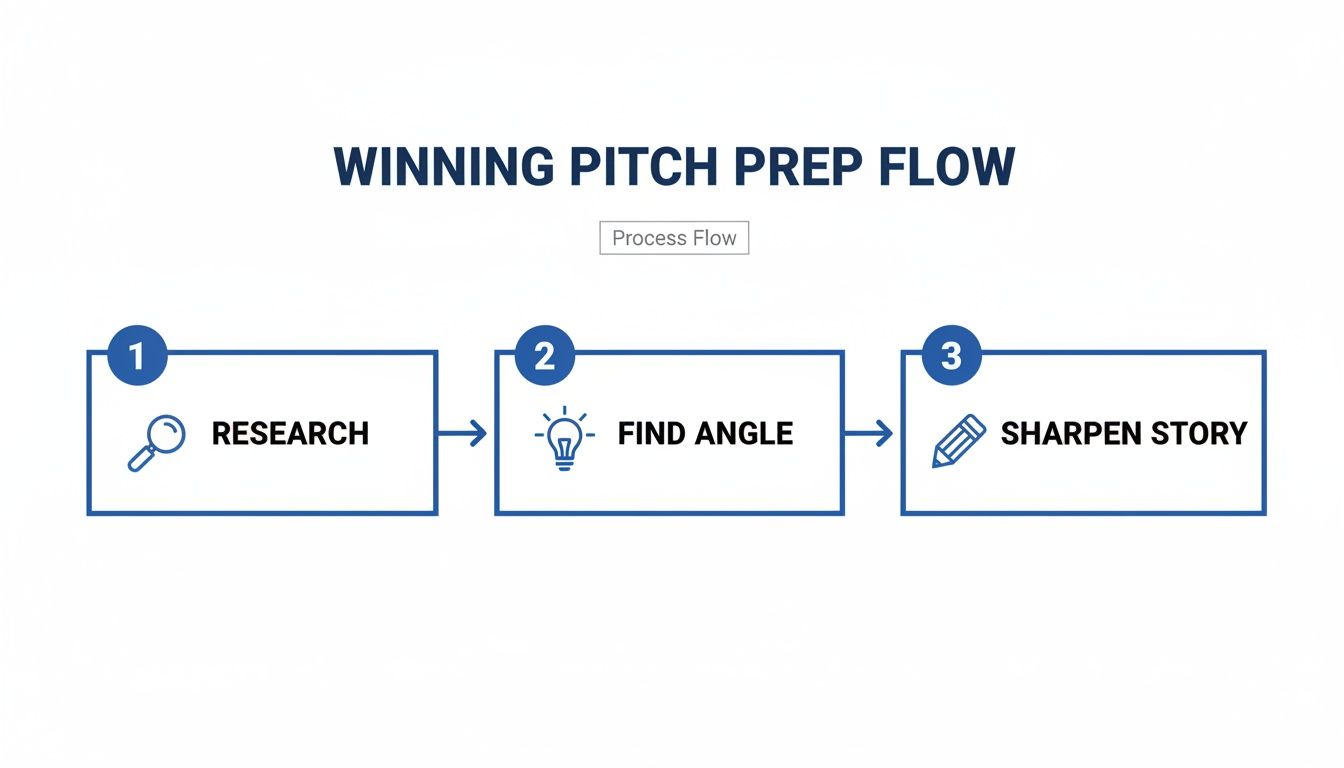
This simple flow—Research, Find Angle, Sharpen Story—is a constant reminder that most of the heavy lifting happens before you even think about hitting "compose."
Crafting a Subject Line That Demands an Open
Think of your subject line as the gatekeeper. It doesn't matter how incredible your story is if nobody opens the email. The goal here is to be clear and compelling without ever straying into clickbait territory. It’s a fine line, but a crucial one.
Your subject line is basically the headline for your story idea. It has to signal value right away. Steer clear of generic, dead-on-arrival phrases like "Story Idea" or "Press Release." Get specific and hint at the newsworthy hook.
Here are a few formulas I’ve seen work time and time again:
- Data-Driven: "[New Data] 75% of Remote Workers Face 'Zoom Burnout'"
- Intriguing Question: "Is the 4-Day Work Week the Future for Tech Startups?"
- Exclusive Offer: "Exclusive: First Look at [Company]'s New AI-Powered Tool"
Your subject line has one job: get the email opened. Make it specific enough to pique real interest but short enough to be fully readable on a phone—which is where most journalists first see it.
Deconstructing the Perfect Pitch Email
Once they open it, the clock is ticking. You have mere seconds to prove you're not wasting their time. A great public relations pitch has a simple, scannable structure that shows you respect how busy they are.
Email is still king for PR outreach. A staggering 96% of journalists say they prefer getting pitches via email. But here's the kicker: the same Cision report found that 67% want those pitches to be under 200 words. Brevity is everything.
To keep your email scannable and out of spam filters, a simple format is your best friend. It’s worth taking a minute to understand the difference between plain-text emails versus HTML to make sure your message always lands cleanly.
The Anatomy of an Irresistible Pitch
Your entire email should be broken down into four quick, distinct parts. Each one has a specific job to do.
The Personalized Opening: This is your "I'm a human" moment. Show them you didn't just scrape their email from a list. A quick reference to a recent article, a tweet, or a topic they cover frequently builds instant rapport.
The Core Pitch (The 'What'): Get straight to the point. In one or two tight sentences, tell them the story. What’s the news? What’s the angle? Don't bury the lead.
The Value Proposition (The 'Why'): Now, explain why this story matters to their audience, right now. This is where you connect your announcement to a larger trend or a problem their readers are facing. Make it relevant.
The Clear Call to Action (The 'What's Next'): Make it ridiculously easy for them to take the next step. Don't be vague. Offer something specific, like an interview with your founder, access to the full dataset, or a product demo.
Here's a quick cheat sheet to keep you on track.
Pitch Component Checklist
A well-structured pitch respects a journalist's time and makes their job easier. This table breaks down the key parts of your email and how to nail each one.
| Component | Purpose | Best Practice Example |
|---|---|---|
| Personalized Opening | To build immediate rapport and show you've done your homework, proving this isn't a mass blast. | "Hi [Name], I really enjoyed your piece last week on scaling remote teams. Your point about asynchronous communication really resonated." |
| The Core Pitch | To state the news or story angle clearly and concisely. This is the "what" of your pitch. | "I'm reaching out because my client, [Company Name], just released a new report on a surprising trend in employee retention..." |
| The Value Proposition | To explain why this story is relevant to their specific audience, right now. This is the "why." | "...which could be a valuable angle for your readers in the HR space as companies finalize return-to-office plans." |
| The Call to Action | To provide a clear, easy next step for the journalist to take if they're interested. This is the "next." | "Are you free for a 15-minute chat next week to discuss the findings? I can also connect you with our CEO for a quote." |
By following this structure, you make it simple for a journalist to grasp the story's value and decide what to do next. The same principles that help people achieve higher reply rates for your public relations pitches apply here. It's all about respecting their time and positioning yourself as a credible, helpful resource.
The Art of Following Up Without Being Annoying
Getting your initial public relations pitch out the door is just the beginning. The real work—and where most stories are actually won—happens in the follow-up. It's a tricky dance. A lot of people either give up after the first email or follow up so aggressively they burn a bridge for good.
The secret is walking that fine line between persistence and becoming a pest. Remember, your goal isn't just to land this one story; it's to build a relationship that could last for years. A smart follow-up strategy shows you’re a pro who is organized and truly believes in the value of what you're offering.
Timing Your Follow-Up Message
Let’s get one thing straight: patience is everything in media relations. Journalists are slammed. They’re juggling multiple deadlines and an inbox that never sleeps. Firing off a follow-up a few hours after your initial pitch is the fastest way to look amateurish and desperate.
As a rule of thumb, wait three to five business days before you even think about sending that first follow-up. This gives the journalist enough breathing room to actually see, read, and consider your pitch. If your story is legitimately tied to breaking news, you can shrink that window to 24-48 hours, but for most evergreen stories, space is your friend.
Do yourself a favor and set a calendar reminder. It’s a simple trick that keeps you from jumping the gun or forgetting to follow up altogether, ensuring you stay on track without adding to their inbox chaos.
Adding Value, Not Just "Checking In"
This is the biggest mistake I see people make. A follow-up that just says, "Hey, just checking in to see if you saw my email," is completely worthless. It adds nothing and only serves to annoy them. Every single time you reach out, you have another opportunity to strengthen your case.
Your mission is to provide something new that makes your original pitch even better or gives it a fresh twist. Think of it as adding another compelling layer to the story you're trying to tell.
Here are a few ways to add real value with each touchpoint:
- Bring New Data: "Hi [Name], following up on my note from last week. We just pulled some fresh internal data and found that [surprising statistic], which I thought added a really interesting dimension to this."
- Share a Relevant Resource: "Hi [Name], I just came across this new industry report from [Source], and it really highlights the trend I mentioned. Figured you might find it useful for your research."
- Offer a Different Angle: "Hi [Name], I know you've got a lot on your plate. If the original idea isn't quite right, I was thinking a story focused on [alternative angle] might be a better fit for your audience right now. What do you think?"
The golden rule of the follow-up is simple: always be helpful. Your message should be framed as an attempt to make their job easier, not as a demand for their attention.
How Many Follow-Ups Are Too Many?
Knowing when to stop is just as crucial as knowing when to start. Sending an endless stream of emails to a journalist who isn't interested is a guaranteed way to get blocked. In my experience, if you get silence after a couple of thoughtful, value-packed follow-ups, it's time to move on.
Here’s a simple, professional sequence that works:
- Initial Pitch: The personalized, compelling story idea you crafted.
- First Follow-Up (3-5 days later): A polite check-in that adds new value (a fresh stat, a related article, etc.).
- Final Follow-Up (Another 5-7 days later): A short, friendly closing message. Some people call this the "breakup email." It’s a professional, no-pressure way to close the loop.
A solid final follow-up could be as simple as: "Hi [Name], I know how slammed you must be, so this will be my last note on this. If this story ever becomes a priority, please feel free to reach out. All the best."
This approach respects their time and leaves the door wide open for you to pitch them again in the future. You've been persistent without being a pain—a balance that’s absolutely essential for any successful public relations pitch campaign.
Measuring Your Pitching Success and Refining Your Strategy
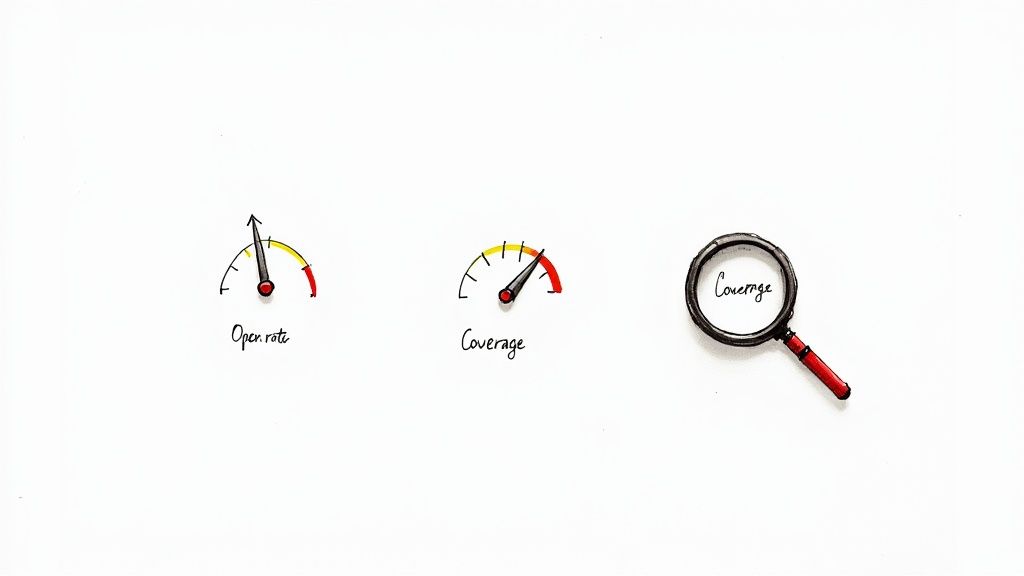
It’s one thing to send a pitch; it’s another thing entirely to know if it actually worked. An effective PR strategy isn't just about firing off emails—it's about learning from every single one you send. To move past guesswork, you have to get serious about tracking the metrics that show what’s hitting the mark with journalists and what’s getting deleted on sight.
Think of it as building a powerful feedback loop. Every campaign gives you a chance to tweak your subject lines, sharpen your story angles, and zero in on the right contacts. This constant refinement is what separates the occasional media mention from a steady stream of high-quality coverage.
Key Performance Indicators for Your Pitches
To really get a grip on performance, you need to track the right numbers. Don’t get bogged down in vanity metrics; concentrate on the data that truly reflects the health of your outreach. These are the core KPIs that I always keep an eye on.
- Open Rate: This is your first and biggest hurdle. A low open rate—and I mean anything dipping below 20%—is a screaming signal that your subject lines are weak or you’re getting flagged as spam.
- Response Rate: This tells you how many journalists were interested enough to actually hit reply. A healthy response rate means your pitch was relevant, timely, and well-crafted.
- Positive Response Rate: Not all replies are good news. This metric gets more specific, separating the genuine expressions of interest from the polite "no, thank yous."
- Coverage Secured: The ultimate prize. This is the bottom-line metric tracking how many pitches led directly to a published article, feature, or backlink.
Measuring these KPIs isn't just about grading your past work. It's about gathering intel to make your future pitches smarter, sharper, and far more likely to land.
Turning Data Into Actionable Insights
Once you start tracking these numbers, the patterns will jump out at you. This is where you can start making real strategic adjustments, because your data is telling you a story.
For instance, you might find that subject lines phrased as a question earn a 15% higher open rate than ones that lead with a statistic. Or maybe you'll notice that pitches sent on Tuesday mornings consistently outperform those sent later in the week. This is the kind of insight that can transform your entire process. For a deeper look, our guide on how to measure public relations covers more advanced techniques for tracking real campaign impact.
This is exactly what you get with a tool like PressBeat. The analytics dashboard gives you a live look at your delivery rates, opens, and journalist engagement without any manual work.
Having this data handy lets you instantly see which campaigns are killing it and diagnose what’s wrong with the ones that are falling flat.
Automating Your Tracking for Continuous Improvement
Let's be honest: manually tracking opens, replies, and follow-ups in a spreadsheet is a nightmare. It's slow, tedious, and you’re bound to make mistakes. This is where specialized PR software becomes a game-changer. A platform like PressBeat automates this whole process, giving you a crystal-clear, real-time view of how your campaigns are doing.
This automation frees you from the tyranny of the spreadsheet and lets you focus on actual strategy. You can quickly see:
- Which journalists opened your email multiple times (a huge buying signal!).
- The exact time of day a reporter engaged with your pitch.
- The results of A/B tests on different subject lines or pitch angles.
When you have this kind of information, you can refine your public relations pitch strategy on the fly. You can double down on what's working and immediately pivot away from what isn't. This constant feedback is the engine that drives predictable, scalable media coverage and ensures your efforts keep getting better over time.
Your Top PR Pitching Questions, Answered
Even when you have a solid story and a great list of contacts, a lot of questions can pop up. Media outreach has its own set of unwritten rules, and what one journalist loves, another might hate. Getting the small details right can be the difference between building a great relationship and getting your email flagged as spam.
Let's clear the air and tackle some of the most common things people ask about pitching the press.
What’s the Best Day and Time to Send a Pitch?
While there's no magic hour that guarantees a feature, you can definitely play the odds. The consensus points to mid-morning, somewhere between 10 AM and 11 AM, from Tuesday through Thursday. This window neatly sidesteps the Monday morning chaos and the Friday afternoon wind-down.
But here’s the thing: relevance will always beat timing. A perfectly timed pitch that misses the mark is just noise. On the other hand, a fantastic, well-researched story that lands at an "off" time still has a fighting chance. Always factor in the journalist's time zone and the urgency of their beat before hitting send.
A truly great story works any day of the week. Focus on creating undeniable value for the journalist first. Think of timing as a strategic boost, not the main event.
How Long Should My Pitch Actually Be?
Short. Seriously short. The data on this is crystal clear: about 67% of journalists prefer pitches under 200 words. Your email isn't the entire story; it's the trailer that makes them want to see the movie. Your one job is to hook their interest as quickly as possible.
Think of it as a compelling summary. All you really need is a killer opening line, a couple of sentences explaining what the story is and why it matters to their audience, and a clear call to action. You should absolutely include links to a full press release, a media kit, or supporting data for those who want to learn more. This shows you respect their time and makes it easy for them to see the story's potential in a single glance.
Is It Okay to Pitch Multiple Journalists at the Same Publication?
As a general rule, don't do it. Blasting the same story to multiple people at the same outlet at the same time is a classic rookie mistake. It creates confusion on their end and instantly signals that you haven't bothered to find the right person for your story.
The professional move is to do your homework upfront. Find the one writer whose beat is the perfect home for your news. Send them a personalized pitch, give them a reasonable window to reply (including one follow-up), and if you get radio silence, then you can consider approaching someone else. If you do pivot to a different editor, it's a good courtesy to mention you'd previously reached out to their colleague.
Should I Add Attachments to My Pitch Email?
Nope. Never. This is one of the simplest and most critical rules of modern PR. Many corporate email systems are set up with aggressive spam filters that automatically flag or block emails with attachments from unknown senders. Your carefully crafted pitch might not even make it to their inbox.
Beyond the technical risks, journalists are justifiably wary of opening unexpected files due to security concerns. The smarter, safer, and more professional way is to host your assets online.
- Post your press release in your website's newsroom.
- Put high-res images, videos, or reports in a cloud folder (like Google Drive or Dropbox).
- Build a dedicated media kit page with everything they might need.
Then, just drop the links directly into your email. It's more secure, you can often track clicks to see if they're interested, and it dramatically increases the odds of your public relations pitch landing safely in their primary inbox.
Ready to stop guessing and start getting results? PressBeat uses AI to identify the perfect journalists for your story and sends personalized pitches that get noticed. See how our platform can help you secure predictable media coverage at https://pressbeat.io.