
A Battle-Tested Public Relations Plan Template for Startups
January 11, 2026
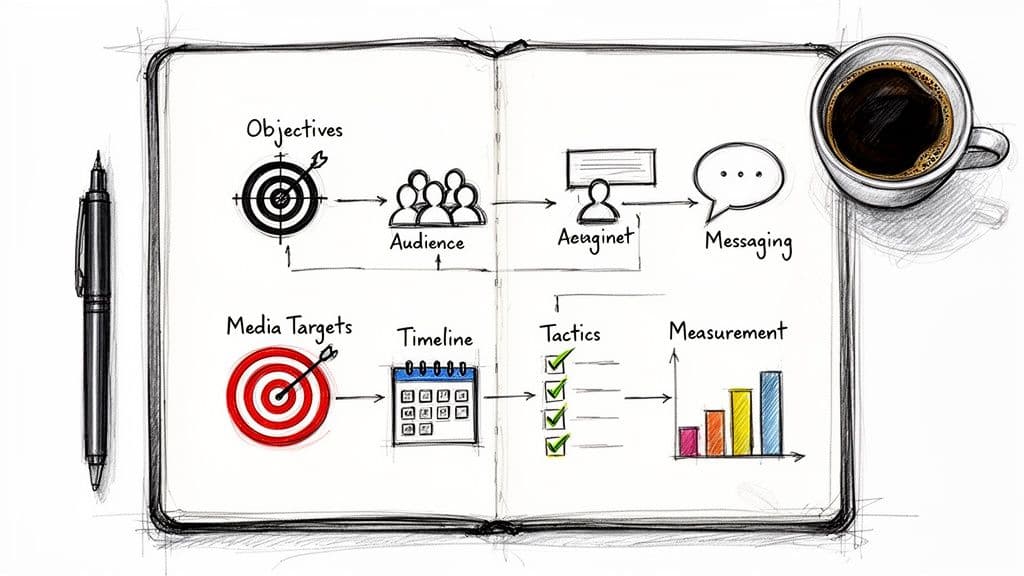
A public relations plan template is more than just a document; it's the bridge that takes your outreach from scattered, one-off efforts to a predictable growth machine. For a startup, this is your strategic playbook. It turns the often-mysterious world of media relations from a game of chance into a deliberate, goal-driven process. This guide gives you that essential structure.
Why Most Startup PR Is Just Guesswork
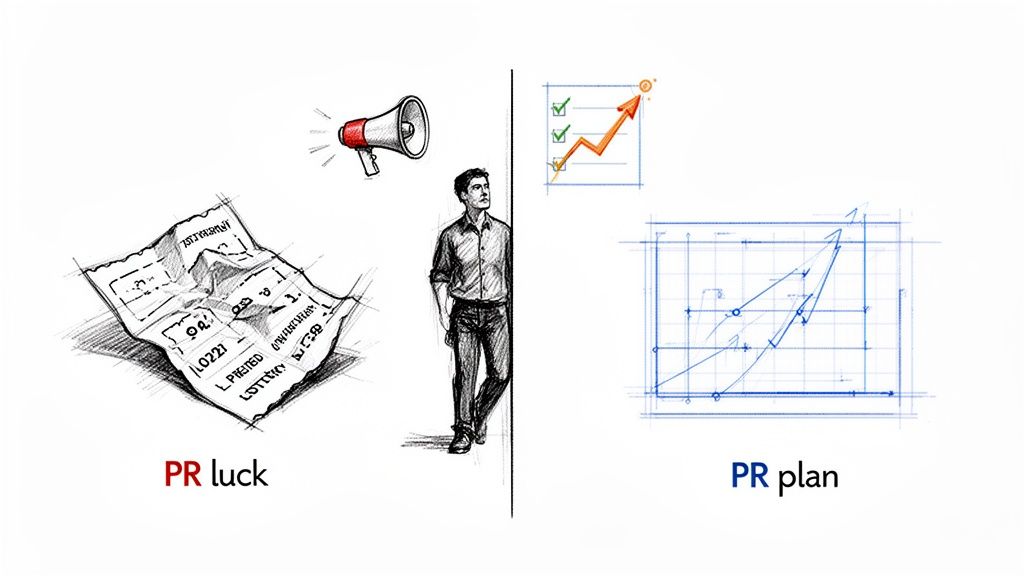
I’ve seen it a thousand times. A startup treats PR like buying a lottery ticket. They blast out a press release, send a few hopeful emails to A-list journalists at major publications, and then wait for the phone to ring. Spoiler: it rarely does.
When that “spray and pray” approach inevitably fails, PR gets written off as a fluffy, expensive, and unpredictable line item.
The problem isn't PR; it's the lack of a plan. This kind of reactive outreach has no strategy, no consistency, and zero connection to what the business is actually trying to achieve. The result is always the same: wasted time, burned cash, and a massive missed opportunity to build real brand authority.
The Power of a Structured PR Plan
Having a well-defined PR plan template fundamentally changes the game. It shifts your team’s mindset from reactive to proactive. Instead of scrambling to comment on the latest news cycle, you’re operating from a playbook designed to put you at the center of the conversation.
This structured approach delivers some serious wins:
- Keeps Everyone on the Same Page: A shared plan makes sure marketing, sales, and product are all telling the same story and rowing in the same direction.
- You Control the Narrative: You get to define how the world sees your brand, instead of letting your competitors or random internet chatter do it for you.
- Builds Investor Confidence: A clear strategy shows you’re thinking ahead. It signals to investors that you have a concrete plan for carving out your space in the market.
A documented plan is your startup’s secret weapon in a noisy market. It’s the strategic foundation you need to turn media outreach into a reliable source of brand authority and customer acquisition.
Before we dive into building your own template, let’s quickly look at the core pieces you'll be putting together. This table breaks down what makes a modern PR plan tick.
From Chaos to Clarity: Key Parts of a Modern PR Plan
This table breaks down the core components you'll build, providing a quick overview of what makes a PR plan effective and actionable.
| Component | What It Achieves |
|---|---|
| Objectives & KPIs | Aligns PR efforts directly with business goals like lead generation or brand awareness. |
| Target Audience | Focuses your efforts on the people who actually matter to your business. |
| Core Messaging | Creates a consistent, compelling story that resonates with your audience and the media. |
| Media Targets | Identifies the specific journalists, publications, and influencers you need to reach. |
| Tactics & Channels | Outlines the "how" and "where" of your outreach—from press releases to podcasts. |
| Timeline & Calendar | Maps out your activities, ensuring consistent momentum and timely execution. |
| Measurement | Defines how you'll track success, proving ROI and informing future strategy. |
Each of these components forces you to make strategic decisions before you ever write a pitch.
Moving Beyond Random Acts of PR
The real magic of a public relations plan template is that it forces you to answer the hard questions upfront. Who are we actually trying to reach? What story will make them care? And how will we know if any of this is actually working in a way that helps the bottom line?
This planning is non-negotiable in today's media environment. The global PR market was valued at about $88 billion in 2020 and is on track to hit over $129 billion by 2025. That’s more than 46% growth in just five years. In a market growing that fast, teams relying on guesswork get left behind. You can dig deeper into PR industry growth and learn how a template helps manage campaigns on Stackby.com.
By creating a clear, actionable plan, you’re not just sending emails—you’re building a system for generating consistent, high-quality media coverage. Let’s get started building that system, one section at a time.
Building a Message That Actually Resonates
Before you even think about writing a pitch, you need to have something worth saying. Great PR isn’t about just blasting out product features; it’s about crafting a story that makes people—especially journalists and your ideal customers—actually want to listen. This means you have to get beyond the corporate-speak and land on a core message that feels real and genuinely important.
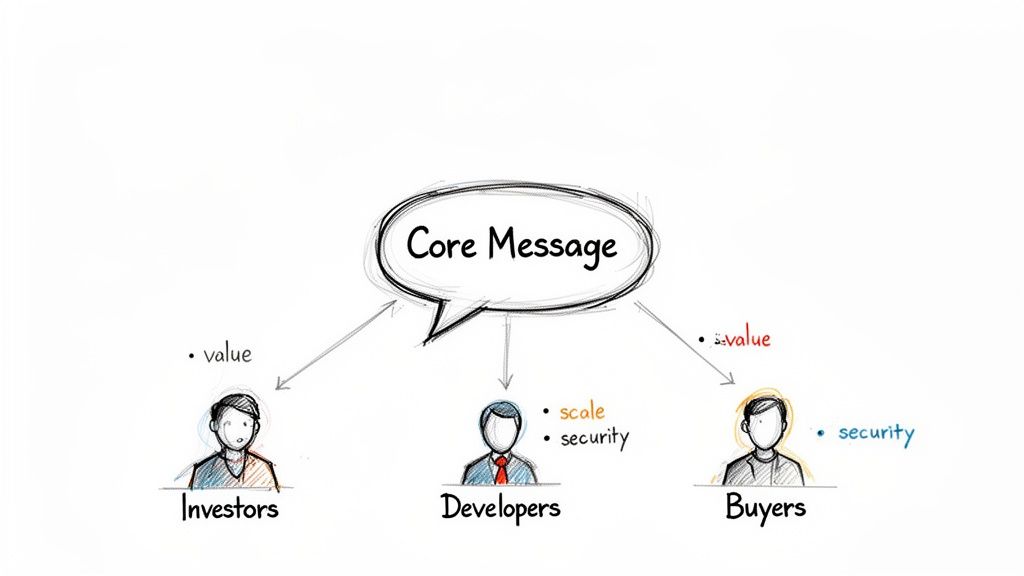
So many startups fall into the trap of leading with the "what"—all the bells and whistles of their product. But a message that truly connects starts with "why." Why does this product even exist? Who is it for? What real-world problem does it solve that keeps your audience awake at night? Nail those answers first, and you'll have the foundation for your entire PR strategy.
Defining Your Core Narrative
Think of your core narrative as your company's origin story, the central idea driving everything you do. It's not just a slick tagline. To find it, you need to put on your journalist hat. What’s the most compelling, human-centric angle here?
Here’s a simple exercise I’ve used dozens of times to cut through the noise. Try to finish this sentence without using any technical jargon:
"We exist to help [a specific group of people] overcome [a specific, painful problem] by [our unique way of doing things]."
Let’s imagine a B2B SaaS startup selling cybersecurity tools to small businesses. Their attempt might look something like this: “We exist to help small shop owners who feel totally exposed to cyberattacks overcome their fear of getting hacked by giving them a simple, affordable security shield they can set up in minutes.”
See what that does? Instantly, you have a hero (the small business owner), a villain (cyber threats), and a clear solution (your product). This narrative becomes the backbone for every press release, media pitch, and interview you give.
Tailoring Your Message for Different Audiences
One of the most common PR mistakes is spraying the same message to everyone. A venture capitalist couldn’t care less about the things that get a CTO excited, and neither of them thinks like an end-user. Your public relations plan template absolutely must account for this by segmenting your messaging.
Let’s stick with our cybersecurity startup. Their message needs to shift depending on who they’re talking to:
- For Investors: The conversation here is all about the market opportunity, scalability, and why the founding team is the one to pull it off. You’re telling a story of growth and return. For instance: "The SMB cybersecurity market is a $15 billion underserved vertical, and our plug-and-play solution is positioned to capture 10% of that market within three years."
- For Enterprise Buyers (like a CTO): This crowd cares about smooth integration, security, compliance, and making their lives easier. The story is one of reliability and efficiency. You might say: "Our platform integrates seamlessly with your existing IT stack, reducing vulnerability patching time by 75% while ensuring full GDPR compliance."
- For End-Users (the Small Business Owners): They just want simplicity, peace of mind, and a price that makes sense. You’re selling empowerment and safety. The message becomes: "You don't need a dedicated IT team to be protected. Our tool gives you enterprise-grade security that you can manage from your phone in five minutes a day."
The core product never changes, but the story you tell—and the data points you highlight—are tailored to what each audience actually cares about.
Your core narrative stays the same, but the hook you lead with has to change for every audience. Speaking their language is the difference between getting a reply and getting deleted.
Creating Authentic Audience Personas
To really nail that tailored message, you have to know who you’re talking to on a much deeper level than just a job title. This is where audience personas are invaluable. And I don’t mean generic descriptions; I mean detailed profiles built on actual research.
Go beyond the basic demographics and get into the psychographics. What are their biggest headaches at work? What blogs or publications do they actually read? Who are they following on LinkedIn or X? What podcasts are they listening to on their commute?
A persona for a CTO at a mid-sized tech company might include notes like: "Reads TechCrunch for industry news, watches keynotes from AWS re:Invent, and is deeply skeptical of any solution that requires a long, painful implementation." This level of detail is a massive advantage. It tells you exactly which journalists to pitch, what topics to hit on, and even the kind of language to use. Building these out is a non-negotiable step for your PR plan.
Setting PR Goals That Your CEO Will Actually Care About
If you want PR to be seen as a strategic part of the business—and not just a "nice-to-have" expense—your goals need to speak the language of the C-suite. Forget vanity metrics like raw "impressions" or the total number of articles you land. Your CEO, your board, and your investors care about one thing: tangible business results.
This is where your PR plan template becomes your most important tool. It’s how you draw a direct line from every press release, media pitch, and thought leadership piece to goals that actually move the needle—things like generating qualified leads, driving high-value website traffic, or eating up your competitor's share of voice. Without that connection, PR is a cost center. With it, PR becomes a growth engine.
From Vague Hopes to SMART Objectives
The best way I've found to craft goals that leadership will get behind is to use the SMART framework. It’s a classic for a reason. It forces you to get specific and turn fuzzy aspirations into concrete objectives that are Specific, Measurable, Achievable, Relevant, and Time-bound.
Let's look at the difference. It’s pretty stark.
- Weak Goal: "Increase brand awareness in Q3." (What does that even mean?)
- SMART Goal: "Increase our share of voice in top-tier tech media from 5% to 15% by the end of Q3, as measured by our media monitoring tool, to support the sales team's entry into the enterprise market."
See how much more powerful that second one is? It’s specific (15% share of voice), you can measure it (with a tool), it feels achievable (a realistic jump), it’s directly relevant (supporting sales), and it has a deadline (end of Q3). This is a goal you can report on with confidence.
Choosing KPIs That Prove Your ROI
Key Performance Indicators (KPIs) are the metrics you’ll track to see if you're hitting those SMART goals. Picking the right KPIs is what gives you undeniable proof of your PR program's value. Instead of just counting your press clippings, focus on metrics that show how your media coverage actually influences what people do next.
Here are a few powerful KPIs I always recommend building into a plan:
- Website Referral Traffic: Track how many people land on your site directly from a link in an article. This is a clean, direct line from a PR win to your digital front door.
- Domain Authority (DA) of Placements: Getting your startup featured in high-DA publications (think scores of 70+) gives your own site's SEO a serious boost. It's a long-term benefit the marketing team and your leadership will definitely appreciate.
- Share of Voice (SOV): This is all about context. It compares your brand's media mentions against your top three competitors. When your SOV is rising, you're not just getting coverage—you're winning the conversation in your industry.
- Message Pull-Through: Measure the percentage of articles that include at least one of your key strategic messages. This proves your narrative is actually landing with journalists and their readers.
Your KPIs should tell a story. It's not just about hitting numbers; it's about explaining what those numbers mean for the business. "We got 500 referral clicks" is just data. "Our feature in TechCrunch drove 500 new visitors, 20 of whom signed up for a demo" is a story of real impact.
This shift toward outcome-focused measurement is happening everywhere. Modern PR plans are built this way because executives are tired of paying for activities—they want to pay for results. Industry analyses project the PR sector will balloon to roughly $132 billion by 2029, and a big reason for that growth is the demand for performance-linked reporting over old-school vanity metrics.
For any startup trying to build a defensible brand and show real traction, knowing how to measure public relations is no longer optional. When you set clear, business-aligned goals from the very beginning, you position your PR function as an absolutely essential part of the company's success story.
Finding the Right Journalists and Crafting Your Pitch
Now for the part of your PR plan that most people think of as "doing PR": the outreach. This is where all your strategic planning—your goals, your messaging—finally turns into action.
But let's get one thing straight. The old spray-and-pray method of blasting a generic press release to a massive, purchased media list is dead. It's worse than ineffective; it’s a great way to get your domain blacklisted. The average journalist gets bombarded with pitches every single day, so success now is all about quality, not quantity.
The goal isn't to reach everyone. It's to reach the right one. Your focus should be on building a small, highly curated list of journalists, podcasters, and influencers who actually cover your world. These are the people who shape the conversations that your ideal customers are listening to.
I'd take a single, well-placed story in a niche publication over a hundred mentions on irrelevant blogs any day of the week. The first one drives business; the second one is just noise.
Building Your Targeted Media List
Stop thinking of this as "list building." It’s more like relationship mapping. You're trying to pinpoint the specific individuals whose work and audience align perfectly with the story you have to tell. This definitely takes more legwork than exporting a CSV, but the payoff is huge.
A great place to start is by seeing where your competitors get their ink. Use a media monitoring tool to track which publications and authors are writing about them. This isn't about copying their moves, but about understanding the media landscape. Who are the key players in your space?
Next, go straight to the source: where do your ideal customers hang out? If you're selling a developer tool, that's probably not Forbes. It’s far more likely a specific Substack newsletter, a respected industry blog, or a popular community forum.
Here are a few pro tips for finding the right people:
- Go Beyond the Big Names: Don’t just chase reporters at major outlets. Freelance journalists are often goldmines. They write for multiple publications in your niche and are constantly on the hunt for great stories.
- Listen to the Conversation: Pinpoint the podcasts your target audience loves. A 30-minute interview on a popular industry podcast can often deliver more qualified interest than a fleeting mention in a mainstream article.
- Track Social Signals: Follow relevant hashtags and reporters on platforms like X (formerly Twitter) and LinkedIn. Journalists often share what they're working on, which can give you the perfect in for a timely, relevant pitch.
This kind of deep research means that every single person on your list is a warm lead. You know their beat, you’ve read their work, and you have a solid reason to believe your story is a great fit for their readers.
Crafting a Pitch That Actually Gets Opened
With your hit list ready, it’s time to write a pitch that doesn't just get opened—it gets a response. Personalization here is absolutely non-negotiable. A generic, copy-pasted email is an instant delete. A great pitch immediately shows you’ve done your homework and that you respect the journalist's time.
Your subject line is the first, and biggest, hurdle. It needs to be compelling without tipping into clickbait territory. Think like a headline writer.
Weak Subject Line: Press Release: New Product Launch from [Your Company]
Strong Subject Line: Story idea: How a new SMB cybersecurity tool is fighting ransomware
See the difference? The second one is framed as a story, not an ad. It immediately signals value and relevance to a reporter covering tech or small business.
Once they open the email, you have just a few seconds to hook them. Keep your pitch brutally short—three quick paragraphs, max.
- The Hook: Start with a personalized line showing you know their work. Mention a recent article you liked. Then, get straight to your story angle. No fluff.
- The Value: Briefly explain why this story matters right now and why their readers would care. Drop in a compelling data point or a unique insight to make it stick.
- The Ask: End with a clear, easy call to action. Offer an interview with an expert, a product demo, or more info. Make it effortless for them to say "yes."
If you want to go deeper on this, our complete guide on how to write pitches that land media coverage is packed with proven examples and frameworks.
Mastering the Art of the Follow-Up
Let's be real: a lot of great pitches get lost in the inbox chaos. A polite follow-up is often necessary, but there's a razor-thin line between being persistent and being annoying.
My rule of thumb is to wait about three to five business days before following up.
Your follow-up email should be even shorter than your pitch. Just reply to your original email and add a simple, one-sentence nudge. Something like, "Just wanted to gently bump this to the top of your inbox in case it's of interest." This brings your original message back into view without adding any pressure.
If you don’t hear back after one follow-up, it’s usually best to let it go. Pestering a journalist is the fastest way to burn a bridge. Remember, this is all about building positive, long-term relationships.
Mapping Your PR Activities with a Strategic Calendar
A PR plan is just a document until you put it on a calendar. Seriously. Without a timeline, even the most brilliant strategies end up collecting digital dust on a shared drive, forever stuck in the "planning" phase. This is where you turn all that hard work—your objectives, messaging, and media lists—into an actual, actionable roadmap. It’s how you build momentum and, more importantly, keep it going.
A good calendar forces your PR efforts to stay in lockstep with the bigger business picture. It stops you from falling into the trap of treating PR as a series of one-off events, like a random press release here or a stray pitch there. Instead, it weaves every activity directly into your company's most important milestones.
Aligning Your Calendar with Business Milestones
Your PR calendar can't live in a silo. Its real power kicks in when it’s fully integrated with what the rest of the company is doing.
I recommend mapping out your PR activities both quarterly and annually, using major business events as your anchors. When you sync up like this, you create a powerful, unified message that resonates across every department.
- Product Launches: Block out dedicated time for pre-launch media briefings, the big announcement-day press release, and a plan for securing post-launch feature stories.
- Funding Rounds: Don't just announce the news. Plan for follow-up interviews with your key investors and ghostwrite a few thought leadership pieces for your CEO on market trends.
- Major Industry Events: Look ahead and schedule pitches for speaking gigs, pre-event outreach to book meetings with reporters on the ground, and a plan for on-site social media.
- Hiring Key Executives: A big hire is a great PR opportunity. Coordinate the internal announcement with an external press release and line up a few introductory interviews to showcase your company's growing bench of experts.
When you take this integrated approach, PR stops being a simple reporting function and starts actively contributing to the success of these big company moments.
This simple timeline shows the basic flow of any media outreach push, from research to execution.
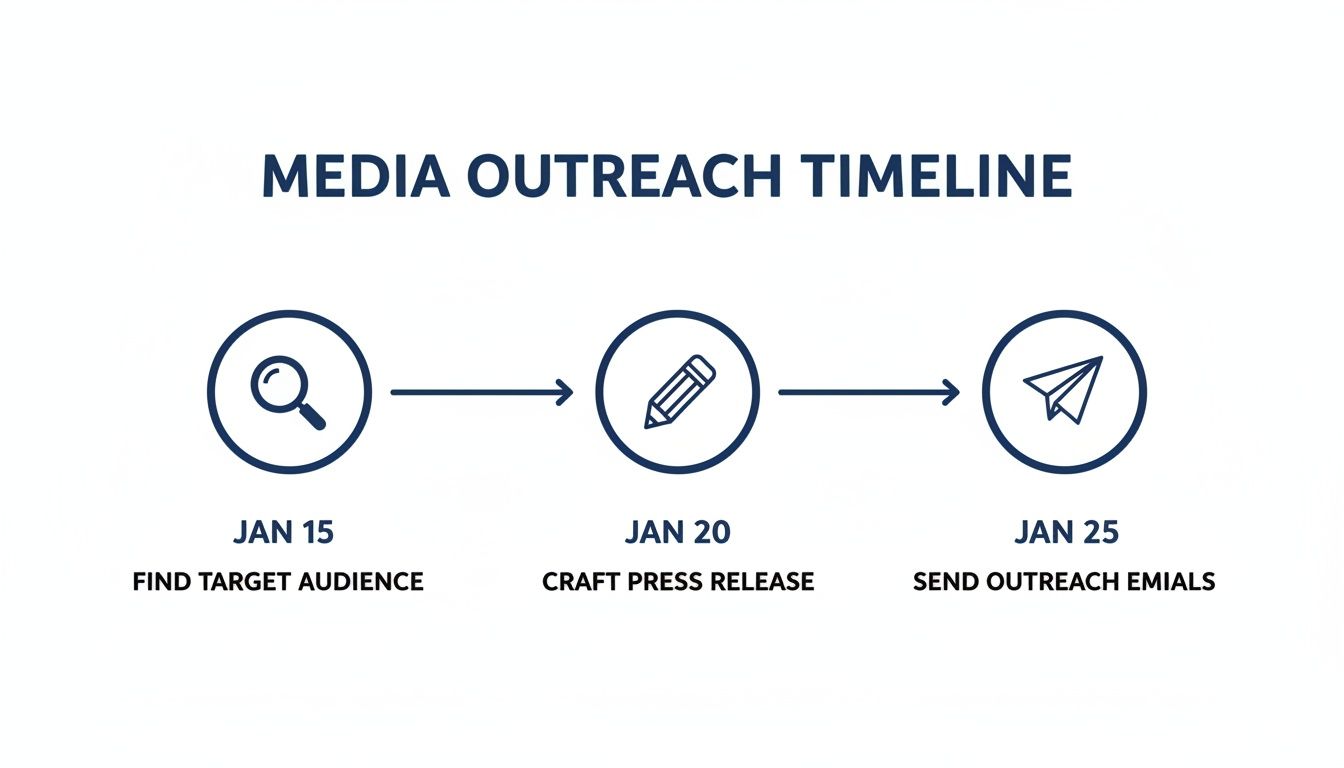
Thinking about your outreach this way helps you remember to budget enough time for each step. You can't rush building a good media list or crafting a pitch that actually gets a response.
A Sample Calendar for a Fintech Startup
Let's make this real. Imagine you're running PR for "FinSecure," a startup launching a new AI-powered budgeting app for freelancers in Q3. Your calendar isn't just a to-do list; it's a story you're telling over several months.
| Month | Key Milestone | PR Activities |
|---|---|---|
| July (Q3 Start) | Pre-Launch Buzz | - Finalize media list of top fintech & freelance writers. - Pitch exclusive, embargoed demos to 3-5 top-tier journalists. - Draft a thought leadership article from the CEO on the future of gig economy finance. |
| August | Product Launch | - Distribute the press release on launch day. - Work with marketing to coordinate a social media blitz. - Schedule CEO interviews with the reporters who got the exclusive demos. |
| September | Post-Launch Momentum | - Pitch customer success stories to niche freelance blogs. - Secure a guest spot for the CTO on a popular fintech podcast. - Monitor all the launch coverage and share the wins with the sales team to use in their outreach. |
See how that structure turns a single launch into a full-blown, multi-month campaign? Each phase builds on the last. It also gives other teams, like marketing and sales, a clear heads-up so they can align their own work. For a deeper dive, check out our guide on building powerful public relation campaigns that actually get results.
Your calendar is more than a schedule; it’s a commitment to being consistent. It’s the tool that keeps your brand top-of-mind, not just during big announcements, but all year long.
By mapping out your PR activities with this kind of focused intention, you transform your PR plan from a static document into a living guide for building real brand authority and driving growth you can actually measure.
Download Your Free Public Relations Plan Template
Alright, we’ve walked through the entire strategic playbook, from nailing down CEO-approved goals to crafting pitches that actually get opened. Now comes the fun part: turning all that theory into a concrete, day-to-day action plan.
This is where you bridge the gap between knowing what to do and actually doing it.
To make that happen, we've built a downloadable public relations plan template just for you. It's a simple, fillable document designed to bring every piece of your strategy together into one cohesive workflow. No more guesswork, no more starting from a blank page.
Turn Your Strategy into Action
Think of this as more than just a document—it's your guided framework for building a PR machine from the ground up. We’ve included dedicated sections for every critical component we've covered, making sure nothing falls through the cracks.
Here’s a peek at what’s inside:
- Objectives & KPIs: A space to clearly define your SMART goals and the exact metrics you’ll use to track success and prove your ROI.
- Audience & Messaging: Prompts to help you zero in on your ideal customer personas and sharpen your core narrative for maximum impact.
- Media Targets & Tactics: Organized sections for building that all-important media list and outlining your outreach strategy.
- Calendar & Measurement: A practical layout for mapping your campaign timeline and consistently tracking your performance.
This template is designed to be your single source of truth for your entire PR program. It's the first real step toward turning random media mentions into a predictable pipeline of high-quality coverage.
Ready to get organized? This tool will help you structure your thinking and build a professional-grade plan that actually gets results. If you're looking for something that covers a wider range of channels, you might also find a modern media plan template useful for coordinating your efforts.
Click below to grab your free template. It's time to start building a PR engine that drives real, measurable growth for your business.
Answering Your Top PR Planning Questions
Even with a solid template in hand, putting a PR plan into action always brings up new questions. Let's tackle some of the most common ones I hear from startups so you can move from strategy to execution with confidence.
How Much Should We Actually Budget for PR?
This is the million-dollar question, isn't it? While there’s no magic number, think about it this way: PR is an investment in your brand's credibility. It’s less about a specific dollar amount and more about resourcing your goals.
If your objective is to land a feature in a major industry publication, you'll need to account for the tools, time, and potentially the expertise required to get there. A good starting point is to allocate a specific percentage of your overall marketing budget to your earned media efforts.
When Is the “Right” Time to Start PR?
Honestly? Probably yesterday. So many teams wait until they have a big launch or funding announcement, but that's often too late.
Building genuine relationships with journalists and establishing your company as a credible source takes time. Start laying the groundwork months before you need the coverage. Share valuable insights, engage with reporters' work, and become a helpful resource long before you ever ask for a feature.
How Do I Handle Negative Feedback or a Crisis?
This is the one thing everyone hopes they'll never need but absolutely should prepare for. A crisis only spirals out of control when you're caught flat-footed. Your PR plan must include a basic crisis communications protocol.
Don't overcomplicate it. At a minimum, your protocol should define:
- Who’s in charge? Designate a single point person or a very small team to lead the response. This prevents mixed messages.
- What’s our first move? Have a pre-approved, empathetic holding statement ready to go. It should acknowledge the situation without prematurely admitting fault.
- How are we listening? Outline a clear process for monitoring social media and news mentions to track sentiment and stay ahead of the narrative.
For complex situations where your brand's image is on the line, getting specialized advice is crucial. You can see how experts handle these scenarios by looking into AI reputation management consultants.
A crisis doesn't become a disaster because of what happened. It becomes a disaster because of how you respond to it. A plan is your best defense.
Remember, your public relations plan template is a living document, not something you write once and forget. Revisit it quarterly. What's changed? What have you learned? The most effective PR programs are agile, using the plan as a strategic compass, not a rigid set of rules.
Ready to stop guessing and start getting featured? PressBeat uses AI to build your media lists, craft personalized pitches, and secure predictable coverage in high-authority publications.