
A Sample News Release Format That Gets Journalists' Attention
December 28, 2025
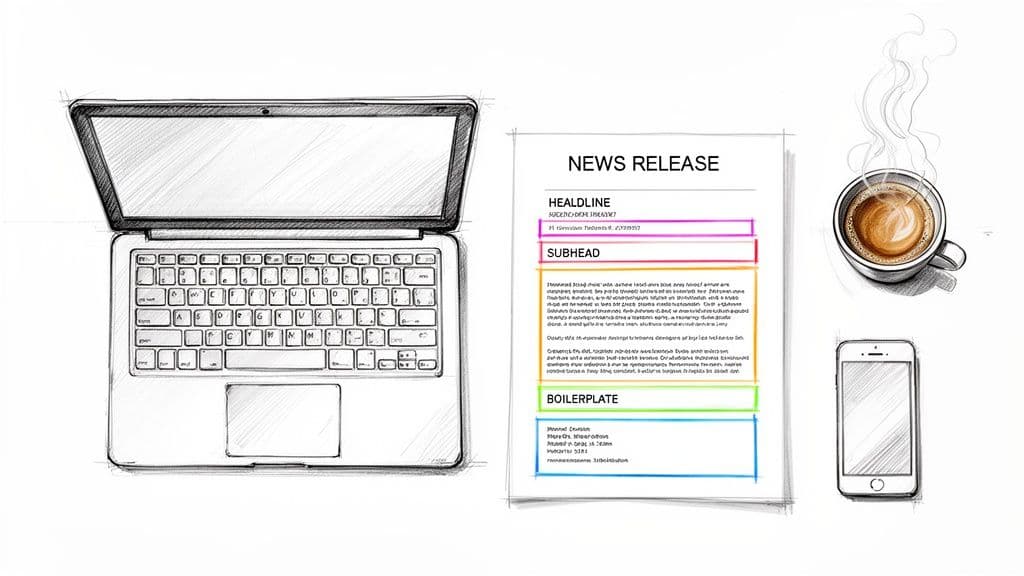
If you want to get a journalist's attention, your press release format is everything. It’s not just about aesthetics; it’s a strategic tool designed to slide seamlessly into a reporter's frantic workflow, respecting their time and making your news easy to understand at a glance.
Why Your News Release Format Can Make or Break Your Pitch
In a world where everyone is shouting for attention, your press release format is the first thing a journalist sees. A clean, predictable structure isn’t about being old-fashioned—it’s about signaling that you’re a professional who knows how the game is played. It makes it dead simple for someone to grasp your story's value in seconds.
A messy, disorganized release? It's hitting the trash folder. A well-formatted one gets a second look.
Think of it as the media's universal language. When a reporter sees that familiar layout—headline, dateline, lead paragraph, boilerplate—they know exactly where to find the information they need without having to hunt for it. This is absolutely critical. We know journalists are swamped, with some receiving up to 50 pitches every single week. With that kind of competition, a flawless sample news release format isn't just nice to have; it's essential. This standard approach ensures your most important messages don’t get buried in a wall of text. The PR landscape is tough, and you can see more trends in the data from MarketersMEDIA to understand what you're up against.
Building Trust Through a Clear Structure
A consistent format builds instant trust. It shows you've done your homework, you understand media conventions, and you respect the reporter's process. The whole point of this structure is to let a journalist scan and assess if your story is newsworthy in a matter of moments.
Here’s why a standard format works so well:
- It’s Instantly Clear: Journalists can immediately pull out the who, what, where, when, and why without having to dig.
- It’s Highly Scannable: Short paragraphs, bullet points, and clean headings are a reporter's best friend. They make the information digestible.
- It Boosts Your Credibility: Following a professional format shows you're a serious source with a legitimate story to tell.
A great news release doesn't just tell a story; it makes that story incredibly easy for a journalist to retell. The format is the scaffolding they use to build their own article from your information, quickly and accurately.
Ultimately, the structure is more than just how it looks. It's a functional tool that dramatically increases the chances of your announcement cutting through the noise. Whether it's being read by a human editor or scanned by a news-gathering bot, a clean format ensures your message lands exactly as intended. That's how you pave the way for real media coverage.
The Anatomy Of A Winning News Release
A truly effective news release is built on a structure that journalists not only recognize but appreciate. It’s less about following rigid rules and more about creating a clear, scannable document that gets straight to the point. Every component has a job to do, fitting together to build a story that a reporter can quickly grasp and use.
Think about it from their perspective: when your release lands in a crowded inbox, its format is the first hurdle. A clean, familiar layout signals that you know what you're doing and makes it easy for them to find what they need.
This simple, three-step "News Readiness" process is how a journalist mentally filters your release.
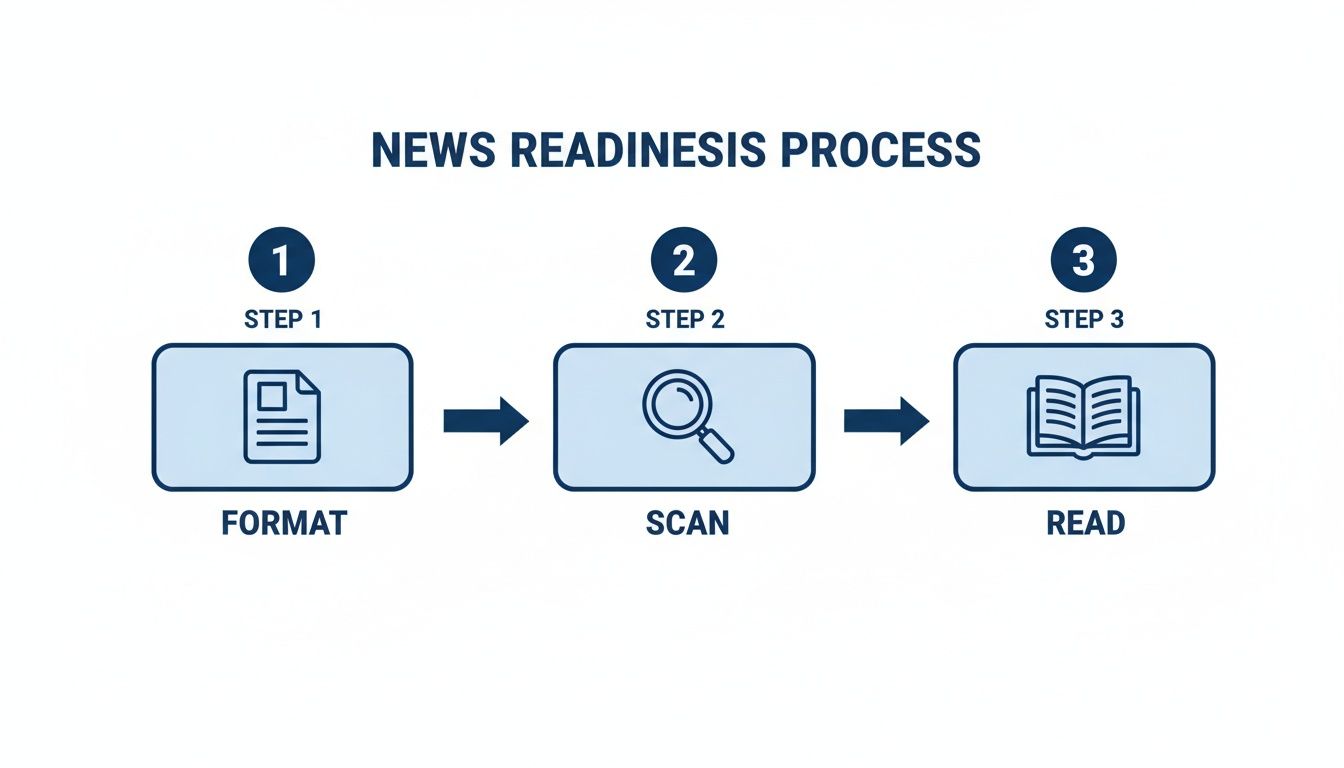
A professional format invites a quick scan, and a successful scan earns a full read. Let’s break down each element to make sure your release nails this every single time.
Crafting The Perfect Headline
Your headline is everything. It's the hook, the pitch, and the first—and sometimes only—thing a journalist will read. You have about three seconds to make it count.
A great headline is active, specific, and cuts right to the heart of the news. Ditch vague fluff like "Company Announces Exciting New Initiative." Be direct and informative.
For example: “Tech Startup 'InnovateAI' Launches Platform to Automate Customer Support for E-commerce Stores.”
That headline tells the journalist exactly what the news is, who it's about, and why it might matter to their audience. Keep it tight—aim for 12 words or less for the most impact. Remember, it also doubles as your SEO headline, so weaving in a primary keyword naturally will help your news live on long after the initial push.
The Lead Paragraph: Answer The 5 Ws Immediately
The very first paragraph—the lede—is your entire story in a nutshell. Its sole purpose is to answer the five essential questions of journalism:
- Who: Who is the main player? (Your company, a partner)
- What: What is the actual news? (A product launch, funding round, new partnership)
- When: When is this happening? (The date of the announcement)
- Where: Where is this taking place? (The city/state of origin, or globally)
- Why: Why should anyone care? (The impact on an industry, customers, or the market)
This critical paragraph should be no more than two or three sentences. Here’s how it looks in practice:
“SAN FRANCISCO – (Date) – InnovateAI, a leader in customer service automation, today launched its new AI-powered support platform designed to help e-commerce businesses reduce response times by 90%.”
The lede is your story in miniature. If a journalist reads nothing else, they should still have all the core information they need to understand your announcement.
Getting this right shows respect for their time and immediately signals that you understand the standard news release structure.
Building The Body With The Inverted Pyramid
Once the lede has set the stage, the rest of your release should follow the inverted pyramid model. It’s a classic journalistic technique for a reason: it works. The most critical information comes first, followed by supporting details, quotes, and general background information.
The paragraph directly after your lede is the perfect place to expand on the "why." This is where you can drop in a compelling statistic, a bit of market context, or the problem your news solves. Subsequent paragraphs can then introduce quotes and other supporting details.
This structure is genius because it allows an editor to cut the story from the bottom up without ever losing the main point.
Adding Authenticity With Quotes
Quotes are where you inject a human element and some much-needed personality into your announcement. They shouldn’t just rehash facts already stated elsewhere; they should provide insight, emotion, and perspective.
A quote from a CEO, a key partner, or even an early customer can bring the story to life.
Avoid the generic: "We are thrilled to launch this product."
Instead, say something that adds real value: "We saw that small e-commerce shops were drowning in support tickets, and existing solutions were too expensive," says Jane Doe, CEO of InnovateAI. "Our platform gives them the power of enterprise-level AI without the enterprise price tag, leveling the playing field."
Now that's a quote a journalist can actually use. It adds a narrative hook and explains the "why" from a human perspective.
The Boilerplate: Your Company’s Elevator Pitch
At the very end of the release, right before your contact information, you’ll place the boilerplate. This is a short, standardized "About Us" paragraph, usually under 100 words, that describes your company.
It should clearly and concisely state what your company does, who you serve, and what your mission is. Think of it as your official elevator pitch.
For example: “About InnovateAI: InnovateAI is a San Francisco-based technology company dedicated to making advanced AI accessible for e-commerce businesses of all sizes. Our platform helps brands automate customer interactions, improve satisfaction, and drive sales.”
To wrap it all up, place "###" on its own line, centered, after the boilerplate. It's a traditional journalism marker that signifies the end of the story—a small but professional touch that shows you know the ropes.
Here's a quick cheat sheet to keep you on track as you write.
News Release Format Cheat Sheet
| Section Component | Core Purpose | Best Practice & Length |
|---|---|---|
| Headline | Grab attention and state the core news | Be specific, use action verbs, and stay under 12 words. |
| Dateline & Lede | Summarize the entire story (the 5 Ws) | City, State – Date followed by a 2-3 sentence paragraph. |
| Body Paragraphs | Expand on the "why" with details and context | Follow the inverted pyramid; keep paragraphs short (2-3 sentences). |
| Quotes | Add a human voice, perspective, and emotion | Attribute to a key person; make it insightful, not just a fact. |
| Boilerplate | Provide a standard company overview | A short "About Us" section; keep it under 100 words. |
| Contact Info | Tell journalists who to contact for more info | Include Name, Title, Email, and Phone Number. |
| ### | Signal the end of the release | Place on a new, centered line after all content. |
This table serves as a handy reference to ensure every part of your release is structured for maximum clarity and impact.
A Complete News Release Sample You Can Use Today
Theory is great, but nothing beats seeing it all come together in a real-world example. To help you connect the dots, I’ve put together a full sample news release. We'll stick with our fictional tech startup, "InnovateAI," which is launching a new AI-powered feature for its e-commerce platform.
This isn't just a fill-in-the-blanks template. It's an annotated guide that shows you why each part works. Feel free to use it as a blueprint for your own announcements.
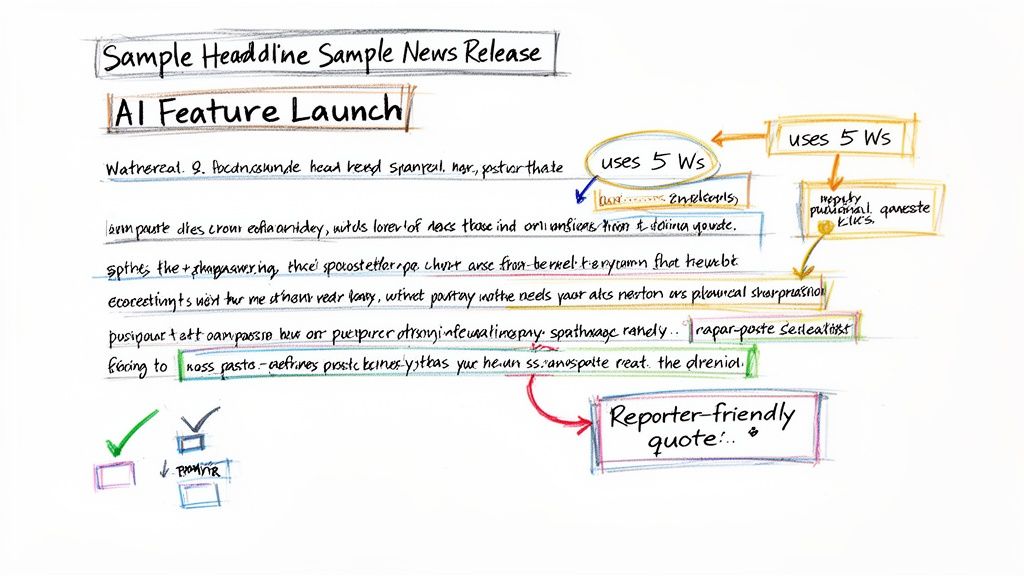
Ready-To-Use News Release Example
Follow this structure, and you’ll be building your next announcement with confidence.
FOR IMMEDIATE RELEASE
InnovateAI Launches 'Predictive Cart' to Reduce Shopping Cart Abandonment by 30% for E-commerce Stores
Subhead: New AI-powered feature analyzes shopper behavior in real-time to offer personalized incentives and prevent lost sales, directly boosting revenue for online retailers.
SAN FRANCISCO, CA – [Date] – InnovateAI, a leading provider of e-commerce optimization tools, today announced the launch of "Predictive Cart," a new AI feature designed to combat shopping cart abandonment. The tool uses machine learning to identify shoppers at risk of leaving and automatically presents targeted incentives to complete their purchase, helping businesses recover potentially lost revenue.
Shopping cart abandonment is a huge headache for online retailers. In fact, studies show the average rate hovers around 70%, costing the industry billions every year. "Predictive Cart" tackles this head-on by going beyond generic pop-ups and analyzing hundreds of data points—like time on page, mouse movements, and historical purchase data—to step in at exactly the right moment.
"We saw countless small and medium-sized businesses losing sales at the final step," said Jane Doe, CEO of InnovateAI. "Our goal with Predictive Cart was to give them the same predictive power as the e-commerce giants, but in a simple, affordable tool that integrates in minutes, not months. It's about leveling the playing field."
The "Predictive Cart" feature delivers a few key benefits for e-commerce stores:
- Real-Time Intervention: It intelligently detects when a shopper is about to leave and triggers a personalized offer, like a small discount or free shipping, before they click away.
- Smart Segmentation: The AI actually learns which incentives work best for different types of customers, optimizing its approach over time to get better results.
- Seamless Integration: The feature connects directly with major platforms like Shopify and BigCommerce with a single click—no custom coding needed.
Early results have been promising. A beta program with 50 online stores showed that businesses using "Predictive Cart" saw an average 30% reduction in cart abandonment within the first 60 days. This directly translated to more completed sales and an average revenue lift of 12%.
"Before Predictive Cart, we were losing a huge number of customers right at the checkout," said John Smith, founder of indie retailer Urban Bloom. "Within a week of turning it on, we saw a noticeable drop in abandoned carts. It’s been a game-changer for our bottom line."
"Predictive Cart" is now available to all InnovateAI customers on the Pro and Enterprise plans. To learn more or to see a demo, visit www.innovateai-example.com/predictive-cart.
About InnovateAI
InnovateAI is a San Francisco-based technology company dedicated to empowering e-commerce businesses with intelligent automation tools. Our suite of products helps online retailers optimize the customer journey, increase conversions, and drive sustainable growth.
Media Contact:
[Name]
[Title]
[Email Address]
[Phone Number]
###
Beyond The Format: Pitching And Distribution Strategies
So you've crafted the perfect press release. That's a great start, but it's only half the battle. If your masterpiece never reaches the right people, or if it lands in a crowded inbox with a generic subject line, all that hard work goes to waste.
Winning at distribution isn't about blasting your news to a massive, generic list. It’s about smart, targeted pitching. Think of it this way: you wouldn't send a steakhouse menu to a vegan food blogger. Sending your big tech launch announcement to a journalist who exclusively covers fashion is just as pointless. The key is to ditch the mass-market mindset and get personal.
Crafting The Perfect Pitch
Your email pitch is the gatekeeper to your press release. Honestly, the subject line is everything—it's the single factor that determines whether a busy journalist even bothers to open your message.
Vague titles like "Press Release" or "Story Idea" are a one-way ticket to the trash folder. You have to be direct and compelling. A great subject line really just mirrors a great headline. For example: "PITCH: New AI Tool Cuts E-commerce Cart Abandonment by 30%." This immediately tells the reporter the core news and its quantifiable impact, making it both relevant and intriguing.
Keep the email body just as concise.
- Personalize it. Use the journalist's first name. Even better, briefly mention a recent article they wrote that you genuinely liked. It shows you’ve actually done your homework.
- Get to the point. In one or two sentences, explain your announcement and, most importantly, why it matters specifically to their audience.
- Provide a link, don't attach. Paste the full press release text below your signature or link to a version on your website's newsroom. Never, ever attach a document. Attachments can trigger spam filters and are just a hassle for reporters on the go.
A personalized, well-researched pitch shows you respect a journalist's time and expertise. It transforms your message from just another piece of junk mail into a valuable, relevant story lead they can actually use.
Finding The Right Journalists And Timing Your Send
Identifying the right contacts is where the real work begins. You can use media databases, but honestly, just searching industry publications and browsing social media can be incredibly effective. Look for reporters who have written about your competitors or similar topics in the past. These are your best prospects.
When you send your pitch also matters. From what I’ve seen, most journalists prefer to receive pitches in the morning on weekdays. Tuesday and Wednesday are often cited as the sweet spot. Whatever you do, avoid sending on a Friday afternoon or over the weekend when your email is sure to get buried.
If you want to really get into the weeds on this, check out our detailed guide on how to send out a press release for a complete walkthrough.
The modern PR world is incredibly competitive, with tens of thousands of releases hitting the wires daily. And while traditional formats are still preferred by 74% of journalists, targeted, thoughtful distribution is what truly makes a campaign successful.
To maximize your reach, it's also worth exploring what happens after your news gets picked up. Understanding Content Syndication Best Practices can help you get even more mileage out of your media coverage. Getting a handle on these dynamics is key to breaking through the noise.
Measuring The Real Impact Of Your News Release
So, you’ve sent out your perfectly crafted release. Job done? Not even close. Now comes the part that really matters: figuring out if it actually worked. Forget simple open rates; we need to talk about metrics that tie directly back to business growth. A successful campaign doesn't just get seen—it drives real results.
The true measure of success is getting picked up by relevant, high-authority media outlets. Honestly, one solid placement in a top-tier industry publication is worth a hundred pickups on spammy, low-quality sites. Every piece of quality coverage has to be weighed for the actual value it brings to your brand.
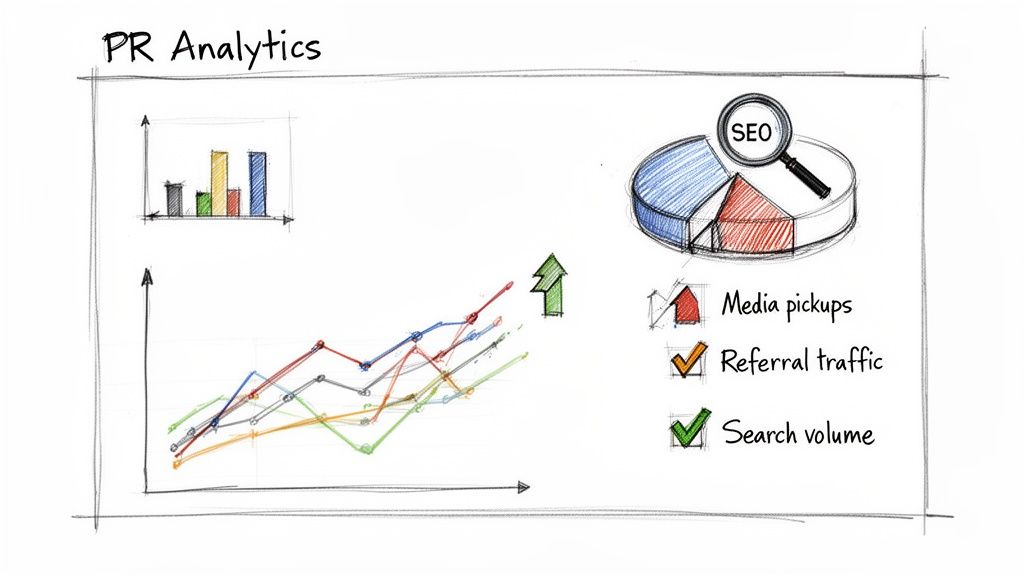
Key Performance Indicators That Matter
Once you’ve got that initial pickup, your attention should immediately pivot to the ripple effects. These are the metrics that connect your PR work to the company's bottom line and build your brand for the long haul.
Keep a close eye on these key areas:
- Valuable Backlinks: Did the article include a "follow" link back to your website? These are pure SEO gold. They boost your domain authority and help you climb the rankings in search results.
- Referral Traffic: Dive into your website analytics. Are people actually clicking through from the news stories to your site? This is a direct measure of how engaged and interested the audience is.
- Brand Search Volume: A big win often causes a spike in people Googling your brand name directly. This is a crystal-clear sign that brand awareness and recall are on the rise.
The ultimate goal here is to turn your announcement into a sustainable growth engine. Every piece of coverage should strengthen your SEO, drive qualified traffic, and build up that all-important brand equity.
In 2025, cost efficiency is everything, and distribution fees can vary wildly. To get the most bang for your buck, using a flawless sample news release format is non-negotiable. Sticking to a standard, journalist-friendly template can produce a 100-175% ROI within 90 days for 68% of users simply because it boosts pickup rates.
By focusing on these outcomes, you can clearly show the business value of your PR efforts. To get the full picture, check out our complete guide on how to effectively measure public relations.
Common Questions About Press Release Formatting
If you’re just diving into the world of PR, you've probably got some questions about how to properly format a press release. It's a valid concern—getting these small details right can make a huge difference in how journalists perceive your announcement. Let's clear up a few of the most common sticking points.
How Long Should a Press Release Be?
First up, length. I see this question all the time. The ideal length for a press release is between 400 and 500 words.
Think of it this way: a journalist is sifting through dozens, if not hundreds, of pitches a day. Your release needs to be concise enough to be read and understood in minutes. Sticking to that word count forces you to focus on the most newsworthy information, which is exactly what they’re looking for.
What About Photos and Videos?
Another big question is how to handle multimedia. It's tempting to attach your high-res photos or embed a video directly in the email, but please don't. Large attachments can clog up inboxes or get flagged by spam filters, killing your chances before your email is even opened.
The professional approach is to include links. Simply point journalists to a media kit on your website where they can easily download high-resolution assets. This keeps your email light and makes their job easier.
Is the Headline Really That Important?
Yes, absolutely. In fact, it's probably the single most critical part of your entire release.
Your headline has one job: to communicate the core news in under 12 words and make a reporter want to read the next sentence. If it fails, the rest of your hard work doesn't matter.
Do I Still Need to Use "###" at the End?
Finally, let's talk about that little "###" symbol. It might look a bit dated, but it's a long-standing tradition in journalism that signifies the end of the release.
Using it is a small nod that shows you understand the industry's conventions. These subtle professional touches add up, helping you build credibility and signal to reporters that you know what you're doing.
Ready to stop guessing and start getting real media coverage? PressBeat's AI-powered platform helps you build the perfect pitch, find the right journalists, and secure guaranteed press articles. Learn more at PressBeat.