
What is Media Kit? what is media kit for startups
January 8, 2026
Ever wondered how some brands seem to pop up in the news so effortlessly? Part of their secret is having a solid media kit ready to go.
So, what is a media kit, really? In simple terms, it's a professional portfolio for your brand. It bundles up all the essential information—your company's story, high-res logos, key facts, and contact details—into one neat package. It's the one-stop-shop that makes it incredibly easy for journalists, partners, and even potential investors to quickly grasp who you are and what you're all about.
Think of It as Your Brand’s Digital Handshake
Imagine a journalist is on a tight deadline. They could spend hours digging through your website for a founder’s bio or trying to find a high-quality version of your logo. Or, you could hand them everything they need on a silver platter with a media kit.
This small bit of preparation can honestly be the difference between getting that feature story and being passed over for a competitor who made the reporter's job easier. It's not just about convenience, though. A media kit is your chance to control your brand’s narrative and make a powerful first impression. You get to frame your mission, highlight your traction, and share your vision on your own terms.
The Secret Weapon for Earning Media Coverage
When it comes down to it, a well-crafted media kit is the foundation for getting press. It’s the single source of truth that journalists can rely on, which is absolutely crucial for any public relations effort.
This is especially true when you're trying to secure what we call earned media—the kind of authentic, credible coverage you can't pay for. Having your story, assets, and facts ready to go is a non-negotiable part of modern startup marketing strategies.
The Core Components of a Powerful Media Kit
Think of your media kit as a journalist's cheat sheet for your brand. It’s not just a folder of random files; it's a strategically assembled package designed to make a reporter's job as easy as possible. Each piece is a vital part of your story, and when they all come together, they give a journalist everything they need to feature you accurately and, more importantly, compellingly.
If you leave something out, it’s like handing someone a book with a chapter missing. They get confused, frustrated, and are far more likely to just move on to the next story. So, let's walk through the non-negotiable elements that every truly effective media kit needs.

Your Company Story and Mission
This is the soul of your media kit. Don't just give a dry description of what your company sells. Tell the story of why you exist. What problem fired you up so much that you had to build a solution? This is your chance to forge a human connection with a journalist before they’ve even seen a demo.
- Your Mission: Nail this down in one or two powerful sentences. What's your purpose?
- Company History: Hit the highlights. Give them a quick timeline of key moments—when you were founded, major product launches, or any pivotal events that defined your journey.
- The "Why": This is where you reel them in. Share the origin story. Was there a personal frustration or a moment of inspiration that sparked the idea? That's the stuff that makes a brand memorable.
A great media kit offers a data-rich snapshot of your brand's audience, reach, and what you bring to the table. For startups, this often means showing off key stats like monthly visitors, social media followers, and user growth. For more established companies, this might include the founding year, number of employees, and total customers served. It’s all about painting a complete picture of your impact. For more great tips, check out this guide to building a data-driven media kit on Foundr.com.
Founder Bios and Headshots
At the end of the day, journalists write about people, not faceless corporations. Your founders are the human element behind the brand, and their personal stories add a layer of credibility and intrigue to any article. Make it dead simple for a reporter to put a face to the name.
You'll want to include a short, professional bio for each key leader that highlights their background and expertise. And please, pair each bio with a high-resolution headshot on a clean background. Pro tip: give them a few options, like a formal shot and a more casual one.
Logos and Brand Assets
Want to know a journalist's pet peeve? Having to hunt down a decent version of your logo. More often than not, they'll give up and just take a low-quality screenshot from your website, which never looks good in print or online. Don't let that happen.
Your brand assets section should be a one-stop shop for visuals. Provide high-resolution logos in various formats (PNG, SVG) and color variations (full color, black, white). If you have specific brand guidelines on how to use your logo, include a link to them here.
Key Facts and Figures
Your story provides the "why," but the data provides the proof. Journalists love hard numbers because they add weight and credibility to their reporting. This section should be a scannable, at-a-glance summary of your most impressive stats.
Your fact sheet should include:
- Traction Metrics: Think user growth, customer numbers, or key activity stats.
- Company Milestones: Total funding raised, year founded, number of employees.
- Contact Information: The direct email and phone number for your media contact. Don't make them dig for it.
To help you get started, here's a simple checklist breaking down what a journalist really wants to see in your media kit.
Media Kit Essentials Checklist
This quick rundown covers the must-have components that will make your media kit stand out and get you noticed.
| Component | What to Include | Why It's Critical |
|---|---|---|
| Company Story | Mission statement, origin story, key milestones | Connects emotionally and frames your narrative |
| Founder Bios | Short bios, relevant expertise, and experience | Humanizes the brand and adds credibility |
| High-Res Headshots | Professional photos of key leadership (multiple options) | Journalists need quality visuals of the people behind the company |
| Logos & Assets | PNG/SVG files in various colors (color, B&W, white) | Ensures your brand is represented professionally and accurately |
| Key Facts & Stats | User numbers, funding, launch date, employee count | Provides concrete proof of your company's traction and scale |
| Press Releases | Links to your most recent and significant announcements | Gives journalists ready-to-use story angles and official news |
| Previous Coverage | Links to 3-5 top-tier media mentions | Social proof that your brand is newsworthy |
| Multimedia | High-quality product shots, B-roll video, screenshots | Saves the journalist time and gives them assets to build their story |
| Contact Info | Direct email and phone for your media contact | Makes it effortless for a journalist on a deadline to reach out |
Think of this table not just as a checklist, but as a recipe for success. By ensuring each of these ingredients is included and polished, you're not just providing information—you're making it incredibly easy for a journalist to say "yes" to covering your story.
Media Kit Examples from Successful Startups
Knowing what goes in a media kit is one thing. Seeing how all those pieces come together to tell a compelling story in the real world? That’s something else entirely. The quickest way to get a feel for this is to look at how successful brands pitch themselves to the press.
Let's break down a few examples to see what makes them so effective. Each one is a masterclass in tailoring a presentation to a specific industry and audience. By looking at their design choices, how they structure information, and the stories they tell, you'll get some great ideas for your own kit.
Remember, a great media kit doesn't just dump a bunch of facts on a journalist. It creates a smooth, intuitive experience for someone who is always on a deadline.
An Excellent SaaS Media Kit
For a Software-as-a-Service (SaaS) company, the name of the game is clarity and hard data. The best SaaS media kits lead with their impact in quantifiable terms—think user numbers, problems solved, or key integration partners. The design is almost always clean and professional, often mirroring the product's own UI to create a consistent brand feel.
These kits make it incredibly easy to find assets like high-res product screenshots, logos, and founder headshots. They get it: a tech journalist needs to see the software to write about it well. The language is direct and cuts right to the chase, focusing on the value proposition and key features that make them stand out in a ridiculously crowded market.
A well-designed kit shows you understand your brand goals and are serious about partnerships. From a marketer’s perspective, it also speeds up the decision-making process.
A Compelling D2C Brand Media Kit
Direct-to-Consumer (D2C) brands live and die by their story and the lifestyle they sell. It's no surprise, then, that their media kits are much more visual. They use stunning product photography and aspirational lifestyle images to make you feel something. The brand story—the "why" behind it all—is front and center, aiming to forge an emotional connection right away.
Instead of just stats, you’ll find powerful testimonials, examples of user-generated content, and links to glowing reviews. In the D2C world, this kind of social proof is gold. The goal is to show a journalist not just what the product is, but how it fits perfectly into the lives of a passionate community of fans.
A Trustworthy Fintech Media Kit
When you're dealing with people's money, trust and credibility are everything. A fintech media kit has to communicate security, expertise, and rock-solid compliance from the moment someone opens it. The design is typically more buttoned-up, using a corporate color palette and a clear, logical layout that inspires confidence.
Here, the focus shifts to a few key areas:
- Leadership Expertise: You'll see detailed founder bios that lean heavily on their experience in finance and tech.
- Security & Compliance: They'll often include specific information about regulatory standards and data protection measures.
- Key Metrics: Hard numbers like funding rounds, assets under management, and transaction volumes are essential for establishing legitimacy.
They give journalists the concrete data and background they need to write with authority on a complex, and often sensitive, subject.
To really see what a powerful media kit looks like in practice, dive into these 10 inspiring media kit examples, templates, and best practices. They offer a fantastic benchmark for what "great" looks like.
How to Build Your First Media Kit Step by Step
Putting together your first media kit can feel like a huge task, but it doesn't have to be. It’s really just about collecting the information you already have and packaging it in a way that’s clear and compelling. Don't think of it as some grand creative project—it's more like a simple, logical assembly process.
By breaking it down into a few manageable steps, you can go from a mess of scattered files to a professional kit that gets journalists excited to feature your story. We'll walk through four key stages: gathering your assets, picking the right format, designing for clarity, and writing copy that actually gets read.
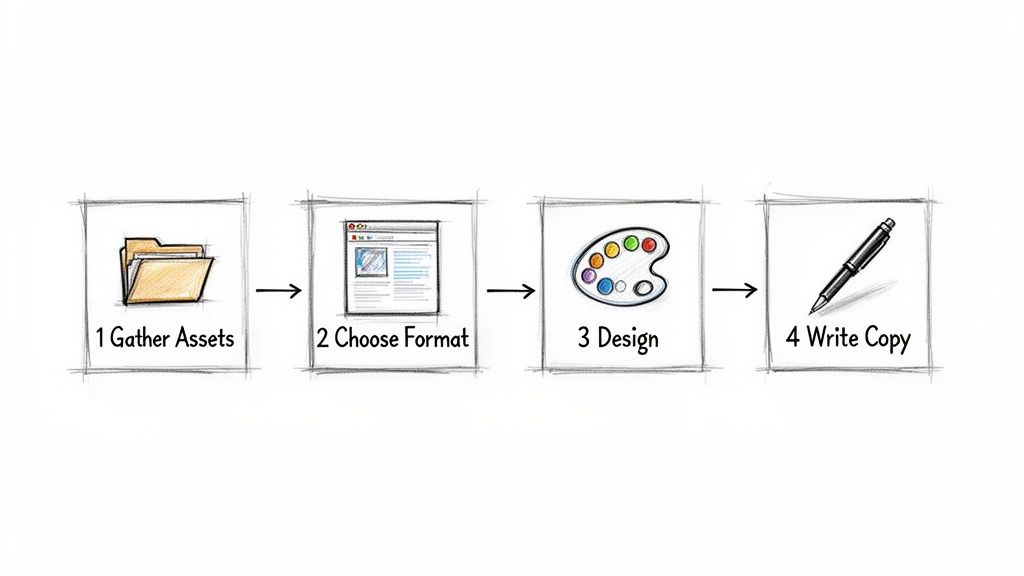
Step 1: Gather Your Core Assets
Before you even think about layouts or fonts, you need to get all your raw materials in one place. This is the foundation. If you skip this, you’ll just be scrambling for files later. So, make a dedicated folder and start dropping in everything a journalist might ask for.
Here’s a quick checklist of what you'll need:
- Company Info: Grab your official mission statement, a quick company history with some key milestones, and a simple list of your main products or services.
- Leadership Bios: Write a short, professional bio for each founder or key executive. Focus on their expertise and what makes them the right person for the job.
- High-Resolution Visuals: This one is critical. Get high-quality headshots of your team, your logo in different formats (like PNG and SVG) and colors (full color, black, white), and some professional-looking product photos or screenshots.
- Key Data Points: Pull together a one-page fact sheet with your most impressive numbers. Think user growth, total funding, the year you were founded, and your employee count.
Step 2: Choose the Right Format
Okay, you have all your stuff. Now, how are you going to present it? The two most popular formats have their own pros and cons. The best choice really depends on your resources and how you want reporters to find and use your information.
PDF vs. Webpage: A Quick Comparison
| Format | Pros | Cons |
|---|---|---|
| Downloadable PDF | It's portable, a breeze to attach to an email, and a fixed layout keeps your branding consistent no matter what device it's viewed on. | It can get outdated fast. Every update means creating and uploading a new file. Large files can also be a pain to send and receive. |
| Dedicated Webpage | It’s always up-to-date and easy to link to. Plus, you can embed dynamic content like videos, which is a nice bonus for your SEO. | You'll need some web development help, and you can't always control how the design looks on every single browser. |
Honestly, you don't have to pick just one. A lot of smart brands use a hybrid approach—they have a great press page on their website but also include a link to download a simplified PDF version.
Step 3: Design for Impact and Clarity
You don’t need to be a graphic designer to pull this off. The goal here is clarity, not a design award. Just use a clean, simple layout that matches your brand’s visual style. Stick to your company colors, fonts, and general vibe.
A well-designed kit shows you understand your brand goals and are serious about partnerships. From a marketer’s perspective, it also speeds up the decision-making process.
Tools like Canva have some fantastic, user-friendly templates made specifically for media kits. They make it incredibly easy to create a polished document without needing to be a design wizard. The main thing is to make your information easy to find and easy on the eyes. For a deeper dive, check out our complete guide on how to create a press kit for more tips and templates.
Step 4: Write Compelling and Concise Copy
Last but not least, it's time to write the words. Journalists are always on a deadline, so your copy needs to be direct, clear, and totally free of fluff. No marketing jargon.
Use short paragraphs and lean on bullet points to highlight key facts. Your goal is to give reporters everything they need to tell their story without making them dig for it. Make it scannable, make it simple, and you'll make their day.
Turn Your Media Kit into Guaranteed Press Coverage
Let's be honest: a killer media kit is fantastic, but it's not going to get you press coverage just by existing. You can have the most beautifully organized folder of assets in the world, but if no one sees it, it’s just taking up space. This is where we bridge the gap between having a great resource and actually getting it into the hands of journalists who will write about you.
Think of your media kit as the high-octane fuel and a modern PR platform like PressBeat as the engine. Instead of spending your days hunting for journalist emails and manually sending pitches one by one, you let a smarter system do the heavy lifting. You load your media kit into the platform, and its AI gets to work, finding hundreds of relevant reporters and personalizing pitches using the facts, figures, and story angles you've already prepared.
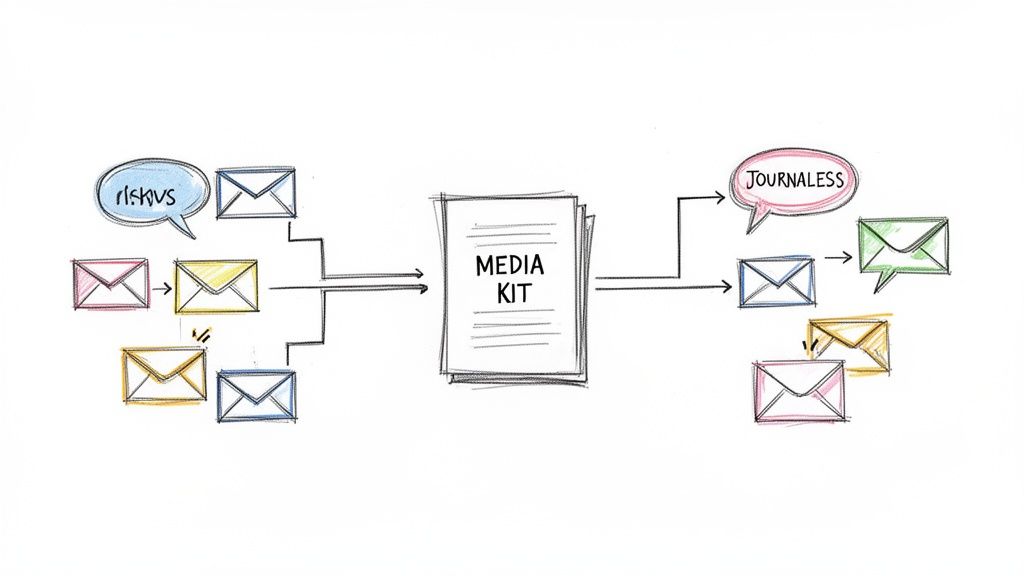
The result? Every journalist gets a consistent, compelling, and data-rich story delivered right to their inbox, and you didn't have to write a single email.
From Static Asset to Outreach Engine
This is how you solve the single biggest problem in public relations: scale.
It's physically impossible for one person, or even a small team, to build genuine, personalized outreach for hundreds of reporters. It just doesn't work. But when you use a platform that pulls directly from your media kit, that kit becomes the single source of truth for your entire campaign.
This system guarantees that every journalist sees the same key metrics—your funding totals, customer numbers, or impressive growth rates. It lets them see, in an instant, if your story is worth their time. By clearly laying out your competitive advantage and story hooks, your media kit becomes a powerful conversion tool that makes you stand out from the dozens of other pitches they get every day.
A media kit isn't just a resource; it's the central pillar of a predictable PR strategy. When combined with automation, it guarantees your story lands in the right inboxes, every time.
This strategic approach turns a simple folder of assets into an engine for predictable earned media. You provide the high-quality fuel (your media kit), and the platform handles the complex distribution. It’s the most effective way to make sure your message is heard, loud and clear.
Need a hand with the actual pitch? We've got you covered. Check out our guide on the best media pitch email templates to get started.
A Few Common Questions About Media Kits
As you start putting your media kit to work, you’ll naturally run into a few practical questions. It happens to everyone. Getting these details right can be the difference between a kit that gets you noticed and one that just sits on your hard drive.
Let's clear up some of the most common sticking points so you can use your media kit with confidence.
How Often Should I Update My Media Kit?
Think of your media kit as a living document, not something you create once and forget about. It should always reflect the latest and greatest version of your company. A good rule of thumb is to give it a refresh every quarter, or immediately after something big happens.
What counts as "something big"?
- New Funding Rounds: Fresh capital is a huge signal of momentum and market trust.
- Major Product Launches: You need to show off your latest innovations.
- Key Executive Hires: Adding serious talent to your leadership team is a story in itself.
- Hitting a Big Milestone: Crossing 100,000 users or hitting $1 million ARR are powerful proof points that journalists love.
An outdated media kit sends a bad signal. It can look like you’ve stalled or just don’t care about the details. For a journalist on a tight deadline, that can be enough to make them lose interest. Keeping it fresh is non-negotiable for making a strong, professional impression.
What's the Difference Between a Media Kit and a Press Release?
This question comes up all the time, but the distinction is actually pretty simple once you understand their different jobs.
Think of it like this: your media kit is the encyclopedia about your company, while a press release is a single news article about a specific event.
A media kit is your foundational, always-on resource. It holds the complete company history, your mission, brand assets, founder bios—all the core context. A press release, on the other hand, is a timely announcement about one specific piece of news: a new partnership, a feature launch, or a major hire. It’s the story of the moment.
A journalist might get hooked by your press release, but they’ll turn to your media kit for the background information they need to write their story. The two work hand-in-hand, but they serve completely different purposes.
Should I Put Pricing in My Media Kit?
For most startups trying to get press, the answer is a firm no. Your goal with a media kit is to get a journalist interested in your story, not to sell them your product. Pricing details can be a distraction and often dilute the core message you’re trying to send.
The only real exception? When your pricing is the story. For example, if you’re launching a revolutionary free plan or a pricing model that completely upends your industry, then it’s newsworthy.
But remember, the audience is everything. If you're an influencer or publisher creating a kit for potential advertisers, then of course you'll include a rate card. That’s exactly what they need to see. Always tailor the information for the person you want to reach.
Where's the Best Place to Host My Media Kit?
Make it dead simple to find. A busy journalist doesn't have time to hunt for information. The standard, and best, practice is to have a dedicated "Press" or "Media" page on your website, with a link clearly visible in your site's footer.
On that page, you can either lay out all the information directly or offer a clean, obvious link to download a polished PDF. Better yet, do both. This gives reporters, bloggers, and even potential partners a frictionless way to get what they need without ever having to email you for it.
Ready to turn your media kit into guaranteed press coverage? PressBeat uses its AI-powered platform to get your story in front of the right journalists, delivering predictable results and measurable wins. Learn how PressBeat can amplify your message today.